How Backlink Exchange Networks Actually Work

Annoyingly, the answer is "it depends." A backlink exchange network done right is a genuinely different animal from the spammy reciprocal link swaps Google's algorithms were literally designed to hunt down. The details are where everything lives. And getting those details right is the difference between building authority that actually sticks and setting off a penalty that'll eat months of your life to recover from.
So let's actually get into how these networks function, why relevance and context are the whole ballgame, and how newer platforms are automating the tedious parts without turning the whole thing into a spam farm.
Table of Contents
- What Is a Backlink Exchange Network?
- The Mechanics: How Exchange Networks Actually Function
- Natural Exchanges vs. Spammy Link Schemes
- Why Google Penalizes Some Networks But Not Others
- Building a Link Building Strategy Around Exchanges
- Comparing Backlink Acquisition Methods
- How AI Is Changing Backlink Exchange Networks
- Frequently Asked Questions
What Is a Backlink Exchange Network?
At its core, a backlink exchange network is a bunch of websites, usually in related or complementary niches, that link to each other's content in a coordinated but natural-feeling way. This isn't the same as a crude one-to-one swap ("you link me, I link you"). A real network spreads links around in a distributed pattern across a bunch of sites, which is a lot closer to how authoritative sites actually reference each other out in the wild.
And honestly, none of this is new. Journalists have cited each other for decades. Academic papers do nothing but cite other papers. What's changed is the scale and the intent. Marketers just formalized a pattern that already happens naturally in any healthy content ecosystem: businesses in adjacent spaces, serving similar audiences, linking to each other because it genuinely helps their readers.
Here's a number that sticks with me. Ahrefs dug through over a billion pages and found the #1 result in Google has, on average, 3.8x more backlinks than positions two through ten. Three-point-eight times. That one stat basically explains why link building is still one of the top three ranking factors nearly a decade after everyone first said "hey, links matter." They're not going anywhere. Which means how you get them, responsibly, matters more than it ever did.
What a Legitimate Network Actually Looks Like
A well-run network isn't hard to spot once you know the tells. The sites in it operate in related or at least complementary industries, not some random grab-bag of unrelated niches. The links live inside genuinely useful content, not shoved into footers or sidebars or some sad "links" page nobody visits. And the structure is distributed. No single site is linking back to every other site in a neat one-to-one pattern, because that's exactly the fingerprint Google looks for.
Two more things I'd add: there's actual gatekeeping on content quality (thin junk doesn't get to play), and the anchor text varies. You don't see the same exact-match keyword hammered across forty different links. Real linking is messy. Good networks stay a little messy on purpose.
The Mechanics: How Exchange Networks Actually Function
Let me walk you through the actual process, because "coordinated linking" is vague and the specifics are what separate legit from garbage.
Step 1: Grouping by Relevance
First step is grouping. Sites join based on shared verticals, complementary services, or overlapping audiences. Take a SaaS project management tool and a remote-work productivity blog. There's enough topical overlap there that a link between them makes sense to a reader and to Google. Somebody (a network operator or a platform) usually screens sites for domain quality, traffic, content standards, and spam signals before letting them in. Or at least they should.
Step 2: Content-Driven Placement
This is the part everybody gets wrong. In a good network, links don't just get jammed into whatever page happens to exist. New content gets written, or existing stuff gets updated, specifically to house a link that actually belongs there. So if Site A publishes something on "email marketing automation," and Site B has a genuinely useful resource on the same topic, the link from A to B lands inside a sentence where it adds something for the reader.
Why does this matter so much? Because ever since the Penguin updates started rolling out in 2012, Google's systems have been specifically trained to sniff out links that show up out of context. Links crammed into irrelevant paragraphs. Weird anchor text density. Clusters that scream "a robot did this and no human ever looked at it." Context is the shield.
Step 3: Distribution and Timing
Here's a classic rookie mistake: every site linking to every other site all at once. That's a flare gun to Google. Legit networks spread placements out over time and across different content. A site might pick up three or four inbound links over a few months, each from a different domain, each in a different context, each with different anchor text. That's what natural link acquisition actually looks like when content earns citations on its own.
Step 4: Monitoring (The Part Spammers Skip)
And this is the piece almost every spam network completely ignores: ongoing monitoring. A serious network keeps an eye on whether linked pages hold their quality over time, whether any member site gets caught doing shady unrelated stuff, whether rankings and traffic for participants are trending up or down, and whether anyone's Search Console lights up with a manual action.
If a site starts to rot or gets slapped with a penalty, it gets kicked out. Not to be mean, but to protect everybody else in the network from getting dragged down with it.
Natural Exchanges vs. Spammy Link Schemes
This is where the SEO world tends to lose its mind. Google's own guidelines flat-out call "excessive link exchanges" a violation. But the key word is excessive. And the context of the exchange matters at least as much as the exchange itself.
So what makes a scheme actually spammy? A few things, and they usually travel in packs. You've got reciprocal one-to-one linking with zero topical connection. Links buried in footers, widgets, or site-wide templates. A giant pile of links appearing all at once across dozens of sites. Cash changing hands purely for placement, no content value attached. The same anchor text copy-pasted everywhere. And sites with no real traffic, no real audience, no original content beyond pages built to hold links.
Backlinko ran a ranking-factors study and found something telling: domains that got hit by Penguin-related updates shared a signature. Heavy anchor text over-optimization plus low topical relevance between the linking and linked sites. That combo. Not links by themselves. The links were never the problem.
A natural exchange is the opposite in almost every way. The thing about a genuinely natural link is that it could've happened without any coordination at all. The coordination just makes it faster and more consistent. You've got real topical alignment, links sitting inside substantive original content, anchor text that reads like a human wrote it, and a sane ratio of outbound to inbound links instead of a rigid tit-for-tat. And no direct cash-for-link deal. Value gets exchanged through the content collaboration itself.
The question Google actually cares about isn't "did these two sites coordinate?" It's "does this link help a real human, and would it plausibly exist even if nobody was thinking about SEO?" Build your network around that one question and you're fine, both by the letter and the spirit of the rules.
Why Google Penalizes Some Networks But Not Others
Google evaluates links with a mix of automated pattern detection and, when things get bad enough, actual humans reviewing your site. Once you understand what trips each one, it gets a lot clearer why some networks quietly thrive for years while others get vaporized in a single update.
The automated stuff hunts for statistical weirdness that just doesn't happen in natural link graphs. Sudden spikes in referring domains. Suspiciously high percentages of exact-match anchor text. Links piling up on thin, low-value pages. Clusters of domains that share the same hosting, the same ownership fingerprints, the same cookie-cutter templates. Private blog networks, PBNs, tend to set off several of these at once, because they're built for link volume, not quality. They can't help it.
Networks that lean on content quality, real relevance, and distributed human-reviewed placement mostly slip past all that. Not through some clever trick. They just don't behave, statistically, like manipulation. The links look like the ordinary citations you'd find scattered across any healthy corner of the web. And this lines up with Google's own Search Central docs, which never say "all facilitated linking is evil." They say links built purely to manipulate PageRank, with no editorial merit, are the problem.
Want content like this running on autopilot for your own site? Try RobinRank free — AI-written, SEO-optimized articles generated and published automatically, no credit card required.
Which is exactly why platforms built around actually producing good content, rather than just pumping out links, tend to deliver ranking gains that last instead of a quick spike followed by a faceplant.
Building a Link Building Strategy Around Exchanges
If you're an SEO, running an agency, or a founder white-knuckling your own growth, folding a backlink exchange network into your broader strategy comes down to a handful of decisions.
First, vet the network before you touch it. Not all of them are worth your time, and some are actively dangerous. Look at the Domain Rating or Authority spread across the member sites. Check whether those sites have real organic traffic (Ahrefs or Semrush will tell you fast). See how often they publish and how good the content is. Find out whether the network actually enforces topical relevance or just lets anybody with a pulse and a domain sign up. And ask how links get placed and monitored. If they're cagey about it, that's your answer.
Second, don't put all your eggs in one basket, even a great one. Leaning entirely on a single network, no matter how well it's run, creates concentration risk. A resilient strategy treats network links as one channel among several. Digital PR, guest contributions, resource page outreach, and the good old-fashioned citations you earn by publishing something genuinely link-worthy like original research or a data study.
Third, and this is the big one: the content around the link decides everything. A backlink stuck in a 300-word nothing-post with no real insight isn't going to hold up, even inside a perfectly legit network. But a link living inside a well-researched, genuinely useful 1,500-word piece? That's an asset. It compounds, because the page itself keeps earning organic citations over time. Cheap content, cheap results. Every single time.
Comparing Backlink Acquisition Methods
To actually place exchange networks in context, here's how they stack up against the other common ways people build links.
| Method | Cost | Time to Results | Risk Level | Scalability |
|---|---|---|---|---|
| Backlink exchange network (quality-controlled) | Low-Moderate | 2-4 months | Low, if relevance is maintained | High |
| Cold outreach guest posting | Moderate-High | 3-6 months | Low | Moderate |
| Paid link placements (undisclosed) | High | 1-2 months | High | Moderate |
| Digital PR / earned media | High | 3-9 months | Very Low | Low-Moderate |
| Private blog networks (PBNs) | Moderate | 1-2 months | Very High | High (until penalized) |
| Resource page / broken link outreach | Low-Moderate | 2-5 months | Very Low | Low |
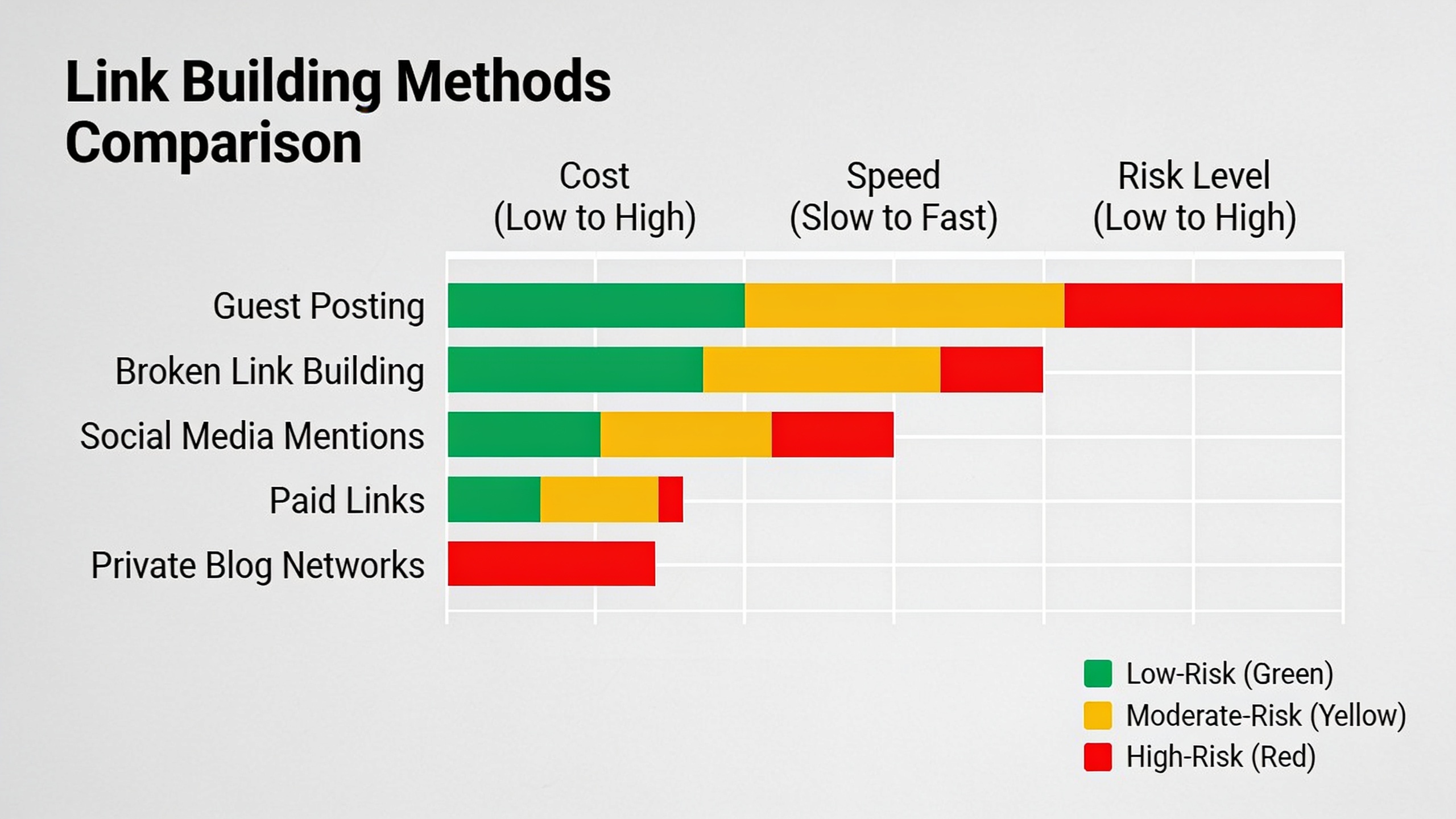
Look at where the quality-controlled exchange network lands. It's sitting in a pretty sweet middle ground. More scalable and cheaper than digital PR or grinding through manual outreach, and way less risky than paid placements or PBNs. The catch, and there's always a catch, is that keeping it in that low-risk zone takes ongoing vetting and real content investment. Cut corners on relevance or quality and it slides toward the spam end of the spectrum shockingly fast.
How AI Is Changing Backlink Exchange Networks
The biggest shift in this space over the last couple years has been AI-driven content and matching systems getting baked into how these networks run. And this is exactly the territory platforms like RobinRank operate in.
Instead of some poor soul manually hunting for topically relevant partner sites, AI can chew through thousands of domains at once, weighing topic clusters, semantic similarity, audience overlap, content quality signals, all of it, to surface genuinely relevant opportunities at a scale no human team could ever match. Which, in practice, means fewer of those low-relevance placements that get you flagged.
There's also the content angle. Because AI platforms can crank out full-length, actually-researched articles at scale, that "content-driven placement" step I described earlier gets a lot less painful. Rather than writing a fresh article by hand every time a link opportunity pops up, AI can draft a relevant, solid piece built around a natural placement. The caveat, and it's a real one, is that a human still has to check it for accuracy, originality, and whether it's actually worth reading.
And the monitoring, which is brutal to do by hand, becomes genuinely manageable. Tracking a few hundred member sites for traffic drops, manual actions, spam signals, and content decay is a full-time headache manually. Automated dashboards flag the problems in real time and let you actually sleep.
That's basically the whole premise behind how RobinRank works. An AI platform that writes, optimizes, and publishes solid articles while connecting sites inside a natural backlink exchange network, built on the same relevance and quality principles this whole article has been hammering on, just executed faster than any manual process could touch. The point was never to hand editorial judgment over to a robot. It's to use automation to enforce good standards more consistently, across a bigger network than a human team could ever babysit.
But let me be blunt about the flip side, because it matters. Fully automated link placement with no relevance filter and no human review is precisely how you build a spam network. Just faster and dumber. The AI that actually improves these networks automates the grunt work (matching, monitoring, drafting) while keeping the quality gates firmly in place: relevance thresholds, editorial review, originality checks. Kill those gates and you've just built a link farm with a nicer dashboard.
Frequently Asked Questions
Is a backlink exchange network just a link farm with better branding?
Nope. A link farm is a pile of junk sites that exist for one reason: spitting out links, with no real content, no traffic, no audience. A properly run exchange network is made of legitimate sites with actual readers, linking to each other inside content that's genuinely useful and on-topic. The dividing line is editorial quality and relevance. Not the fact that some coordination exists.
Will Google punish my site for joining one of these?
Depends entirely on how it's done. If your links sit inside relevant, high-quality content and don't follow the obvious manipulation patterns (identical anchor text, mass simultaneous linking, random unrelated pairings), the risk is genuinely low. Google's guidelines go after excessive and manipulative exchanges, not every form of coordinated linking. Honestly, just read Google's Search Central link spam docs before you join anything. Ten minutes, saves you a lot of grief.
How many backlinks a month should I be aiming for?
There's no magic number, but for most small-to-midsize sites, somewhere between 3 and 10 quality links a month is a sane target, as long as they arrive at a steady, varied pace and not all in one lump. If you're suddenly gaining 50+ links in a week, that's the kind of thing that gets you looked at. Gradual and organic-looking beats fast and suspicious.
How's this different from guest posting?
Guest posting is usually a one-off. You write a whole article for someone else's site, get a byline link, done, negotiated individually. An exchange network is more of an ongoing system: multiple sites trading links across lots of content over time, often with a platform or coordinator handling the relevance matching and quality control. And they're not either-or. Plenty of good link building plans run both at the same time.
Can I safely use AI-written content in one of these networks?
Yeah, as long as it's actually good. Original insight, accurate info, decent structure, real value for the reader, not thin generic filler churned out to hit a word count. Google's said over and over that it cares about content quality, not how the content got made. AI platforms that bolt on human editorial review, fact-checking, and originality standards can produce stuff that performs every bit as well as hand-written content, just a lot more of it.
Exchange networks aren't good or evil on their own. They're a mechanism, and a mechanism just takes on the character of whoever's running it. The ones that survive algorithm updates and keep pushing rankings up all share the same DNA: relevance, real editorial quality, and distributed, non-manipulative link patterns. The ones that get penalized share the opposite. And as AI keeps making content and monitoring cheaper and faster, the barrier to running a legit, high-quality network keeps dropping. Which, funnily enough, means the bar for "good enough" keeps climbing right along with it.
Ready to stop writing content by hand? Start your free RobinRank trial and get a full month of SEO-optimized articles published on autopilot.