Reciprocal Links: When to Accept and How to Audit Them

If someone emails you asking for a swap right now, here's your immediate move:
- Check relevance first. If their site fits your niche and the link makes sense in context, accept it as a one-off editorial placement, not a standing arrangement.
Key Takeaways
Reciprocal links work when they stay rare, relevant, and editorially placed, and become a liability the moment they're organized at scale to move rankings.
| Point | Details |
|---|---|
| Define the two types | Direct reciprocity is a deliberate A↔B swap; indirect reciprocity happens naturally without any agreement. |
| Know Google's actual target | Google's policies flag excessive exchanges and partner-only pages, not occasional editorial reciprocal links. |
| Weigh prevalence against risk | Over 73.6% of high-traffic domains have some reciprocal links, but heavy concentration is what draws scrutiny. |
| Follow the safe-linking checklist | Prioritize relevance, in-content placement, varied anchors, and rel attributes for commercial swaps. |
| Choose verified exchanges over cold swaps | Robinrank pairs you with reviewed sites by niche and confirms every link is live before it counts. |
Table of Contents
- What Are Reciprocal Links, and What Do They Look Like?
- How Does Google Treat Reciprocal Links?
- Do Reciprocal Links Help or Hurt SEO?
- What Are the Best Practices for Safe Reciprocal Linking?
- What Are Better Alternatives to Organized Link Swaps?
- How Do You Find and Audit Existing Reciprocal Links?
- Where a Verified Exchange Fits Into Your Link Strategy
- Frequently Asked Questions
- Sources
What Are Reciprocal Links, and What Do They Look Like?
There are two flavors. Direct reciprocity is a deliberate agreement: Site A links to Site B, and B links back, usually because someone asked. Indirect reciprocity happens organically: A links to B because the content is genuinely useful, and B later links back to A without any conversation between the two site owners.
Real-world examples make this concrete. A local bakery links to its flour supplier's site; the supplier features the bakery in a "customers we love" post. Two researchers cite each other's papers across separate publications. Two niche blogs covering adjacent topics, say home coffee roasting and specialty tea, link to each other's guides because readers of one topic often care about the other.
You'll see reciprocal links show up in a few standard spots:
- In-content links inside articles or guides
- Dedicated "partners" or "resources" pages
- Site-wide footers
- Author bio sections on guest posts
How Does Google Treat Reciprocal Links?
Google's spam policies name "excessive link exchanges" and partner pages built solely for cross-linking as textbook examples of a link scheme. That's the line: a single relevant, editorial reciprocal link is not what the policy targets. A network of partner pages that exist only to trade backlinks is exactly what it targets.
The gap between "allowed" and "flagged" comes down to intent and pattern, not the mere existence of a two-way link. A Nizam SEO War Room analysis breaks it down cleanly: safe reciprocity has editorial intent, topical relevance, and varied anchor text. Dangerous reciprocity looks like sitewide swaps, identical anchors repeated across dozens of pairs, and a high volume of one-to-one exchanges concentrated in a short window.
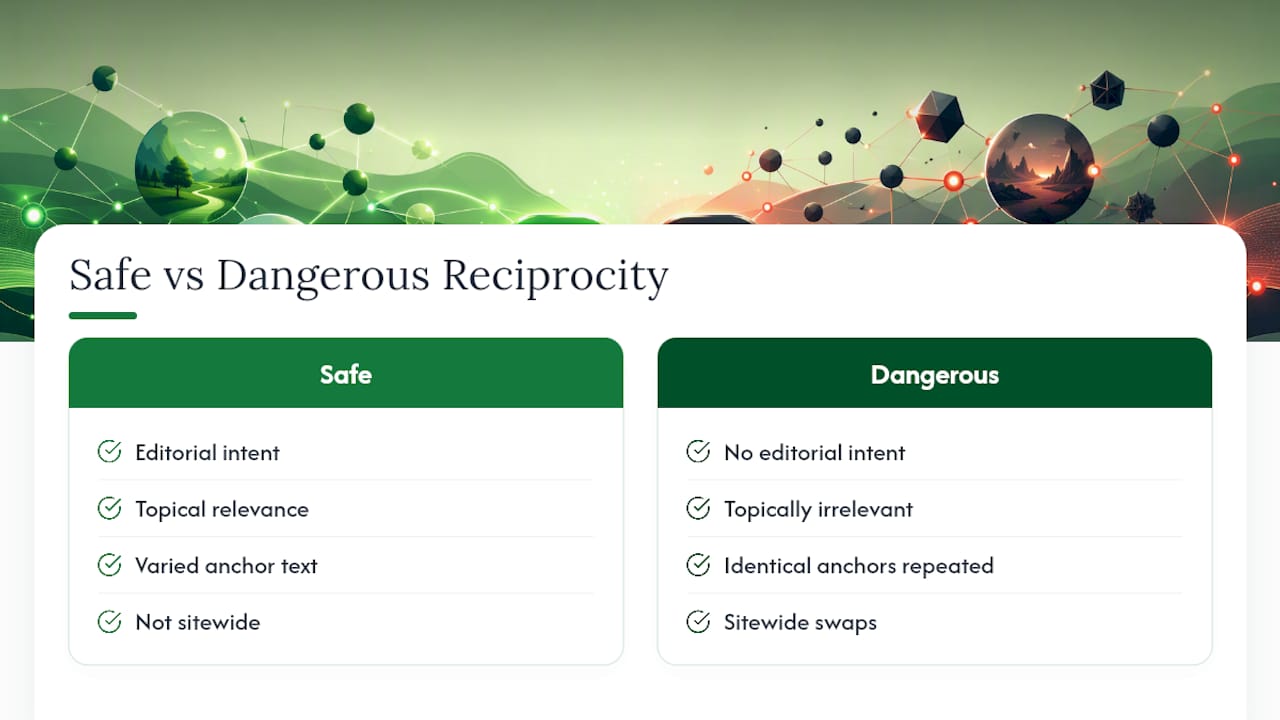
Here's the tension worth sitting with: Ahrefs found that over 73.6% of domains with at least 10,000 monthly visitors had some reciprocal links in their backlink profile. Reciprocity itself is common and largely unremarkable. The risk isn't having reciprocal links. It's having them dominate your referring domains or follow an obvious, repeatable pattern.
When patterns do look manipulative, outcomes range from algorithmic devaluation (the links just stop counting) to a manual action, which is far more disruptive and requires a cleanup before rankings recover.
Do Reciprocal Links Help or Hurt SEO?
The honest answer is both, depending on scale and quality. Backlinko's analysis frames it well: reciprocal links can drive real referral traffic and build lasting relationships, but they turn risky the moment they're used at scale or with low-quality partners.
What works in your favor:
- Referral traffic from a genuinely overlapping audience
- Editorial value when the link actually helps the reader
- Free, mutual marketing with zero cost to either side
- Better user experience when the linked resource is a natural next step
What works against you:
- A detectable pattern if you do this repeatedly with the same partners
- Association risk if your reciprocal partner is a low-quality or spammy site
- Wasted effort chasing swaps that never move the needle
- Handing a competitor equal SEO value for a link that barely helps your own audience
Picture two blogs in the same niche trading links inside relevant, well-written posts. That's a small win for both. Now picture fifty small sites all linking to each other from identical "Our Partners" pages. That's the pattern search engines are built to catch.
What Are the Best Practices for Safe Reciprocal Linking?
Treat reciprocal links as a byproduct of good relationships and good content, not a metric you're chasing. Here's the checklist:
- Relevance first. Only reciprocate with sites your actual readers would want to visit.
- Place links editorially, in-content. A link buried in a relevant paragraph reads very differently to Google than one sitting on a dedicated partner page.
- Keep reciprocity rare. A handful of two-way links scattered across a large, diverse link profile is normal. Dozens of them is a signal.
- Avoid sitewide and partner-page swaps. These are the exact structures Google's guidance calls out.
- Vary your anchor text. Identical anchors across multiple reciprocal links are one of the easiest patterns to flag, according to Search Engine Journal's guidance.
- Use `rel="sponsored"` when the exchange has any commercial angle, or `rel="nofollow"` if you're not confident the link should pass ranking value.
Quick dos and don'ts:
- Do link to sites you'd recommend even without a link back.
- Don't set a target like "get 20 reciprocal links this quarter." That's exactly the kind of KPI thinking that produces detectable patterns.
- Do request placements only when the relationship or content genuinely justifies it.
- Don't accept a swap just because someone asked.
Pro Tip: Before agreeing to any swap, spend 60 seconds on the partner's site: check their organic traffic trend, skim three articles for editorial quality, and glance at their own backlink profile for diversity. If everything looks thin or their links come mostly from other swap partners, walk away.
When you do want to request a reciprocal link, frame it around mutual benefit, not a transaction. Mention specifically why the link helps their readers, not just yours, and suggest an in-content placement rather than a footer slot.
What Are Better Alternatives to Organized Link Swaps?
Reciprocal swaps are the easiest link pattern to detect in a link graph, according to Stork. Building assets that earn links on their own merit sidesteps that risk entirely.
- Guest posts on relevant, established sites. Payoff: one-way authority with no reciprocity footprint. Start with sites that already publish in your niche.
- Broken-link building: find dead links on resource pages and offer your content as the replacement. Payoff: a clean, one-way link with almost no downside.
- Resource and "best of" pages that naturally include quality tools or guides. Payoff: durable, high-relevance placements.
- Original research or data. Payoff: journalists and bloggers cite data they can't find elsewhere.
- PR and outreach tied to a genuine news hook. Payoff: coverage from outlets with authority you can't buy through swaps.
- Content partnerships where two sites co-produce something, rather than just trading links.
A quick case: instead of asking a supplier for a reciprocal link, find a resource page in your niche with a dead link to a competitor's discontinued guide, then pitch your own updated version as the replacement. One clean, one-way link, no exchange required, and no pattern for anyone to notice.
How Do You Find and Audit Existing Reciprocal Links?
Start with the standard toolkit: Ahrefs and SEMrush for full backlink exports, and Google Search Console for a free view of your own inbound links, as outlined in Links of exchange detection.
- Export your full inbound link list from your backlink tool.
- Sort by referring domain and cross-reference against your own outbound links.
- Flag every domain pair where you link to them and they link back.
- Check anchor text diversity across those flagged pairs.
- Evaluate each partner's overall quality and traffic.
Watch for these red flags:
- A high volume of one-to-one exchange pairs
- Identical or near-identical anchor text repeated across pairs
- Links sitting on partner directories or dedicated partner pages
- A sudden spike in reciprocal links appearing in a short time frame
A publisher's take on reciprocity
Reciprocal links show up naturally when you publish things worth citing and build real relationships in your niche. We treat reciprocity as a side effect, not a target, and lean on manual review plus live verification to keep placements legitimate.

Where a Verified Exchange Fits Into Your Link Strategy
If you'd rather not chase cold outreach or vet unknown partners one by one, a verified exchange network solves the trust problem that makes swaps risky in the first place. Robinrank connects you with site owners by niche and domain rating, and every placement gets checked automatically before it counts for either side, so you're not trusting a stranger's word that the link went live.
When you evaluate any exchange service, look for:
- Manual review of every site before it joins the network
- Automated, live backlink verification rather than a one-time check
- Editorial in-content placements, not sitewide partner pages
- Transparent metrics like domain rating and niche match, visible before you request a placement
If you want a low-pressure first step, run a site through Robinrank's free domain rating checker before you agree to any swap. It takes less time than the vetting checklist above and tells you immediately whether a potential partner is worth pursuing.
Frequently Asked Questions
Are reciprocal links bad for SEO?
Not inherently. A relevant, editorial reciprocal link is common and low-risk. Reciprocal links become a problem when they're organized at scale, follow identical patterns, or make up a large share of your backlink profile.
Is reciprocal linking against Google's guidelines?
Google doesn't ban two-way links by name. Its spam policies target "excessive link exchanges" and partner pages built solely for cross-linking, not the occasional relevant link between two sites.
How many reciprocal links are too many?
There's no fixed number, but if reciprocal links make up a noticeable chunk of your total referring domains, or you're trading with the same handful of partners repeatedly, you're in risky territory.
Should I use rel="nofollow" on reciprocal links?
Use `rel="sponsored"` if any money or product changed hands, or `rel="nofollow"` if you're not fully confident the link deserves to pass ranking value. Purely editorial links between relevant sites don't need it.
What's a safer alternative to link swapping?
Guest posts, broken-link building, and original research all generate one-way links without the detectable pattern that comes from organized reciprocal exchanges.
Sources
- Spam policies for Google Search
- What is a Reciprocal Link? | Ahrefs
- Are Reciprocal Links Worth It? | Backlinko
- Stork
- Reciprocal Links: How To Use Them Safely | Search Engine Journal