SEO Trends 2025: What's Actually Changing (And What to Do About It)
So this piece is my attempt to sort out what actually matters this year versus what's just noise. AI-powered search, Google's E-E-A-T framework, content automation, and the technical stuff that decides whether you show up or vanish. Doesn't matter if you run an in-house team, handle SEO for a roster of clients, or you're a founder trying to grow traffic with no content department to speak of. This stuff isn't optional reading anymore.
Table of Contents
- Why SEO Trends 2025 Look Different From Previous Years
- How Is AI Search Changing SEO?
- E-E-A-T: Why Credibility Now Outranks Keyword Density
- Content Automation: Scaling Without Sacrificing Quality
- Technical SEO Shifts You Can't Ignore
- Link Building in the AI Era
- What Does the Future of SEO Look Like Beyond 2025?
- Frequently Asked Questions
Why SEO Trends 2025 Look Different From Previous Years
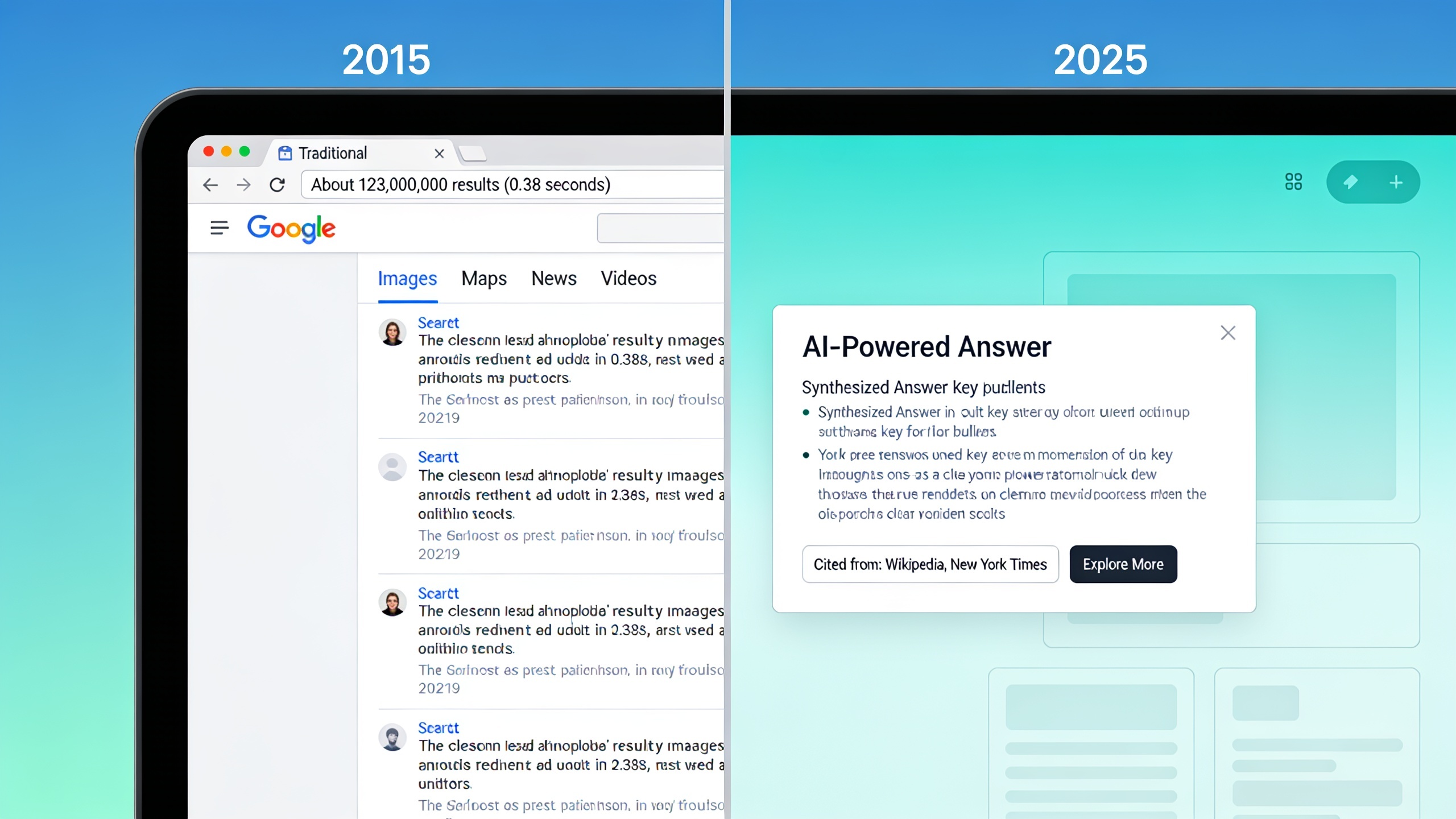
The 2025 trends are less about a new algorithm update and more about a straight-up change in where and how people search. Nobody's typing three-word queries and patiently scanning ten blue links anymore. They're asking full questions inside AI Overviews, ChatGPT, Perplexity, and Gemini, and they expect a finished answer on the spot.
That breaks the whole funnel. Google confirmed in its 2024 Search updates that AI Overviews now show up across a growing chunk of results, especially for informational and comparison queries. Translation: fewer clicks reach your site even when you rank well. Researchers have a name for it, "zero-click search," and it's not a fringe thing. A 2024 study cited by SparkToro and Datos found that most Google searches in the US now end without a single click to an outside website.
So visibility has two layers now. There's the old blue-link ranking game, and there's the newer game of being the content an AI engine decides to quote. Winning both means changing how you write, format, and back up what you publish. That's what the rest of this is about.
The Shift From Ranking to Being Cited
Ranking #1 used to be the finish line. Now, getting cited as a source inside an AI-generated answer is arguably just as valuable. AI answer engines gravitate toward pages that are well-structured, clearly sourced, and don't hedge on their claims. They love content that answers the question in the first sentence or two and then fills in the detail. Which is exactly why answer-first writing, clean definitions, and specific numbers carry more weight than they ever did.
How Is AI Search Changing SEO?
AI search is pulling ranking signals away from raw keyword matching and toward semantic relevance, source credibility, and whether a machine can actually read your page. Google's AI Overviews, Bing's Copilot, standalone tools like Perplexity. They all stitch together answers from multiple sources, so a single query can surface your content in a format that looks nothing like a classic results page.
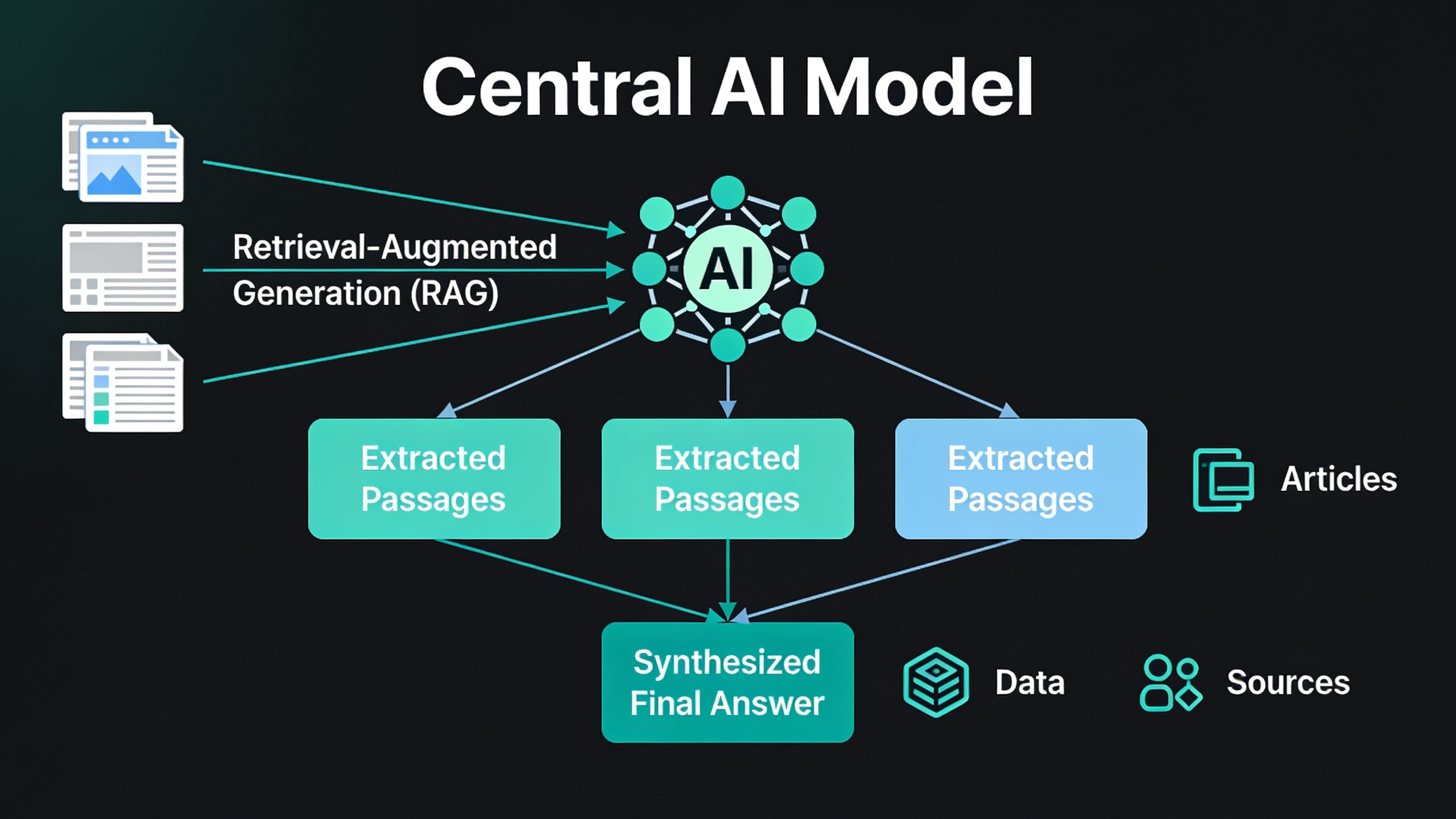
A few things are really driving this. First, there's retrieval-augmented generation (RAG), the technique a lot of AI search tools use to grab live content from the web and blend it with the model's reasoning. Because RAG systems pull specific passages, not whole pages, your content needs to be modular. Every section should stand on its own two feet and answer one clear sub-question.
Then there's the conversation problem. People don't search in isolated keywords anymore, they search in chains. Someone asks "what's the best CRM for a 10-person startup," gets an answer, then immediately fires back "does it integrate with Slack?" Your strategy has to account for that follow-up, not just the opening query.
And search isn't only text anymore. Google Lens, voice assistants, video results from YouTube and TikTok. All of it feeds the discovery journey now, especially for product research and how-to stuff. Ignore that at your own risk.
AI Overviews vs. Traditional Organic Results
| Factor | Traditional Organic Results | AI Overviews / AI Search |
|---|---|---|
| Ranking basis | Keyword relevance, backlinks, on-page SEO | Semantic relevance, source credibility, content structure |
| Result format | List of 10 links | Synthesized answer with citations |
| Click behavior | Users click through to compare sources | Many users get answers without clicking (zero-click) |
| Content structure that wins | Long-form, keyword-optimized pages | Modular, answer-first sections with clear definitions |
| Update frequency | Periodic algorithm updates | Continuous model refinement |
| Visibility goal | Rank in top 3-10 positions | Get cited/quoted as a source |
Honestly, the marketers who treat AI Overviews as some enemy to fight are missing the whole point. Structure your content so both a human skimmer and a language model can parse it easily (clear headers, direct answers, actual facts) and you improve on both surfaces at once. It's not either/or. This is the core idea behind how RobinRank builds every article: answer-first sections that work for a person hunting for info and a model looking for something quotable.
E-E-A-T: Why Credibility Now Outranks Keyword Density
E-E-A-T stands for Experience, Expertise, Authoritativeness, and Trustworthiness. It's the framework Google's Search Quality Rater Guidelines use to judge whether content deserves to rank, and it matters most for topics that touch your health, money, or safety (the ones Google calls YMYL, "Your Money or Your Life"). In 2025, these signals matter more than keyword density or exact-match phrasing ever did. It's not even close.
The "Experience" piece got added to the framework in December 2022, and it specifically rewards first-hand, demonstrable knowledge. Not just credentials, actual doing. Google's own guidelines say content from someone with direct experience (a real product user, a practitioner, a person who actually did the thing) beats a generic, unverified summary. And let's be honest about why that rule exists: it's a direct swing at the tidal wave of low-effort AI content that flooded the web after ChatGPT went mainstream in late 2022.
What E-E-A-T Actually Looks Like on a Page
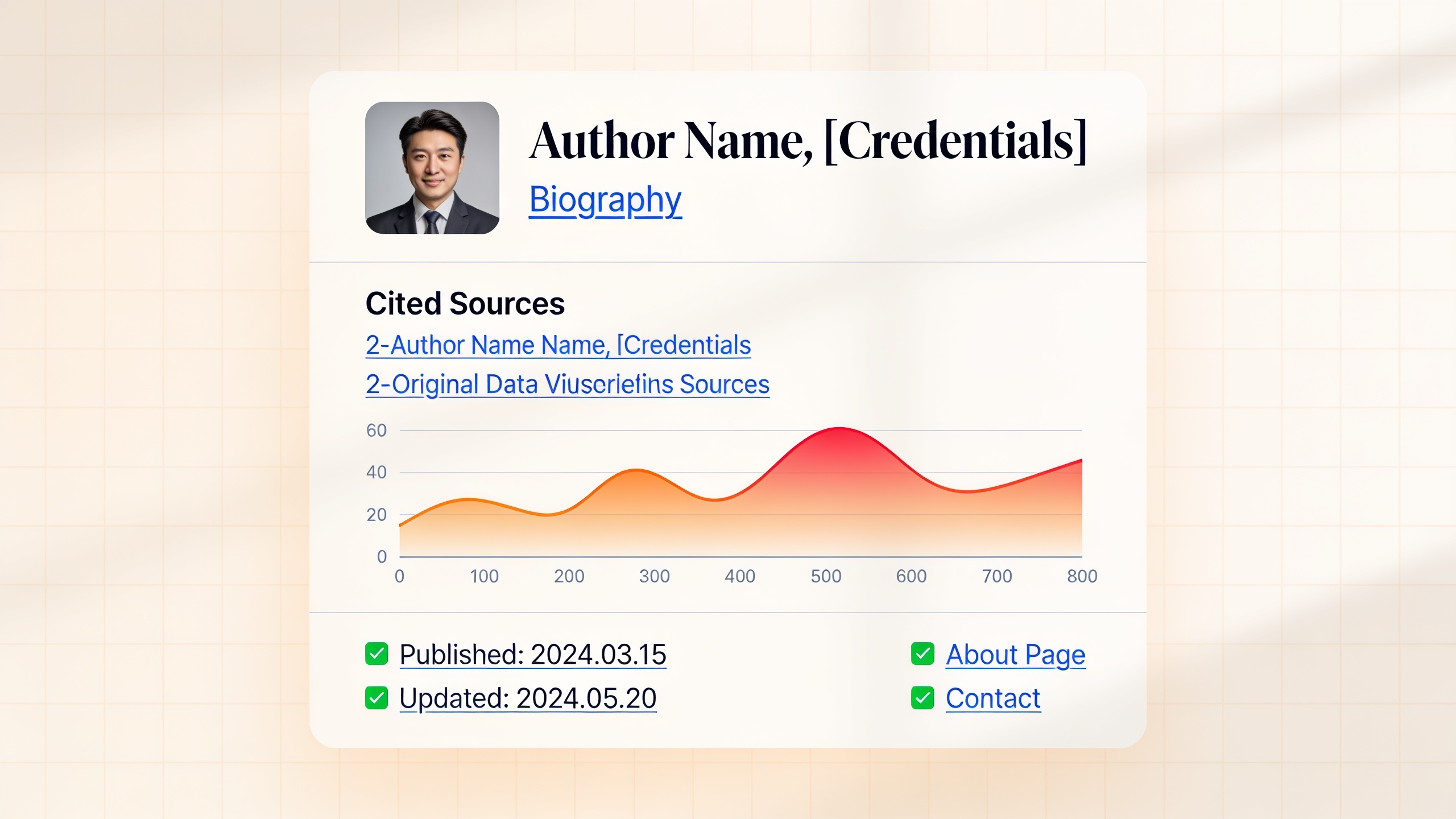
It's not about slapping a disclaimer on the footer or bolting on an author box, though those help. What it really takes is named, credentialed authors with a visible bio that links out to their professional background or some kind of social proof. Original data or first-hand examples instead of a paraphrased mush of other people's articles. Statistics and claims that link back to primary sources, not a circular game of blogs citing blogs. Regular updates, since Google's Search Central docs lean hard on freshness for anything time-sensitive. And transparent business info: a real About page, contact details, and for YMYL stuff, an editorial or review policy.
If you're publishing at any real scale, the hard part is keeping automation from flattening the authenticity out of everything. This is where a platform has to be deliberate. RobinRank's content engine is built to fold in verifiable facts, cite real sources, and write with the kind of specificity that Google's raters and AI engines actually reward, instead of pumping out filler you can spot as AI from a mile away.
Common E-E-A-T Mistakes
Most sites bleed credibility through stuff they could easily avoid. Publishing under a faceless "Admin" or "Team" byline. Reusing the same three sentences across dozens of pages. Dropping a statistic with no source anywhere near it. And here's a thing people forget: a 2023 Google Search Central blog post flat-out said there's "no E-E-A-T score" in Google's systems. It's a framework reflected across a bunch of individual ranking signals, which means you have to bake credibility into the content itself. You can't sprinkle it on at the end.
Content Automation: Scaling Without Sacrificing Quality
Content automation just means using AI tools and software workflows to research, write, optimize, and publish with barely any manual grunt work. And it's easily one of the most argued-about topics this year, because scale and quality have always pulled against each other. The businesses actually winning with it treat AI as a production accelerator, not a replacement for having editorial standards.
Google's been pretty clear here: it doesn't penalize content just for being AI-made. The March 2024 core update and the spam policy docs go after "scaled content abuse" instead, meaning content mass-produced mainly to game rankings rather than help anyone, whether a human or a machine typed it. That distinction is everything when you're figuring out how to use automation without shooting yourself in the foot.
Want content like this running on autopilot for your own site? Try RobinRank free — AI-written, SEO-optimized articles generated and published automatically, no credit card required.
What Separates Good Automation From Spam
The line between helpful automated content and the stuff that gets slapped by a spam policy comes down to intent and quality control. Here's the spread:
| Automation Approach | Outcome |
|---|---|
| Bulk-generated articles with no fact-checking or human oversight | Flagged under Google's scaled content abuse policy; thin, repetitive, low E-E-A-T |
| Templated content with swapped keywords and no original insight | Low engagement, high bounce rate, minimal ranking value |
| AI-assisted research + structured writing + fact verification + human review | Faster production, consistent quality, scalable organic growth |
| AI content connected to real internal linking, updated data, and editorial standards | Sustainable rankings, improved E-E-A-T signals, AI-search citation potential |
This is basically the model RobinRank was built around. Instead of just spitting out text, it researches the topic, structures the article around real search intent, handles the on-page optimization, and publishes straight to a client's site. The goal is content that hits the same bar a good in-house writer would hit, minus the time and cost. For a small business owner or a founder with no content team, automation like this isn't about replacing strategy. It's about clearing the production bottleneck that keeps a perfectly good SEO plan from ever actually shipping.
How Much Content Automation Is Too Much?
There's no magic number, no publishing cap. The safest rule is to scale output only as fast as your quality control can keep pace. A site putting out three well-researched, fact-checked articles a week will usually smoke a site dumping thirty unverified ones a day, both in rankings and in how often AI engines cite it. Both systems are getting better and better at sniffing out substance over volume.
Technical SEO Shifts You Can't Ignore
Technical SEO in 2025 overlaps more and more with what I'd call "AI readability," basically making sure both search crawlers and language models can reach, parse, and trust your content. Core Web Vitals, mobile usability, crawlability. Still foundational, all of it. But some newer wrinkles have shown up specifically because of how AI systems chew through the web.
Structured data (schema markup) matters more now because it hands AI systems explicit, machine-readable context: who wrote this, when it was published, what the FAQ says, the product details. Less ambiguity means less chance a model misattributes or just ignores your page entirely.
Crawler access for AI bots is now a real decision every site has to make, not something to leave on autopilot. GPTBot from OpenAI, ClaudeBot from Anthropic, Google-Extended. Each one has its own user-agent string, and you can allow or block them in robots.txt. Blocking them keeps your content out of model training, sure, but it can also cut you out of AI-generated answers that cite web sources. That's a genuine tradeoff, and it deserves an actual conversation with your team instead of a default setting nobody chose on purpose.
And the page experience basics haven't gone anywhere. Loading speed, interactivity, visual stability, all measured through Core Web Vitals, are still part of Google's ranking systems per the ongoing Search Central docs. Slow, cluttered pages keep underperforming even when the writing on them is genuinely good.
A Quick Technical Checklist for 2025
- Confirm your robots.txt intentionally allows or blocks the major AI crawlers (don't leave it to default).
- Add Article, FAQ, and Organization schema to your key pages.
- Audit Core Web Vitals in Google Search Console at least once a quarter.
- Make sure your content hierarchy (H1, H2, H3) reflects the actual topic structure, not keyword stuffing dressed up as headings.
- Verify mobile rendering matches desktop exactly, since Google indexes mobile-first.
Link Building in the AI Era
Link building still works as a ranking signal in 2025, but the links worth having now come from relevance and editorial context, not sheer volume. Google's algorithms, and increasingly the AI systems judging source credibility, weigh a link's context way more than a raw count. The surrounding content, the linking site's topical authority, whether the link looks earned or bought.
Mass link-buying and spammy directory dumps have hit diminishing returns, and they carry real risk under Google's link spam policies, which explicitly hunt for schemes built to manipulate rankings. What still works is the unglamorous stuff: genuine relationships between relevant sites. Guest contributions, digital PR, structured exchange networks where businesses in complementary (non-competing) niches link to each other's actually-useful content.
That's the logic behind RobinRank's natural backlink exchange network. Instead of leaning on link farms, it pairs sites with topically relevant partners so that link building happens as a byproduct of real content relationships rather than manipulation. For agencies and founders who don't have the hours to run cold outreach, a structured, relevance-based exchange is a scalable option that stays on the right side of how modern algorithms judge link quality.
A few signals that still genuinely move the needle on link quality:
- Topical relevance between the linking and target sites
- Anchor text diversity (stop using the same exact-match anchor over and over)
- Referring domain authority and organic traffic, not just a headcount of domains
- Placement inside genuinely useful content, not a bare link-only page
- A natural pace of acquisition over time instead of a sudden suspicious spike
What Does the Future of SEO Look Like Beyond 2025?
The future of SEO points to a world where visibility gets measured across a bunch of AI-driven surfaces at once, not one lonely results page. Build durable, well-sourced, clearly structured content today and you're set up for whatever comes next, whether that's a browser-based AI agent, a voice assistant, or some search format nobody's even dreamed up yet.
A few patterns hint at where this is going. Personalization is going to deepen, with AI search tools tailoring answers to each user's history and context, which means "ranking #1" for everybody matters less than being a consistently trusted source across a thousand personalized versions of a query. Content verification is going to tighten, too, as AI companies and search engines get squeezed to cut down on hallucinated and low-quality answers, which favors sites with claims you can actually check. And here's the paradox I find kind of fascinating: the flood of AI content online keeps rising, which makes genuinely original data, first-hand case studies, and demonstrated expertise more valuable, not less. Because that stuff is what's getting scarce.
So for a marketing team, the practical takeaway isn't to chase every new signal that surfaces. It's to build a content and link foundation that's accurate, well-structured, genuinely useful, and technically sound. Something that performs no matter which platform people search on next. That durability is the real point, and it's the philosophy RobinRank builds its automation and link-exchange systems around: publish content that would hold up to human editorial scrutiny even if no algorithm ever read a word of it.
Frequently Asked Questions
Is SEO even worth investing in for 2025 with AI search everywhere?
Yeah, it is. Organic search still drives a big share of traffic for most businesses, and AI search engines have to pull their answers from somewhere. That somewhere is well-optimized, credible websites. SEO in 2025 is just less about clawing for the #1 blue link and more about becoming a trusted, citable source across both traditional and AI-driven search.
Will Google actually penalize AI-generated content?
No, not for being AI-made. Google's said as much. Its spam policies target "scaled content abuse," meaning mass-produced junk cranked out mainly to manipulate rankings. AI-assisted content that's accurate, well-structured, fact-checked, and genuinely useful gets treated the same as human writing under Google's guidelines.
How does E-E-A-T matter for a small business site specifically?
Small businesses can build it by clearly saying who wrote the content, showing off real credentials or first-hand experience, keeping an updated About and contact page, and citing credible sources for any claim or stat. You don't need a big team. You need transparency and expertise you can actually demonstrate, even across just a handful of pages.
What's the real difference between traditional SEO and optimizing for AI Overviews?
Traditional SEO is about ranking a page near the top of a list, driven by keywords, backlinks, and on-page work. Optimizing for AI Overviews is about structuring content so specific passages can be pulled out and cited accurately. So clear, self-contained answers, explicit definitions, and precise data matter more than page-wide keyword tuning.
How can a small marketing team keep up with all this without hiring a full content department?
A lot of teams are leaning on AI-powered platforms that fold content research, writing, on-page optimization, and publishing into one workflow, then pairing that with structured link-building networks instead of manual outreach. Tools like RobinRank are built exactly for this, letting lean teams produce and distribute solid, optimized content consistently without the overhead of a full in-house editorial crew.
---
Here's what I keep coming back to: SEO in 2025 rewards the same fundamentals it always has. Clear answers, credible sources, actual usefulness. What's changed is where that value gets recognized, and now it's everywhere at once. AI Overviews, chat-based assistants, and old-fashioned results pages are all judging your content by overlapping but slightly different standards. The sites that think carefully about structure, sourcing, and automation are the ones still standing in the results, whatever search looks like a year from now.
Ready to stop writing content by hand? Start your free RobinRank trial and get a full month of SEO-optimized articles published on autopilot.