The Rise of AI Writers: Are Human Content Teams Obsolete?

But the question won't die. It keeps popping up in Slack threads, in LinkedIn comment wars, in agency pitch decks where somebody's trying to justify a smaller retainer. If AI can research, draft, and publish articles at scale, do you even need human content people anymore? I want to walk through what these tools actually do well, where they fall on their face, how the smart teams are reorganizing around them, and what all of this means going forward. Spoiler: it's not the death match everyone keeps framing it as.
Table of Contents
- What Are AI Writers, Really?
- Why AI Writers Are Scaling So Fast
- Where AI Writers Excel
- Where Human Judgment Still Wins
- AI Writers vs. Human Content Teams: A Side-by-Side Look
- The Hybrid Model: How Smart Teams Are Restructuring
- What This Means for the Future of Content Marketing
- How to Transition Your Team Without Losing Quality
- FAQ: Common Questions About AI Writers and Content Teams
What Are AI Writers, Really?
At the core, an AI writer is just software built on a big language model, GPT-4, Claude, Gemini, that kind of thing, that spits out written content when you feed it a prompt or a brief. But calling them "text generators" in 2025 kind of undersells what they've become.
The clunky article-spinners of the early 2020s are long dead. Today's tools will pull live search data to figure out what's worth writing about, draft a full article complete with headers and internal links and metadata, mimic your brand voice if you feed them enough of it, optimize for keywords on the fly, and in a lot of cases push the thing straight to your CMS without you lifting a finger.
Platforms like RobinRank push it even further by welding AI writing onto full SEO automation. They'll hunt down keyword opportunities, generate the optimized draft, and handle the technical layer most standalone writers completely ignore, stuff like internal linking, schema, backlink exchanges. And that's an important distinction. An "AI writer" these days is rarely one thing. It's usually a single gear in a much bigger content machine.
A Quick History Check
It's honestly kind of wild how fast this moved. Back in 2019, GPT-2 couldn't hold a coherent thought across three paragraphs. By 2023 we had models passing bar exams and cranking out publishable long-form work. Now the writing tools are just baked into CMS platforms and SEO suites and social schedulers by default, not as some fancy add-on you pay extra for.
Here's the messy part, though. Adoption raced way ahead of workflow design. Most companies bolted these tools onto processes built for humans and never rethought the actual structure. Which is exactly why so many teams feel weirdly unsettled right now, even the ones using AI every day.
Why AI Writers Are Scaling So Fast
Three things are driving this, and none of them are backing off anytime soon.
First, money. Freelance blog writers in competitive niches run $150 to $500 a pop. Do the math on a team pumping out 20 articles a month at $300 average and you're at $6,000 before you've paid a single editor or designer. AI tools can knock out comparable first drafts for a sliver of that, which frees up cash for promotion, backlinks, the stuff that actually moves the needle.
Second, speed. Google likes freshness and depth. Waiting three weeks for one writer to research, draft, and revise a single piece feels painful when a competitor just published ten optimized articles in that same window.
Third, and this one gets overlooked, search itself fragmented. All those long-tail, hyper-specific queries (partly thanks to voice search and Google's AI Overviews) mean brands have to cover way more ground than before. Manually writing for every relevant long-tail keyword just isn't realistic money-wise for a small business. With AI in the mix? Suddenly it is.
A 2023 McKinsey report on generative AI flagged marketing and sales as one of the highest-value places to actually apply this stuff, estimating productivity gains somewhere between 5% and 15% of total marketing spend at scale. That's not pocket change. For a mid-size company dropping $500,000 a year on content and marketing, you're talking $25,000 to $75,000 in reclaimed budget or extra output. Nothing to sneeze at.
Where AI Writers Excel
Not every content task is the same, and AI has some genuinely clear strengths.
Volume and consistency. AI doesn't get writer's block. It doesn't need the brief explained three times. It doesn't have an off day because its dog is sick. If you need to hold a steady cadence, say three to five articles a week to build topical authority, AI makes that achievable without proportionally growing your headcount.
First-draft speed. The blank page is the biggest time-suck in this whole business, and everyone who's ever written for a living knows it. AI collapses that ideation-to-draft stretch from hours down to minutes. Now your editors have something concrete to push against and sharpen instead of staring at a blinking cursor.
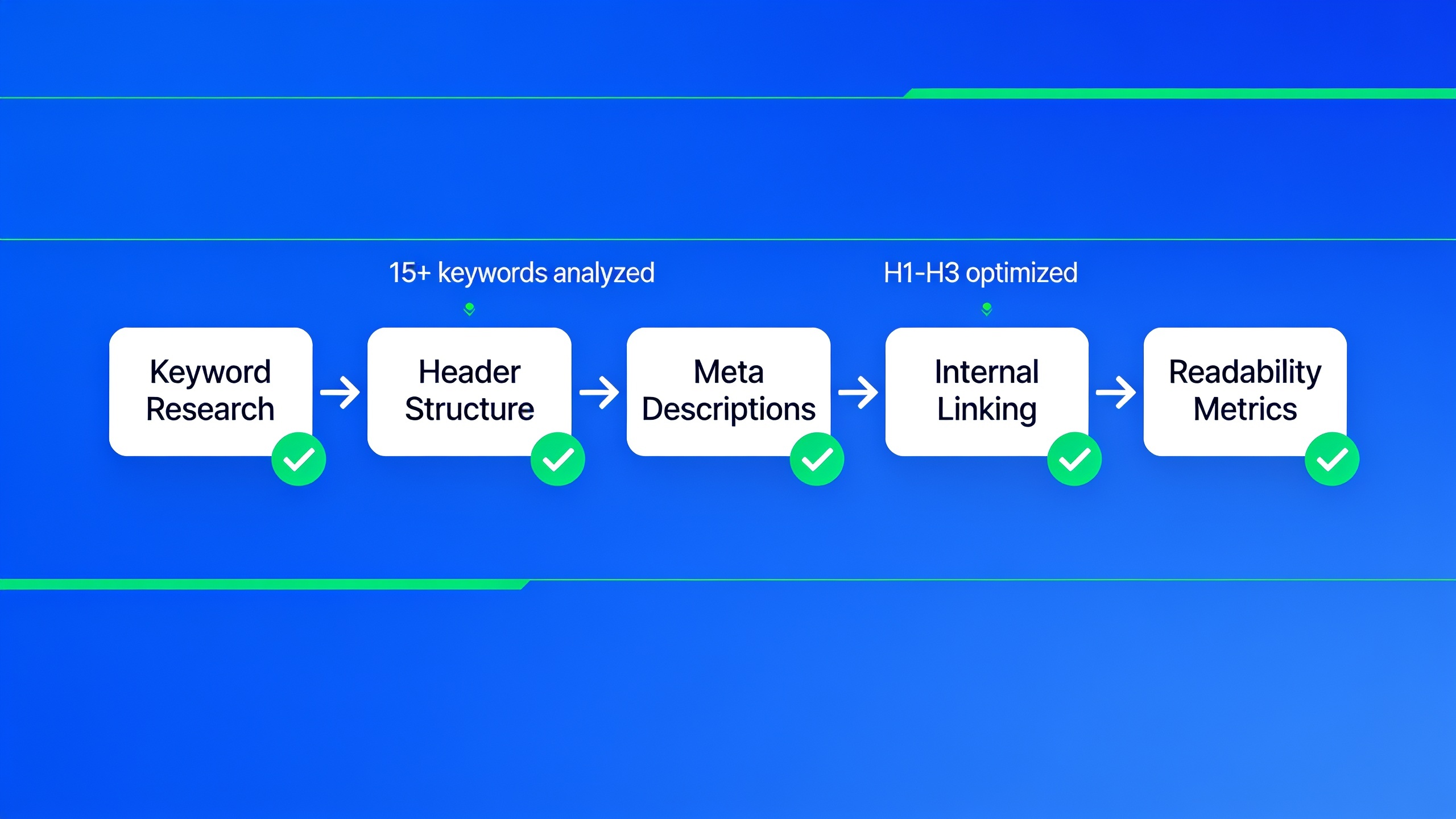
Then there's the on-page SEO grunt work. Keyword placement, header structure, meta descriptions, internal linking, readability scoring. All of that is pattern-based, and pattern recognition is literally what these models were built to do. They're weirdly good at it. Better than most human writers, honestly, and more consistent too.
And repurposing. Turning one long article into five social posts, a newsletter, and three localized versions used to eat entire days. AI does the first pass in minutes. If you're an agency juggling a dozen client accounts, or a franchise that needs the same core content tweaked for different markets, that's a lifesaver.
Where Human Judgment Still Wins
This is the part the "AI will replace all writers" headlines conveniently skip.
AI writers learn from existing content. Which means, left to their own devices, they tend to produce something that sounds like the average of everything already published on a topic. Competent. Fine. Completely forgettable. Real competitive advantage in content comes from unique data, spicy contrarian takes, proprietary case studies, insight only your brand has. Humans generate that raw material. AI just organizes and scales it.
There's also the trust question, and it's a big one. Google's own Search Quality Rater Guidelines lean hard on E-E-A-T, Experience, Expertise, Authoritativeness, Trustworthiness, especially for anything touching health, finance, or safety (the YMYL stuff). And here's the thing an AI can never fake: it has no lived experience. It's never tried the product. Never sat in the conference room. Never made an expensive mistake and learned from it the hard way. That first-hand experience signal, which Google's been rewarding harder ever since the 2022 helpful content update, is stubbornly, unavoidably human.
Then there's accuracy. Language models hallucinate, meaning they'll generate stuff that sounds totally plausible and is just... wrong. A Stanford HAI 2024 report on AI transparency pointed out that even the top commercial models still produce factual errors in a meaningful chunk of long-form output, particularly around stats, dates, and niche technical claims. In finance, healthcare, or legal? That's not just a quality problem. That's a liability problem. The kind that ends up in front of a compliance officer.
And finally, the relationship stuff. Interviews, original research, expert roundups, community insight, all of it runs on human connection. Sure, an AI can format a customer interview beautifully. But it can't conduct one. It can't build rapport, read the room, or throw in that unexpected follow-up question that pulls out the one quote you end up building the whole piece around.
AI Writers vs. Human Content Teams: A Side-by-Side Look
| Factor | AI Writers | Human Content Teams |
|---|---|---|
| Production speed | Minutes to hours per article | Days to weeks per article |
| Cost per article | $5–$50 (tool/subscription cost) | $150–$1,000+ (freelance/agency rates) |
| SEO structure & keyword optimization | Excellent, consistent | Variable, depends on writer training |
| Original research & data | Cannot generate independently | Core strength |
| Brand voice nuance | Good with fine-tuning, imperfect | Strong, especially with tenured writers |
| Factual accuracy on niche topics | Risk of hallucination | Higher reliability with subject expertise |
| Scalability | Very high | Limited by hiring and onboarding |
| Emotional resonance / storytelling | Adequate, sometimes generic | Stronger, especially for brand narrative |
| E-E-A-T / trust signals | Weak without human input | Strong when experience is genuine |
| Best use case | High-volume, structured, SEO-driven content | Flagship content, thought leadership, sensitive topics |
Want content like this running on autopilot for your own site? Try RobinRank free — AI-written, SEO-optimized articles generated and published automatically, no credit card required.
Look at that table long enough and the real answer basically jumps out at you. This was never one winner and one loser. It's a division-of-labor question. Always was.
The Hybrid Model: How Smart Teams Are Restructuring
The best organizations aren't torching their content teams. They're reorganizing around AI. It's the same thing that happened in a dozen other industries when automation matured: the job doesn't vanish, it just climbs up the value chain.
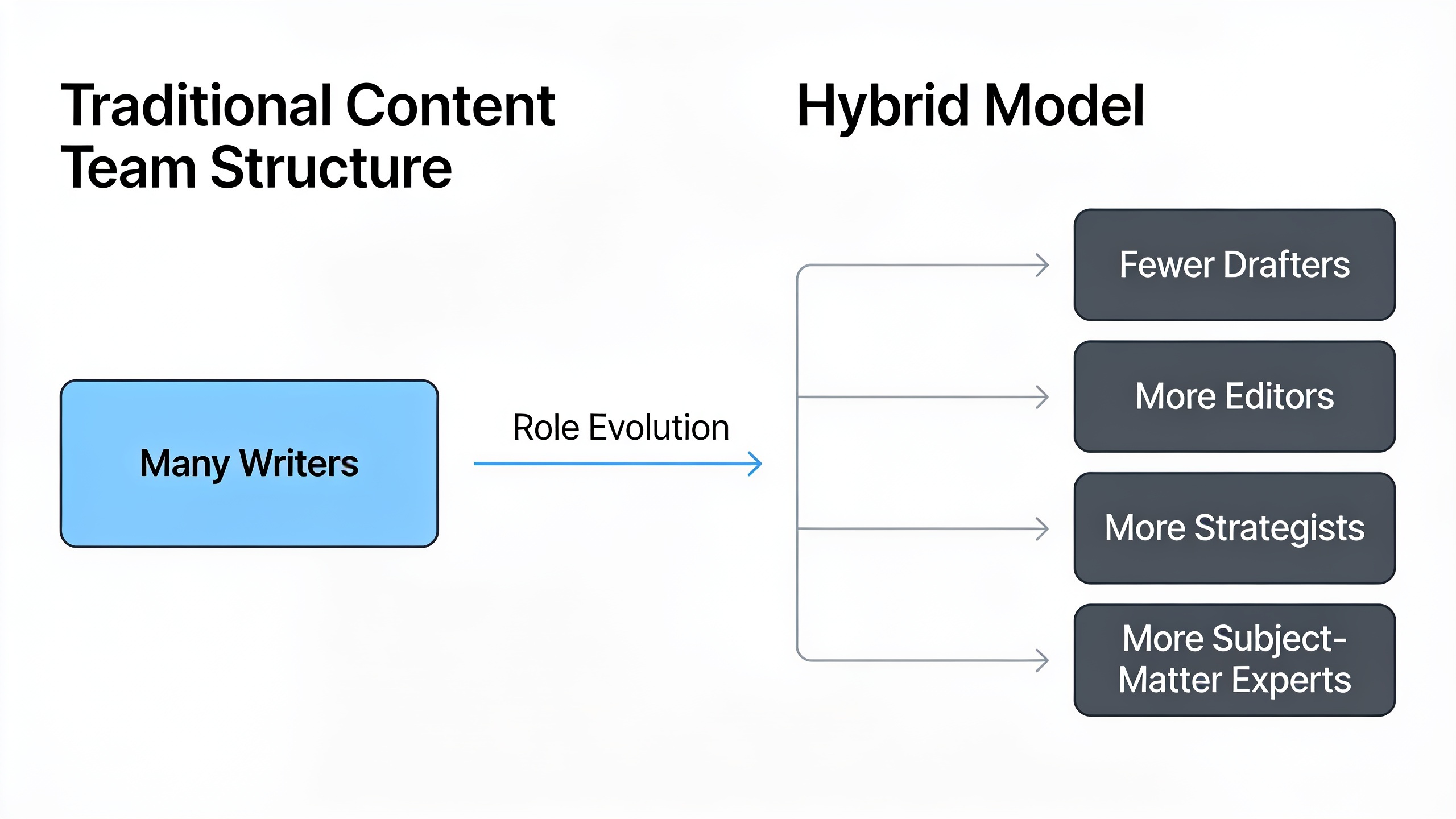
So instead of a bunch of pure drafters, teams now want more editors, fact-checkers, and strategists who can actually aim the AI at business goals. The valuable skill stopped being "can you write 1,500 words on this" and became "can you spot which topics matter, brief the machine so it doesn't produce mush, and refine the output into something people actually want to read."
Subject-matter experts are moving too, from the drafting seat into the review seat. Take a financial services company. They might have AI draft an explainer on mortgage rate trends, then hand it to a licensed advisor for a quick 15-minute accuracy pass. Not a full rewrite. Just a sanity check from someone who knows the rules cold.
Publishing itself is changing shape as well. Platforms like RobinRank represent this next layer, where instead of a human manually grabbing each draft and hitting publish, the whole pipeline runs on its own, research, drafting, optimization, publishing, with people applying oversight at strategic checkpoints (brand guidelines, quality bars, backlink strategy) rather than babysitting every single article. That's how a solo founder or a two-person agency can now hold a publishing rhythm that used to demand a five-person department.
A few roles have popped up or gotten a lot louder over the past couple years. There's the AI Content Editor, who cleans up drafts, checks facts, keeps the voice consistent. The Prompt/Brief Architect, who designs the structured inputs that decide whether the output is gold or garbage. The Content Operations Manager, running the tech stack that stitches the writers, SEO tools, and CMS together. And the E-E-A-T Contributor, basically your subject experts lending real credibility and firsthand experience to AI-assisted work.
What This Means for the Future of Content Marketing
The real fight isn't AI versus humans. It's AI-augmented teams versus teams still doing everything by hand. And that gap is already showing up in publishing velocity and organic traffic among the early movers. You can see it.
Worth knowing: Google has been pretty clear it doesn't penalize content just for being AI-generated. Its 2023 guidance basically said quality matters more than who or what typed it. What does get you slapped is content made purely to game rankings, human or machine, doesn't matter. That distinction is huge. The winners won't be the companies that swear off AI out of pride, or the ones spraying unchecked AI slop everywhere. They'll be the ones using it to make genuinely useful stuff faster than competitors can produce it by hand.
Here's something that surprises people: pure volume isn't a moat anymore. Once everyone can publish fast, publishing fast stops being special. So what's actually becoming the edge?
- Proprietary data and original research woven right into the AI-assisted content
- Reacting faster to trending topics and algorithm shakeups
- Smarter internal linking and topical authority (structural stuff that raw volume doesn't hand you)
- Backlink networks and off-page authority, which are still heavily relationship-driven
Which is exactly why RobinRank pairs its AI writing with a natural backlink exchange network. When every competitor can crank out content in an afternoon, off-page authority and structural SEO become the levers that actually move rankings. The writing's table stakes now.
And the money's already shifting. A 2024 Gartner marketing budget survey noted CMOs increasingly moving content dollars toward tooling and tech rather than piling on headcount, with a growing slice pointed at AI and automation platforms. Reads to me like the future favors lean, tech-enabled teams over big traditional departments. Not because quality stopped mattering. Because quality-per-dollar increasingly tilts toward the hybrid setup.
How to Transition Your Team Without Losing Quality
If you're a founder or marketing lead trying to fold AI in without wrecking your content, do it in phases. Ripping the whole thing out overnight tends to end badly.
Start by auditing your content by task, not by role. Break down what your team actually does, research, drafting, editing, SEO, publishing, promotion, and sort which pieces are pattern-based (good AI candidates) versus judgment-based (keep those human). This matters more than it sounds, because job titles hide the fact that most people do a mix of both.
Then pilot AI on the low-risk stuff first. Informational, non-YMYL topics where a factual slip won't hurt anyone. Glossary pages, how-to guides, listicles. Prove it out there before you let it anywhere near sensitive or high-stakes material.
Build a human checkpoint into every AI-assisted article, even a light one. A quick fact-check, a brand voice pass, dropping in one genuine first-hand insight. Small stuff, but it meaningfully lifts quality and cuts down the hallucination risk.
Track performance, not just how much you're publishing. Watch organic traffic, rankings, and conversion rate on your AI-assisted pieces against your old human-only benchmarks. Then adjust based on what the data says, not what your gut assumes. And whatever time you claw back on drafting? Pour it into the things AI can't touch. Outreach. Backlink building. Original research. Customer interviews. Those are the exact ingredients that make content stand out in a search landscape that's getting more AI-saturated by the week.
FAQ: Common Questions About AI Writers and Content Teams
So are AI writers going to wipe out content marketing jobs?
Probably not anytime soon. The roles are shifting, not disappearing, moving from drafting toward editing, strategy, and quality control. Think about how design software killed manual paste-up work but not designers. Augmentation, not extinction, is the far more likely story here.
Does Google actually penalize AI content?
Nope, not for being AI. Google's official line is all about quality and helpfulness, regardless of how it got made. What crosses the line is content built purely to manipulate rankings, and that's a violation whether a human or a machine wrote it. The automation itself isn't the problem.
How much can a business realistically save with AI writers?
Cost per article usually drops from that $150–$500 freelance range down to roughly $5–$50 with a platform. That said, your actual savings depend a lot on how much human editing and oversight you layer back on top. Skimp there and you'll pay for it later.
Can a small business use AI writers with no in-house content team?
Absolutely, and honestly it's one of the fastest-growing use cases out there. Platforms like RobinRank are built specifically for businesses and agencies without a dedicated content department, automating the research, drafting, optimization, and publishing while still letting you customize the brand and keep an eye on things.
What's the single biggest risk of going all-in on AI?
Two things, really: hallucinated facts and generic, forgettable content. Without human review and some original insight mixed in, AI content just melts into the giant pile of near-identical articles already out there. That tanks both your SEO and your readers' trust, which is a rough combo.
---
Honestly, the whole "will AI make human teams obsolete" debate misses the more useful question underneath it. Which parts of content production genuinely need human judgment, and which parts were only ever mechanical tasks we did by hand because we had no other option? Once you frame it that way, the answer gets a lot less scary. The businesses pulling ahead aren't the ones clinging to fully manual workflows out of nostalgia, and they're definitely not the ones flooding the internet with unchecked AI. They're the ones quietly building lean hybrid systems where the machine handles scale and speed, and the humans handle judgment, trust, and the stuff that makes anyone care in the first place. That balance is what's actually taking shape across the industry right now. Not a winner-take-all bloodbath. Just a smarter way to work.
Ready to stop writing content by hand? Start your free RobinRank trial and get a full month of SEO-optimized articles published on autopilot.