What Is AI Content Marketing? A Complete 2025 Guide

Let me try to answer that without the fluff.
At its core, AI content marketing is using artificial intelligence to research, draft, optimize, and (increasingly) publish content at a scale that no human team could realistically hit on its own. And no, it's not just "I asked ChatGPT to write a blog post." That's like calling a hammer a house. It's a structured approach that pulls together machine learning, natural language processing, and real SEO data to make content that actually ranks, converts, and keeps working for you long after you hit publish.
This guide covers the whole thing: how it works, how it stacks up against the old-school way, the tools worth knowing about, and how to build something sustainable around it in 2025. No hype, or at least less hype than usual.
Table of Contents
- What Is AI Content Marketing?
- How AI Content Marketing Differs From Traditional Content Creation
- Why Businesses Are Adopting AI Content Marketing in 2025
- Core Components of an AI Content Marketing Strategy
- AI Content Marketing Tools: What to Look For
- Common Pitfalls and How to Avoid Them
- Building a Scalable AI Content Marketing Workflow
- Frequently Asked Questions
What Is AI Content Marketing?
AI content marketing is the practice of using artificial intelligence, especially large language models, natural language generation, and predictive SEO analytics, to plan, create, optimize, and distribute content built to pull in organic traffic and drive real business results.
Now, this is different from plain old automation. Scheduling tools and templated email blasts are automation. What we're talking about is generative intelligence that can actually understand search intent, chew through your competitors' content, spot the topics nobody's covering well, and spit out publish-ready articles optimized for both search engines and, you know, humans who have to read them.
The way I like to frame it: traditional content marketing asks one person to research, write, edit, and optimize every single piece by hand. AI content marketing hands most of that grunt work to a system, while humans stay in charge of strategy, quality, and making sure it actually sounds like your brand and not a robot in a suit.
And this isn't some niche thing anymore. A 2024 Content Marketing Institute survey found that 78% of marketers were using AI somewhere in their content workflow. Back in 2022? That number was 29%. So in about two years it went from "some of us are experimenting" to "almost everybody's doing it." That's not a trend. That's a rebuild of how content gets made.
The Three Pillars of AI Content Marketing
Most of these systems, RobinRank included, are built on three pieces that feed into each other.
First, there's research and ideation, where the AI digs through search results, keyword clusters, and competitor content to find the high-opportunity topics before anyone writes a word. Then comes generation and optimization, where content gets drafted by models trained on SEO best practices and automatically checked against the stuff that matters for ranking: keyword usage, header structure, readability, internal links, all of it.
The third piece is the one that's changed the most recently: distribution and publishing. A lot of these tools don't just hand you a draft anymore. They'll push it straight to your CMS, manage your content calendar, and in some cases even handle backlink placement to build authority faster. That last part used to be entirely a human job. Not so much now.
How AI Content Marketing Differs From Traditional Content Creation
To really get what makes AI content marketing tick, you've got to hold it up next to the way most businesses have done things for years.
The traditional model is linear and, honestly, kind of exhausting. A strategist picks the topics. A writer drafts the piece, usually over a few days. An editor cleans it up. An SEO person optimizes it. Then it sits in a publishing queue. Orbit Media's annual blogging survey puts the average somewhere between 5 and 15 hours per article. Fifteen hours. For one post.
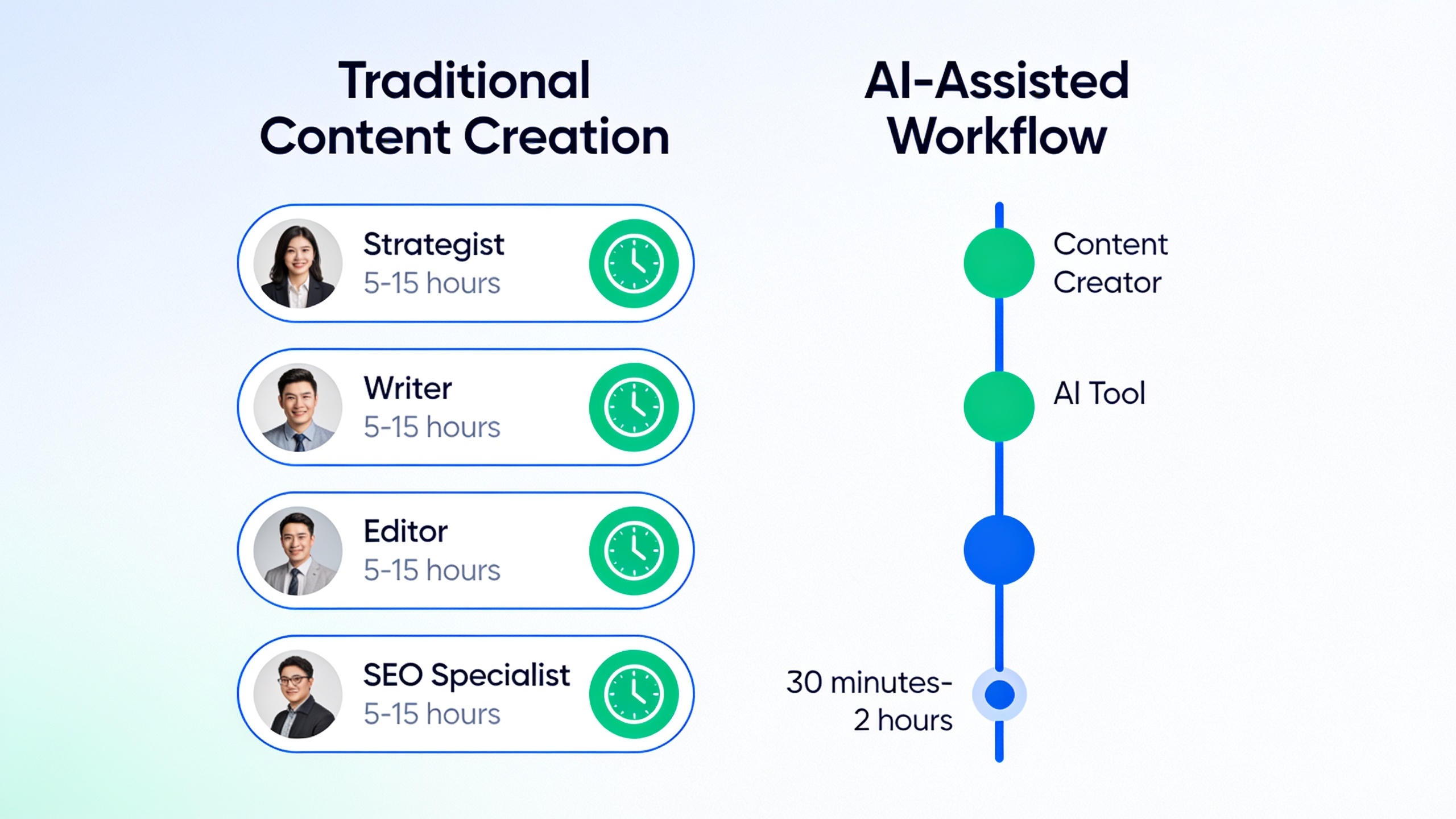
AI content marketing squeezes that timeline hard. Competitor research that used to eat up an afternoon happens in minutes. The first-pass draft that took days shows up almost instantly, which means your human reviewers get to spend their time actually improving the thing instead of staring at a blank page at 4pm.
| Aspect | Traditional Content Marketing | AI Content Marketing |
|---|---|---|
| Average time per article | 5–15 hours | 30 minutes–2 hours (with human review) |
| Research method | Manual keyword tools, manual SERP review | Automated SERP analysis, AI topic clustering |
| Scalability | Limited by team size and budget | Scales with software, not headcount |
| Cost per article | $100–$500+ (freelancer/agency rates) | Often a fraction of that via subscription tools |
| Consistency | Varies by writer and editor availability | Consistent structure, tone, and optimization |
| Speed to publish | Days to weeks | Same day to a few days |
| SEO optimization | Manual, often post-hoc | Built into the generation process |
None of this means humans are out of a job. If anything it's the opposite. What changes is where your people spend their energy. Instead of grinding out drafts, they're working on strategy, on making the brand actually feel distinct, on catching the stuff a model would never catch. You end up with a hybrid: AI handles the volume and the consistency, humans handle the nuance and the trust. That's the sweet spot, and I've watched teams that ignore that balance flame out pretty quickly.
Why Businesses Are Adopting AI Content Marketing in 2025
The adoption curve has gotten steep, and when you look at what's pushing it, it makes sense.
Start with money. Running a full content team, a strategist, a couple writers, an editor, an SEO specialist, can easily set a mid-sized operation back $8,000 to $15,000 a month, sometimes way more. For a small business or a startup, that's a tough sell, especially since content ROI usually doesn't show up for months. AI platforms let those teams produce comparable output for a fraction of the cost. Suddenly organic growth isn't just a game for companies with deep pockets.
Then there's what search engines actually want now. Google keeps leaning toward sites that publish deep, regularly updated content and demonstrate real topical authority. If you're putting out one article a month, good luck signaling expertise on anything. AI makes it realistic to publish several solid, optimized pieces a week without the wheels falling off. A few years ago that was basically impossible for a lean team.
The talent thing is real too. Good SEO writers who understand both the craft and how search actually works are genuinely hard to find, and expensive to keep. Agencies talk about two-to-four-week turnaround delays when they're leaning on freelancers. AI cuts through that by handing you a strong first draft immediately, so your editors aren't starting from nothing.
And here's the part I find most interesting: these platforms don't just write, they analyze. They'll track which topics are gaining search volume, which competitors are ranking for what, which formats work for which intents. That's a feedback loop. Compare that to the traditional approach where you plan your content calendar in a quarterly meeting and then... hope. The speed difference is embarrassing, frankly.
Oh, and the compounding effect. Teams that get into this early tend to build an advantage that snowballs. More content means more indexed pages, which means more long-tail rankings, which means more traffic, which feeds back into everything. Traditional teams take years to build that flywheel. AI-assisted teams can spin it up a lot faster.
Core Components of an AI Content Marketing Strategy
Understanding the concept is easy. Building something that actually works is where people trip up. So here's what separates the programs that succeed from the ones just pumping out generic filler.
It all starts with keyword and topic research, because even the smartest AI model is only as good as what you feed it. Good AI content marketing begins with real keyword clustering, grouping search terms by intent instead of chasing each one as a standalone target. Skip this and you'll end up with a bunch of articles cannibalizing each other in the SERPs. Not fun.
Right alongside that is search intent mapping. Not every piece should look the same, obviously. Somebody searching "best CRM software for startups" wants something completely different from someone searching "what is a CRM." The tools that hold up over time are the ones that adjust structure, tone, and depth based on what the searcher actually wants, not just where they cram the keyword.
Then you've got on-page SEO. Header hierarchy, internal linking, meta descriptions, schema, readability. AI can automate a ton of this, but the strategy behind which pages link to which, and why, still really benefits from a human eye. Especially for your cornerstone content.
Want content like this running on autopilot for your own site? Try RobinRank free — AI-written, SEO-optimized articles generated and published automatically, no credit card required.
Now, the one you can't skip: E-E-A-T and editorial quality control. Google cares about Experience, Expertise, Authoritativeness, and Trustworthiness, which means technically-optimized-but-empty content won't cut it. This is exactly where human review stays non-negotiable. Fact-checking, adding an actual original take, making sure your claims aren't nonsense. That protects your rankings and your reputation, and honestly the second one matters more.
Finally, distribution and links. Content nobody sees does nothing for you. A real strategy includes a plan to get eyes on it: internal linking, newsletters, social, and increasingly, structured backlink exchange networks that help fresh content earn authority faster than pure organic link-building ever could.
AI Content Marketing Tools: What to Look For
The tool market has absolutely exploded, and they're not all doing the same job. Some are just fancy drafting assistants. Others run the whole pipeline from research to published post. When you're evaluating one, a few things actually matter.
Look for SEO-native architecture first. Does the tool build content around real-time SERP data, or does it generate generic text and cross its fingers? The ones plugged into live search data tend to produce content that can actually compete.
Publishing integration matters more than people expect. Can it connect straight to your CMS, whether that's WordPress, Webflow, Shopify, whatever, or does it make you copy-paste everything by hand? Because if it's the latter, congrats, you just reintroduced the exact bottleneck you were trying to kill.
You also want solid editorial controls, brand voice customization, a fact-checking layer, human-in-the-loop review before anything goes live. Fully "black box" automation makes me nervous, and it should make you nervous too. Beyond that, the best platforms understand your existing site structure and suggest contextual internal links on their own, which quietly strengthens your topical authority over time.
A couple more. Some tools, RobinRank being one, go past content creation and connect sites into natural backlink exchange networks, so new content earns authority signals faster than you'd get waiting around for organic links. And please, get one with real reporting. Content without measurement is just guessing with extra steps. You want dashboards showing indexed pages, keyword movement, and traffic trends so you actually know if any of this is working.
Common Pitfalls and How to Avoid Them
This stuff isn't risk-free. Teams that treat AI content as "set it and forget it" run into the same problems over and over, and it usually wrecks both their SEO and their credibility.
The biggest one is publishing without review. People fully automate the pipeline, walk away, and then get burned when the model produces a factual error or some bland phrasing that sounds nothing like their brand. Even great models do this. A quick human pass, just checking facts, tone, and specificity, fixes most of it without slowing you down much.
Ignoring search intent is another classic mistake. If you generate content purely off keyword volume without thinking about what the searcher actually wants, you'll technically target the term but leave the reader cold. High bounce rates, low dwell time, and eventually your rankings suffer for it.
Over-optimizing is a related trap. Older or badly calibrated tools sometimes stuff keywords until the text reads like it was written by someone having a stroke. Modern algorithms will punish that. The goal is always natural, valuable writing that happens to be well-optimized, not the reverse.
Then there's the volume-over-depth thing. Cranking out a hundred shallow articles rarely builds the authority Google rewards. You're usually better off with fewer, genuinely comprehensive pieces backed by a network of supporting content. AI can absolutely execute this at scale, but only if you point it in the right direction.
And last, don't skip link building. I see teams pour everything into on-page content and completely forget that backlinks are still one of Google's strongest signals. Great content with zero link strategy tends to plateau and just sit there. Platforms that pair content generation with natural backlink exchange help close that gap without needing a whole outreach team on payroll.
Building a Scalable AI Content Marketing Workflow
Okay, so how do you actually put this into practice in a way that lasts, rather than just spiking your traffic for a month and then crashing? Here's a framework I'd trust.
Start by auditing what you've already got. Before you generate a single new thing, understand what you rank for, where the gaps are, and how your internal linking currently flows. You'd be surprised how much low-hanging fruit is sitting in content you already own.
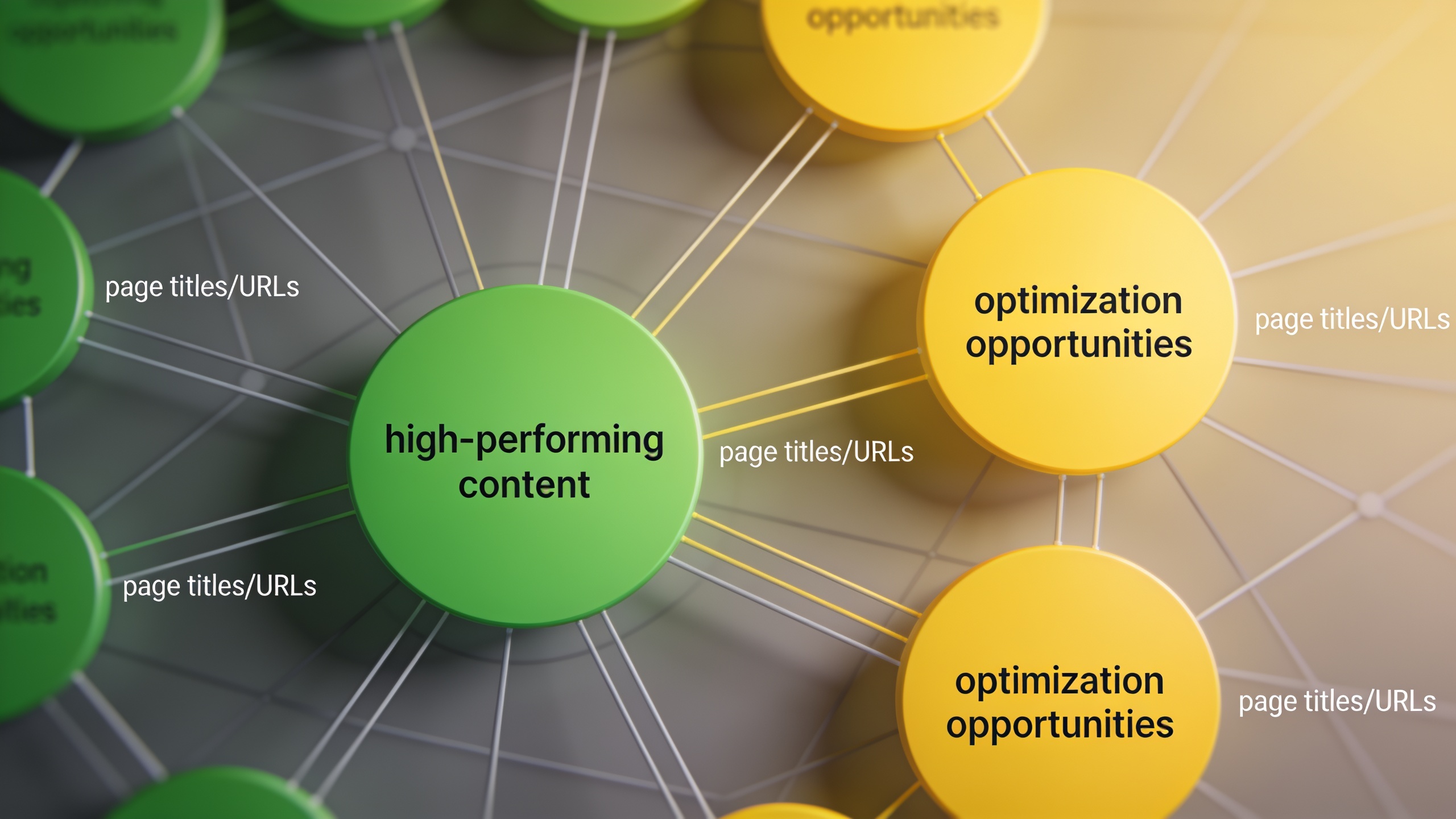
Next, build a topic cluster map. Group your keywords by intent and figure out which pillar topics deserve the full comprehensive treatment, then map the supporting subtopics around them.
Before you let the AI loose, set your guardrails. Define your brand voice, your tone, your accuracy standards, and flag any topics that need extra scrutiny. Anything legal, medical, or financial, you want humans watching that closely.
From there, work in batches. Instead of publishing one article at a time, a lot of teams find it way more efficient to generate a batch, review the whole thing for quality and accuracy, then schedule it out over a few weeks rather than dumping everything at once. Google doesn't love a sudden flood of a hundred posts overnight anyway.
Then just watch and adjust. Track which pieces are ranking, which ones need a refresh, which topics are flopping, and feed all of that back into your research. And keep layering in link building the whole time, whether that's outreach, guest posts, or exchange networks, so you're actively accelerating authority instead of passively waiting for links that may never come.
This is basically the whole reason platforms like RobinRank exist: to automate the research-to-publish pipeline while keeping strategy, quality control, and link-building stitched together instead of scattered across five disconnected tools.
Frequently Asked Questions
Wait, does Google actually penalize AI content?
Nope. Google's been pretty clear about this, repeatedly: it doesn't penalize content just for being AI-generated. What it cares about is quality, helpfulness, and whether the content follows E-E-A-T. Thin, inaccurate, or manipulative content gets penalized, sure, but that's true whether a human or a machine wrote it.
How much cheaper is this than hiring writers, really?
It varies a lot, but here's the ballpark. Most AI platforms run on subscriptions somewhere between $50 and a few hundred dollars a month for meaningful output. Compare that to $2,000–$10,000+ a month for a small in-house or freelance team producing similar volume. Your actual savings depend on how complex your content is and how much human oversight you need on top.
Can AI just replace human writers entirely?
Not really, and it honestly shouldn't try. The best setup treats AI as a force multiplier for research, drafting, and optimization, while humans handle strategy, fact-checking, and the brand-specific insight a model can't fake. Fully unsupervised AI publishing consistently underperforms a well-managed human-AI hybrid. I've yet to see an exception worth bragging about.
How long until I actually see results?
About the same as regular SEO, so three to six months before things really move. The upside is that the publishing speed AI gives you can shorten how long it takes to rack up indexed pages and long-tail rankings. Competitive niches will still test your patience, though.
So what's the difference between this and just using ChatGPT for blog posts?
Using a general chatbot to draft posts is one small slice of AI content marketing, but on its own it's missing the SEO research, intent mapping, structured optimization, and publishing integration that a real platform brings. The proper systems fold data-driven research, on-page optimization, and often distribution or link-building into one coordinated workflow. It's the difference between a text generator and an actual growth engine.
---
AI content marketing isn't a fad you can wait out. It's a genuine shift in how businesses chase organic growth, and if you don't have the budget or bandwidth for a full traditional content operation, it's probably the most realistic path to competing on both volume and quality at once.
But here's what I keep coming back to: the teams winning at this aren't the ones who automated everything and wandered off. They're the ones pairing AI's speed and research muscle with actual human judgment, smart SEO, and steady link-building. Whether you're just poking at what all this means for your business or trying to sharpen a workflow you've already got running, the goal doesn't change. Publish stuff that genuinely helps people, and build the process so it can actually scale without burning you out.
Ready to stop writing content by hand? Start your free RobinRank trial and get a full month of SEO-optimized articles published on autopilot.