AI Content Copyright: What Every Marketer Needs to Know in 2025
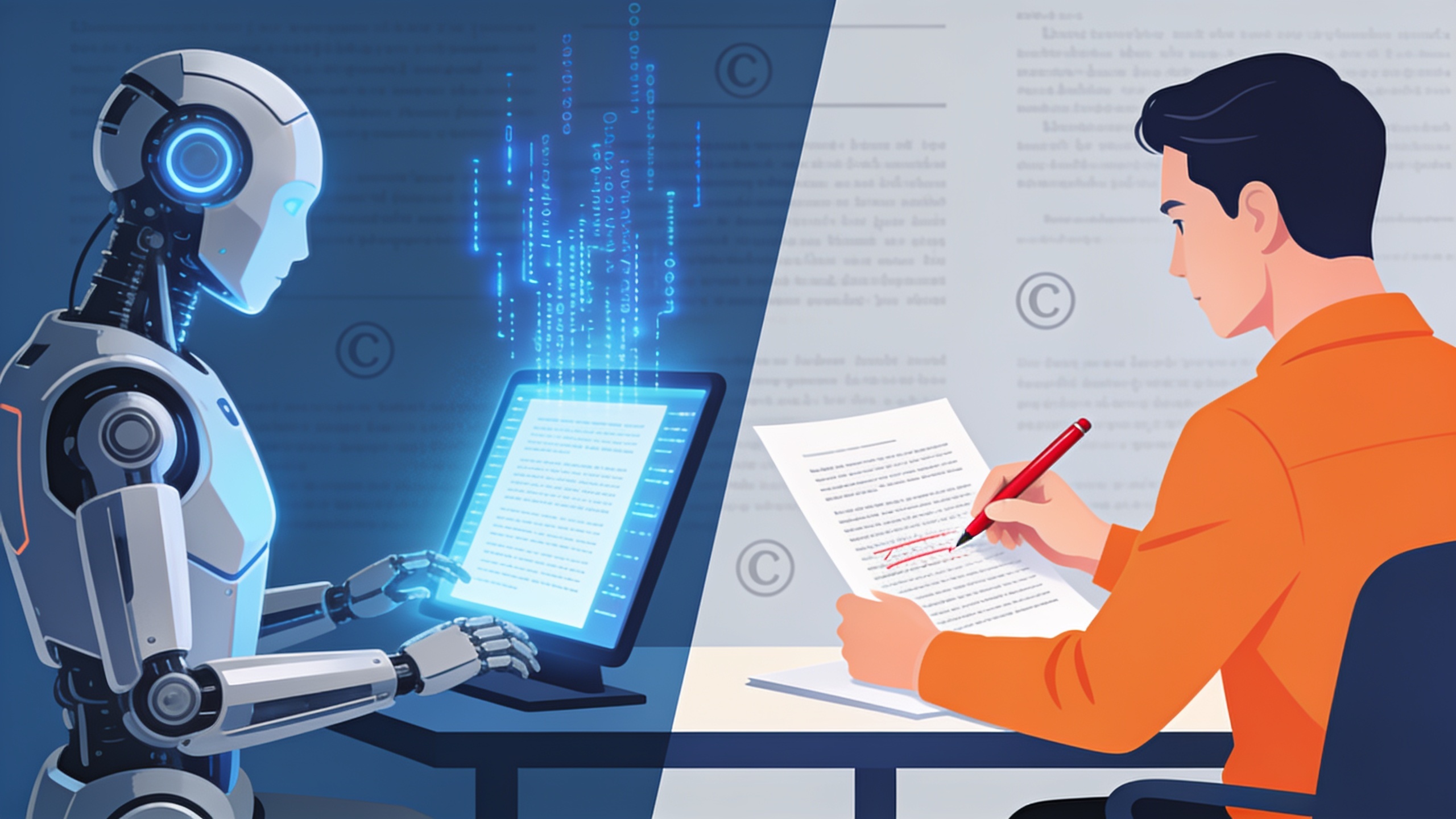
I wish I could give you a clean yes or no. The truth is messier. AI content copyright, meaning the rules about who holds rights to content that a machine helped create, is still half-formed in a lot of ways. But courts, regulators, and Google have already dropped enough guidance that you can't keep pretending this is somebody else's problem. Get it wrong and you're looking at content you can't register, takedown notices, the FTC poking around, or your name on a copyright lawsuit.
So let's sort out what's actually settled, what's still a coin flip, and what a real compliance process looks like if you're an SEO team, an agency, or a founder cranking out content at scale.
Table of Contents
- What Is AI Content Copyright, and Who Actually Owns AI-Generated Work?
- The AI Content Copyright Landscape: Key Rulings and Guidance
- What Are the Biggest AI Content Legal Risks for Marketers?
- Do You Have to Disclose AI-Generated Content?
- Building an AI Content Compliance Program: Practical Steps
- AI Content Copyright Across Different Publishing Scenarios
- How AI Content Copyright Affects SEO and Publishing Strategy
- Frequently Asked Questions
What Is AI Content Copyright, and Who Actually Owns AI-Generated Work?
AI content copyright is really just the question of whether something an AI tool produced (text, images, video, code, whatever) can be copyrighted at all, and if so, who gets to claim it. In the U.S., as of 2025, the short version is blunt: if a machine made it with no meaningful human creativity involved, you generally can't copyright it. Full stop.
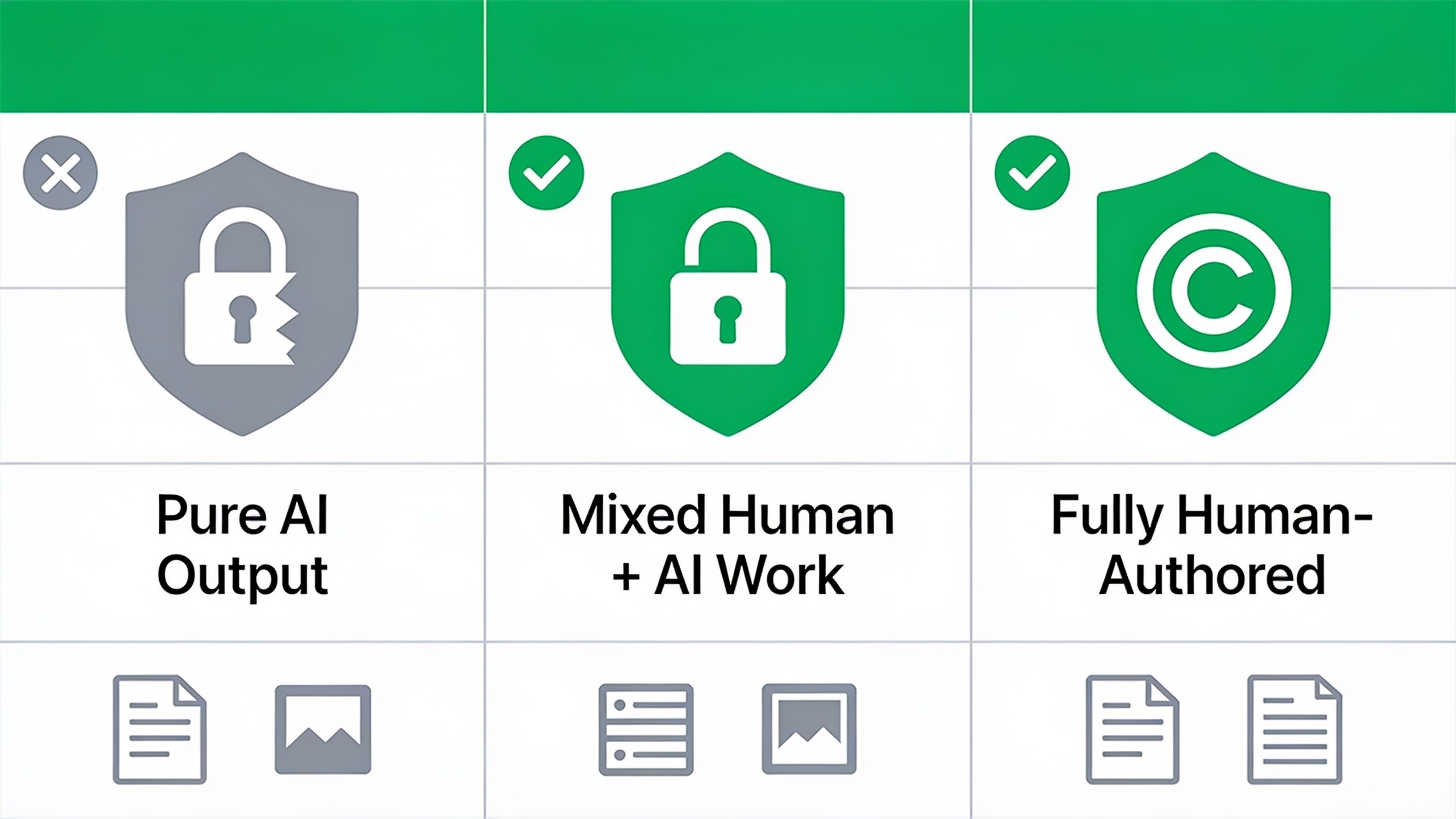
The Copyright Office hasn't been shy about this. Their March 2023 policy statement, with the very lawyerly title "Copyright Registration Guidance: Works Containing Material Generated by Artificial Intelligence," basically restated a principle that's been around forever: copyright protects human creativity. So if an AI is the one picking the words, the phrasing, the visual layout, and you didn't do enough selecting, arranging, or reworking of that output, the Office looks at those elements and says nope, not protectable.
But here's where people get confused. That doesn't mean AI-assisted content is automatically a lost cause. The Office draws a line between AI as a tool (think of it like a camera or your word processor) and AI as the author. Take an AI draft, rewrite big chunks of it, restructure the thing, layer in your own analysis, mix it with stuff you actually made... and the human parts can absolutely be copyrighted, even if the raw AI draft never could be on its own.
For your marketing team, that has a very concrete consequence. Copy that got prompted and pasted straight from a chatbot with zero editing? No protection. Which means a competitor could legally lift it word for word and there's nothing you can do about it. Content that went through real human editing, fact-checking, and creative rework has a much stronger claim. That's one more reason AI drafts should never go straight from generation to live. If you want a sense of what "real editing" actually looks like, how to write SEO content that doesn't sound robotic covers the kind of substantive human input that both improves the writing and strengthens your copyright footing.
The AI Content Copyright Landscape: Key Rulings and Guidance
Everything we know about AI content copyright rests on a surprisingly small pile of actual rulings. Two of them come up constantly, so you should know both.
First, Thaler v. Perlmutter. A computer scientist named Stephen Thaler tried to register a copyright for an image called "A Recent Entrance to Paradise" that his AI system generated on its own. He listed the AI as the creator. The Copyright Office said no. And in August 2023, the U.S. District Court for D.C. backed them up, ruling that human authorship is a bedrock requirement and a work made with no human hand in its authorship simply can't be registered. If you ever wondered whether "the AI made it" counts as a copyright claim, this case is your answer. It doesn't.
Then there's Zarya of the Dawn. Back in February 2023, the Copyright Office looked at a graphic novel by Kris Kashtanova that paired original writing with images made in Midjourney. The Office registered the text and the overall selection and arrangement of the work, but refused to protect the individual AI-generated images, because Kashtanova couldn't show enough creative control over how those specific visuals came out. This one gets cited a lot because it's the "mixed work" scenario most of us actually deal with. A blog post with AI-assisted images. A written piece that's part human, part machine.
Now, step outside the U.S. and the rules stop lining up. The UK's Copyright, Designs and Patents Act has a provision, Section 9(3), that hands authorship of a "computer-generated work" with no human author to "the person by whom the arrangements necessary for the creation of the work were undertaken." That's a genuinely different philosophy than the American human-authorship requirement. So if you're working internationally, or licensing content across borders, don't assume the U.S. rules travel with you. This is one of those spots where a quick chat with a lawyer is cheap insurance before you go claiming ownership of something an overseas team built with AI.
What Are the Biggest AI Content Legal Risks for Marketers?
The biggest risks for marketers split into two buckets: risk from what went into the model, and risk from what comes out of it. And the annoying part is you can get burned by both even though you never trained a model in your life.
On the input side, a bunch of high-profile lawsuits claim AI companies trained their models on copyrighted work without asking. The New York Times sued OpenAI and Microsoft in December 2023, alleging millions of Times articles got used to train large language models without authorization, and that the models can spit out close copies of that content. Getty Images filed its own suit against Stability AI in February 2023, claiming Stable Diffusion was trained on millions of its copyrighted images, some of which apparently came out with traces of Getty's watermark still on them. These target the vendors, not you. But they matter to you, because they build the legal theory that AI output can carry infringement risk it inherited from its training data, and that risk flows downstream to whoever publishes it.
On the output side, the practical danger is simpler: you publish AI content that looks a little too much like something that already exists. A paragraph that echoes a specific article's structure and word choices. An image that mimics a recognizable style or character. Code that reproduces licensed snippets. Because these models are basically trained to predict what word comes next based on massive piles of text, accidental near-duplication is a real, documented thing. Nobody has to intend to copy for it to happen.
| Risk Category | What It Looks Like | Who Bears Exposure | Mitigation |
|---|---|---|---|
| Training-data infringement | Model was trained on copyrighted text/images without a license | Primarily the AI vendor, but reputational/contractual risk flows to publishers | Review vendor terms of service; prefer vendors with clear licensing commitments |
| Output infringement | AI output closely mirrors existing copyrighted work | The business that publishes the content | Run originality/plagiarism checks before publishing; edit substantially |
| Unregistrable content | Purely AI-generated content has no copyright protection | The business that relies on that content as an asset | Add substantial human authorship; document edits |
| Defamation / false statements | AI "hallucinates" facts about real people or brands | The business that publishes the claim | Fact-check every AI-sourced claim before publishing |
| Deceptive AI claims | Content or reviews implied to be human-written or human-tested when they aren't | The business making the representation | Follow FTC disclosure rules; avoid fake reviews/testimonials |
Do You Have to Disclose AI-Generated Content?
There's no single U.S. federal law forcing every business to stamp "AI-generated" on every blog post. But disclosure rules already exist in specific, enforceable situations, and more are on the way. My advice? Treat disclosure as a compliance thing, not just an ethics nicety.
The FTC has been the loudest U.S. regulator here. In August 2024 it finalized a rule on consumer reviews and testimonials that flat-out bans deceptive AI-generated reviews. That includes fake reviews written by generative AI to look like they came from real customers, and undisclosed AI-generated endorsements. Read the rule carefully and you'll notice it's about deception, not AI. Using AI to draft your marketing copy? Fine. Dressing up AI output as a genuine human customer experience? That's the illegal part.
Want content like this running on autopilot for your own site? Try RobinRank free — AI-written, SEO-optimized articles generated and published automatically, no credit card required.
The EU's AI Act piles on a broader transparency layer. Article 50 creates obligations for providers and deployers of certain AI systems to disclose when content (text, images, audio, video) was artificially generated or manipulated, with a heavy focus on deepfakes and stuff that could mislead people on matters of public interest. The Act came into force in August 2024, and its provisions phase in over roughly two years, with the transparency obligations for AI-generated content landing later in that timeline. If you market to EU audiences, watch this rollout, because it applies no matter where your company is headquartered as long as you're serving EU users.
Search engines sit in their own category. Not legal, but commercially, they might matter more to you day to day. Google's Search Central guidance says its systems reward high-quality content "regardless of how content is produced," and that using automation, AI included, isn't against the rules by itself. What does break its spam policies is content made primarily to game rankings with little regard for whether a human reader gets anything out of it. So Google doesn't ask you to disclose AI authorship. It just punishes lazy, mass-produced AI slop built to trick the algorithm. That line matters way more for your visibility than any current disclosure law, and will AI content detection flag your SEO content digs into how detection tools and quality signals actually tangle up with rankings.
Building an AI Content Compliance Program: Practical Steps
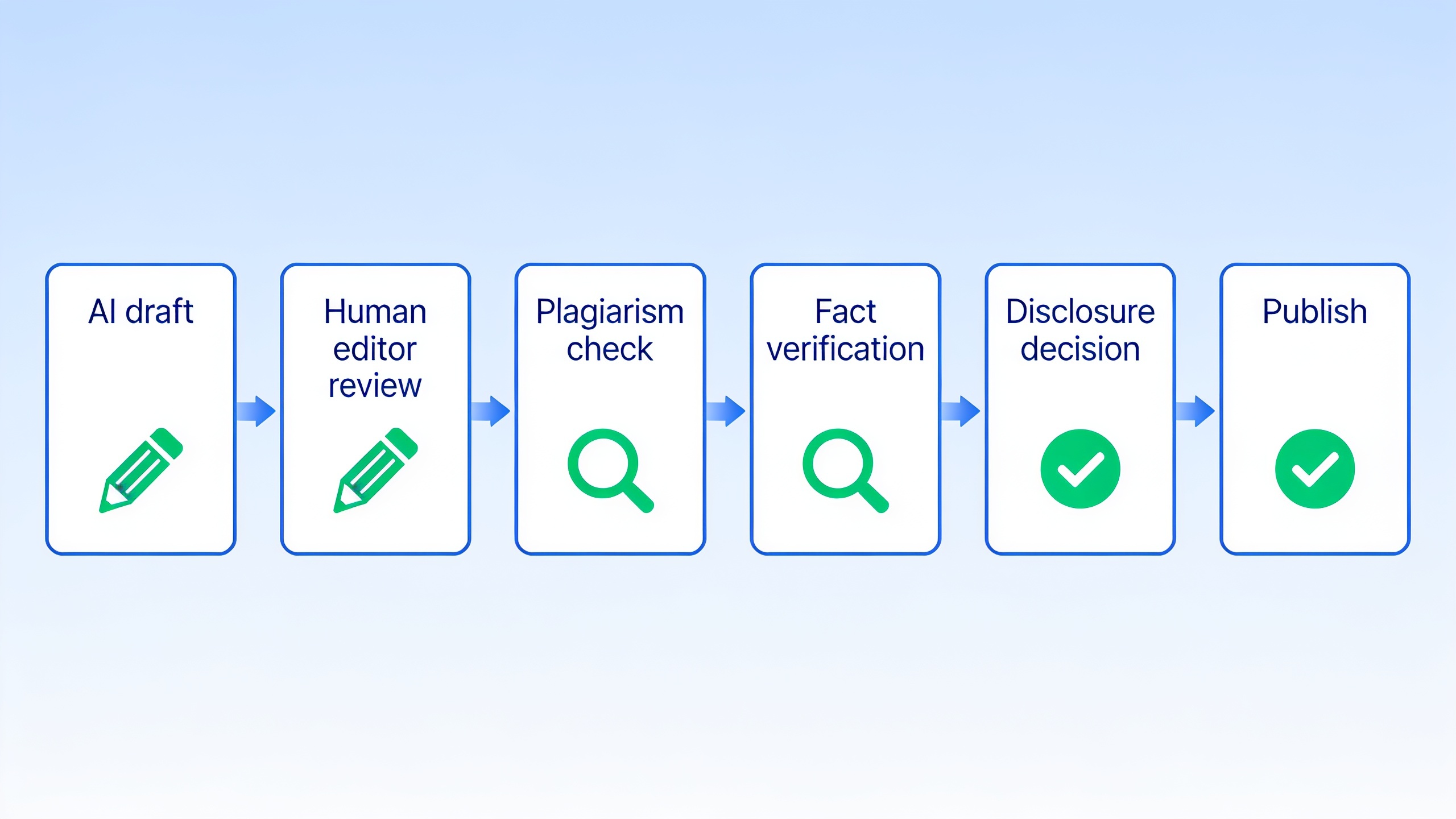
A compliance program sounds intimidating. It's really just a repeatable process that makes sure every piece of AI-assisted content clears your legal, quality, and disclosure checks before it goes live. And for most teams, you don't need a legal department for this. You need a checklist that people actually use.
Put a human in the editing loop, always. Every AI draft should hit a human editor who verifies facts, rewrites the weak generic bits, and adds real analysis or a point of view. This does two jobs at once. It shores up the copyright status of the finished piece (that human-authorship standard again) and it keeps you from publishing hallucinated claims or that unmistakable AI mush that quietly torches your credibility with readers.
Run originality and fact checks before it publishes. Before anything goes out, push the draft through a plagiarism or originality checker to catch accidental close paraphrasing, and manually verify every stat, quote, or named source the AI dropped in. These models love to produce citations and figures that sound real but trace back to nothing. Publish those as fact and you've got a credibility problem, and sometimes a defamation problem if the made-up claim is about an actual company or person.
Write down what you did. Keep a simple internal record of which prompts you used, which sections were AI-drafted, and what the human editor changed. Boring, I know. But that paper trail matters if you ever need to prove the human-authored parts of a piece for a copyright registration, or show a regulator or client that a real person was actually involved and it wasn't just a bot on autopilot.
Set a disclosure policy and stick to it. Decide in writing when your business discloses AI involvement. Reviews and testimonials, obviously, or anything that could pass for a genuine first-person customer account. Then apply it the same way every time. Even where no law demands it, a consistent internal policy is your best defense if someone comes asking later how the content got made.
Actually read your AI vendor's terms of service. Different tools handle input and output rights differently, and those terms decide what you're even allowed to do commercially with what you generate. Read them before you scale anything, and lean toward vendors that are upfront about where their training data came from and how output is licensed. Part of your legal exposure is inherited from theirs, so their transparency is your protection.
AI Content Copyright Across Different Publishing Scenarios
How much protection and how much risk you're carrying shifts a lot depending on how much of an actual human touched the finished thing. The table below follows the general framework from the Copyright Office guidance plus the Thaler and Zarya of the Dawn decisions. Just remember outcomes always come down to the specific facts of a given work.
| Scenario | Likely U.S. Copyright Status | Legal Risk Level | Recommended Action |
|---|---|---|---|
| Pure AI output, published unedited | Not protectable | High (no ownership, possible unintentional close paraphrasing) | Avoid publishing without review |
| AI draft + substantial human rewrite, fact-check, and original analysis | Protectable (human-authored elements) | Low to moderate | Standard workflow for most teams |
| Human-written text + unedited AI-generated images | Text protectable; images likely not | Moderate (image-specific) | Commission or heavily modify AI images |
| AI-generated code snippet reused verbatim | Uncertain; may carry inherited license risk | Moderate to high | Review licensing terms; test originality |
| AI-assisted research summarized and rewritten by a human | Protectable | Low | Preferred for factual/statistical content |
How AI Content Copyright Affects SEO and Publishing Strategy
Here's something most marketers underrate: copyright and search visibility are more connected than they look, because both reward the exact same behavior. Substantial, original, human-verified work instead of raw unedited AI output. Google's own guidance ties ranking quality to genuine usefulness, not to how the content was authored. But skip the human review and you tend to fail on both fronts at the same time, because unedited AI drafts are both weaker copyright assets and more likely to read like the generic low-value pages Google's systems are specifically built to bury.
And durable organic visibility takes more than good content. It takes real signals of authority, including backlinks from actual relevant sites. RobinRank runs a manually reviewed backlink exchange network where site owners request and offer placements directly with each other, where every listing needs a minimum Domain Rating of 5 (via Ahrefs) and gets a manual review before it shows up in the network's Discover section. The whole thing is designed to steer clear of the PBNs, link farms, and thin doorway pages that carry their own spam baggage. Pair a disciplined AI content process with legit link building and you've covered both sides of the risk equation: content that holds up on copyright grounds, and a link profile that holds up on quality grounds.
Frequently Asked Questions
Can I actually copyright content that AI wrote entirely on its own in the U.S.?
No. The Copyright Office's 2023 guidance and the Thaler v. Perlmutter ruling both make clear that copyright needs human authorship. Content generated fully by an AI tool, with no meaningful human creativity in how it's expressed, can't be registered in the U.S.
Do I legally have to tell people my website content was written by AI?
There's no blanket U.S. law requiring an "AI-generated" tag on your everyday marketing content. But it becomes a legal requirement in specific spots, most notably the FTC's 2024 rule banning deceptive AI-generated reviews and testimonials passed off as real human accounts. The EU AI Act layers on broader transparency obligations for certain AI content as it phases in. When you're not sure, just disclose.
Will publishing AI content get my site nuked by Google?
Not just for being AI-assisted, no. Google's Search Central guidance says it judges content on quality and usefulness regardless of how it was made, but it treats content mass-produced mainly to manipulate rankings as a spam policy violation. The danger is low-effort, unedited output at scale. Not the AI involvement itself.
What if the AI content I publish ends up infringing someone else's copyright?
The publishing business, not the AI vendor, usually eats the direct legal exposure for infringing content it distributes, even when the model is what actually generated the infringing bit. That's exactly why originality checks, human editing, and keeping an eye on the ongoing training-data lawsuits (Getty Images v. Stability AI, for one) matter before anything goes live.
So who owns content made with ChatGPT or Midjourney?
Depends on two things: the vendor's terms of service and how much genuine creative control a human applied to the output. Under U.S. law, unedited AI output generally isn't ownable by anyone. But substantially human-edited or human-arranged work built from AI drafts can belong to the person or business that created those human-authored parts. Zarya of the Dawn is the go-to example.
AI content copyright is going to keep shifting as more lawsuits reach final rulings and as things like the EU AI Act fully kick in. But the core idea guiding marketers in 2025 hasn't budged: meaningful human involvement is what makes content both legally defensible and, honestly, worth publishing in the first place. Bake that human layer into your workflow through editing, fact-checking, a real disclosure policy, and honest authority-building, and you've got the most durable protection available right now, no matter which court rules on which case next.
Ready to stop writing content by hand? Start your free RobinRank trial and get a full month of SEO-optimized articles published on autopilot.