Will AI Content Detection Flag Your SEO Content? What to Know

Let me save you some anxiety. AI content detection is genuinely unreliable, Google doesn't use it as a ranking signal, and the thing that'll actually hurt your SEO has nothing to do with detection at all. It's publishing stuff that reads like a robot phoned it in and offers zero real value. That's the real risk. Everything else is mostly noise.
Below, I'll walk through how these detectors actually work (spoiler: it's guesswork), what happens when your content gets flagged, and how to keep AI-assisted writing sounding like a person and ranking like it deserves to.
Table of Contents
- What Is AI Content Detection and How Does It Work?
- Do AI Writing Detectors Actually Affect SEO Rankings?
- Which AI Content Detection Tools Are Editors Actually Using?
- Why AI Writing Detectors and SEO Concerns Persist Anyway
- How to Keep AI-Assisted Content Reading Naturally
- How RobinRank Approaches AI-Assisted Content
- Frequently Asked Questions
What Is AI Content Detection and How Does It Work?
AI content detection is software making an educated guess about whether a chunk of text came from a machine or a human. And I do mean guess. These tools don't know anything. They spot statistical patterns that tend to show up in machine-generated writing and spit out a probability.
Most of them lean on two signals. The first is perplexity, which is basically a measure of how predictable your word choices are to a language model. Humans write weird. We go on tangents, pick odd words, build sentences that meander. That unpredictability reads as high perplexity. AI, on the other hand, tends to grab the statistically safest next word every time, which produces low perplexity and a machine-shaped fingerprint.
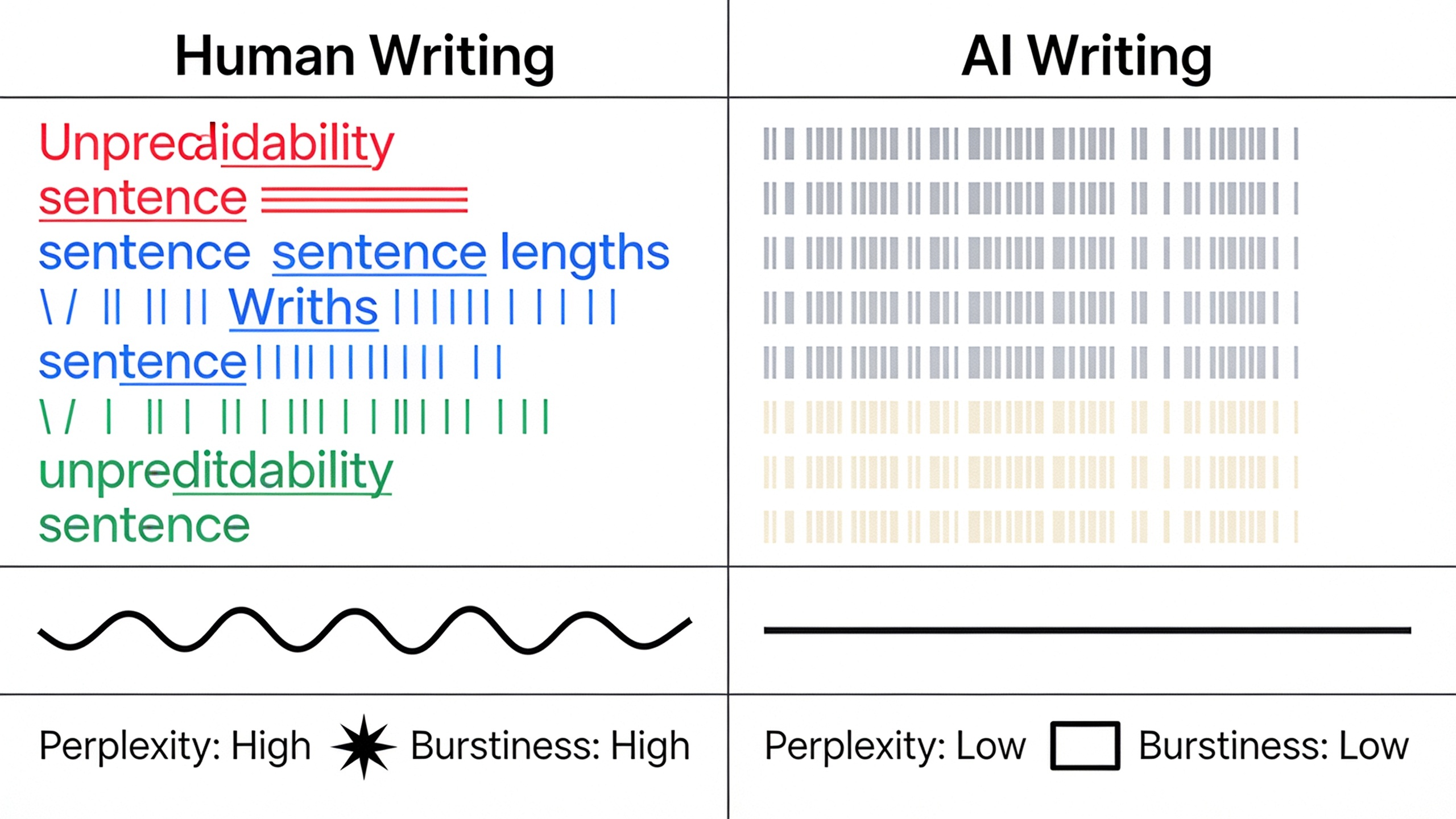
The second is burstiness, which looks at how much your sentence lengths and structures vary. People naturally mix a short punchy line with a long, winding one that keeps going and adds a clause or two before finally landing. A lot of AI models produce sentences that are all roughly the same length and rhythm, and detectors read that uniformity as a red flag.
So the tool runs your text through a model, scores those patterns, and hands you a percentage or a plain "likely AI" versus "likely human" label. Some detectors, like the classifier OpenAI put out in early 2023, are trained to catch outputs from specific model families. Here's the kicker though: OpenAI quietly killed that public classifier a few months later because it just wasn't accurate enough. Think about that. The company building the models couldn't reliably detect their own output.
Which is the whole problem in a nutshell. This is probabilistic guesswork, not forensic proof. There's no watermark or hidden signature buried in AI text (a few experimental research projects aside) that a detector can read like a barcode. It's pattern-matching, and pattern-matching fails both ways. It misses AI text that's been lightly edited, and it wrongly flags perfectly human writing that happens to be plain, repetitive, or written by someone whose first language isn't English.
Do AI Writing Detectors Actually Affect SEO Rankings?
No. Google does not use third-party AI detector scores as a ranking factor, and there's no public evidence that any major search engine feeds a detector's output into its algorithm. What moves rankings is whether your content is helpful, original, and actually answers what people are searching for. How it got written doesn't enter into it.
Google said as much in a 2023 Search Central blog post about AI-generated content. Their focus, in plain language, is content quality, not production method. And they draw a line between two things people constantly mix up.
One is using automation to crank out low-value junk purely to game the rankings. That violates Google's spam policies, and it doesn't matter one bit whether a human or a machine typed it. The other is using AI as a tool somewhere in your content process. That, on its own, breaks no rules.
Notice what Google has never said: that AI-written pages get penalized. What they've said is that content made primarily to manipulate search results, automated or not, can be treated as spam. That distinction is everything if you're losing sleep over detection. A well-researched, genuinely useful article that happened to be drafted with AI help is not sitting on some hit list. A thin, repetitive, keyword-stuffed page churned out with zero editorial oversight? That's the one at risk, and it would've been at risk even if a human hand-typed every word.
This is also why teams that pair automation with real editorial standards actually see results. Take a SaaS SEO case study on how a startup doubled trial signups with automated content . The growth there came from consistently publishing relevant, well-targeted articles, not from fooling an algorithm. Rankings responded to relevance and coverage. Nobody was worried about whether a detector would flag the draft.
And look, the words on the page are only part of the game anyway. Technical fundamentals still carry serious weight: site structure, page speed, structured data. If you haven't set up structured data yet, go read how structured data improves rankings first. No amount of "detector-proofing" your prose makes up for missing the technical basics.
Which AI Content Detection Tools Are Editors Actually Using?
The big names editors, publishers, and universities reach for are GPTZero, Originality.ai, Copyleaks, and Turnitin's AI writing indicator. They all analyze that same perplexity-and-burstiness stuff, but they're built for different crowds. Academic integrity, publishing compliance, content-marketing QA. Different jobs, similar guts.
Now, none of these vendors has put out independently verified accuracy numbers that hold up across every writing style, language, and editing scenario. So I'm not going to quote you a shiny percentage for any of them, because it wouldn't mean much. What is well documented is how these tools tend to behave, and where they trip over themselves.
| Detection Signal | What It Measures | Common False-Positive Trigger |
|---|---|---|
| Perplexity | How predictable each word choice is given prior context | Formal, textbook-style human writing (common in ESL and academic writers) |
| Burstiness | Variation in sentence length and rhythm across a passage | Highly structured content like FAQs, step-by-step guides, or technical documentation |
| Repetition of phrasing | Reuse of similar sentence openers or transition words | Writers following strict style guides or SEO templates |
| Vocabulary diversity | Range of word choices used across a document | Subject-matter writing with limited specialized terminology |
| Formatting uniformity | Consistent paragraph and list structure | Content edited heavily for SEO readability scores |
Look at that table for a second and the problem jumps right out. The exact things that make SEO content clean and scannable (short paragraphs, consistent headers, predictable structure) are the same patterns detectors treat as machine-written. A detector can't tell the difference between "this was optimized for readability" and "this was generated with the creativity of a spreadsheet." That ambiguity is precisely why leaning on any single detector score as your quality gate is a bad idea.
Why AI Writing Detectors and SEO Concerns Persist Anyway
Here's what's interesting. Even though search engines don't punish you over detector scores, worries about AI detectors and SEO keep popping up in real workflows. And a few of those reasons are actually legit, they just have nothing to do with Google's algorithm.
First, editorial and brand trust. Plenty of publications, guest-post hosts, and content marketplaces now run submissions through detectors as a screening step. Not because Google demands it, but because they're trying to protect their standards and avoid publishing bland filler. So if you're pitching a guest article or doing a backlink exchange, don't be shocked if a site owner glances at a detector score as one of several things they weigh before saying yes.
Want content like this running on autopilot for your own site? Try RobinRank free — AI-written, SEO-optimized articles generated and published automatically, no credit card required.
Then there's the client and stakeholder thing, which is honestly the messiest part. Agencies and in-house teams often need to reassure clients, executives, or the legal folks that published content clears some quality bar. A flagged score, even a flat-out wrong one, can kick off awkward conversations and extra review rounds and a general erosion of trust, none of which has any bearing on actual rankings. It's a perception problem, but perception problems still eat up your afternoon.
Some platforms and forums also have their own rules about AI submissions that go well beyond what search engines care about. Ignore those and you can get content rejected or your account flagged, completely separate from any SEO outcome.
And sometimes, honestly, the detector flags your stuff because it genuinely reads like generic mush. Repetitive sentence openers, shallow claims, not a single specific example or number. In that case the detector isn't the villain. It's a symptom. It's pointing at thin content that would've flopped in search regardless, because Google's helpful content systems are built to reward depth, specificity, and actual expertise.
Which brings me to the point I really want to hammer: the fix was never "beat the detector." The fix is writing something substantive enough that the detection question stops mattering.
How to Keep AI-Assisted Content Reading Naturally
The most reliable way to stop AI-assisted content from reading like a machine wrote it is to pair the AI draft with real editorial input. Original examples, varied sentences, specific data, an actual point of view. Detection risk drops on its own once your content stops sounding like the average of everything on the internet and starts reading like something only your team could've produced.
A few things that actually work, and I've watched all of them make a difference.
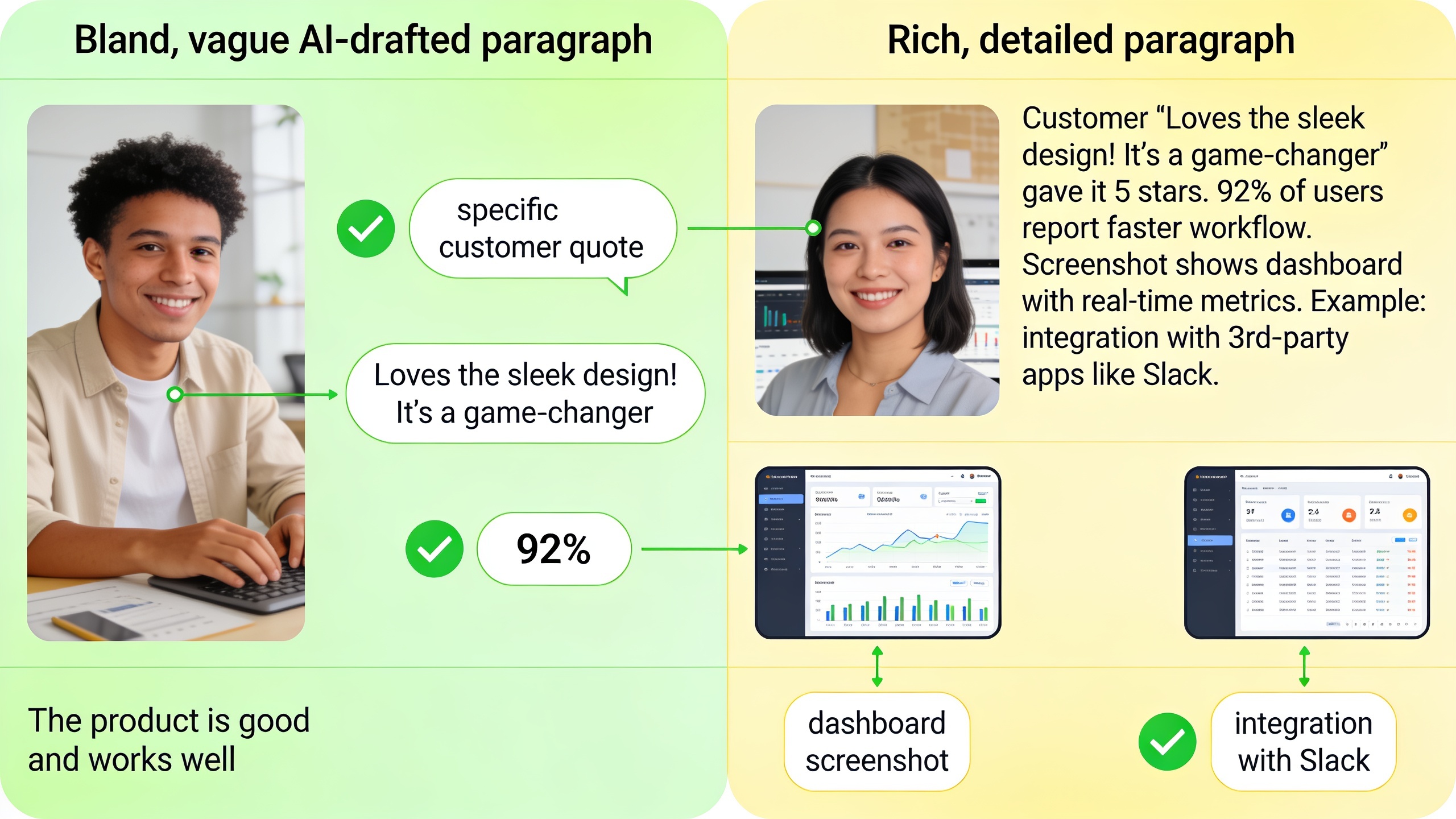
Add specificity the AI can't invent. Drop in real customer examples, your own internal data, screenshots, exact numbers from campaigns you ran, a direct quote from someone on your team. AI drafts default to vague generalities. Concrete facts change the entire texture of the writing and, bonus, make it genuinely more useful.
Mess with the rhythm on purpose when you edit. After you generate a draft, read the thing out loud. When you hit a wall of same-length sentences, break it up. Merge two short ones. Split a long one down the middle. This targets the burstiness pattern that both readers and detectors clock, and it just sounds better anyway.
Kill the crutch phrases. "Furthermore," "in conclusion," "it's important to note," "overall." These show up way too often in AI drafts and most of them add nothing. Delete or replace. You won't miss them.
Take a position. This is the big one. AI models are trained to hedge and stay balanced on everything, which makes them read like a nervous intern. Real expert content picks a side, pushes back on a common assumption, explains a trade-off and then tells you what to actually do. That opinionated texture is one of the hardest things for AI to fake, and it happens to be exactly what makes content useful.
Edit at the paragraph level, not just the word level. Reordering ideas, cutting a whole filler paragraph, tightening a bloated intro. That changes the feel of a piece far more than swapping out individual words ever will.
Oh, and fact-check everything before it goes live. AI will hand you confident-sounding stats and dates that are just wrong. A human review pass isn't only about tone. It's what keeps you from publishing an error that torches your credibility way harder than any detector flag could.
Bottom line, treat AI like a first-draft engine, not a final-copy machine. The teams pulling the best SEO results use it to speed up research, outlining, and drafting, then do real human editing before anything publishes. Think research assistant, not ghostwriter with the final say.
How RobinRank Approaches AI-Assisted Content
RobinRank is an AI-powered SEO platform built for businesses that want to grow organic traffic without hiring a whole in-house content team. It drafts, optimizes, and publishes articles automatically, and it connects sites through a backlink exchange network. The whole philosophy is that "AI-written" and "high-quality" aren't opposites. Automation handles the repetitive production grind while search relevance and technical optimization stay consistent across everything you publish.
On the link side, RobinRank runs a manually reviewed backlink exchange where site owners request placements from each other directly, instead of grinding through cold outreach or gambling on anonymous marketplaces. Every listed site gets reviewed by hand before it shows up, sites need a Domain Rating of at least 5 on Ahrefs, and RobinRank actually crawls the live page to confirm a promised link exists before counting it as placed. Pro accounts get ongoing automatic checks that ping you if a verified link vanishes later. That verification layer matters for the same underlying reason the whole detection debate matters: search engines and site owners both care about real, durable value, not stuff that only looks legit on the surface.
There's a 7-day free trial once your site's approved, no card required up front, then it's $19 a month and you can cancel anytime. That gets you direct placement requests, no cold emailing, and automatic weekly checks confirming your backlinks are still live.
Frequently Asked Questions
Can AI detectors actually tell if I used ChatGPT?
Not reliably, no. They estimate probability from patterns like perplexity and burstiness, but they can't prove who or what wrote something. Text you edited after generating it, or plain structured human writing, can throw off the result in either direction. It'll flag human work as AI and miss AI work entirely. And remember, OpenAI pulled its own public classifier in 2023 after admitting it just wasn't accurate.
Will Google penalize me just for using AI to help write?
No. Google's Search Central guidance says its policies target content made primarily to manipulate rankings, human-written or AI-generated, not AI assistance itself. Helpful, original, well-researched content gets treated the same whether or not AI helped draft it.
Should I run my articles through a detector before publishing?
You can, as a rough sanity check on whether your writing sounds generic. Just treat the score as a hint, not a verdict. Honestly, your time's usually better spent doing an actual editorial read-through, checking for specific examples, varied sentences, and a real point of view. Those are the same things that make content rank in the first place.
What's riskier for SEO, a detection flag or thin content?
Thin content, and it's not close. There's no confirmed mechanism where a detector flag directly drops your rankings. But Google's helpful content systems absolutely hunt down and demote pages with no depth, originality, or expertise, which happens to be the same content that trips detectors. Fix the quality problem and you've solved both at once.
How much editing does AI content need before it's ready?
There's no magic percentage. Most effective workflows treat the AI output as a first draft that still needs fact-checking, added specificity (real examples, data, opinions), and structural editing before it goes live. Publishing raw, unedited AI output is where people get into trouble.
Bringing It All Together
AI content detection is a real technology with real limits. What it isn't is a search-ranking gatekeeper. Everything we can actually see points to search engines caring about whether content is useful and original, not about which tool spat out the first draft.
So the smart move for SEO folks, marketers, and founders isn't chasing a lower detector score. It's building an editorial process that layers real expertise, specific examples, and a distinct voice onto whatever the machine helps you write. Nail that, and the detectors and the search engines tend to land in the same place: this is worth ranking.
Ready to stop writing content by hand? Start your free RobinRank trial and get a full month of SEO-optimized articles published on autopilot.