Google Core Update News: What Marketers Should Watch For
So let's sort through it. What a core update really is, what the big recent rollouts went after, how the damage tends to show up in your analytics, and what's actually worth doing in the weeks after Google confirms one.
Table of Contents
- What Is a Google Core Update?
- Google Core Update News: What the Recent Rollouts Targeted
- How Big Is the Algorithm Update Impact, Really?
- Which Types of Sites Are Most at Risk?
- How Long Does a Core Update Take to Fully Roll Out?
- What Should Marketers Do Right Now?
- Common Mistakes Marketers Make After an Update
- FAQ: Google Core Updates
What Is a Google Core Update?
A Google core update is a broad, unnamed change to Google's main ranking systems that affects search results worldwide, across every language and content type, rather than going after one narrow thing like spam or images. Google's own Search Central docs describe these as significant, wide-reaching changes designed to improve how search results get assessed in general. They're not a punishment aimed at your site specifically.
That distinction is where most of the confusion starts. A core update isn't a manual penalty, and there's no magic "fix" that guarantees you'll bounce back, because technically nothing was broken on the page that dropped. Google is just re-evaluating what "helpful, reliable, people-first content" looks like compared to everything else floating around the web that week. So a page that crushed it in January can lose visibility in March not because it got worse, but because Google's read on relative quality across the whole index shifted under your feet. Annoying? Yeah. But that's the game.
Google usually announces these through its Search Liaison account and the Search Central blog, and it confirms both when the rollout starts and when it finishes. And it's that confirmation window, not the announcement date, that most rank trackers and SEO teams use to measure before-and-after. Worth remembering.
Google Core Update News: What the Recent Rollouts Targeted
The biggest recent one, announced back in March 2024, bundled a core ranking change together with new spam policies going after scaled content abuse, expired domain abuse, and site reputation abuse, that last one being the sneaky practice of parking low-quality third-party content on a trusted domain just to borrow its authority. Google said at the time that these combined changes were meant to cut low-quality, unoriginal content in search results by 40%, a number the company published directly on its Search Central blog when it made the announcement.
That March 2024 update was also a slog. It took roughly 45 days to finish rolling out, one of the longest core update rollouts Google has ever confirmed, which naturally set off a whole wave of speculation about just how big the underlying changes really were. It also swallowed up Google's older "helpful content system," baking those page-level quality signals directly into core ranking instead of running them off to the side as a separate classifier.
The core updates that followed through 2024 and into 2025 have kept doing this same thing. Consolidating quality signals rather than inventing brand-new mechanisms. And Google's been pretty blunt that there's no special "recovery" lane for sites that got hit. Your visibility can climb again in a later update if Google's systems decide your content is more relevant and reliable compared to the rest of the web, not because you applied some specific patch.
If you're watching this pattern play out, the practical read is this: core updates are getting less about isolated technical signals and more about the accumulated editorial quality, originality, and trustworthiness of your content over time. Slow and cumulative. Which is either good news or bad news depending on how you've been running things.
How Big Is the Algorithm Update Impact, Really?
The impact of a core update swings wildly from site to site and niche to niche, but the pattern that shows up most reliably in analytics is a visibility hit concentrated in a narrow band of query types rather than a clean, uniform drop across the whole site. Sites built on thin, templated, or AI-churned content with no original reporting or firsthand experience take the sharpest hits. Sites with unique data, actual research, or clearly demonstrated expertise tend to either hold or gain.
Here's the caveat nobody likes: Google doesn't publish site-level data, so almost everything the industry "knows" about update impact comes from aggregated observations by SEO tools and publishers after each rollout, not from one authoritative source. That matters. Those breathless "publishers lost X% of traffic" posts that flood social media after every update are rarely independently verifiable. Treat them as directional vibes, not gospel.
What is verifiable is Google's own stated intent. Here's what the company has actually said publicly about how its core updates work, pulled from Search Central documentation and its announcement posts.
| Aspect | What Google Has Stated Publicly |
|---|---|
| Purpose | Improve overall assessment of content quality and relevance across the entire index, not target individual sites |
| Frequency | Several broad core updates per year, plus occasional smaller adjustments |
| Rollout window | Can take up to two to three weeks to fully complete; the March 2024 update took roughly 45 days |
| Recovery mechanism | No dedicated fix; visibility can shift in a later update if Google's systems reassess the content more favorably |
| Combined signals (March 2024) | Core ranking changes plus new spam policies on scaled content abuse, expired domain abuse, and site reputation abuse |
| Stated goal (March 2024) | Reduce low-quality, unoriginal content in search results, with Google citing a 40% reduction target |
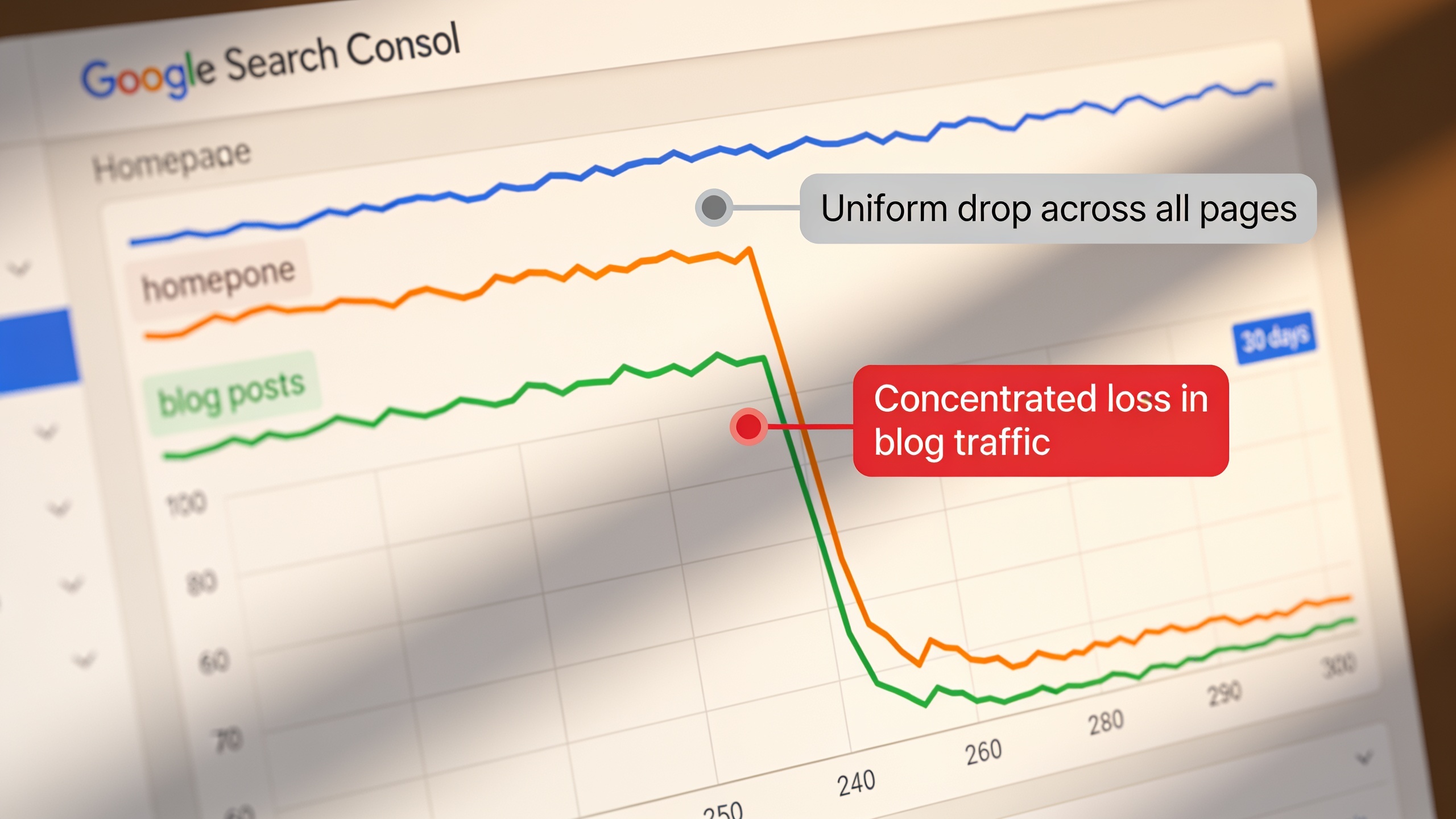
Because the impact is so uneven, the single most useful thing you can do after any update is segment your traffic by page type and query intent in Google Search Console instead of staring at the site-wide trendline and spiraling. A homepage that holds steady while a cluster of thin blog posts falls off a cliff tells a completely different story than a uniform decline across the domain. One is a content problem you can fix. The other is... something else.
Which Types of Sites Are Most at Risk?
The sites most exposed to core update chaos usually share a profile: high-volume content with barely any editorial oversight, next to no firsthand expertise, and heavy dependence on search traffic for a narrow set of money queries. This isn't new. It's held true across basically every confirmed core and helpful content update since 2022. But it's gotten worse as generative AI made it dirt cheap to pump out mountains of generic filler.
Programmatic content sites, affiliate roundups where nobody actually tested anything, and domains that ballooned into unrelated topics purely to grab search traffic get named again and again in post-update analysis as the categories with the ugliest swings. And Google's site reputation abuse policy, introduced right alongside that March 2024 update, targets a cousin of the same problem: third-party content dumped onto an otherwise reputable domain just to exploit its existing ranking power.
On the flip side, sites with a clear topical focus, named authors who've actually done the thing, original data or images, and technically healthy pages tend to ride it out fine. And that technical health matters more than a lot of marketers give it credit for. Page experience signals like load speed, layout stability, and interactivity all feed into the broader quality picture Google's systems use, even if they aren't the main lever in a core update. If you haven't looked at these fundamentals in a while, Core Web Vitals Explained: A Simple Checklist for Marketers walks through exactly what to check and why it still matters right alongside content quality.
Want content like this running on autopilot for your own site? Try RobinRank free — AI-written, SEO-optimized articles generated and published automatically, no credit card required.
How Long Does a Core Update Take to Fully Roll Out?
A Google core update usually takes about one to two weeks to fully roll out, though Google has confirmed longer windows for the bigger changes. The March 2024 update, again, took roughly 45 days from announcement to completion. Google flat-out recommends waiting until a rollout is fully done before you draw any conclusions, because rankings can bounce around in both directions while it's still deploying.
This is a huge source of confusion in the news cycles around updates, because early volatility in rank trackers constantly gets reported as the "final" impact before Google's even finished. If you're watching Search Console during an active rollout, expect noise. A page that tanks in week one might partially claw its way back by the time Google confirms completion, and vice versa. The saner approach is to compare a stable 28-day window before the update started against a stable 28-day window after it's confirmed done, rather than reacting to every daily wobble mid-rollout. Patience isn't sexy, but it's right here.
What Should Marketers Do Right Now?
The right move after a core update is a structured content and technical audit, not a frantic rewrite of every page that slipped a couple of positions. Google itself warns against making changes purely to chase a specific update. Instead it tells you to step back and honestly ask whether your content shows real expertise, originality, and usefulness next to the competing pages.
So start with data segmentation. Pull your Search Console performance for the 28 days before and after the confirmed window, filtered by landing page and query. Figure out which specific pages or clusters actually lost ground instead of assuming the whole site got smacked equally. This is usually where the real story becomes legible. A tiny cluster of thin how-to posts might be dragging down a site-wide number that looks terrifying in aggregate but is actually concentrated in a handful of URLs.
Then audit for genuine originality. For every affected page, ask the blunt question: does this say anything a dozen other pages on the same topic don't already say? Google's guidance on helpful, reliable content keeps hammering firsthand experience, original analysis, and clear expertise. Those are hard to fake with generic AI output but pretty easy to add through original data, screenshots, case studies, or real expert quotes.

Don't skip the technical layer either. Content gets all the airtime in core update chatter, but page experience is still part of the broader system Google uses to size up results. Slow pages, jumpy layouts, and bad mobile usability don't sit off in their own corner. They compound your content problems. Which is another reason it's worth revisiting Core Web Vitals Explained: A Simple Checklist for Marketers as part of a post-update audit instead of treating it like a one-and-done setup task.
And strengthen your off-page trust signals, because content quality on its own doesn't build authority. The links pointing at your domain still count, and Google's site reputation abuse policy makes it obvious the company is actively scrutinizing domains whose authority looks disconnected from their own content. This is exactly where a deliberate, manually reviewed link-building process beats raw volume. RobinRank's exchange network connects site owners directly: members request a placement, offer a reciprocal link when it makes sense, and every site gets reviewed by hand with a minimum Domain Rating of 5 before it's even in the network, so the links you're trading come from real, active domains rather than link farms or PBNs. Placements only count once RobinRank crawls the live page and confirms the href is genuinely there, which honestly matters a lot in a post-core-update world where thin or vanishing links can set your recovery back more than help it.
One last thing, and it's important: resist the urge to nuke everything at once. Mass content removal, especially right after an update, can itself throw off signals Google reads as manipulation rather than honest cleanup. A measured, page-by-page plan holds up way better over future update cycles. Consolidate near-duplicate posts, rewrite the thin ones with actual insight, retire the genuinely dead stuff. A reactive purge almost always ages badly.
Common Mistakes Marketers Make After an Update
Most of the damage that happens after a core update comes from overreacting, not from the update itself. And the same mistakes repeat basically every single cycle. Spotting them early can save you weeks of wasted effort.
The first one is drawing conclusions from data collected while the rollout is still in progress. Rankings genuinely swing around during deployment, so teams that rewrite or delete content off week-one numbers are usually chasing noise that would've partly corrected itself once the thing finished.
The second is treating a core update like a technical penalty with a specific fix. There's no dedicated recovery mechanism, remember, so teams that burn weeks hunting for one broken schema tag or a missing meta description are almost always looking in the wrong place. Google's been consistent that this is about overall content quality and relevance versus the rest of the web, not a single busted line of code.
The third is ignoring the winners in your own niche. If competing pages on the same topic held steady or grew during that same window, comparing what they do differently (depth, originality, structure, demonstrated expertise, page experience) tells you far more than staring at your losing page in a vacuum.
And the fourth is obsessing over on-page content while completely neglecting the link profile. Authority signals and content quality get evaluated together, not in separate silos, which is a big part of why deliberate, transparent link building through verified, reviewed placements is a more durable play than either ignoring links entirely or reaching for the sketchy tactics Google's spam policies are specifically built to catch.
FAQ: Google Core Updates
How do I actually know if a core update caused my traffic drop?
Line up the date your traffic changed against Google's confirmed start and completion dates for the update, which the company publishes through its Search Liaison account and the Search Central blog. If the drop tracks closely with that window and hits a broad set of pages rather than one isolated issue (like a broken redirect or a deindexed page), it's probably the update and not some site-specific technical bug.
Can a site actually recover from a core update?
Yes, but not through some specific "fix." Google has said your visibility can improve in a future update if its systems decide your content is more relevant and reliable compared to everything else being weighed. In practice that means genuinely improving depth, originality, and trustworthiness over time, not tweaking a few surface-level things aimed at the last update.
How often does Google run these things?
Several confirmed broad core updates per year, plus smaller, quieter ranking adjustments in between. The exact cadence shifts year to year, but multiple updates inside a 12-month stretch has been the norm since 2022.
Does a core update mean my content got penalized?
No. Google's explicit that core updates aren't penalties aimed at specific sites. They're broad reassessments of how content ranks across the whole index, so a page can lose visibility simply because Google's updated systems now favor other pages more. Nothing was necessarily wrong with yours.
Should I stop publishing new content until an update finishes rolling out?
Not really. Google says to keep focusing on genuinely helpful, original content rather than freezing production around update cycles. What's actually worth holding off on during an active rollout is the big reactive stuff, like mass deletions or a full site restructure, until the update's confirmed done and you've got stable data to work with.
Core update news is going to keep coming in waves, and every cycle drags in a fresh round of speculation before the dust ever settles. The most reliable move for any marketing team is also the least dramatic one: track the confirmed rollout dates, segment your data by page and query, keep the technical foundation healthy, and pour your energy into original content and legitimate authority signals that hold up no matter which update rolls out next.
Ready to stop writing content by hand? Start your free RobinRank trial and get a full month of SEO-optimized articles published on autopilot.