10 Content Distribution Channels Beyond Your Company Blog

You know the feeling. You write something genuinely good, publish it, get maybe thirty pageviews, and then watch it slide quietly into your archive to die. Nine times out of ten the writing wasn't the problem. The problem was that no plan existed beyond "post it and see what happens."
Table of Contents
- What Are Content Distribution Channels, and Why Look Beyond Your Blog?
- How Can You Amplify Blog Content Without Relying Only on Organic Search?
- 10 Content Distribution Channels Beyond Your Company Blog
- Content Distribution Channels Compared: Effort, Reach, and Best Fit
- How Do You Choose the Right Distribution Channels for Your Strategy?
- Common Mistakes That Undermine Content Distribution
- FAQ: Content Distribution Channels
What Are Content Distribution Channels, and Why Look Beyond Your Blog?
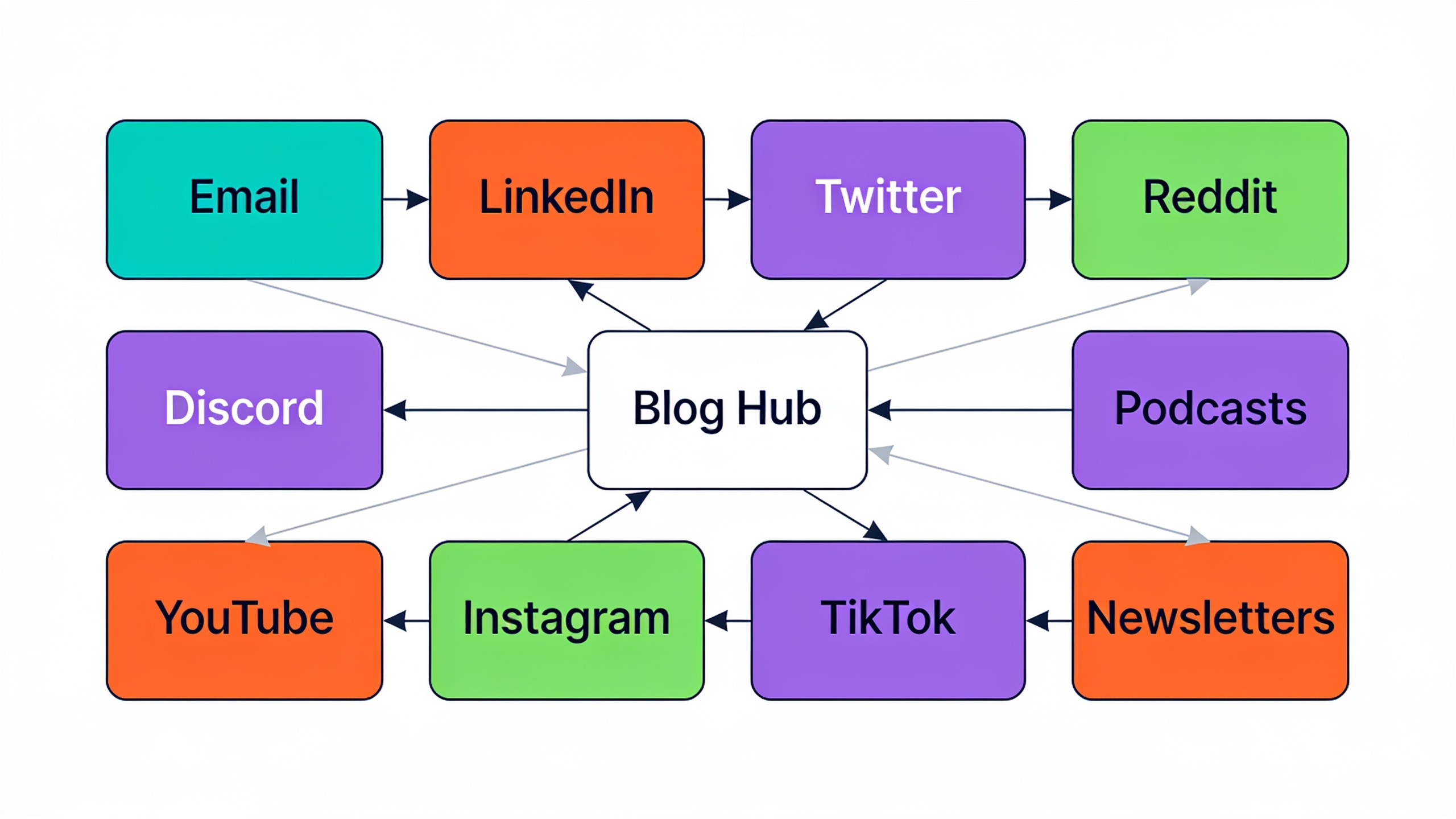
Content distribution channels are the specific platforms and touchpoints, whether owned, earned, or shared, where you place content so people can find it somewhere other than your own website. Your company blog is one channel. Email is another. So are forums, social platforms, syndication partners, and backlink networks, and here's the thing worth remembering: each of those reaches a different slice of your audience at a different moment in how they make decisions.
Your blog is what marketers call an "owned" channel, and it leans heavily on search engines to do the heavy lifting. Which is fine, until you notice its two big limitations. One, it only helps people who are already typing a related query into a search bar. It does absolutely nothing for the much larger crowd who don't even know yet that they have the problem you just solved. And two, ranking is slow. A new article can take weeks or months to build up any real search visibility, assuming it ranks at all.
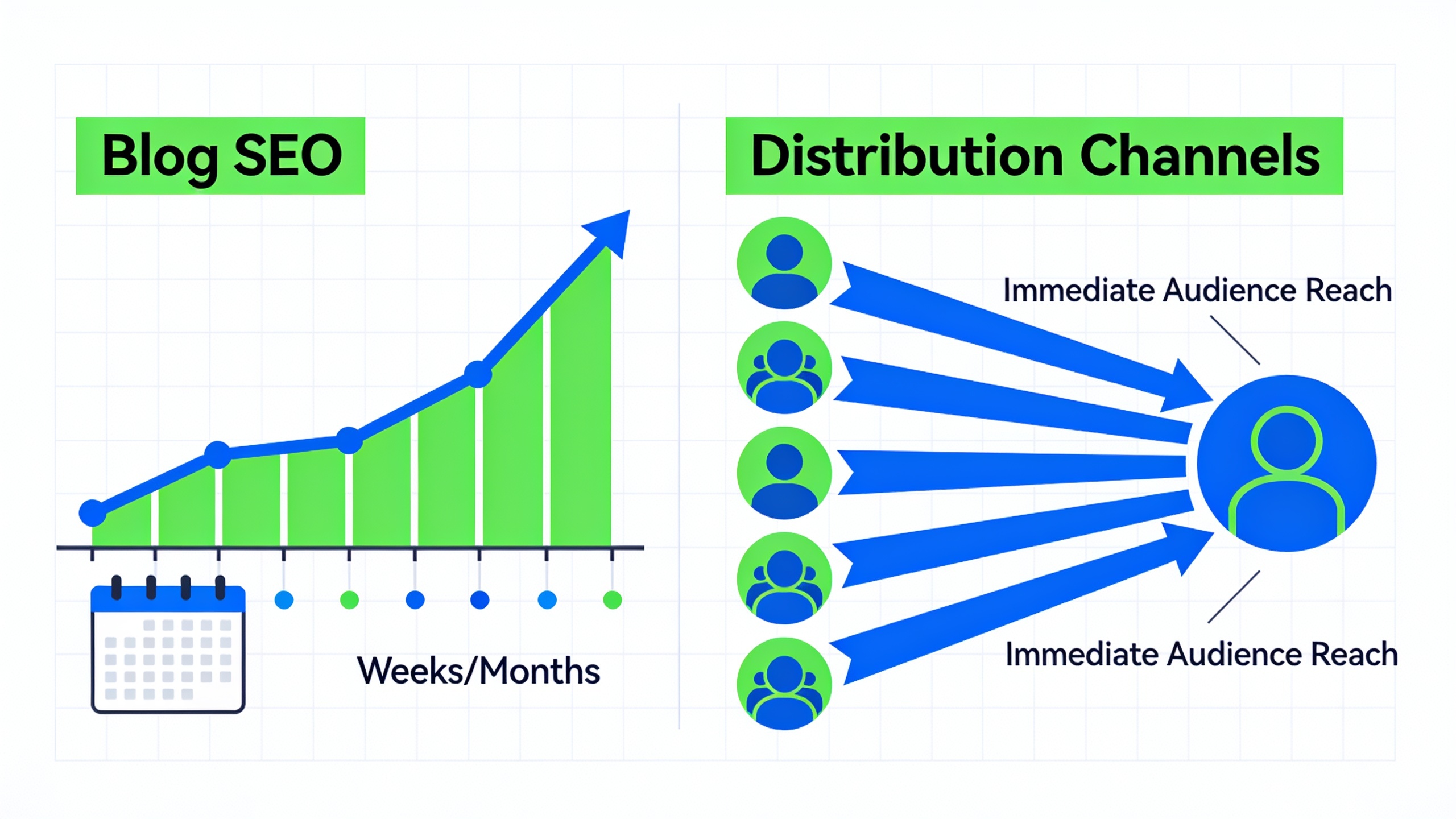
Distribution channels fix both of those problems by dropping your content in front of an audience right now, on platforms where people are already paying attention. An inbox they open every morning. A forum thread they're mid-scroll on. A newsletter they actually trust. And done right, these channels don't fight with your SEO. They feed it, because clicks, shares, and links from other sites are exactly the kind of signals that build a page's authority over time.
How Can You Amplify Blog Content Without Relying Only on Organic Search?
You amplify blog content by repackaging and republishing it across the channels your audience already hangs out on, instead of treating "publish once on the blog" as the end of the job. The whole point is to get one piece of research or writing in front of several audiences, in several formats, without redoing all the work from scratch every time.
This is exactly where repurposing and distribution shake hands. One solid, well-researched article can become a newsletter section, a forum answer, a LinkedIn post, a Twitter thread, and a talking point for a podcast, each version reshaped to fit the channel it's living on. If you want the full nuts-and-bolts version of how to pull that off, the piece on content repurposing: turning one article into 10 pieces of content breaks down the actual mechanics.
One more thing, and people mess this up constantly: timing matters. Blasting everything out on the same day just splits your own attention and everyone else's. Space it out over a couple of weeks instead. Blog first, then the newsletter, then a forum discussion, then a LinkedIn recap. Each channel gets room to drive its own little traffic spike, and you get multiple shots at reaching the folks who missed round one.
10 Content Distribution Channels Beyond Your Company Blog
Here are ten channels worth testing, roughly ordered by how fast a small team can actually start using them without a huge lift.
1. Email Newsletters
Your own email list is one of the highest-converting channels you've got, full stop, because it lands in front of people who already raised their hand to hear from you. No algorithm gets a vote on whether they see it. Every article you publish should have a newsletter send attached to it, and no, that doesn't mean pasting the whole thing in. Give subscribers a short framing instead: the problem, the one insight that matters, a link. Something that makes them want to click.
Newsletters also compound in a way social never quite does. A list of 2,000 genuinely engaged subscribers can out-click a much bigger social following, because those 2,000 people already sorted themselves into "cares about this topic." That's the whole game.
2. Niche Online Forums
Forums like the right subreddits, Indie Hackers, Growth Hackers, or whatever industry-specific board your people live on let you drop content straight into conversations where someone is literally asking the exact question your article answers. But, and this is the part everyone gets wrong, the move is participation, not a drive-by link. Answer the question in your own words, right there in the thread, then link the fuller article as a resource for anyone who wants to go deeper.
Almost every forum has rules against pure self-promotion, and mods will nuke posts that reek of link-dropping. So treat forums like a place where you build a reputation over months, not a one-and-done distribution trick. Show up, be useful, and the links take care of themselves.
3. Content Syndication Platforms
Syndication just means republishing your article, whole or in part, on somebody else's platform (Medium, an industry publication, a partner blog) with a canonical tag or credit pointing back to your original. You get access to an audience that already trusts that platform, and your original stays the primary source as far as search engines are concerned.
Works best for evergreen, well-researched stuff, not time-sensitive announcements. The value here comes from people discovering it over time on the second platform, and nobody's discovering your product launch update six months late.
4. Backlink and Content Exchange Networks
A backlink and content exchange network is a system that connects publishers so their articles link to each other inside genuine, on-topic content, instead of relying on cold outreach emails or paid placements. It counts as a distribution channel because a contextual link sitting inside another site's article can send you real referral traffic on top of whatever SEO benefit it carries.
RobinRank runs a community-powered version of this. When you publish an article with a contextual link to another member's site, you earn Domain Rating-weighted credits once that link is verified live, and you spend those credits later when an eligible article links back to your own site. Matching happens by niche, language, Domain Rating, and contribution history, and the links go inside real articles rather than junky link directories, with regular checks to keep the whole thing fair. For teams that genuinely do not have time to run manual outreach campaigns, a setup like this turns distribution and link building into a side effect of just publishing normally. Which, honestly, is the dream if outreach isn't your idea of a good time.
5. LinkedIn Native Posts and Newsletters
LinkedIn rewards content posted natively, right there in the platform instead of as an external link, with a lot more feed visibility. That makes it a great channel for a standalone, summarized version of a blog article. Write a post that lays out your core argument or a surprising stat as if it's the whole thought, not a teaser, and it'll almost always beat a lazy "read more on our blog" link. People can smell a teaser, and they hate leaving the platform.
LinkedIn's own newsletter feature is a decent secondary play too. Publish there regularly and you build a subscriber base that lives on LinkedIn itself, so you've got a second list that doesn't depend on email at all.
6. X (Twitter) Threads
A thread that chops one article into a run of short, self-contained posts lets you deliver the guts of a piece to an audience that scrolls fast and basically never clicks external links. Every post in the thread needs to stand on its own, because retweets and quote-posts will yank individual entries out of context all the time.
Threads shine for how-to content, spicy contrarian takes, and data-heavy articles where each step or each stat can be its own post. If your article is one long unbreakable argument, though, threads are a harder sell.
7. Slack and Discord Communities
Private Slack groups and Discord servers built around a profession or a product category are more and more where practitioners actually go for recommendations, instead of the open forums. Sharing an article works the same way it does on a forum: answer the specific question being discussed, then link your resource. The difference is that these smaller, higher-trust rooms tend to send you better-quality referral traffic and much more useful direct feedback than the wide-open social platforms ever will.
Want content like this running on autopilot for your own site? Try RobinRank free — AI-written, SEO-optimized articles generated and published automatically, no credit card required.
8. Q&A Platforms
Quora, Stack Exchange, and product-review sites with Q&A sections (G2, for instance) let you distribute content by directly answering the exact question your article was built to solve, with a link back for anyone who wants the full walkthrough. What I like about these is how long they last. A well-written answer can keep pulling in traffic for years, which is a wildly different lifespan from a social post that's dead by tomorrow morning.
9. Podcast Guesting and Audio Repurposing
Showing up as a guest on an industry podcast, or turning your article's core argument into your own short audio or video, gets your ideas to people who consume content passively while they're commuting or at the gym rather than reading. This one's a slow burn. Booking guest spots takes outreach and actual relationship-building, so it's not a same-week win. But the payoff is some of the highest-trust exposure out there, because a host vouching for you basically hands you their credibility. For a real-world look at a small team building an entire content engine on a shoestring, including how they stretched almost nothing across a bunch of formats and channels, check out how a broke SaaS startup built a content engine that actually worked.
10. Third-Party Newsletter Sponsorships and Curated Roundups
Loads of industry newsletters run a "worth reading" or curated-links section, and some will sell you a sponsorship slot. Getting your article included, whether you earn it by pitching the curator or you pay for placement, drops it in front of a pre-qualified, opted-in crowd that already trusts that newsletter's taste. The catch is you need to find the right newsletters for your niche and build the relationship (or set aside the budget) before you actually need it. So start early. Don't go scrambling for this the same week you publish the thing you really want to push.
Content Distribution Channels Compared: Effort, Reach, and Best Fit
Not every channel deserves the same slice of your time. The table below stacks the ten up on setup effort, how fast they typically drive traffic, and where each one fits in a distribution plan.
| Channel | Setup Effort | Time to Traffic | Best For |
|---|---|---|---|
| Email newsletters | Low (once list exists) | Immediate | Existing subscribers, product updates |
| Niche forums | Low | Fast, if allowed | Answering active questions, niche credibility |
| Content syndication | Medium | Slow to medium | Evergreen articles, extended reach |
| Backlink/content exchange networks | Medium | Medium | SEO + referral traffic combined |
| LinkedIn native posts | Low | Fast | B2B audiences, thought leadership |
| X (Twitter) threads | Low | Fast | Data-driven or contrarian content |
| Slack/Discord communities | Medium | Fast, if trusted member | High-trust niche audiences |
| Q&A platforms | Medium | Slow, long-lasting | Evergreen how-to and comparison content |
| Podcast guesting | High | Slow | High-trust audience, brand credibility |
| Newsletter sponsorships/roundups | Medium to high | Fast, one-time spike | Launches, high-value gated content |
How Do You Choose the Right Distribution Channels for Your Strategy?
Pick your channels by figuring out where your specific audience already spends its attention, not by trying to plant a flag on every platform at once. That way lies burnout. A B2B SaaS founder's people probably live in LinkedIn feeds, Slack communities, and industry newsletters. A consumer product crowd might respond way better to Reddit, Twitter threads, and email. Different rooms, different vibes.
Here's a gut-check exercise: go pull up your last five to ten published articles and ask yourself, honestly, where each one got distributed beyond the blog. If the honest answer is "nowhere," well, there's your gap, and it's worth closing before you write a single new thing. A rough rule I keep coming back to: for every hour you spend writing an article, budget at least another hour distributing it. Reshape it for two or three of the channels above. The writing was never the whole job.
It also helps to sort channels by who owns them. Owned channels (your email list, your LinkedIn newsletter) give you total control and zero algorithm risk, but they take a while to build up. Earned and shared channels (forums, syndication, backlink networks, guest podcasts) get you to new audiences faster, but you're playing by someone else's rules: their moderation policies, their editorial guidelines, their host's format. A healthy plan uses both. Owned stuff for reliability, shared stuff for growth. You don't have to choose.
If you don't have a dedicated content or distribution person (and most small teams don't), tools that bundle content production with built-in distribution can shave off a genuinely painful amount of manual work. RobinRank, to use one example, is built around a workflow where AI-written, SEO-optimized articles publish on a schedule and can carry contextual links to other community members' sites. So distribution through a backlink network just happens as part of publishing, instead of being one more campaign you have to remember to run by hand.
Common Mistakes That Undermine Content Distribution
The number one mistake is copy-pasting the same content, word for word, across every channel with zero adaptation. It reads as spam on a forum and gets scrolled right past on social. Every channel has its own expectations for tone, length, and how much self-promotion it'll tolerate, and content that ignores those norms flops even when the underlying idea is genuinely great. The idea was fine. The delivery was tone-deaf.
Second mistake: treating distribution as a one-time thing tied to publish day. Nope. Articles, especially evergreen ones, can be redistributed months down the line through a different channel, a seasonal newsletter mention, an updated social post. There's no law that says a piece only gets one shot at an audience.
Third one, and this is the quiet killer: nobody measures anything. If you're not tracking which channel actually drove the traffic, the replies, the conversions (UTM parameters or channel-specific links do the trick), you're just guessing about which of these ten deserves more of your time next quarter and which ones are quietly wasting it.
And finally, a lot of teams badly underestimate how much distribution and repurposing overlap. Instead of grinding out ten separate pieces for ten channels, the saner move is producing one strong article and adapting it, which is exactly the process laid out step by step in the guide on content repurposing: turning one article into 10 pieces of content.
FAQ: Content Distribution Channels
So what's the actual difference between content distribution and content promotion?
Distribution is about the channels and platforms where you place content so people can find it: email, forums, syndication, social. Promotion is the broader umbrella that can also include paid ads and influencer partnerships alongside those channels. In real life, people use the two terms interchangeably all the time, so don't lose sleep over it.
How many channels should a small team actually use?
There's no magic number, but a small team almost always does better consistently working three or four relevant channels (say, email, LinkedIn, one forum or community, and a backlink network) than frantically trying all ten and quietly abandoning eight of them within a month. Consistency beats coverage.
Wait, doesn't syndication hurt SEO with duplicate content?
Not if it's set up right. Syndication is specifically designed to dodge duplicate-content problems when the syndicating site uses a canonical tag pointing back to your original, which tells search engines which version is the source. Just confirm your partner supports canonical tags or proper attribution before you republish. Don't assume.
Can backlink networks just replace old-school link-building outreach?
A backlink and content exchange network like RobinRank's can seriously cut down the need for manual outreach by matching publishers on niche, language, and Domain Rating and dropping links inside genuine, contextual articles. Whether it fully replaces outreach, though, depends on your niche and your goals. Outreach still has its place for those high-authority, hand-picked placements a network might not surface for you.
How do I know which channel is actually working?
Track referral traffic by source with unique links or UTM parameters for every channel, then line that up against each platform's native engagement metrics: open rates for email, upvotes or replies for forums, click-throughs for social. Review it monthly rather than after a single post. One post tells you almost nothing; a month of data tells you where to put your energy.
Distribution is the easiest part of content marketing to skip and the most expensive to ignore. A blog post that never leaves your blog is, functionally, a private diary entry. Pick even two or three of the channels above, run them consistently, pair them with a publishing workflow you can actually stick to, and you'll do more for your reach than you would by cranking out twice as many articles that just sit there.
Ready to stop writing content by hand? Start your free RobinRank trial and get a full month of SEO-optimized articles published on autopilot.