How a Broke SaaS Startup Built a Content Engine That Actually Worked

This is the story of how one cash-strapped SaaS startup pulled that off. Not by publishing a hundred mediocre posts and praying, but by being borderline obsessive about picking the right ones.
Quick disclaimer before we go further: the company in here is a composite. It's stitched together from the patterns I keep seeing lean SaaS teams follow when they build this stuff from nothing. So treat it as a framework, not a promise. Your mileage will vary depending on how brutal your niche is, how much domain authority you're starting with, and honestly, how well you execute. Nobody can hand you a guaranteed outcome. Anyone who says otherwise is selling something.
Table of Contents
- What "SaaS Content Marketing" on a Tight Budget Actually Requires
- The Starting Point: Why This Startup Needed a Content Engine Fast
- How the Team Prioritized Topics Before Writing a Single Word
- Building the Startup Content Engine: Tools, Workflow, and Roles
- What Changes When Prioritization Replaces Volume
- How Much Does It Cost to Run a Lean SaaS Content Marketing Program?
- Common Mistakes That Derail Budget Content Engines
- FAQ
What "SaaS Content Marketing" on a Tight Budget Actually Requires
Running SaaS content marketing on a tight budget comes down to one trade: you give up volume and buy precision instead. Rather than publishing everything under the sun, a lean team picks the handful of topics most likely to bring in people who'll actually buy, then executes those really, really well.
Here's the part most people miss, and it took me a while to internalize too. A content engine and a content calendar are not the same animal. A calendar is a list of stuff you plan to write. An engine is the whole apparatus behind it, and it has three moving parts that have to click together: a way to decide what to write, a workflow for turning that decision into a published page without wasting your life, and a measurement loop that tells you what to do next.
Skip the first part and you end up with a blog full of vaguely nice posts that rank for absolutely nothing. Skip the last part and you keep churning out content while staying completely blind to which topics move actual pipeline. So the budget isn't really your enemy here. The real enemy is not having a system at all.
The Starting Point: Why This Startup Needed a Content Engine Fast {#the-starting-point}
Pretty much every early-stage SaaS company hits the same wall. Paid acquisition keeps getting more expensive, the sales team is begging for more inbound leads, and there's basically no organic search presence to lean on when the ad spend gets tight.
In our story, the company was a project-management SaaS with a two-person marketing team and a monthly marketing budget under $3,000. They had a handful of blog posts written over the course of a year, almost no real keyword targeting, and a domain with a laughably small number of referring domains. Classic.
The founders weren't naive. They'd read enough case studies to know that "just publish more content" isn't a strategy, it's a to-do list. Their problem wasn't motivation. It was method. With a pathetically small number of hours and dollars, how do you figure out which twenty articles, out of two hundred possible topics, are worth the effort? That question, not the writing itself, was the first thing they actually built.
It's a pattern I've seen play out before. There's a related case study, AI Content Case Study: How a SaaS Startup Tripled Organic Traffic in 6 Months, where another tiny team poured its limited hours into a narrow set of high-intent topics instead of spreading itself thin across a giant calendar. Same lesson every time: constraint forces discipline, and discipline is what a content engine is really made of.
How the Team Prioritized Topics Before Writing a Single Word {#how-the-team-prioritized-topics}
Prioritizing topics for a budget content engine means scoring every possible article against buyer intent, competitive difficulty, and internal linking value before you commit a single writing hour. This team built a dead-simple scoring model instead of going with gut feel or, worse, dumping a generic "content ideas" list out of some keyword tool and calling it strategy.
Every candidate topic had to survive four filters:
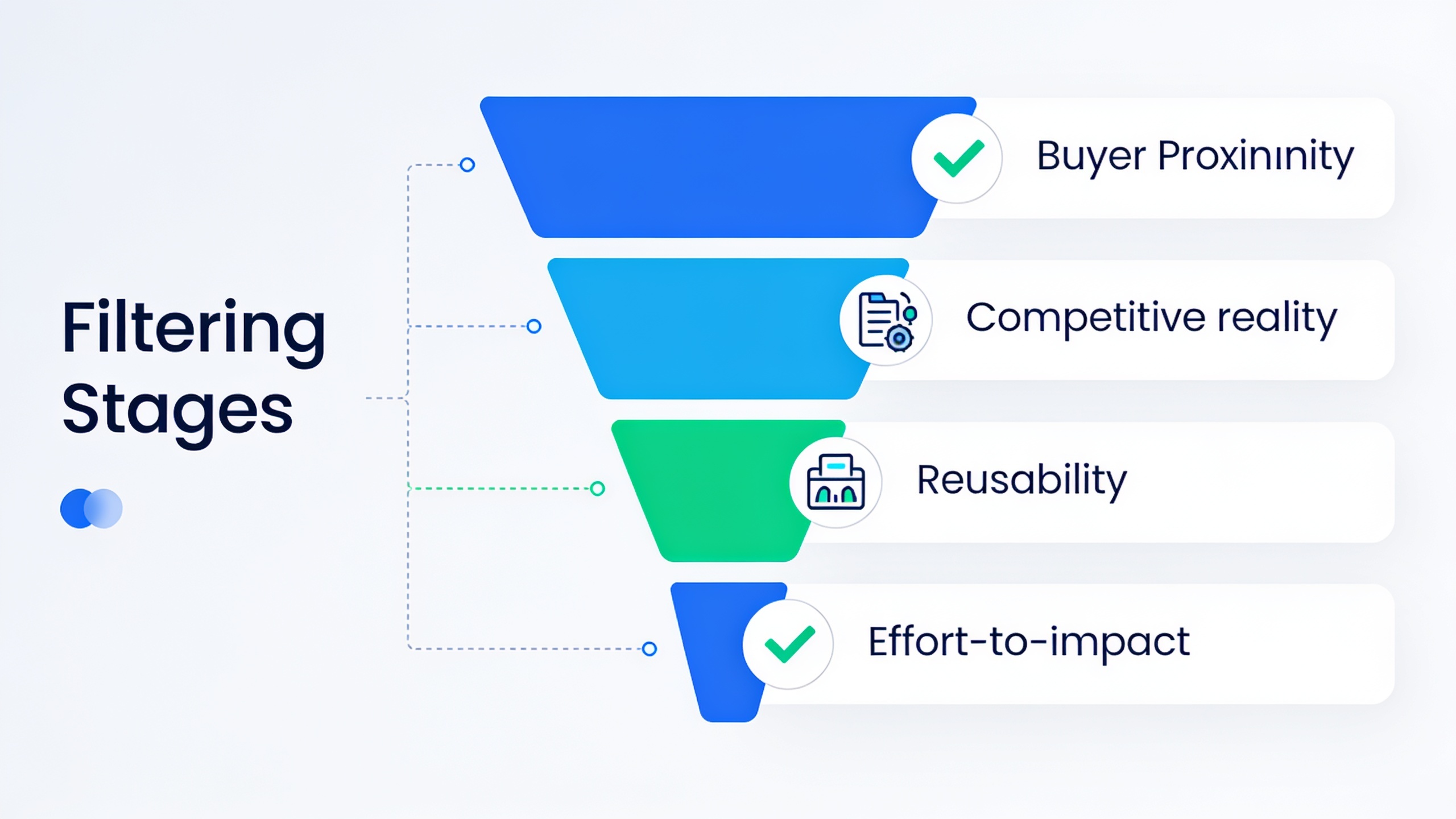
- Buyer proximity. Is this something a prospect searches while actively shopping for a tool (say, "best project management software for remote teams"), or is it a tangent nobody near a buying decision would ever type (like "history of Gantt charts")?
- Competitive reality. Could a brand-new domain plausibly compete for this in six to twelve months, given who's currently squatting in the top results?
- Reusability. Will this article feed future content, like comparison pages or feature pages, or even give the sales team something to reference in calls?
- Effort-to-impact. Can two people actually produce this well within their weekly capacity, or does it need research and expertise they flat-out don't have?
Any topic that flunked more than one filter got cut on the spot. Didn't matter how juicy the search volume looked.
And this is the exact step most broke teams skimp on, because writing feels like progress and filtering feels like procrastination. But an hour spent whittling fifty ideas down to twelve saves you dozens of wasted writing hours down the line. Smart move on their part: they treated this filtering pass as a recurring monthly thing, not a one-and-done. Competitors publish new stuff, products change, and the list has to breathe with all of that.
Building the Startup Content Engine: Tools, Workflow, and Roles {#building-the-startup-content-engine}
A budget startup content engine usually pairs a few specialized tools with a tightly defined weekly workflow, so that two people can produce what would normally need a five-person team. The point isn't to remove human judgment. It's to strip out the repetitive, brain-dead tasks (keyword clustering, outline drafting, formatting, internal linking, publishing) that devour hours without demanding any actual expertise.
This team ran a three-stage workflow, which loosely mirrors how AI-assisted publishing platforms like RobinRank structure things: business analysis first, then drafting and publishing, then backlinks.
Stage one, analysis. Before anyone wrote a word, the team (or their tooling) sized up the competitive landscape, the site's current visibility, and the gaps between the two. RobinRank frames this as analyzing "niche, competitors, topics, and DR [Domain Rating]" to surface both content ideas and link opportunities. Honestly, that's a solid mental model for any small team trying to figure out where to point its scarce hours.
Stage two, production. Drafts came from either the in-house marketer or AI assistance, and then got a human review for accuracy, tone, and the product-specific details that generic templates always botch. They never treated an AI draft as a finished asset. Every article got a human pass to confirm the product claims were true and that the whole thing sounded like it came from people who actually get the customer. Because nothing torches trust faster than a blog post that clearly doesn't.
Stage three, distribution and backlinks. Hitting publish isn't the finish line. Without any authority signals pointing back to your domain, even a genuinely great page can just sit there and rot in the rankings. This startup couldn't afford a traditional outreach retainer, so they looked at models where verified backlinks get earned through a community network instead of paid placements. RobinRank describes it as a network that "gets stronger with every member," where publishing an article with a contextual link to another site earns you Domain-Rating-weighted credits, and you spend those credits later when another eligible article links back to you. Not free exactly, but a very different cost structure than writing checks for links.
Here's how this shoestring workflow stacks up against a fat-budget operation:
| Workflow Element | Traditional High-Budget Approach | Lean SaaS Content Engine |
|---|---|---|
| Topic selection | Broad keyword lists, high output volume | Scored, filtered shortlist tied to buyer intent |
| Writing | In-house writing team or agency retainer | Founder/marketer + AI-assisted drafting, human review |
| Publishing cadence | Multiple posts per week | Fewer, higher-effort posts published consistently |
| Link building | Manual outreach and paid placements | Community-based, verified backlink exchange |
| Measurement | Monthly agency reporting | Direct tracking against a small set of priority pages |
| Primary cost driver | Headcount and outreach fees | Time and a modest software subscription |
Want content like this running on autopilot for your own site? Try RobinRank free — AI-written, SEO-optimized articles generated and published automatically, no credit card required.

What Changes When Prioritization Replaces Volume {#what-changes-when-prioritization-replaces-volume}
The clearest sign the prioritization-first approach is working is when a small number of pages start pulling a wildly disproportionate share of your organic traffic and leads, instead of traffic being smeared thin across dozens of also-ran posts.
In the case study, this shift showed up roughly three to four months after the team adopted the scoring model. A handful of comparison and "best of" pages, chosen specifically because they matched active buyer intent, started popping up in search for terms tied directly to purchase decisions. Not brand-awareness fluff. Actual "I'm about to buy something" queries.
That's exactly what an intent-first strategy is built to do: concentrated wins on high-value topics rather than a wide, shallow puddle of visibility. And it's also why measurement carries as much weight as production. A team that doesn't know which specific pages drive signups, demos, or trial activations has no clue whether its filters are working or whether it just got lucky a couple of times. If you're trying to figure out whether an AI-assisted workflow is even paying for itself, the framework in How to Measure ROI on AI Content Marketing Tools is a good next stop. It tackles the exact question this startup had to wrestle with internally: is all this time and subscription money turning into pipeline, or just page views to feel good about?
How Much Does It Cost to Run a Lean SaaS Content Marketing Program? {#how-much-does-it-cost}
The cost of a lean SaaS content program hinges on two things almost entirely: how much of the work you keep in-house versus outsource, and whether your link building runs on paid placements or a community exchange. There's no tidy industry-standard number here, and anyone who quotes you one is guessing. A solo founder writing every article has a completely different cost profile than a team leaning on a freelance writer plus a paid outreach agency.
What I can tell you plainly, without inventing figures, is where the money actually goes:
Software and AI tooling usually ends up being the smallest recurring line item. That's your keyword research, your AI drafting and publishing platform, your analytics. Cheap, relatively.
Human time is the real cost for most lean teams, even though it never shows up on an invoice. Reviewing drafts, verifying product claims, babysitting the workflow. All of that eats founder or marketer hours that have a very real opportunity cost. Just because nobody billed you doesn't mean it was free.
Link building has historically been one of the priciest parts of SEO when you're doing manual outreach or buying placements. Community-based models, where verified links get exchanged for DR-weighted credits instead of cash, are one way lean teams try to shrink this line without giving up on links entirely.
And then there's occasional freelance support, used surgically for topics that need expertise nobody on the team has. Not a replacement for the core workflow, just a spot fix.
So the takeaway if you're a founder staring at a budget spreadsheet: don't hunt for some magic average dollar figure to benchmark against. Map these four buckets against your own reality. Time you've got, expertise you've got, and your patience for the slow-burn payoff that organic content brings compared to the instant gratification of paid ads.
Common Mistakes That Derail Budget Content Engines {#common-mistakes}
The most common way a tight-budget program dies isn't running out of money. It's blowing the limited time you have on the wrong stuff, usually by publishing too broadly before you've earned any topical authority. A few specific patterns show up again and again:
Chasing volume over relevance. Cranking out two or three posts a week feels productive. But if half of them don't match buyer intent, you just burned scarce hours on pages that'll never rank or convert. And a tight budget makes this worse, not better, because you've got zero reserve capacity to absorb the waste.
Treating link building as optional. Great content with no referring domains behind it usually just... sits there, losing to established competitors no matter how good the writing is. The teams that assume "amazing content will naturally attract links" tend to wait a lot longer for results than the ones actively going after links, whether through outreach, guest posts, or a structured community exchange.
No feedback loop. If you're not tracking which pages generate signups, demos, or qualified traffic, you can't refine your filters. Content production becomes pure guesswork that occasionally lucks into a win, instead of a system that gets sharper over time.
Underestimating the review step. Whether the draft is human-written or AI-assisted, skipping a careful review before publishing is one of the fastest ways to nuke your credibility. Wrong claims about your product, generic phrasing that no real customer would relate to, thin pages that don't actually answer the question. Any of these quietly undermine the trust the whole engine is supposed to build.
Bailing too early. Organic content takes months, not weeks, to show real traffic and lead impact. And budget-strapped teams sometimes pull the plug right before a topic cluster starts gaining traction, just because the early numbers looked underwhelming. Which, at that stage, they always do.
FAQ
How long before a SaaS startup actually sees results from a content engine?
Realistically, three to six months minimum before organic traffic and lead gen become clearly measurable. Search engines need time to crawl, index, and size up your new pages against the established players. That said, startups that aim their early effort at lower-competition, high-intent topics (instead of going toe-to-toe with giants on broad generic keywords) tend to see traction sooner.
Do I really need a full-time writer to do this on a budget?
Nope, not necessarily. A lean team can run a solid engine with a founder or part-time marketer owning strategy and review, backed by AI drafting tools and the occasional freelance expert for the technical stuff. What matters way more than headcount is a consistent prioritization and review process. Inconsistent quality or off-target topics will tank your results no matter who's writing the drafts.
Is link building actually necessary if my content is genuinely great?
Generally, yeah. Quality content improves your odds of ranking once a page gets discovered, but referring domains and authority signals still heavily influence how competitive results get sorted, especially in crowded SaaS categories. Budget teams often handle this with lower-cost routes like community-based backlink exchanges, where verified links are earned through contribution rather than bought outright.
What's the actual difference between a content calendar and a content engine?
A content calendar is just a schedule of topics and publish dates. A content engine is the entire system underneath it: the method for picking topics, the workflow for producing pages efficiently, and the measurement loop for learning what's working. You can have a gorgeous, color-coded calendar and still have no engine at all if there's no consistent way to decide what to publish or to evaluate what happened after you did.
How do I measure whether a lean content program is actually working?
Track a small set of outcomes tied to real business goals. Organic sessions to your priority pages, ranking movement for the terms you're targeting, and downstream actions like signups or demos attributed to organic. Not vanity metrics like "total posts published" or overall pageviews, which make you feel busy and tell you nothing. There's a dedicated guide on measuring content marketing ROI that digs into this, including how to weigh AI tooling costs against actual pipeline.
Look, building a content engine on a tight budget isn't about finding some clever shortcut around the fundamentals of SEO. It's about being unusually disciplined about which fundamentals get your attention first when time and money are both scarce. The startups that make real headway all seem to share the same habits: they filter topics ruthlessly before they write anything, they treat backlinks as a core part of the system instead of an afterthought, and they watch their results closely enough to actually know which part of the engine to feed next.
Ready to stop writing content by hand? Start your free RobinRank trial and get a full month of SEO-optimized articles published on autopilot.