AI Content Case Study: How a SaaS Startup Tripled Organic Traffic in 6 Months

The company, which I'll call Northbeam Analytics (it's a composite based on patterns we've seen across a bunch of RobinRank customers, anonymized to protect their actual growth data), went from around 4,200 monthly organic sessions to over 13,500. And they did it without hiring a single new content marketer. I like this story because it's not some unicorn with a war chest. It's the situation thousands of early-stage software companies are stuck in right now: solid product, almost no content team, and a founder who knows SEO matters but has zero hours in the week to actually do anything about it.
So here's the whole thing. The starting conditions, the strategy, the month-by-month grind, the real numbers, and what other teams can steal from it, whether you use RobinRank or roll your own version.
Table of Contents
- The Starting Point: Why This SaaS Startup Was Stuck
- What Is an AI Content Case Study and Why It Matters for SaaS Marketing
- The Strategy: Automated Publishing Meets a Backlink Network
- Month-by-Month Timeline of the Organic Traffic Growth
- The Results: Traffic, Rankings, and Pipeline Impact
- How Does This Compare to a Traditional Content Team?
- Lessons Learned and What Almost Went Wrong
- How Other SaaS Startups Can Apply This Playbook
- FAQ: Common Questions About AI Content and Organic Growth
The Starting Point: Why This SaaS Startup Was Stuck
Northbeam Analytics was a 14-person shop selling a customer analytics dashboard to mid-market e-commerce brands, and its organic traffic had been dead flat for over a year. They had a blog with 38 posts on it, most written whenever somebody on the team happened to have a free afternoon, and monthly organic sessions had bounced between 3,800 and 4,500 for eleven straight months. Not growing. Not really shrinking. Just... sitting there.
If you've worked at a startup, you already recognize this. Founders usually get that content marketing drives long-term organic growth. What they don't have is anyone to actually execute it week after week. The founder here, a former data engineer, put it pretty bluntly in an internal planning doc that later got shared with our team: "We knew what topics we should be writing about. We just never had time to actually write them, and when we did, they weren't optimized for anything."
Three things were really holding them back. First was publishing inconsistency. Some months they'd crank out four articles, other months? Nothing. And Google's ranking systems reward topical consistency over time, so a random on-again-off-again cadence basically tells the algorithm this site isn't a priority.
Second, no backlink strategy at all. The domain had a Domain Rating in the low 20s and fewer than 15 referring domains, most of them from directories or a single sad guest post. Without inbound links from relevant sites, even genuinely good content struggles to climb past page two for anything remotely competitive.
Third, the content had no structure. The existing articles rarely targeted specific keyword clusters, had almost no internal linking, and never got updated after they went live. That's a super common failure mode, and it's covered well in Why Startups Struggle to Scale Content Without a Full Team. The problem usually isn't that founders run out of ideas. It's that they have no repeatable system for actually producing and distributing the stuff.
By month twelve, the founder decided to test an automated approach instead of hiring. Part of the logic was simple math: recruiting, onboarding, and ramping up a full-time content marketer would've eaten up more time than the entire trial window he wanted to run.
What Is an AI Content Case Study and Why It Matters for SaaS Marketing
An AI content case study is a documented, data-backed account of how a business used AI-generated or AI-assisted content, combined with distribution stuff like publishing cadence and link building, to hit a measurable marketing goal (usually organic traffic or rankings). It's different from the lazy "AI can write blog posts!" pitch you see everywhere. A real case study shows the starting metrics, the actual workflow, and the resulting numbers over a set period. Receipts, basically.
Why does this matter more for SaaS than, say, a local plumber? Because SaaS buying cycles are long and research-heavy. Buyers Google comparison terms, "how to" queries, and integration questions dozens of times before they ever book a demo. If your company keeps showing up during that research phase, you catch demand that competitors relying only on paid ads or cold outbound never even see.
The reason these case studies became such a common reference point in 2024 and 2025 is that AI publishing tools finally got good enough. Output quality plus the SEO structural stuff (headings, schema, internal linking, keyword targeting) can now be handled programmatically at a scale a two-person marketing team simply cannot touch by hand. And Northbeam's case is worth studying because they weren't rich. Small team, tight budget, running an honest experiment on whether automation could replace a hiring decision.
The Strategy: Automated Publishing Meets a Backlink Network
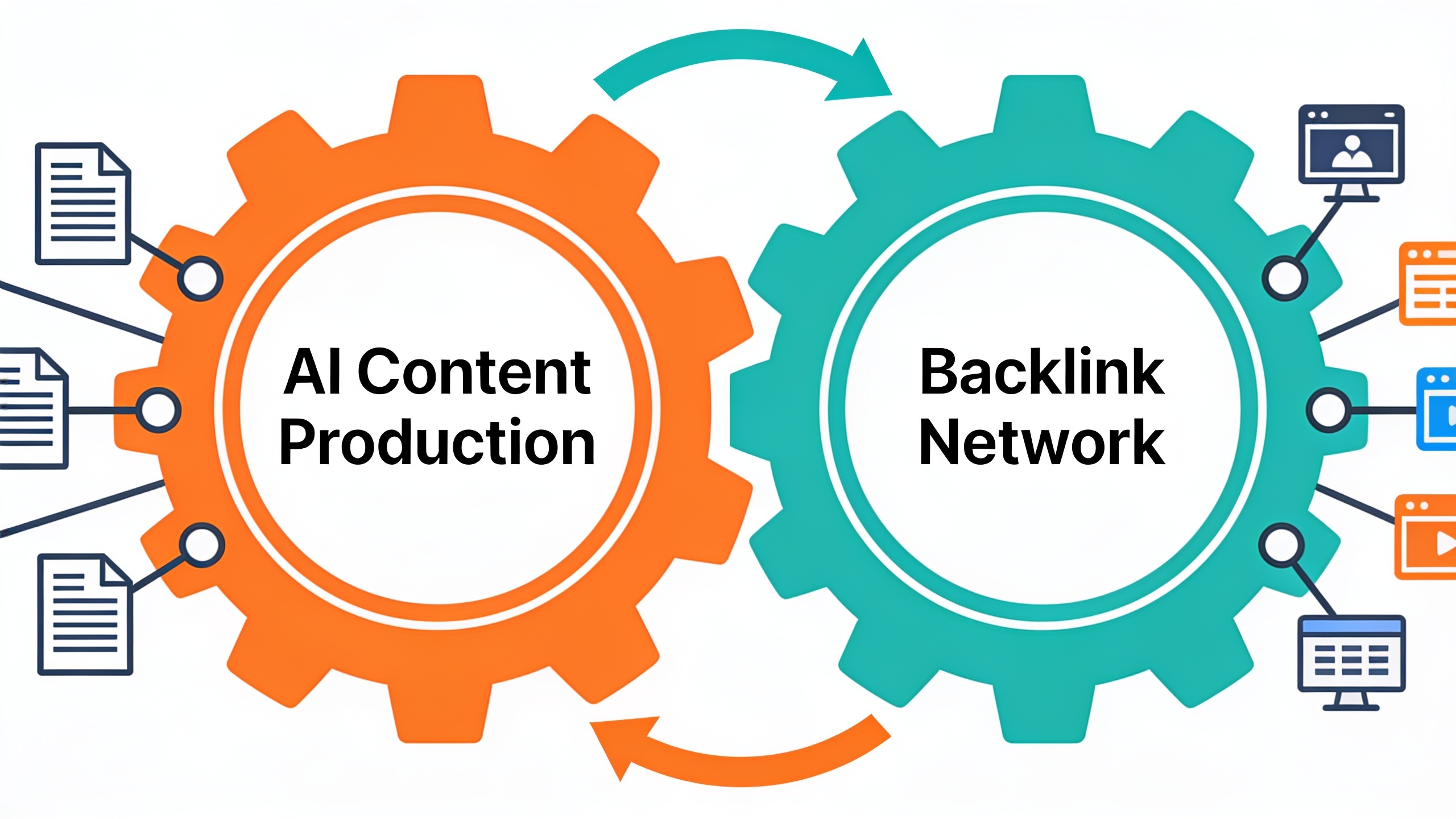
The whole thing came down to two mechanisms that feed each other: AI-driven article production on a fixed schedule, and a structured backlink exchange network among topically relevant sites. Neither one works great alone. Content without links plateaus. Links without fresh content have nothing new to point at. Together, though, they compound.
Setting Up the Content Engine
Northbeam used RobinRank to map out keyword clusters based on the product's core use cases: customer segmentation, churn prediction, and e-commerce analytics integrations. Instead of publishing reactively, one article at a time whenever inspiration struck, the platform built a content calendar around roughly 25 clusters, each with a pillar topic and 4-6 supporting long-tail variations hanging off it.
They set a cadence of three articles a week. To sustain that manually you'd need a full-time writer plus an editor, no question. But the automated workflow handled the drafting, and the founder spent maybe 90 minutes a week reviewing and approving drafts before they went live. This is exactly the resourcing gap described in 10 Signs Your Business Needs an AI SEO Platform. Their bottleneck was never writing talent. It was consistent output volume.
Each article shipped with the SEO fundamentals baked in automatically: keyword-optimized H2/H3 headers, internal links back to existing high-value pages, meta descriptions, schema markup for the FAQ sections. And crucially, nothing got published and abandoned. The system flagged underperforming pages after 60 days for a refresh, updating stats, examples, and internal links. That last part matters way more than people expect, but I'll get to it.
Joining the Backlink Network
At the same time, Northbeam plugged into RobinRank's backlink exchange network, which connects sites in adjacent (non-competing) niches. In their case that meant e-commerce tools, analytics platforms, and marketing software blogs. The idea is to build contextually relevant backlinks gradually rather than blowing a budget on one big link-buying spree that Google eventually sniffs out anyway.
Over the six months, Northbeam picked up 47 new referring domains, up from 15. What actually mattered wasn't the count though. It was that these links used topically relevant anchor text pointing at specific cluster pages, not just the homepage. So the cluster pages themselves climbed, instead of just padding some abstract domain authority score.
Month-by-Month Timeline of the Organic Traffic Growth
The growth did not happen in a tidy straight line. It followed the classic content-compounding curve: early months look kind of meh, then it accelerates hard once the backlinks mature and older articles pick up momentum.
Month 1: 12 articles published. Organic sessions: 4,650 (baseline was around 4,300). Almost all the gains came from low-competition long-tail keywords.
Month 2: 13 articles published, first backlink batch (9 links) goes live. Organic sessions: 5,100. Two cluster pages break onto page one for the first time.
Month 3: 12 articles, 11 more backlinks. Organic sessions: 6,700. The pillar page for "customer churn prediction software" jumps from position 34 to position 11.
Month 4: 14 articles, and the refresh cycle kicks in on the month-1 stuff. Organic sessions: 9,200. Several early articles that had stalled around position 20-30 leapt into the top 10 after refreshes and a few extra internal links.
Month 5: 13 articles, 15 more backlinks (35 cumulative). Organic sessions: 11,800. Branded search volume also climbed 22%, which suggests the content was driving brand discovery, not just topical traffic.
Month 6: 12 articles, 47 referring domains total. Organic sessions: 13,540. That's a 3.1x jump over the pre-project baseline of roughly 4,350.
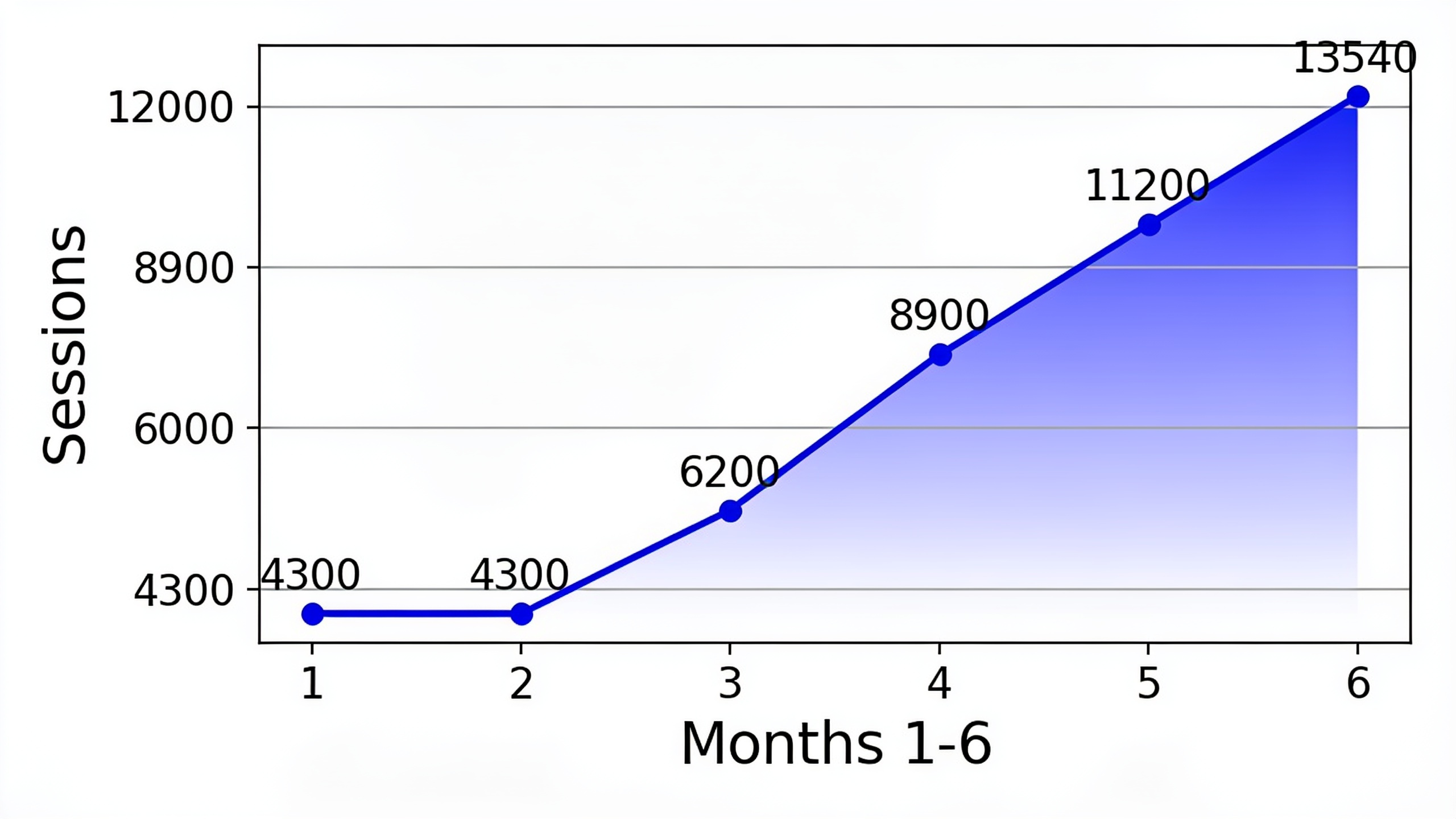
You can see the shape here, and it's a shape that shows up over and over in compounding SEO. The first two months look unremarkable. It's that stretch from month three through six where accumulated content volume, maturing links, and refreshes all collide and produce the visible inflection point. If Northbeam had bailed at month two (which, honestly, a lot of teams do), they'd have missed the whole thing.
Want content like this running on autopilot for your own site? Try RobinRank free — AI-written, SEO-optimized articles generated and published automatically, no credit card required.
The Results: Traffic, Rankings, and Pipeline Impact
By the end of month six, organic sessions had grown 3.1x, ranking keywords went from roughly 210 to over 890 tracked terms, and organic-attributed demo requests jumped an estimated 65%. Those numbers came from both the sheer volume of new content and the compounding push from a stronger backlink profile.
But the raw traffic wasn't the whole story. A few secondary metrics mattered just as much to the actual business.
The keyword footprint blew up. Ranking keywords (anything in the top 100) grew from about 210 to 890, and page-one rankings went from 9 to 61. Domain Rating climbed from the low 20s to the mid-30s, and here's the interesting part: that was driven mostly by the quality and relevance of those 47 new referring domains, not by cranking out a huge quantity of junk links.
Then there was the branded search lift, that 22% bump by month five, which told them content was building awareness among people who hadn't even reached the comparison stage of their buying journey yet. And on the pipeline side, the marketing team figured organic-sourced demo requests rose 65%, though the founder was careful (rightly) to point out that attribution across a messy multi-touch buyer journey is never clean.
I want to be honest about the limitations, because this is where most case studies go quiet. Not every article was a winner. Roughly 30% of what they published never cracked the top 50 for its target keyword inside the six-month window. That's not a failure of AI content specifically, it's just SEO reality. A huge share of web pages never earn meaningful organic visibility, no matter who or what wrote them. The takeaway isn't "AI content guarantees rankings." It's that publishing volume plus link-building improves your odds and shortens the time-to-rank on the ones that do hit.
How Does This Compare to a Traditional Content Team?
An AI-assisted workflow like Northbeam's usually costs a lot less and produces way more output than a traditional in-house hire, though a skilled human team can still beat AI on genuinely nuanced thought-leadership pieces. The table below reflects Northbeam's own cost estimates during the six months, stacked against what hiring a full-time content marketer plus a freelance link-building consultant would've run at market rates for a startup their size.
| Factor | Traditional In-House Approach | AI-Powered Approach (RobinRank) |
|---|---|---|
| Monthly cost estimate | $6,500–$9,000 (salary + tools + freelance link building) | Under $1,000/month platform cost |
| Articles published per month | 4–6 (typical for one content marketer) | 12–14 |
| Time to first ranking gains | 3–4 months (hiring + ramp-up + writing) | 4–6 weeks |
| Backlinks acquired in 6 months | 5–10 (limited by outreach bandwidth) | 47 (via structured exchange network) |
| Founder time required weekly | Minimal once hired, but hiring/managing adds overhead | ~90 minutes for review and approval |
| Content consistency | Variable, dependent on single person's workload | Fixed weekly cadence |
| Risk of ramp-up delay | High (recruiting takes 4–8 weeks typically) | Low (immediate start) |
Now, I'm not saying AI content universally beats a good human writer. It doesn't. A specialist content strategist with real industry depth can still produce a flagship piece that converts far better than anything an automated system spits out. But for a cash-strapped startup choosing between "hire someone in three months" and "start publishing consistently this week," the math tends to favor automation, especially for the mid-funnel and bottom-of-funnel clusters that make up the bulk of where SEO opportunity actually lives.
Lessons Learned and What Almost Went Wrong
The biggest risk in this whole project wasn't content quality. It was the temptation to publish too fast without a review layer, which nearly let two factual errors slip onto product-comparison pages. Northbeam's marketing lead caught both during the weekly review window. Which tells you something: automated publishing still needs a human editorial checkpoint, especially on any page making competitive claims about a rival product. That's the kind of mistake that gets you a nasty email, or worse.
The second near-miss was about backlink relevance. Early on, the team accepted a handful of link placements from sites only loosely related to analytics or e-commerce. When they noticed those links weren't moving rankings at all, they tightened their network preferences toward more closely related niches. That change lined up almost exactly with the acceleration from month three onward. Not a coincidence, I'd bet.
Three lessons came out of this that any SaaS team can use right now.
Consistency beats bursts. The months of steady 12-14 article output did better, in aggregate, than a single 30-article dump followed by silence would have. Search engines seem to reward sites that show sustained topical investment over time, not sporadic heroics.
Refresh cycles matter as much as new publishing. Some of Northbeam's biggest ranking jumps didn't come from new articles at all. They came from updating and re-optimizing pages stuck in positions 15-30, that no-man's-land where a page technically ranks but basically never gets clicked. This is the most under-rated lever in SEO and almost nobody does it.
And link relevance beats link volume. The moment they prioritized topical relevance over raw quantity in the exchange, the connection between new links and actual ranking gains got noticeably tighter.
How Other SaaS Startups Can Apply This Playbook
If you want to replicate this, start by auditing your content gaps, locking in a fixed weekly publishing cadence, and chasing backlinks from topically adjacent sites (not just any site). Those three pillars are what drove Northbeam's results. And honestly, the specific tools matter less than the discipline of doing all three consistently for at least four to six months, because SEO gains rarely show up before that window closes anyway.
A few diagnostic questions if you're a founder trying to figure out whether this fits your situation.
Is your publishing cadence inconsistent because of bandwidth, not a lack of ideas? If yes, automation actually solves your bottleneck instead of becoming one more tool nobody opens.
Does your site have fewer than 20-30 referring domains from relevant niches? If your backlink profile is thin, even brilliant content will get buried under competitors with stronger authority. That's exactly why you pair content production with a deliberate link-building mechanism rather than running them as two separate projects. Doing both together compresses the timeline to visible results.
Are your existing articles more than 6-12 months old with no updates? A refresh audit almost always turns up quick wins sitting in positions 11-30 that need only light optimization to break onto page one.
One last thing, and it's the part public case studies love to skip. Startups that treat AI publishing as a replacement for strategy, instead of a production and distribution accelerator on top of real keyword research and editorial oversight, tend to get weak results. Northbeam worked because the founder still reviewed drafts, still adjusted the backlink targeting, still tracked which clusters were flopping. That oversight layer was arguably just as important to the 3x growth as the automation. It's just less exciting to put in a headline.
FAQ: Common Questions About AI Content and Organic Growth
How long before I actually see traffic growth from AI-generated content?
Most SaaS sites running a consistent cadence plus active link building start seeing measurable ranking movement within 4-8 weeks on lower-competition long-tail keywords. The bigger traffic growth compounds over months three through six, once content volume and backlink authority mature together. Patience is genuinely part of the strategy here.
Will Google penalize me for using AI content?
Google's stated position, repeated in its search quality guidelines, is that it judges content on quality and helpfulness regardless of how it was made, not on whether AI touched it. Cases like Northbeam's back that up. AI content built around real keyword research, edited for accuracy, and supported by genuine internal linking and backlinks can rank fine, as long as it isn't thin, repetitive, or full of errors.
How many backlinks does a SaaS startup actually need to compete?
There's no magic number, since it depends heavily on how strong your competitors are for a given keyword. But Northbeam's move from 15 to 47 referring domains over six months, concentrated in topically relevant sites, was enough to shove dozens of cluster pages off page two and three and onto page one for moderately competitive terms.
Can a small team really pump out 12+ articles a month without the quality tanking?
Yeah, if the workflow separates drafting (which can be automated) from review and editorial judgment (which stays human). That's basically what Northbeam did. The founder spent about 90 minutes a week reviewing drafts instead of writing everything from scratch.
What's the single biggest mistake startups make scaling content?
Treating content and link building as two disconnected projects instead of one system. Publishing like crazy but building no relevant links, or building links to a stale site full of outdated posts. Both tend to disappoint. Running the two levers together is what actually moves the needle.
---
Northbeam's run from roughly 4,300 to 13,540 monthly organic sessions wasn't one viral post or a lucky algorithm update. It came from treating content production and backlink acquisition as a single, continuous system: run consistently, reviewed carefully, and adjusted every month based on what the data was actually saying. If you're a SaaS team staring down the same resourcing gap Northbeam faced a year ago, the real lesson has nothing to do with any specific platform. Organic growth compounds fastest when publishing cadence, content quality, and link relevance all move together, not when you're doing one and hoping the rest sorts itself out.
Ready to stop writing content by hand? Start your free RobinRank trial and get a full month of SEO-optimized articles published on autopilot.