Why Startups Struggle to Scale Content Without a Full Team

You've seen this movie before. A founder gets fired up, cranks out three blog posts in a weekend, hits publish, checks the analytics two weeks later, sees nothing, and quietly slinks back to shipping product. Fast forward six months. The blog has eleven posts, no editorial calendar, and a founder who's now convinced that "content doesn't work for us." Except the strategy was never the problem. The problem was there was no system, no way to keep producing content without a team big enough to actually sustain it.
So let's talk about why this keeps happening, what specifically falls apart when a startup tries to scale output on fumes, and how automation is quietly rewriting the math for founders who need organic growth but can't exactly justify a five-person content department.
Table of Contents
- Why Startup Content Marketing Efforts Stall So Quickly
- The Real Cost of Building an In-House Content Team
- What Actually Breaks When Startups Try to Scale Content Without a Team
- How Much Content Does a Startup Actually Need to Compete?
- How Automation Tools Bridge the Resource Gap
- In-House Team vs. Freelancers vs. AI-Assisted Content: A Comparison
- Building a Lean Content Engine That Scales
- Frequently Asked Questions
Why Startup Content Marketing Efforts Stall So Quickly
Startup content marketing stalls because founders treat content like a side project instead of a system, which means output depends entirely on whoever happens to have a free afternoon that week. No dedicated owner, no repeatable process, no publishing cadence that survives a product sprint or a fundraise. The whole thing folds the second priorities shift somewhere else.
And here's the frustrating part: most startups don't fail at content because their ideas are bad. They fail because content is a grind. Keyword research, drafting, editing, formatting, internal linking, publishing, promotion. Every week. For months. Before Google gives you anything back. HubSpot's 2024 State of Marketing research found that companies publishing consistently over long stretches see compounding organic traffic gains, while the stop-start crowd sees flat or declining numbers. Google's algorithm rewards topical depth and freshness, and you just can't fake those signals with the occasional burst of enthusiasm.
The pattern is almost always the same:
- A founder or early marketing hire commits to a content plan.
- The first month goes great, because there's energy and a backlog of ideas.
- A product launch, a fundraise, or some customer fire pulls everyone's attention.
- Publishing drifts from weekly to monthly to, well, whenever.
- Traffic never compounds, because Google never got enough signal to trust the site in the first place.
That's the whole tension right there. The channel rewards patience and volume. Early-stage companies are structurally short on both.
The Real Cost of Building an In-House Content Team
Building a full in-house content team usually runs a startup somewhere between $180,000 and $350,000 a year once you count a content strategist, a writer or two, an editor, and some basic SEO tooling. That's money most seed-to-Series A companies flat out haven't set aside for marketing. And even at the bottom of that range, you're committing a real slice of your burn to a function that takes three to six months to show a single measurable result.
Think about what you're actually staffing here. You need a content or SEO strategist to own keyword research, topic clusters, and performance tracking (Glassdoor's 2024 marketing salary data puts the average US base somewhere around $75,000 to $95,000). You need one or two writers, whether staff or a rotating freelance bench, running $50 to $150 per article depending on depth. You need an editor to keep quality and brand voice from wandering off. You'll want design help for graphics and screenshots. And you'll need SEO software licenses for keyword tracking and audits.
Now stack the management overhead on top. Somebody has to brief writers, review drafts, chase deadlines, and handle all the publishing logistics. Suddenly "let's just hire someone to run the blog" has become a part-time job for whoever's managing that person. This is exactly why so many startups start strong and then quietly ghost content marketing within a year. The invoice was never the real cost. The management burden was.
What Actually Breaks When Startups Try to Scale Content Without a Team
When startups try to scale content without a team, the first thing to break is consistency, and then quality control goes, then internal linking, then any coherent keyword strategy. And they don't break independently. Each failure feeds the next, which is why content programs at scrappy startups tend to rot rather than just plateau.
Inconsistent Publishing Cadence
Google rewards sites that publish regularly. A startup that runs on "whoever has extra time this week" publishes in bursts and gaps, and that stop-start rhythm chokes off the topical authority signals Google leans on heavily for newer domains.
No Dedicated Keyword or Topic Strategy
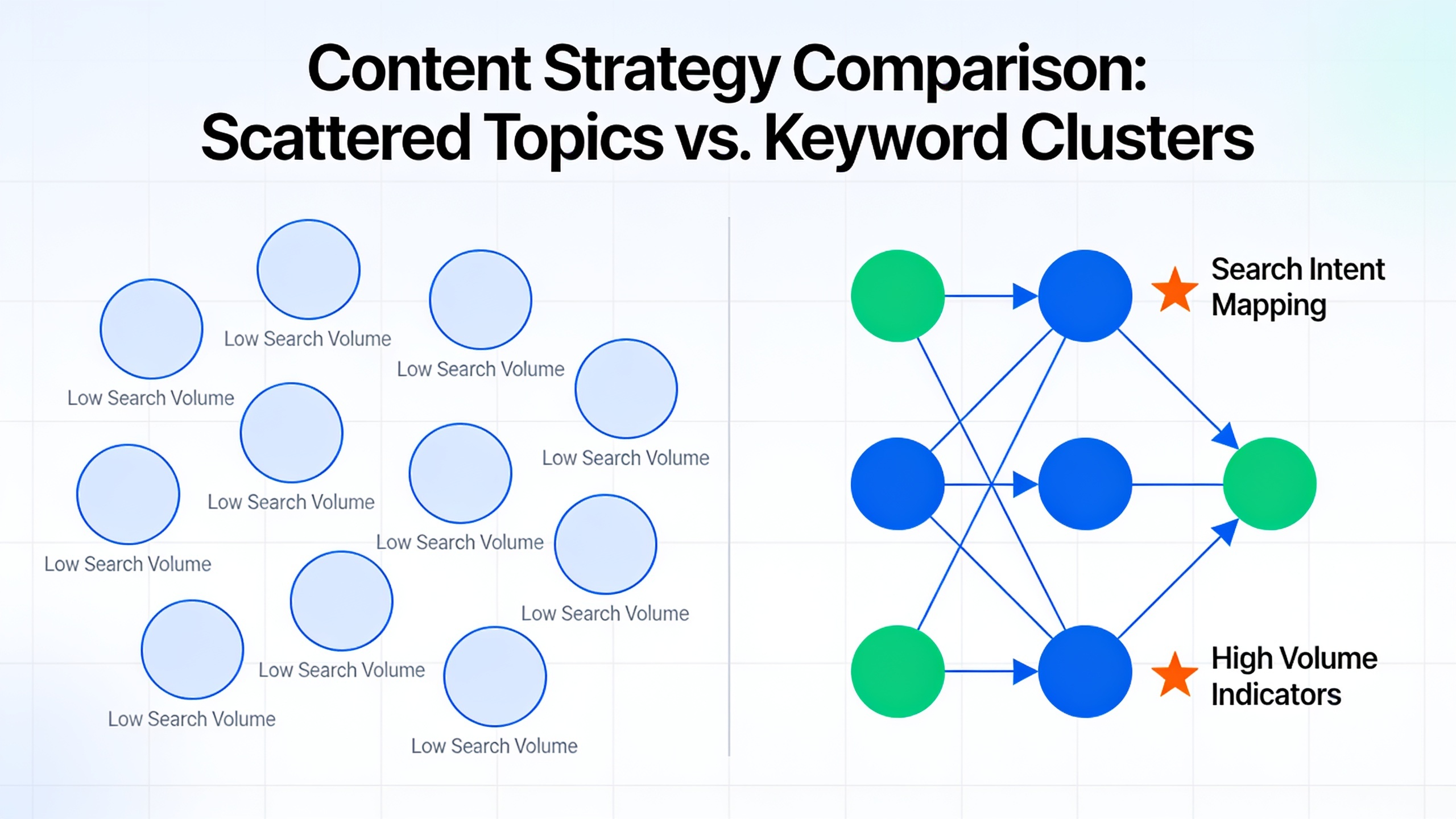
Without someone whose actual job is researching search intent and mapping content to a funnel, teams default to writing about whatever feels interesting internally. Which is almost always product features nobody's searching for. This is one of the biggest gaps we get into in our guide on what AI content marketing actually is and how it works, which breaks down how intent-mapped content is a completely different animal from just blogging about your latest feature.
Quality Drift
Five different people writing at five different times in five different voices? Brand consistency erodes fast. Readers pick up on it, and so does Google's helpful content system, which specifically checks whether content shows consistent expertise and an actual point of view.
Zero Internal Linking Strategy
Internal links spread authority around your site and help Google understand how your pages relate. Startups without a documented content structure basically never link new posts back to older relevant ones. So every article sits there as its own lonely island instead of pulling weight inside a cluster.
No Distribution or Repurposing Plan
Publishing is honestly only half the job. With no one to turn posts into LinkedIn updates, newsletter blurbs, or social snippets, most startup content gets published once and then vanishes outside of organic search. Which, again, takes months to kick in anyway.
Founder Bottleneck
At a lot of startups, the founder is the only person who knows the product and market well enough to write anything credible. So the founder becomes both the single most valuable content asset and the single point of failure. That's the exact opposite of scalable.
How Much Content Does a Startup Actually Need to Compete?
Most startups need to publish somewhere between 8 and 20 well-optimized articles a month to build meaningful topical authority within 6 to 12 months, depending on how crowded their niche is. And that's a volume that's nearly impossible to sustain by hand without either a real team or some automation doing the heavy lifting.
Ahrefs' analysis of ranking factors has shown, over and over, that domains with more topical depth (think dozens of interlinked articles covering a subject thoroughly) tend to outrank single isolated posts, even when the individual pieces are roughly the same quality. So the real competitive unit in SEO isn't the article. It's the cluster.
| Content Volume | Typical Result Timeline | Feasible Without Automation? |
|---|---|---|
| 1–4 articles/month | Minimal traffic growth, no topical authority | Yes, but rarely effective |
| 5–10 articles/month | Modest growth in 6–12 months for low-competition niches | Difficult without at least 1 dedicated writer |
| 10–20 articles/month | Meaningful topical authority within 6–12 months | Very difficult without a team or automation |
| 20+ articles/month | Competitive positioning in most B2B SaaS niches within 6–9 months | Nearly impossible manually at quality |
Now, before anyone runs off to spew garbage in bulk: don't. Google's helpful content guidelines are crystal clear that content made purely to game rankings, with no real value, gets penalized. The goal is sustained, genuinely useful volume. Which, yeah, is a brutally hard combination to pull off with a two-person marketing team already juggling five other jobs.
How Automation Tools Bridge the Resource Gap
AI-powered content automation bridges the resource gap by taking over the repetitive, time-sucking parts of production (keyword research, drafting, on-page optimization, publishing) so a lean team can hit the volume and consistency that used to demand five or six full-time hires. It's not about stripping out strategy or human judgment. It's about killing the bottleneck of manual execution.
Want content like this running on autopilot for your own site? Try RobinRank free — AI-written, SEO-optimized articles generated and published automatically, no credit card required.
Honestly, we've watched this exact thing play out in other marketing functions already. Email used to mean manually building every single send. Then automation platforms showed up and didn't fire the marketers, they just let one person do what used to take a team. Content is going through the same shift right now. Our piece on whether AI writers are making human content teams obsolete digs into this more, but the short version is: automation changes the ratio of output to headcount. It doesn't change the need for a human keeping an eye on things.
What's neat is that modern AI content platforms happen to hit the exact failure points I described earlier. Automated publishing schedules kill the dependency on someone "finding time," which solves the single biggest reason startup content stalls in the first place. AI tools can chew through search intent and competitive gaps at a scale no lone strategist could ever match by hand, so articles actually map to real demand instead of internal guesswork. A well-configured system holds a consistent voice and structure across hundreds of articles, something a rotating freelance bench genuinely struggles with. Platforms like RobinRank can automatically spot and drop relevant internal links across a growing library, reinforcing your clusters without anyone auditing it manually. And the CMS integration handles all the formatting, scheduling, and uploading that quietly eats hours every week.
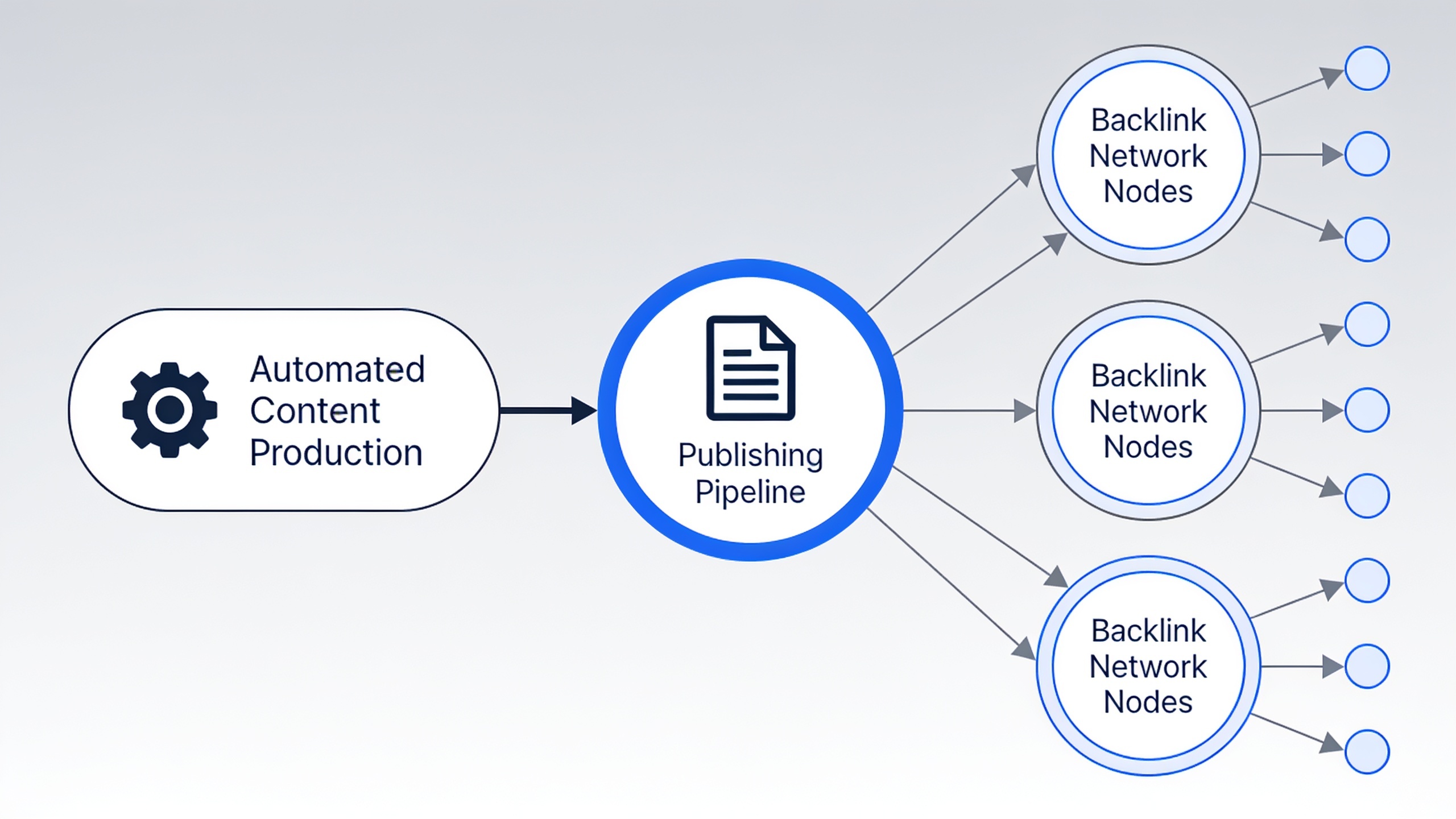
That's basically the model behind how RobinRank works: it writes, optimizes, and publishes SEO-focused articles automatically, and it plugs sites into a natural backlink exchange network to support off-page authority. Those two levers, content volume and links, are the ones startups almost never manage to resource internally at the same time. So instead of the brutal binary of "hire a full team" or "give up on content," founders can run a system that behaves like a content team without dragging that headcount onto the balance sheet.
One thing I want to be honest about, though. Automation shouldn't replace everything. The strategic calls, which markets to chase, what actually makes your product different, which competitor gaps are worth attacking, still lean hard on human insight. Especially from founders and subject-matter experts who understand the customer better than any model ever will. The best setups I've seen pair that human strategy with automated execution. They don't try to automate the thinking itself.
In-House Team vs. Freelancers vs. AI-Assisted Content: A Comparison
Every approach trades off differently on cost, speed, consistency, and scalability, and the right pick honestly depends on your stage and your budget. There's no universally "best" option here. But for early-stage startups specifically, the math tends to tilt toward automation-assisted models, because they solve the consistency problem without the fixed weight of full-time salaries.
| Factor | In-House Team | Freelancer Network | AI-Assisted Platform (e.g., RobinRank) |
|---|---|---|---|
| Approximate monthly cost | $15,000–$29,000+ | $2,000–$8,000 | Typically a fraction of freelancer costs, often subscription-based |
| Time to first published content | 4–8 weeks (hiring + onboarding) | 1–3 weeks | Days |
| Consistency of publishing cadence | High, if retention is stable | Variable, depends on freelancer availability | Very high, automated scheduling |
| Keyword/topic strategy depth | Strong, if strategist is experienced | Inconsistent across freelancers | Data-driven and continuously updated |
| Management overhead required | High | Moderate to high | Low |
| Scalability (10x content volume) | Requires more hires | Requires more freelancers, more coordination | Scales without proportional cost increase |
| Best suited for | Well-funded companies with dedicated marketing budget | Mid-stage companies testing content-market fit | Pre-seed to Series B startups needing volume fast |
If there's one thing to pull out of that table, it's this: scaling content without a team was never about finding cheaper humans. It's about removing the parts of the process that don't need a human at all, so the humans you do have can spend their time on strategy, product insight, and reviewing output instead of grinding through first drafts.
Building a Lean Content Engine That Scales
A lean content engine that scales combines a clear topical strategy, automated production for volume and consistency, and a small dose of human oversight for quality and direction. That's the setup that lets a two-person team, or even a solo founder, go toe-to-toe with companies whose content departments are ten times the size.
Step 1: Map Topic Clusters Before Writing Anything
Start with a pillar-and-cluster structure. Pick three to five core topics that sit at the heart of your product, then map 10 to 20 supporting subtopics under each. This one move prevents the classic startup mistake: scattered, disconnected posts with zero internal linking logic.
Step 2: Automate the Repetitive 80%
Drafting, on-page SEO formatting, meta descriptions, publishing. Automation handles all of it reliably and fast. Offloading this layer is what actually cracks the "scaling content without a team" problem. And it's not about writing faster, it's about not needing a human to do that specific task at all.
Step 3: Keep Human Review in the Loop
Even a fully automated pipeline benefits from a human giving each piece a once-over for accuracy, tone, and factual claims. Especially in regulated spaces like finance, health, or legal, where a mistake carries real risk. A 20-minute review pass beats writing the thing from scratch every single time.
Step 4: Build Backlinks Alongside Content Volume
Content with no off-page authority plateaus. Full stop. That's why pairing content automation with link building (like RobinRank's natural backlink exchange network) matters so much. Volume gets you indexed and topically relevant, but earned or exchanged links are what let you actually leapfrog the established players.
Step 5: Review Performance Monthly, Not Daily
Startups check analytics way too often and then draw wild conclusions from two weeks of noise. SEO content usually needs 3 to 6 months to show its real trajectory, a pattern that's well documented across Ahrefs and Semrush content marketing case studies. Set a monthly review cadence for rankings, traffic, and conversions, and please, resist the urge to blow up your whole strategy after a couple flat weeks.
Frequently Asked Questions
How long before startup content marketing actually shows results?
Most startups start seeing measurable organic traffic growth somewhere between three and six months after they've locked in a consistent publishing cadence, though brutally competitive niches can stretch that to nine or twelve. And that timeline assumes consistent output, not sporadic posting. Which is exactly why consistency, not raw writing talent, is usually the thing that decides who wins.
Can a solo founder really run a content program alone?
Yes, but only with either a serious time commitment or automation backing you up. A solo founder writing by hand can realistically sustain two to four quality articles a month before burnout or competing fires take over. Automation can push that output way higher without piling more onto the founder's plate.
Does Google penalize AI-generated content?
No. Google has said outright that its ranking systems care about content quality and helpfulness, not how the content was made. What gets penalized is low-value, spammy stuff built purely to game rankings, and it doesn't matter whether a human or an AI produced it. Well-optimized, accurate, genuinely useful AI-assisted content performs the same as well-written human content in search.
How many articles a month does a startup need to compete?
Depends on how competitive your niche is, but most B2B startups need 8 to 20 well-optimized articles a month to build meaningful topical authority within 6 to 12 months. If you're in a cutthroat SaaS category, you'll probably need to sit near the top of that range or above just to catch up to the incumbents.
What's the real difference between freelancers and an AI content platform?
Freelancers give you flexible, human-written content, but you're also signing up for variable quality, coordination headaches, and per-article costs that scale straight up with volume. AI platforms like RobinRank automate the research, drafting, optimization, and publishing at a more predictable price, so you can scale volume without scaling your management time or budget right along with it.
Look, scaling content without a team isn't some scrappy workaround for startups too broke to hire. It's fast becoming the default operating model for lean companies that would rather sink their limited budget into product and growth experiments than a full content department. The startups winning organic search in 2025 aren't necessarily the ones with the biggest teams. They're the ones that built systems combining strategic clarity with automated execution, systems that don't collapse the moment someone gets slammed with something else.
Ready to stop writing content by hand? Start your free RobinRank trial and get a full month of SEO-optimized articles published on autopilot.