How to Measure ROI on AI Content Marketing Tools

So that's what this guide is about. I'll walk through how to track each of those variables, which metrics matter at which stage, and how to throw together a simple ROI model you can update once a month without it eating your afternoon. Doesn't matter much whether you're an SEO trying to justify a new tool, a founder deciding between AI and a full-time hire, or an agency reporting back to clients. Same framework applies.
Table of Contents
- What Is AI Content ROI, and Why Is It Hard to Measure?
- How Do You Measure Content Marketing ROI Before Adding AI?
- Tracking Traffic Growth From AI-Generated Content
- Calculating Cost Savings vs. a Human Content Team
- Measuring Conversion Impact, Not Just Traffic
- Building a Monthly AI Content ROI Report
- Common Mistakes That Skew ROI Calculations
- Frequently Asked Questions
What Is AI Content ROI, and Why Is It Hard to Measure?
AI content ROI is the ratio of value a platform generates (traffic, leads, revenue, saved labor hours) to what it costs you to run it (subscription, editing time, human oversight). The formula itself is dead simple: ROI = (Value Generated − Total Cost) / Total Cost × 100.
The math is easy. The measuring is where it gets messy, and the reason is content's built-in delay. You publish an article today and Google might not fully index or rank it for weeks. Ahrefs ran a study back in 2023 across two million pages and found that the average page sitting in Google's top 10 was about two years old, though plenty of pages pull real traffic within the first three to six months. Either way, that lag matters. A snapshot ROI number you take 30 days after switching on a tool is going to lie to you, and it'll almost always lie low.
Then there's attribution, which is the part that actually keeps me up at night. If you're publishing AI-written articles alongside your existing content, your sales team, and your paid campaigns, figuring out which leads came specifically from the new stuff is genuinely hard. You need clean UTM tagging, you need to actually use Google Search Console, and you need a defined "before" baseline to measure against. Skip any of those and you're basically guessing.
How Do You Measure Content Marketing ROI Before Adding AI?
You measure content marketing ROI by nailing down a baseline first: your current output, cost per piece, organic traffic, and conversion rate before you touch a single new tool. Then you track those same numbers afterward and look at the difference. Skipping this baseline is, hands down, the number one reason marketers can't prove (or disprove) AI content ROI later. They just don't have a "before" to point at.
So for the three to six months before you adopt anything, pull together your total content spend (writer fees, prorated editor salaries, freelancer invoices, any SEO tools you use specifically for content), your publishing velocity in articles per month, and your average cost per article, which is just spend divided by articles. Then grab your organic sessions and keyword rankings out of Search Console and GA4, and your conversion rate on organic content pages (leads or sign-ups or purchases, divided by organic sessions on your blog URLs).
Once you've got those five numbers, congratulations. You now have a control group of one, which is your own site's history. And honestly, that's worth more than any industry benchmark you'll find online, because publishing cadence, niche competitiveness, and domain authority vary so wildly that generic averages are pretty much useless for a decision this specific. Reference your own baseline, not somebody's blog post about "average content ROI."
If you're still working out what a tool will run you relative to what you spend now, it's worth reading up on how much AI content marketing actually costs in 2025 before you lock in that baseline, since pricing swings a lot based on how much you're publishing and which SEO features come bundled in.
Tracking Traffic Growth From AI-Generated Content
To measure traffic growth from AI content, segment out organic sessions, keyword rankings, and indexation rate for the URLs your AI tool published, then compare that segment against your pre-AI baseline over a similar stretch of time. The whole game is segmentation. Dump AI-published pages in with your entire site's traffic and you'll never untangle cause from effect.
Setting Up Proper Segmentation
In GA4, set up a content grouping or a custom dimension that tags anything published through your AI tool. Most platforms, RobinRank included, apply a consistent URL slug pattern or a publish-date range you can filter by, so this is usually less painful than it sounds. Over in Search Console, use the "Pages" filter with a URL pattern match to isolate the exact same set of pages.
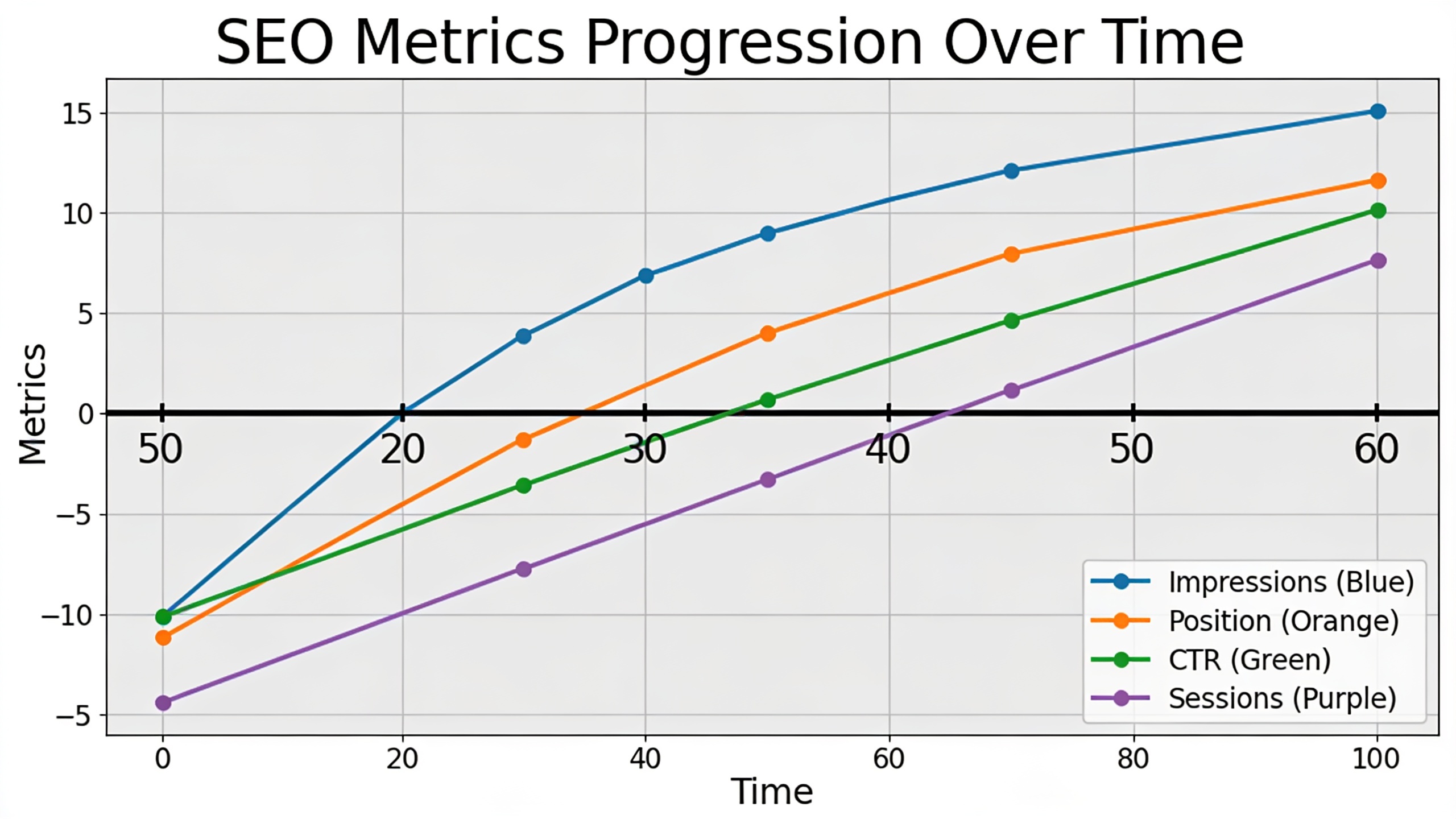
Then track four things weekly for that segment. Impressions come first, because they're your earliest signal that Google is even showing your pages before rankings settle. Average position tells you where you're landing for target keywords (expect a slow crawl upward over 8 to 16 weeks for anything competitive). Click-through rate tells you whether your titles and meta descriptions are actually pulling people in. And organic sessions is the number that ties everything back to revenue.
Setting Realistic Timelines
Here's where I have to be a bit of a buzzkill: don't expect much in the first 30 days. Indexing and ranking take time, full stop. A more honest window is 90 days for early signals and six months for the real picture, especially if you're fighting for competitive B2B or SaaS keywords. If you want a low-effort way to keep the publishing engine running so you've actually got enough data points to analyze, setting up an automated SEO content workflow in 30 minutes means you're not bleeding weeks to manual publishing delays that muddy your whole traffic timeline.
Calculating Cost Savings vs. a Human Content Team
Cost savings from AI content tools come from three places: a lower cost per published article, faster turnaround, and less overhead than hiring writers, editors, and SEO strategists separately. But if you want a real number, compare the fully loaded cost per article for each model. Not the sticker price on the software. The whole thing.
For a human team, "fully loaded" means the freelance writer fees (usually somewhere between $50 and $400 per article depending on length and expertise, per rates reported by the American Writers & Artists Institute and the various freelance marketplaces), plus your editor or content manager's time to review and format, plus an SEO specialist's hours for keyword research and internal linking, plus the project management overhead of just scheduling and shipping the thing. It adds up faster than people expect.
An AI platform, by contrast, is usually a flat monthly subscription covering a set volume of articles, often with keyword research, on-page SEO, and publishing baked in. Here's roughly how the two stack up at a moderate volume:
| Cost Factor | Traditional Human Team (10 articles/month) | AI Content Platform (10 articles/month) |
|---|---|---|
| Writing cost per article | $150-$400 | Included in subscription |
| Editing/QA time per article | 30-60 minutes (staff time) | 5-15 minutes (review only) |
| SEO research per article | Separate tool or specialist hours | Typically automated |
| Publishing/formatting | Manual (CMS upload, image sizing) | Often automated |
| Estimated monthly cost | $1,800-$5,000+ | $200-$1,000 (typical platform tiers) |
| Time to publish 10 articles | 2-4 weeks | Same day to a few days |
Obviously these ranges shift depending on your niche and your quality bar, so run your own numbers off actual invoices and time-tracking data instead of taking mine as gospel. And I want to be clear about what this table is not saying. It's not claiming AI is cheaper in every scenario. A specialized, thought-leadership B2B blog might genuinely still need human expert writers, and no amount of automation changes that. The table's just a template for working out your own delta.
Want content like this running on autopilot for your own site? Try RobinRank free — AI-written, SEO-optimized articles generated and published automatically, no credit card required.

To turn savings into an ROI number: Cost Savings ROI = (Previous Cost Per Article − New Cost Per Article) × Monthly Article Volume. Say your old cost per article was $250 and the AI platform drops it to $40 at the same 10 articles a month. That's $2,100 saved every month, money you can throw back into paid promotion, link building, or just more content.
Measuring Conversion Impact, Not Just Traffic
Conversion impact is the revenue or pipeline value that comes from people who arrived through your AI-published content, and honestly it matters more than raw traffic ever will. Traffic that doesn't convert doesn't pay for the tool. A page can rank beautifully and pull in a crowd of visitors with zero purchase intent, and all you've bought yourself is a nice-looking vanity metric.
Setting Up Conversion Tracking
To track this properly, set up goal tracking in GA4 for the actions that actually matter to your business: trial sign-ups, demo requests, newsletter subs, purchases, whatever moves your needle. Then attribute those conversions back to the landing page and source using GA4's attribution reports, or wire it into a CRM like HubSpot or Salesforce that captures the original landing page in the lead record.
And if you're in content-driven B2B, don't stop at the first conversion. Track assisted conversions too, the ones where a blog post nudged a deal along even though the buyer eventually converted through some other channel. GA4's multi-channel funnel data (or your CRM's first-touch and multi-touch models) will sometimes show you that a piece of AI-published content quietly contributed to a closed deal weeks after the visitor first landed. That stuff is easy to miss and it's real money.
Calculating Revenue-Based ROI
Once you know how many conversions trace back to AI-published pages, multiply by your average customer value (or deal size for B2B) to get revenue attributable to the content. Then run it against total tool spend:
Content ROI (%) = [(Attributed Revenue − Total Content Cost) / Total Content Cost] × 100
Quick example. Say your AI articles drove 40 trial sign-ups in a quarter, your trial-to-paid rate is 15%, and your average customer lifetime value is $1,200. That works out to roughly $7,200 in attributable revenue. Against a quarterly tool spend of $900, you're looking at something like a 700% return. And even if you slap a conservative discount on that (because no, not every one of those conversions is purely content-driven), the margin is usually wide enough that you can tolerate messy attribution and still come out looking great. That's kind of the whole point.
Building a Monthly AI Content ROI Report
A good monthly ROI report pulls traffic, cost, and conversion data into one dashboard so people can see the whole story in a single glance instead of hunting across three tools. And I'll say this bluntly: consistency beats sophistication every time. A boring spreadsheet you actually update every month will out-perform the slickest dashboard nobody ever opens.
At a minimum, mine tracks articles published this month plus the cumulative total since adoption, total cost this month (subscription plus whatever editing and oversight labor you spent), and cost per article as a trend line so you can watch efficiency improve. Then organic sessions to AI-published pages month over month, keyword rankings gained (especially anything that clawed its way into the top 10), conversions attributed to those pages with an estimated revenue value, and finally cumulative ROI using the formula from the last section.
One trick I really like: plot cost per article against organic traffic growth on the same timeline. Early on your cost per unit of traffic looks brutal, because nothing's ranking yet. But somewhere around months 4 through 12 the curve starts bending upward as your older articles compound. This isn't just my hunch either, it's well documented in both Ahrefs' and HubSpot's content marketing benchmark studies, both of which hammer the same point: content ROI compounds, it doesn't arrive in a neat straight line.
If you're an agency running this across a bunch of clients, standardize the template. Same report, every account. That way you can benchmark which niches and content types are actually delivering, and you can lean on those insights when you're pitching new clients on what realistic timelines look like.
Common Mistakes That Skew ROI Calculations
The single most common mistake is judging results too early, before content has had time to index, rank, and pile up traffic. You want a 90-day window minimum and ideally six months for anything reliable. Evaluating a content investment at day 30 is about as useful as judging a fitness program after one workout.
A few other traps people fall into. First, ignoring editing and oversight time. Even the best AI tools still need a human pass for brand voice, factual accuracy, and the E-E-A-T signals Google leans on in its search quality guidelines, and if you don't count that time in your cost basis, your savings look better than they really are. Second, comparing against a garbage baseline. If your old content program was inconsistent or basically dead, almost anything will look like a win, so use an honest, representative period, not your worst months cherry-picked to flatter the tool.
Third, and this one's sneaky: crediting the AI tool for all your traffic gains. Algorithm updates, seasonal demand, new backlinks, technical SEO fixes, all of these move organic traffic on their own. Isolate the AI-published URLs specifically rather than handing the tool a trophy for site-wide growth it didn't cause. Fourth, overlooking backlink and internal linking effects. Platforms with a backlink exchange network or automated internal linking can push rankings beyond the writing itself, so figure out whether your gains come from content quality, SEO structure, or link equity, because each one means something different for your long-term strategy.
And last, not accounting for compounding. An article you shipped in month one might still be climbing in month twelve. Any ROI model that only looks at the current month is quietly understating the whole value of your content library.
Frequently Asked Questions
How long before I actually see ROI from an AI content tool?
Most businesses catch measurable organic traffic movement within 60 to 90 days of consistent publishing, with the more substantial ROI usually landing between months 4 and 12 as pages stack up rankings and backlinks. Really competitive keywords or brand-new domains with thin authority will take longer. Niche, low-competition topics can move faster.
What's a good ROI benchmark for AI content marketing?
There isn't a universal one, because it hangs on your average customer value, your publishing volume, and how brutal your niche is. That said, a lot of businesses aim for 3x to 5x (that's 300% to 500% ROI) in the first year, counting both cost savings and revenue attribution. Track your own cost-per-article and conversion trends rather than chasing some industry-wide figure, since niche and business-model differences make broad benchmarks pretty unreliable.
Should I count editing time when I calculate ROI?
Yes. Absolutely. Even AI-generated content usually needs a human review pass for accuracy, voice, and internal linking, and that time is real labor with a real cost that belongs in your total. Leave it out and your ROI number is basically fiction compared to what you're actually spending.
How do I attribute conversions to specific blog articles?
Use UTM parameters or GA4's landing page reports alongside your CRM's first-touch attribution field to tie a specific conversion (a sign-up, a demo, a purchase) back to the article that brought the visit in. For longer B2B sales cycles, dig into multi-touch reports to see whether a piece played an assisting role even if it wasn't the last touch before the deal closed.
Is measuring ROI different for agencies juggling multiple clients?
The core framework (cost per article, traffic segmentation, conversion attribution) is exactly the same. But agencies should standardize their reporting templates across every account so results are comparable and can shape pricing and timeline expectations for new clients. You also need to factor your own margin on top of the tool cost when you're figuring out client-facing ROI versus your actual internal profitability.
Look, measuring AI content ROI isn't some mysterious dark art. It's the same as measuring any marketing investment, it just demands patience with timelines and discipline with your data. Start with an honest baseline, track cost per article next to traffic and conversions in one report, and give the content enough runway to compound before you pass judgment. Do that consistently and "does AI content even work for us?" stops being a shrug and starts being a number you can defend in any budget conversation.
Ready to stop writing content by hand? Start your free RobinRank trial and get a full month of SEO-optimized articles published on autopilot.