How Much Does AI Content Marketing Cost in 2025?
The reason that range is so absurdly wide is that "AI content marketing" isn't really one thing. It covers everything from a $20/month writing assistant that helps you unstick a paragraph, all the way to a fully autonomous engine that researches keywords, drafts the article, optimizes it for search intent, and pushes it live to your CMS while you're asleep. Figuring out where your business sits on that spectrum is honestly the whole game when it comes to budgeting.
Table of Contents
- What Determines AI Content Marketing Cost?
- AI Content Tool Pricing Models Explained
- What Is the Average Cost Per AI-Written Article?
- SEO Software Pricing: How It Factors Into Total Cost
- AI Content Marketing Cost by Business Size
- ROI Expectations: What You Get Back
- Hidden Costs to Watch For
- How to Choose the Right Budget Tier
- Frequently Asked Questions
What Determines AI Content Marketing Cost?
Your total cost comes down to five things: how much you publish, how automated the whole process is, how deep the SEO features go, whether it can publish for you, and whether you're paying a flat subscription or buying credits by the article. A company cranking out four articles a month with a basic writer is playing a completely different budget game than one shipping 50 optimized, auto-published pieces through an end-to-end platform.
Volume is the big one. Most subscription platforms price by word count or article count, so a plan for 10 articles a month might run $99, while a 100-article plan could hit $999 or more. And if your strategy calls for publishing three to five times a week (which a lot of SEO teams aim for), your subscription tier had better keep up. Otherwise you'll smack into your caps and start bleeding overage fees.
Automation depth is where the pricing gets interesting, and where a lot of people get the math wrong. Basic writing assistants (outline generators, paragraph rewriters, that sort of thing) are cheap because a human still has to research, edit, format, and publish everything. Fully automated platforms cost more per seat, but they gut the labor cost sitting underneath the software price. Something like RobinRank researches the topic, writes the full article, handles on-page SEO, and publishes straight to your site. When you're comparing tools, the question I'd always ask is: after this software runs, what am I still paying a human to do?
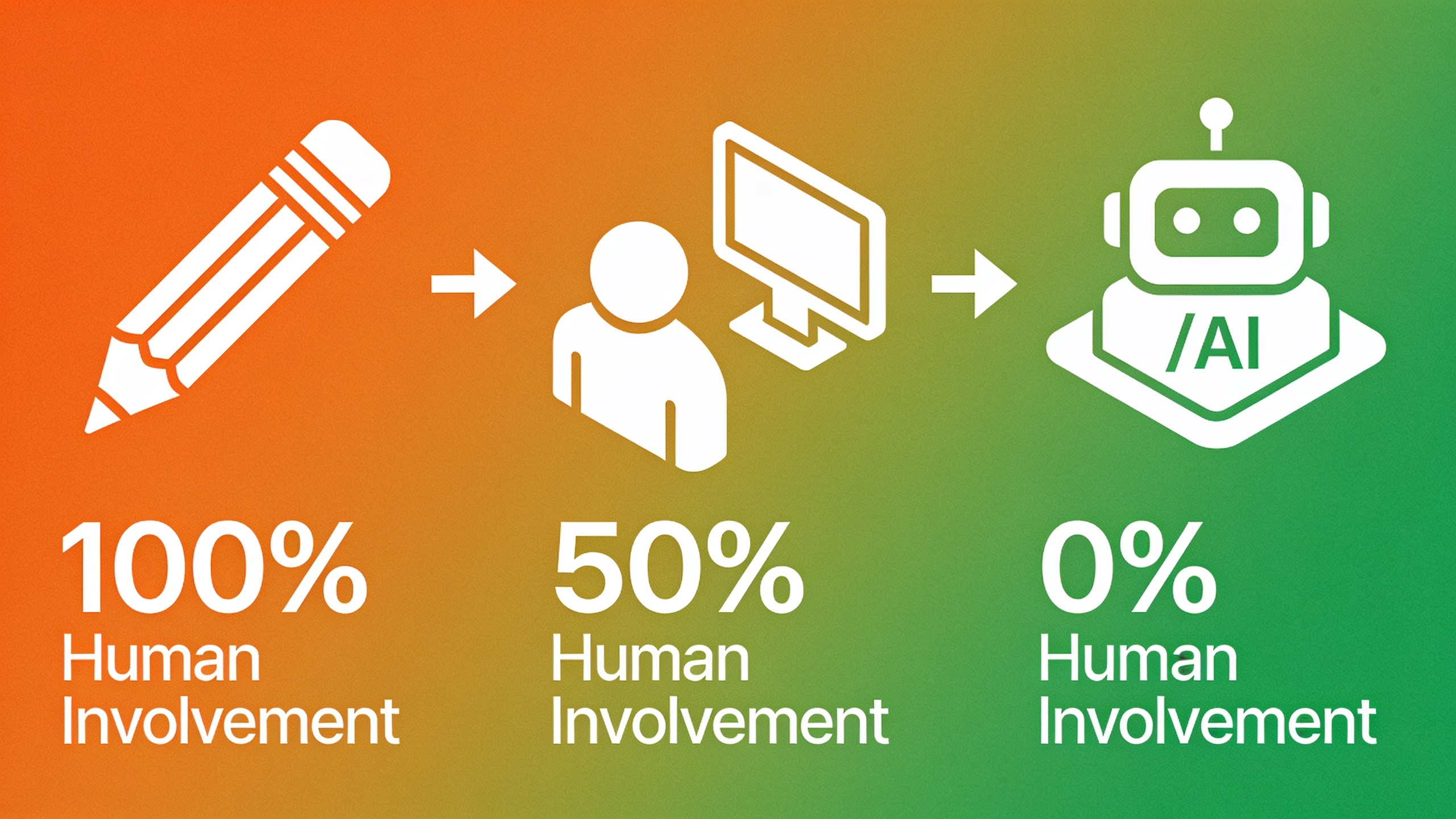
Then there's SEO depth. A tool that only spits out text is cheaper than one that also does keyword research, internal linking, schema markup, meta tags, and backlink strategy. SEO software usually costs more than a plain writing tool, so bundling the two changes the whole equation. You might pay more per month but kill your separate SEO subscription entirely.
Publishing and integration matter too. Some tools hand you a draft you have to copy-paste into your CMS yourself. Others plug straight into WordPress, Webflow, Shopify, or your API. Direct publishing tends to live in the mid-tier and up, mostly because it takes more infrastructure and support on the vendor's end to pull off.
AI Content Tool Pricing Models Explained
AI content tools basically price themselves one of four ways: flat monthly subscriptions, word or credit metering, per-article pricing, or custom enterprise contracts. Each one suits a different kind of buyer.
Flat monthly subscriptions are the most common, and for good reason. You pay a fixed fee for a set quota of articles, words, or credits, plus the dashboard, integrations, and support. It's predictable and dead simple to budget for, which is exactly why most small businesses and agencies gravitate toward it.
Word or credit metering charges you based on what you actually use. Every word or "credit" chips away at a balance. Great if your content needs are all over the place month to month. Not so great when usage spikes and you open a bill that makes you wince.
Per-article or per-project pricing shows up a lot with freelance-adjacent AI services, or agencies that use AI behind the scenes but bill clients per deliverable. You're looking at $50 to $300 for a single AI-assisted, human-edited article, depending on length, research, and how many revisions you drag them through.
And custom enterprise pricing is the big-org stuff: dedicated support, custom integrations, security reviews (SOC 2, SSO), volume discounts. These get negotiated directly and almost never show up on a public pricing page.
| Pricing Model | Typical Monthly Cost | Best For | Main Drawback |
|---|---|---|---|
| Flat subscription | $49–$999+ | Small businesses, agencies, consistent publishers | Overage fees if volume grows |
| Word/credit metering | $20–$500+ (variable) | Teams with unpredictable content needs | Unpredictable bills at scale |
| Per-article pricing | $50–$300 per article | One-off projects, occasional publishers | More expensive per piece long-term |
| Enterprise/custom | $2,000–$10,000+ | Large teams, agencies with many clients | Requires sales negotiation, longer onboarding |
What Is the Average Cost Per AI-Written Article?
An AI-generated, SEO-optimized article through a subscription platform runs somewhere between $5 and $50 in 2025. Compare that to $100 to $500+ for a human-written, professionally edited piece from a freelancer or agency, and you've got the entire economic case for AI content marketing in one line.
Do the math and it gets kind of ridiculous. If a $299/month plan includes 30 articles, you're paying under $10 each. A traditional agency charging $250 an article for that same volume? That's $7,500 a month. Roughly 25 times more. Now, that doesn't mean AI is automatically the right call for everything. Deeply technical stuff, highly specialized topics, real thought-leadership pieces still want serious human involvement. But for standard SEO blog content, informational guides, and product pages, the cost efficiency is honestly hard to argue with.
Here's the catch, though. Those "cost per article" numbers get slippery if the platform doesn't also handle optimization and publishing. A cheap draft that still needs an SEO specialist to rewrite the headers, add internal links, and format it for upload isn't really saving you much. You've just shuffled the cost from the software line to the labor line. Which is a big part of why a lot of teams are moving toward platforms like RobinRank that fold writing, on-page optimization, and publishing into a single price, instead of stacking three separate tools and three separate invoices.
SEO Software Pricing: How It Factors Into Total Cost
SEO software is the piece of the budget people forget about, and it matters because content without SEO optimization basically doesn't rank. Standalone SEO tools for keyword research, rank tracking, and technical audits typically run $99 to $500+ per month, and that's on top of whatever you're already paying to generate content.
The old-school content stack looked something like this: a keyword tool ($99–$199/month), a content optimization tool ($100–$300/month), an AI writing assistant ($50–$100/month), and a rank tracker ($50–$150/month). That's $300 to $750 a month before a single writer or editor gets paid. In 2025, more businesses are collapsing that stack, because integrated platforms that bake SEO into the writing tool usually cost less overall than four separate subscriptions. Plus you skip the tedious data-shuffling between tools.
When you're sizing up SEO software as part of your content budget, look past the keyword suggestions. Does it analyze competitor content gaps? Does it recommend internal links on its own? Does it generate schema markup? Those features often justify a higher sticker price because they replace work an SEO specialist would otherwise bill you hourly for. And if you're an agency juggling multiple client accounts, the consolidation math matters even more. The guide on how marketing agencies can scale client SEO with AI digs into exactly how agencies rebuild their tool stack (and their margins) when they switch to an all-in-one approach.
AI Content Marketing Cost by Business Size
Costs scale pretty predictably with publishing volume and team complexity. Solo founders and small businesses usually spend $50–$500 a month, growing agencies land at $500–$3,000, and enterprises are in the $3,000–$15,000+ range.
Want content like this running on autopilot for your own site? Try RobinRank free — AI-written, SEO-optimized articles generated and published automatically, no credit card required.
If you're a solo founder or small business publishing one to eight articles a month, entry-level and mid-tier plans do the job. Budget $50 to $500 monthly for a combined writing-and-optimization tool. At this stage the goal isn't cranking out volume, it's showing up consistently. Even modest, well-optimized content can move real organic traffic in a low-competition niche, so the win is publishing on a schedule and not falling off.
Growing businesses and agencies are a different animal. If you're managing content for multiple clients, or scaling to 20–50 articles a month, you'll want mid-to-upper tiers, usually $500 to $3,000 a month, sometimes spread across multiple seats or client workspaces. At this volume, bulk publishing, white-label reporting, and multi-site management stop being nice-to-haves and start being worth paying for. Agencies especially benefit from platforms that let them swap backlinks across a client network instead of buying links one at a time, which changes both the cost structure and what they can actually promise clients.
Enterprises and high-volume publishers, the folks shipping 100+ articles a month across multiple domains, brands, or languages, are almost always on custom pricing. That's $3,000 to $15,000+ monthly, typically bundling dedicated account management, custom enterprise CMS integrations, security compliance, and priority support SLAs.
| Business Type | Monthly Article Volume | Typical Monthly Budget | Common Priorities |
|---|---|---|---|
| Solo founder / small business | 1–8 articles | $50–$500 | Consistency, basic SEO optimization |
| Growing business / agency | 20–50 articles | $500–$3,000 | Bulk publishing, multi-client management |
| Enterprise / high-volume publisher | 100+ articles | $3,000–$15,000+ | Integrations, compliance, dedicated support |
ROI Expectations: What You Get Back
For most small-to-midsize businesses, AI content marketing pays for itself in three to nine months, mostly through organic traffic growth that weans you off paid ads over time. How fast depends heavily on how competitive your niche is, how good the content actually is, and whether it's genuinely optimized for search intent rather than just churned out by the ton.
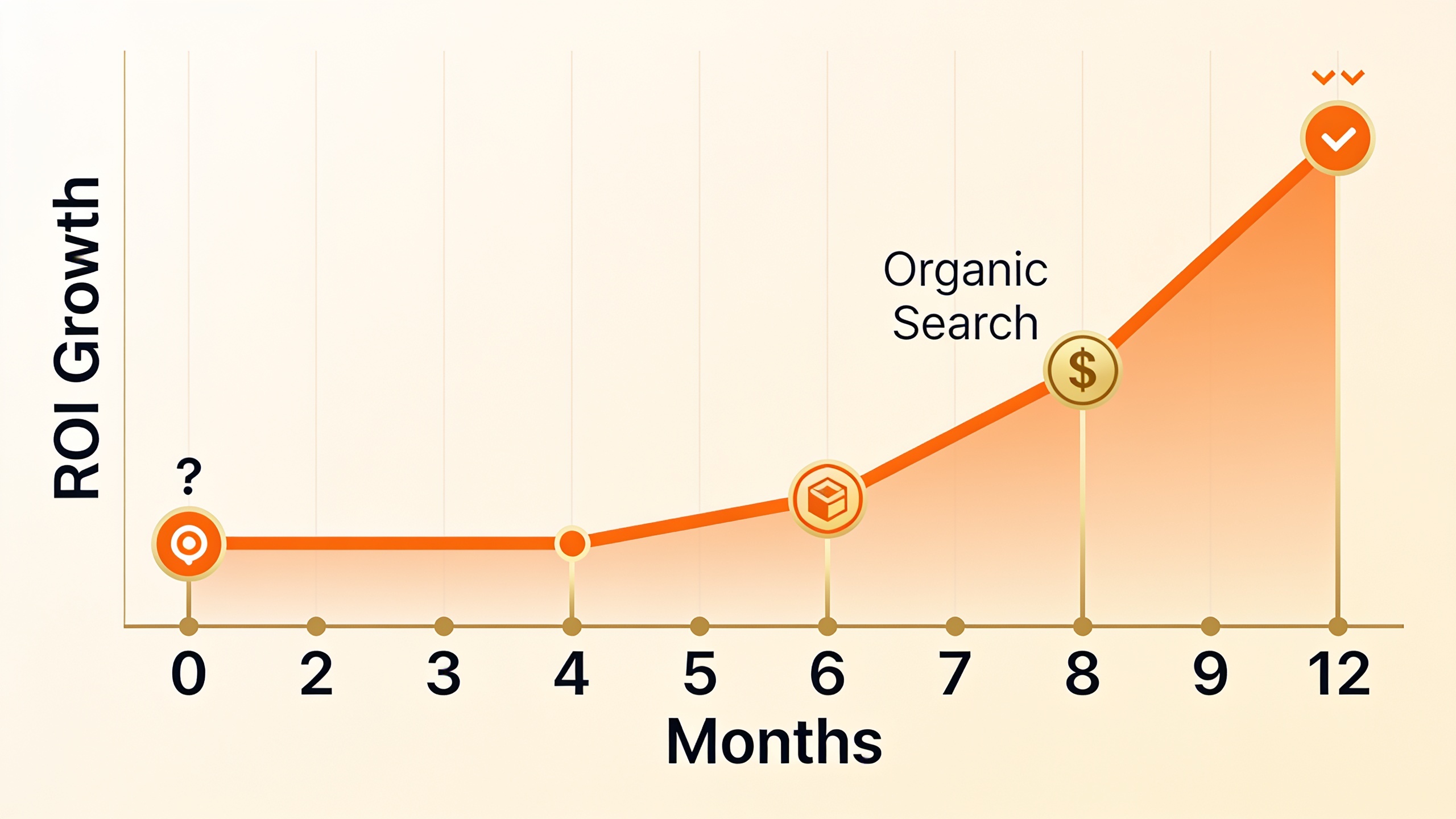
Content ROI has always been a compounding asset, not a one-and-done transaction. A paid ad stops working the second you stop paying. A well-optimized article can keep ranking and pulling organic clicks for years. According to HubSpot's State of Marketing research, companies that prioritize blogging are more likely to report positive ROI from their content, and that compounding effect is exactly why cost-per-article comparisons only tell half the story. The number that actually matters is cost-per-organic-visitor over a 12-month window. Not cost-per-piece-of-content.
If you want to estimate your own ROI, I'd measure it against three benchmarks.
First, traffic value. What would it cost to buy that same traffic through paid search? If an article ranks for keywords that'd run you $2 a click in Google Ads, and it pulls 500 organic clicks a month, that single article is worth roughly $1,000/month in equivalent ad spend.
Second, lead and conversion value. Track how many leads or sales come from organic content versus what it cost you to make it. A $10 article that produces one $500 sale over its lifetime has already returned 50x. That's not a typo.
Third, time saved. Count the hours your team would otherwise burn on research, drafting, editing, and formatting. If a platform automates that, the labor you're not paying for is a direct, tangible return, before a single visitor even shows up.
If you're brand new to all this, it's worth reading a broader primer like What Is AI Content Marketing? A Complete 2025 Guide before you commit a budget. Understanding how AI content actually earns rankings makes it a lot easier to set realistic ROI timelines instead of expecting fireworks overnight.
Hidden Costs to Watch For
The advertised subscription price is almost never the real number. A few sneaky costs love to inflate your actual budget, and they catch people off guard constantly.
The first is editing and quality control. Even the best AI tools benefit from a human giving them a once-over, especially for accuracy, brand voice, and the E-E-A-T signals (Experience, Expertise, Authoritativeness, Trustworthiness) that Google's search quality guidelines lean on hard. If your tool needs heavy manual editing before anything is publish-ready, that labor cost can easily blow past the software subscription itself.
Then there are overage and add-on fees. Plenty of plans cap your article or word counts, and blowing past your tier either triggers per-article charges or forces an upgrade. Read the fine print on what happens when you hit the limit. Seriously.
Integration costs sneak in too. If a tool doesn't play nice with your CMS out of the box, you're looking at developer time to wire up a custom connection, or a middleware tool like Zapier to bridge the gap.
But the worst one? Redo costs. Cheap, low-quality AI content that gets penalized, ignored by readers, or just never ranks is pure sunk cost. You paid for something that returns nothing and now has to be rewritten or yanked entirely. In my experience this is the single most expensive "hidden" cost in the whole category, and it's precisely why judging output quality matters way more than chasing the lowest sticker price.
How to Choose the Right Budget Tier
The right budget is the smallest spend that reliably matches your publishing cadence and your quality bar. Not the cheapest. Not the most expensive. Before you compare a single tool, nail down three numbers: your target monthly article volume, your minimum acceptable quality standard, and how much you can actually spend each month.
Publishing fewer than 10 articles a month and mostly need drafts a human will heavily edit? A lower-tier plan in the $50–$200 range is plenty. Need SEO-optimized, mostly-ready content at moderate volume (10–50 articles a month)? Plan on $200–$1,000 monthly for an integrated platform that handles both the writing and the optimization. Running an agency or enterprise publishing at scale across multiple sites or clients? Budget $1,000+ and prioritize bulk management, white-label options, and dedicated support.
One thing that actually works: run a 90-day pilot before you sign anything annual. Track how many articles you really published, how much editing time you saved, and any early bump in organic impressions or clicks (Google Search Console shows you this for free). Real data beats vendor promises every single time.
Frequently Asked Questions
Is AI content marketing actually cheaper than hiring a content team?
In most cases, yeah. A single in-house content writer runs $50,000–$70,000 a year in salary alone, before benefits and management overhead, based on typical US marketing salary benchmarks. An AI platform at $500–$2,000 a month ($6,000–$24,000 annually) can often match or beat that in published volume. Just keep an editor in the loop for brand voice and accuracy. That part's still worth a human.
Do I have to pay for SEO software separately from my AI writing tool?
Not necessarily. Standalone SEO software runs $99 to $500+ a month, but a lot of modern AI content platforms fold keyword research, on-page optimization, and publishing into one subscription. That can seriously cut your total cost compared to running everything as separate tools.
How long until I actually see ROI?
Most businesses notice some organic traffic movement within three to six months of publishing consistently, with more meaningful ROI (measurable leads or revenue) usually showing up between six and twelve months. Search engines need time to crawl, index, and rank new content, and rankings tend to climb gradually rather than flip on overnight.
Can free AI tools just replace a paid subscription?
For occasional, low-volume needs, sure, free tools can hold you over. But they usually skip the SEO optimization, the publishing integrations, and the consistent quality control a real content strategy needs. Most businesses outgrow the free tier within a few months of actually committing to a publishing schedule.
What's the biggest budget mistake people make with this stuff?
Picking the cheapest tool without accounting for the hidden labor of editing, optimizing, and publishing every draft by hand. A slightly pricier, fully integrated platform often ends up cheaper overall once you factor in the time you're not spending on work that would otherwise need a dedicated person.
So here's where I land: AI content marketing cost in 2025 isn't a single number, and anyone quoting you one is oversimplifying. It's a budget shaped by how much you publish, how much SEO depth you need, and how much manual work still sits between the software and a live article. Whether you're a solo founder poking at your first $50/month tool or an agency hammering out a five-figure enterprise deal, the smart move is the same. Calculate cost per organic outcome, not cost per piece of content, and pick a pricing model that scales cleanly as you grow. Everything else is noise.
Ready to stop writing content by hand? Start your free RobinRank trial and get a full month of SEO-optimized articles published on autopilot.