How Marketing Agencies Can Scale Client SEO with AI

So let's talk about how that actually works in practice. Not the buzzword version. The real, messy, day-to-day version: which tools matter, how to build the workflow, how to price it, and the mistakes I've watched agencies make when they move too fast.
Table of Contents
- Why Agencies Need AI SEO Now
- What Does AI SEO for Agencies Actually Look Like?
- How Can Agencies Scale SEO Clients Without Hiring More Writers?
- Building an AI-Powered Content Workflow Across Multiple Accounts
- How Much Does AI SEO Save Agencies on Margins?
- Link Building at Scale: The Missing Piece
- Avoiding Common Pitfalls When Scaling with AI
- Choosing the Right AI SEO Platform for Your Agency
- FAQ: AI SEO for Agencies
Why Agencies Need AI SEO Now
Agencies need AI SEO because clients now expect a volume and speed of content that a traditional writer-and-editor team simply can't sustain. That's the blunt version. And the numbers back it up: 88% of marketers said they were using some form of AI in their content production in a 2024 Content Marketing Institute survey, way up from the year before. Which means if you're still running a fully manual shop, you're not the standard anymore. You're the exception.
The problem is baked into the structure of how agencies are built. Picture a mid-size shop with 15-20 SEO clients. Maybe two or three writers, one strategist, one account manager. Each client wants somewhere between 4 and 8 published articles a month to stay competitive, plus on-page work, internal linking, the technical stuff. Do the math and that team is suddenly on the hook for 60 to 160 pieces of decent content every single month. Something has to give. Usually it's the staff (burnout), the freelancers (inconsistent), or the delivery (quietly under-served and hoping the client doesn't notice).
AI changes that equation. And I want to be clear about what I mean, because this gets misunderstood constantly: it's not about replacing your strategist. It's about handing off the repetitive, soul-crushing parts of the job. Keyword clustering. Brief creation. First drafts. On-page optimization. Even pushing the finished piece straight to the client's CMS. Startups hit this exact same wall when they try to grow organically without a real team behind them, which is something I've written about in why startups struggle to scale content without a full team. Agencies are solving the identical problem. They're just solving it across two dozen accounts at once.
What Does AI SEO for Agencies Actually Look Like?
AI SEO for agencies means running keyword research, content drafting, on-page optimization, and publishing across a bunch of client sites from one central dashboard, instead of manually repeating every step for every account. That last part matters. Dumping client briefs into a chatbot one at a time isn't this. That still needs heavy editing and it falls apart the second you're past a handful of accounts.
A workflow that actually holds up at scale usually has automated topic and keyword discovery finding content gaps for each client's niche (no strategist burning hours in keyword tools per account), AI-generated drafts that respect each client's voice and hit the structural basics like headings and meta descriptions with minimal rewriting, direct CMS publishing so nobody's manually uploading anything, and dashboards that show ranking movement and output per client so account managers can report results without building spreadsheets by hand.
The real distinction, and this is the thing I'd underline twice, is between AI as a writing assistant versus AI as an operating system. The assistant model is still one-to-one. Still slow. You're just typing prompts faster. The operating-system model is one-to-many, actually built for scale, where the software writes, optimizes, and publishes so one account manager can genuinely run strategy for a dozen-plus clients instead of hand-drafting every article. Platforms like RobinRank are built around that second idea, and honestly, that's the whole game. If your tool is still one-to-one, you don't have a scaling solution. You have a faster typewriter.
How Can Agencies Scale SEO Clients Without Hiring More Writers?
You scale by moving your people off drafting and onto the stuff AI genuinely can't do yet: strategy, quality review, and talking to clients like humans. That single shift is the biggest lever you've got for improving margins.
Think about what it does to a role. Instead of a writer spending three hours researching and drafting one 1,500-word piece, that same person reviews and lightly edits five AI drafts in the same window. Checking facts. Checking voice. Checking whether it actually fits the strategy. They go from "creator" to "editor and quality gatekeeper," which is a far better use of an experienced person anyway. Nobody skilled loves grinding out first drafts.
Then there's onboarding, which is where a lot of agencies quietly leak their advantage. If you build a repeatable template (brand voice guidelines, target keywords, competitor benchmarks, publishing cadence), you can plug a new client into your system in days instead of weeks. It's basically a manufacturing line. The cleaner and more consistent your setup process, the more accounts one team can absorb without anyone drowning.
And batch your work. This one sounds obvious but almost nobody does it. Rather than crawling through clients one at a time, run keyword research for all ten of your SaaS clients in a single sitting, then generate drafts for all ten, then move to review. Developers have known about batching forever. Context-switching is expensive, and constantly hopping between accounts quietly eats hours you'll never get back.
Building an AI-Powered Content Workflow Across Multiple Accounts
A workflow that scales runs the same five stages, in the same order, for every client: research, brief, draft, review, publish. AI does the heavy lifting at each stage and your people check quality at fixed checkpoints. The consistency is the point. If every account works differently, you don't have a system, you have chaos with a login.
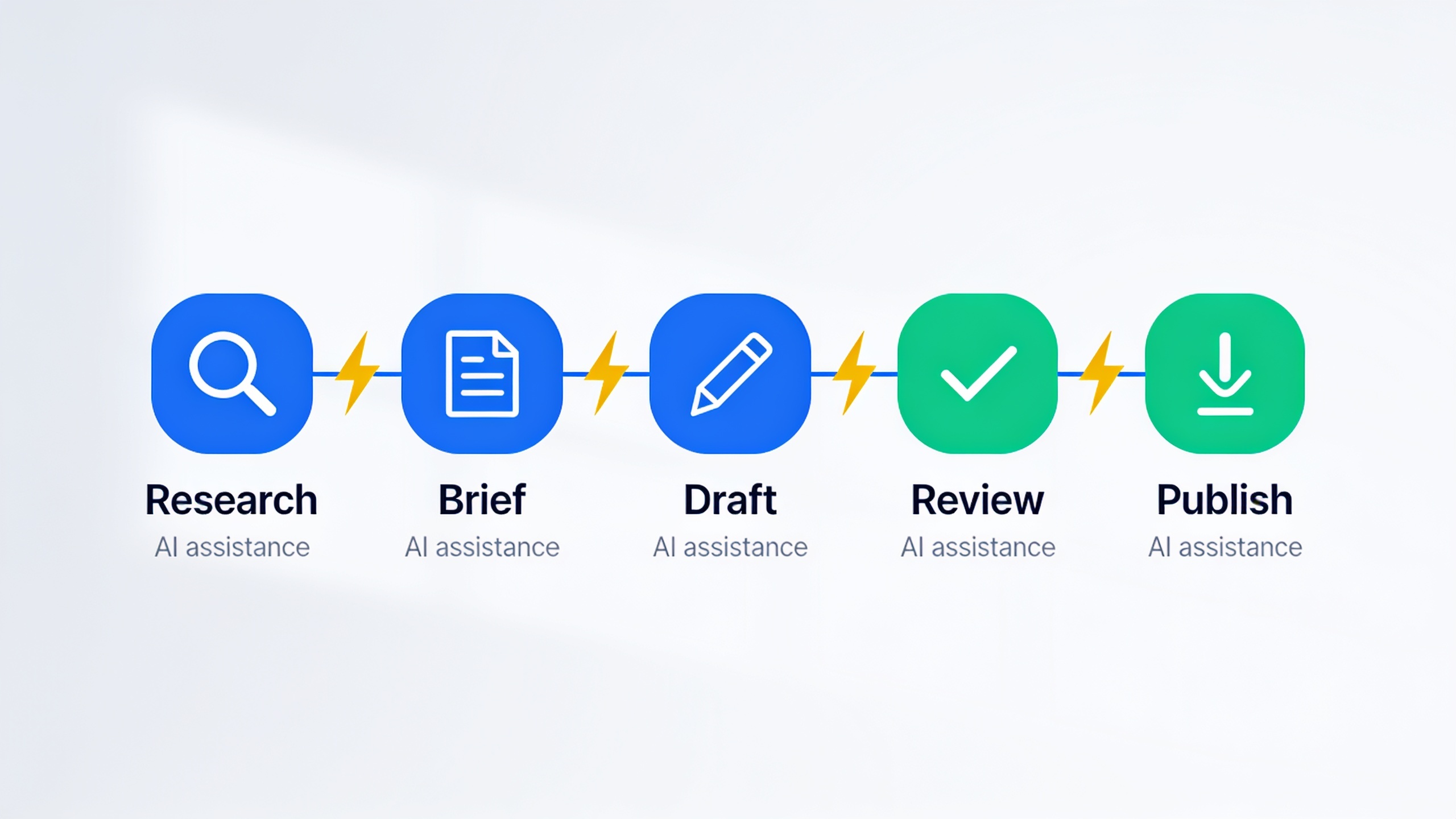
Stage 1: Centralized keyword and topic research. Instead of hunting through disconnected tools for each client, you want one system that ingests each site, its competitors, and its audience, then surfaces opportunities on its own. That turns a multi-hour slog into a review-and-approve.
Stage 2: AI-generated briefs. Automated briefs that spell out target keywords, search intent, competitor gaps, and structure mean your drafts start from something strategically sound instead of a bare prompt and a prayer.
Stage 3: Draft generation at volume. This is where the time savings get almost comical, generating full optimized drafts for a bunch of clients at once instead of one writer chewing through a queue.
Stage 4: Human-in-the-loop review. Keep this. Always. Even the best setup needs a person catching factual slips, checking client-specific rules, and confirming the tone is right before anything goes live. Skip it and you'll regret it, I promise.
Stage 5: Automated publishing and tracking. Approved content goes straight to the client's CMS, performance data flows back into a shared dashboard, and the loop closes. Your account managers get to show ranking and traffic wins without assembling a report from scratch the night before the call.
| Workflow Stage | Manual Process (Traditional) | AI-Assisted Process |
|---|---|---|
| Keyword research | 2-4 hours per client, per month | Minutes per client, batch-processed |
| Content brief creation | 30-60 minutes per article | Auto-generated, reviewed in 5-10 minutes |
| First draft writing | 2-3 hours per 1,500-word article | Generated in minutes, edited in 15-30 minutes |
| Publishing to CMS | Manual upload, formatting, image sizing | Automated publishing integration |
| Reporting to client | Manual spreadsheet compilation | Live dashboard, auto-updated |
How Much Does AI SEO Save Agencies on Margins?
AI SEO improves margins by slashing the labor hours per published piece, though how much you save depends on your account volume, how complex the content is, and how much human review you keep in the loop. Agencies making the jump from manual writing to an AI-assisted review model usually report content costs dropping by roughly half or more, because the most expensive stage, the drafting, collapses from hours into minutes.
Want content like this running on autopilot for your own site? Try RobinRank free — AI-written, SEO-optimized articles generated and published automatically, no credit card required.
Let me put real numbers on it. Say you pay a freelancer $150 per 1,500-word article and you're producing 100 articles a month across 15 clients. That's $15,000 monthly on content alone, before overhead. Now shift the human cost per article down to a review-and-edit task worth maybe $30-40 in an editor's time. Suddenly those same 100 articles cost you closer to $3,000-4,000 in labor, plus your platform subscription. Even after software fees, the margin swing is significant. And that's before you count the new clients you can take on with all that freed-up capacity.
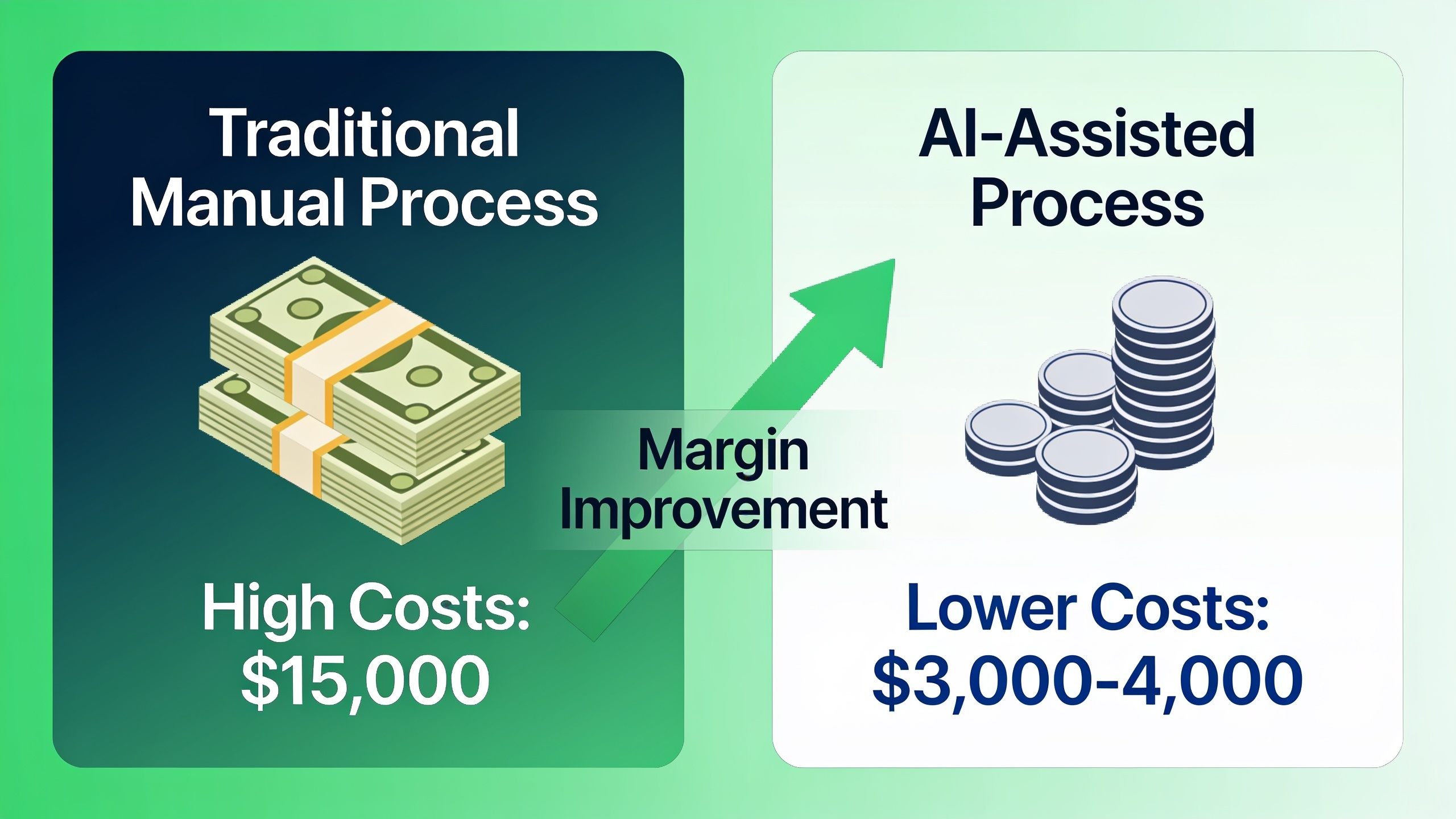
Here's why it compounds: content is almost always the single biggest cost line in an SEO retainer, bigger than technical audits, bigger than link building in most packages. When you get more efficient in your biggest cost center, the effect on profitability is outsized. That's exactly why so many agencies make content their first automation investment rather than starting with reporting or ad tools. It's where the money is.
One caveat, and I feel strongly about this. The margin gains only show up if you actually do something smart with the savings. Push them into lower client-facing prices to win competitive deals, or serve more clients with the same team. What you should not do is turn the savings into a firehose of declining-quality content and call it a win. The agencies that scale well treat AI savings as reinvestment. Hire one senior strategist instead of three junior writers, for example. That's the move.
Link Building at Scale: The Missing Piece
Content is only half of a scalable SEO strategy. Link building is the other half, and it's always been the harder half to scale because it runs on relationships, outreach, and negotiation instead of raw output. I've seen plenty of agencies nail content volume and then watch client rankings just... flatten out. Because backlinks are still one of the strongest signals search engines use to judge authority, and no amount of publishing fixes a link gap.
The trouble is manual link building doesn't scale the way content does. Cold outreach, guest post pitching, babysitting relationships, every placement needs its own individual negotiation. It's slow and it doesn't multiply cleanly. Which is why natural backlink exchange networks have become such a useful companion to AI content production, especially for agencies juggling a lot of sites. I dug into how these work in the ultimate guide to natural backlink exchange networks, but the short version is they connect sites for reciprocal, contextually relevant links at a scale manual outreach can't touch. That matters enormously when you need to build authority for a dozen client sites at once, not one lonely site at a time.
Pair AI content with an automated backlink network and every article you publish isn't just sitting there on a client's blog hoping for the best. It's positioned to pull in relevant inbound links from other sites in the network, so the SEO value of each piece compounds instead of content and links living in two separate, disconnected buckets.
Avoiding Common Pitfalls When Scaling with AI
The biggest danger in scaling client SEO with AI isn't the tech. It's using AI content generation without real quality control, which will absolutely burn client trust and can drag you into search quality trouble. Google's own guidance on AI content, folded into its helpful content system, basically says quality and usefulness to readers matter more than how the thing was made. So the agencies that get hurt are the ones treating AI output as a finished product instead of a strong first draft. Big difference.
The most common mistake, by a mile, is killing the human review step to squeeze out max speed. Don't. Even a ten-minute pass per article catches the factual slips, tone mismatches, and clunky phrasing that quietly erode a client's faith in your work. Ten minutes. That's the price of not embarrassing yourself.
Right behind that is feeding generic prompts into a general tool. "Write an article about X" gets you thin, forgettable content that struggles to rank against anything. The agencies winning with AI use structured, keyword-informed briefs with search intent and competitive gaps spelled out, so the AI has something real to build on instead of guessing.
Then there's brand voice, which clients notice frighteningly fast. If you're running dozens of accounts, you need a tool you can configure per client, not one spitting out the same beige tone across every site. Related to that is the volume trap: publishing more articles is not the same as better SEO. Track rankings, organic traffic, and conversions per client, not article counts. Article counts are a vanity metric. Business outcomes are what keep the account.
Last one, and it's the one people underestimate: onboarding time for the tool itself. Switching your whole content workflow over takes real ramp-up. Training people, building client style guides, testing output before you go wide. Pilot it with two or three clients first. If something needs fixing, you find out before it's touched your entire book of business, not after.
Choosing the Right AI SEO Platform for Your Agency
The right platform for an agency handles multi-client management, publishes directly into client CMS platforms, and lets you customize enough per client that your output doesn't come out sounding interchangeable. Plenty of AI writing tools are built for a single website and turn into a nightmare the moment you try to run 10, 20, or 50 accounts through them. So shop carefully.
A few things I'd genuinely insist on. You want multi-account or white-label dashboards so one person can oversee a lot of pipelines without juggling a dozen logins. You want direct publishing integrations with the usual suspects (WordPress, Webflow, Shopify) so nobody's manually uploading. And you want per-client brand voice settings, because that's the difference between content that sounds like each client and content that sounds like a robot filled in a template.
Beyond that, look for built-in on-page SEO so your content isn't waiting on a separate optimization pass, some kind of backlink or authority-building feature (since content and links together beat either one alone, as I keep harping on), and reporting clean enough that an account manager can drop it straight into a client meeting without rebuilding it into slides.
RobinRank is built around exactly this agency-first model. It writes, optimizes, and publishes automatically, and it also wires client sites into a natural backlink exchange network, so it covers both halves of the scaling problem, content and links, inside one system. Which beats duct-taping five disconnected tools together and hoping they play nice. (They rarely do.)
FAQ: AI SEO for Agencies
Does AI-generated content actually hurt your rankings?
No, not on its own. Google has said its systems reward helpful, high-quality content regardless of how it was made, and they're not out to penalize something just for being AI-assisted. What does hurt you is thin, unhelpful, or flat-out wrong content, and that can come from a human writer just as easily as from AI if your quality control is weak.
Realistically, how many clients can one account manager handle with these tools?
Depends on your agency and how complex the content is, but agencies using AI content platforms commonly report managing two to three times more accounts per person than they could manually. The drafting stage, which used to eat all the time, is mostly automated, so human effort moves to review and strategy where it's worth more.
Is AI SEO genuinely cheaper than just hiring more writers?
Usually, yes. These platforms run on subscriptions that cost far less than adding full-time or freelance writers to hit the same monthly volume, especially once you factor in how much less editing time an optimized draft needs compared to starting from scratch.
Can AI actually nail a client's specific voice and tone?
Modern platforms can be loaded with brand guidelines, tone preferences, and style examples per client, so output reflects each brand instead of sounding generic. That said, the quality of this varies a lot between tools, so test it specifically before you commit to anything across your whole roster. Don't take a sales page's word for it.
What's the real difference between ChatGPT and a dedicated AI SEO platform?
ChatGPT and similar chat tools can draft content, but you're manually prompting, formatting, optimizing, and publishing every single piece. A dedicated AI SEO platform automates the whole pipeline, keyword research through to direct publishing, and that's what actually unlocks scale across dozens of accounts instead of just shaving a bit of time off each article.
---
Scaling client SEO with AI was never about replacing the strategic judgment that makes your agency worth paying for. It's about freeing that judgment from hours of drafting and manual publishing so you can spread it across more accounts, more consistently. Build disciplined workflows, keep that human review checkpoint no matter how tempting it is to drop it, and pair your content with link building that can actually scale. Do that and you get to grow your client base and your margins at the same time, instead of picking one and sacrificing the other.
Ready to stop writing content by hand? Start your free RobinRank trial and get a full month of SEO-optimized articles published on autopilot.