5 Content Marketing Mistakes That Are Quietly Wrecking Your SEO

I see the same handful of mistakes over and over. Keyword stuffing, thin content, publishing whenever you feel like it, that kind of thing. They don't blow up your rankings overnight. They just erode your visibility so gradually you barely notice until someone asks why the blog "isn't working anymore." And here's what gets me: most of the teams making these mistakes are working really hard. Semrush's 2023 State of Content Marketing report found that 45% of marketers say creating content that actually ranks is one of their biggest challenges. So it's not effort. It's execution.
So let's go through the five worst offenders, why they happen, and how to fix each one. Doesn't matter if you're a solo founder banging out your own blog posts or an agency juggling forty client accounts. This stuff is practical enough to start on this week.
Table of Contents
- Mistake #1: Keyword Stuffing and Outdated Optimization Tactics
- Mistake #2: Publishing Thin, Low-Value Content
- Mistake #3: Inconsistent Publishing Schedules
- Mistake #4: Ignoring Search Intent
- Mistake #5: Neglecting Content Updates and Internal Linking
- How These SEO Ranking Mistakes Compare in Impact
- How to Audit Your Content for These Mistakes
- Frequently Asked Questions
Mistake #1: Keyword Stuffing and Outdated Optimization Tactics
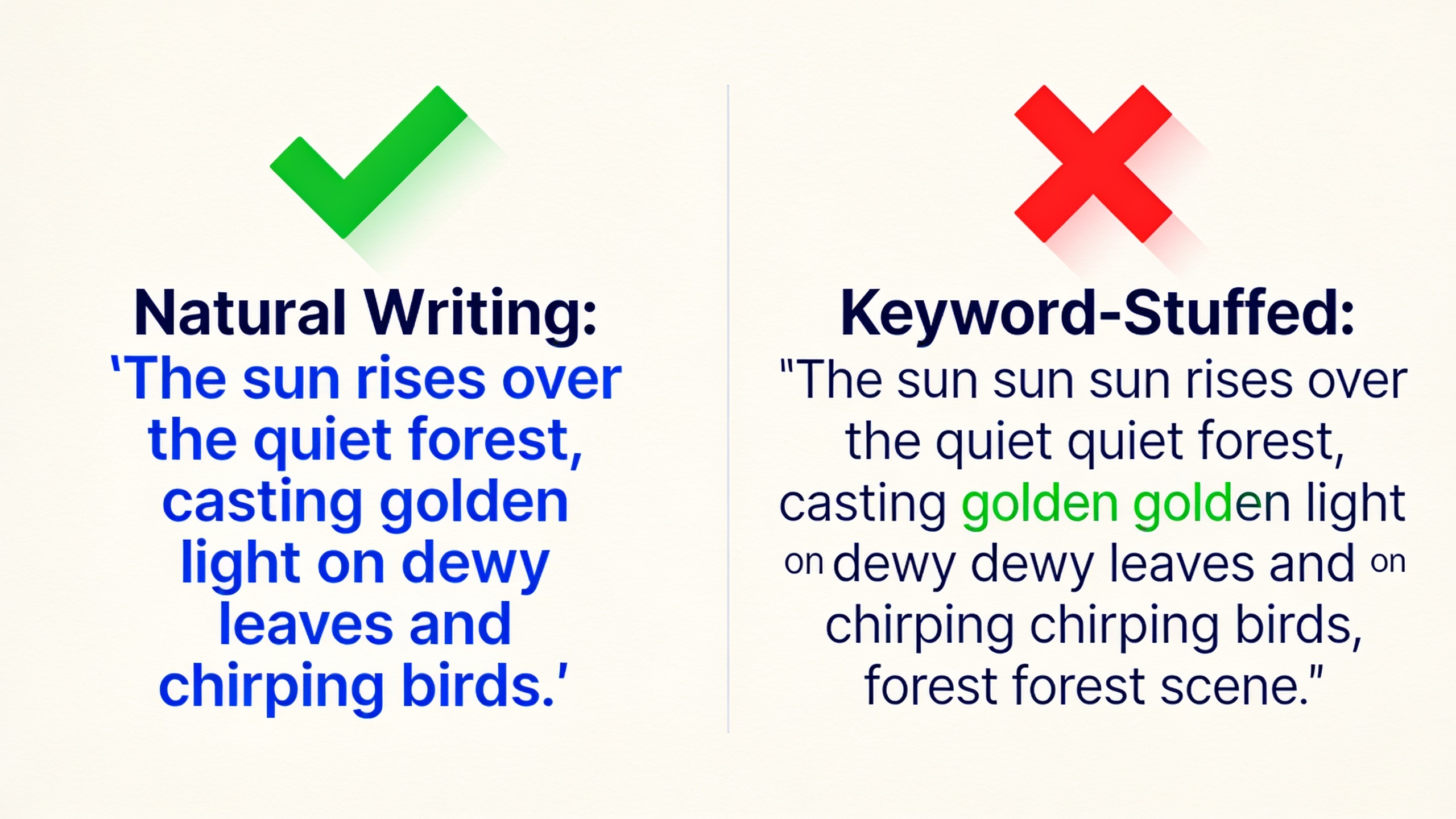
Keyword stuffing is cramming your target keyword into content over and over to try and game the rankings, and somehow it's still everywhere years after Google made it clear this doesn't work. Ever since BERT landed in 2019 and the helpful content updates started rolling out in 2022, Google's been reading your writing more like a human would. It cares about whether the language is natural, not how many times you managed to wedge in "best CRM software."
And the thing is, stuffing isn't always as obvious as repeating a phrase 20 times in an 800-word post. It hides in sneakier places. Like forcing an exact-match keyword into a heading where it reads all clunky and weird. Or writing two nearly identical pages, one for "best CRM software" and one for "top CRM software," which just makes them fight each other for the same spot. Or chasing keyword volume so hard that you end up with a page that technically matches the search term but completely whiffs on what the person was actually asking.
Why This Hurts Rankings
Google's systems now lean way more on semantic relevance and topical depth than on literal keyword matches. Content that reads like a robot wrote it (repetitive, mechanical) throws up low-quality signals. It also tanks the human stuff, like how long people stick around and whether they bounce. Both of those track pretty closely with how well you rank.
The Fix
Write for the topic, not the keyword. Drop your primary keyword naturally into the title, the opening, a subhead or two, and the meta description, and then just... let it go. Related terms, synonyms, and entities will show up on their own if you actually know your subject. If you want to get systematic about it, tools that measure topical coverage (not just keyword count) will show you the subtopics your competitors cover that you skipped. This is honestly the whole point of AI content platforms like RobinRank, which build articles around search intent and semantic relevance instead of some rigid keyword quota you have to hit.
Mistake #2: Publishing Thin, Low-Value Content
Thin content is any page that gives a searcher almost nothing they couldn't get elsewhere in five seconds. Usually it's a short post, under 500 or 600 words, that skates across the surface with no data, no examples, no real guidance. Google's Helpful Content System, which started rolling out in August 2022 and got baked into the core ranking systems in 2024, was basically built to hunt this stuff down and bury it.
You know the type. A blog post that just repeats what everyone else already said without adding a single new angle. A product page with two sentences of generic description. AI-generated content someone published without so much as a read-through, let alone fact-checking. Listicles that tell you what without ever bothering with the how or why. That's the pattern.
Why This Hurts Rankings
Thin content can't earn backlinks, barely holds anyone's attention, and rarely clears the E-E-A-T bar (experience, expertise, authoritativeness, trustworthiness) that Google spells out in its Search Quality Rater Guidelines. And here's the part that stings in 2025: pages that don't show real expertise almost never make it into AI Overviews or featured snippets, which increasingly reward the comprehensive, well-sourced answers.
The Fix
Every piece you publish should answer its question more completely than whoever's currently ranking. Before you hit publish, ask yourself one blunt question: does this have an example, a stat, a screenshot, a table, or a specific recommendation that a reader couldn't grab from a quick Google search? If the answer's no, it's not done yet. And if you don't have an in-house content team to lean on, you can still close that depth gap without going broke. If you're weighing your options, this breakdown of AI content marketing costs in 2025 compares the pricing models so you can budget for actual depth.
Mistake #3: Inconsistent Publishing Schedules
Inconsistent publishing is exactly what it sounds like: three posts one month, then radio silence for the next two. It's probably the most underrated mistake on this list because it doesn't trigger a penalty you can point at. The damage just piles up quietly.
Search engines form a kind of "crawl expectation" based on how often you put out fresh stuff. If your publishing is all over the place, you get crawled less predictably, which means your new pages take longer to get indexed and your organic growth loses momentum. HubSpot's own research backs this up: companies that publish consistently end up with a lot more indexed pages and organic traffic over time than the ones who post whenever inspiration strikes.
Why does this happen? Usually because content gets treated as a "when we have a spare minute" chore instead of a real business function. Sometimes there's no editorial calendar at all, so the team just waits around for a good idea instead of running a repeatable process. And sometimes a freelancer bails or an agency swaps out your account manager and the whole pipeline stalls.
The Fix
| Publishing Cadence | Typical Outcome |
|---|---|
| Sporadic (0-2 posts/month, irregular) | Slow indexing, stalled keyword growth, inconsistent traffic |
| Consistent but low volume (4 posts/month) | Steady incremental growth, good for niche topics |
| Consistent and scaled (8-16+ posts/month) | Faster topical authority build, more indexed long-tail keywords |
| AI-assisted automated publishing | High consistency with lower time cost, requires quality oversight |
A realistic cadence you can actually keep beats an ambitious one you ditch after six weeks. Every time. A lot of teams find that automating parts of the writing and publishing workflow is the only way to stay consistent without torching the whole content team, and that pressure gets brutal for agencies running multiple client calendars at once. If that's you, this guide on scaling client SEO with AI walks through how agencies keep output steady across accounts without hiring a new person for every new client.
Mistake #4: Ignoring Search Intent
Search intent is just the goal behind the query. Someone's either looking for information, trying to get to a specific site, comparing options before they buy, or ready to pull out their credit card. And mismatching your content to that intent is one of the fastest ways to lose rankings even when your keyword targeting is flawless. A page can be beautifully written, perfectly optimized, and still flop because it's answering the wrong kind of question.
Want content like this running on autopilot for your own site? Try RobinRank free — AI-written, SEO-optimized articles generated and published automatically, no credit card required.
Classic example: you target "best project management software" with a big, thoughtful educational essay. Problem is, that query screams commercial intent. Those searchers want comparisons, pricing, and recommendations. They do not want a history of project management as a discipline. That's exactly why the SERP for that term is wall-to-wall comparison listicles and review roundups, not explainers. Google matches format to intent on purpose, and if you show up with the wrong format, you're basically not invited to the party.
How to Diagnose Intent Mismatches
Honestly, the easiest tell is just Googling your target keyword and looking at the top 10. Are they guides? Product pages? Listicles? Tools? That's your answer format right there. While you're at it, notice the SERP features, because shopping results, a "People also ask" box, or a video carousel all hint at what Google thinks satisfies the query. And dig into your own analytics for keywords with tons of impressions but hardly any clicks. That gap is often a flashing sign that your format isn't what searchers expected to see.
The Fix
Before you write a single word, figure out the intent and then mirror whatever format is dominating the SERP. Comparison-heavy results? Build a comparison. Step-by-step results? Use numbered structure with clean headings. This one adjustment tends to move rankings faster than just cranking out more content, because you're fixing a fundamental mismatch between what you're serving up and what Google (and the human behind the search) actually wanted.
Mistake #5: Neglecting Content Updates and Internal Linking
These are two separate sins, but they travel together. Neglecting updates means letting published articles sit untouched forever while the facts, stats, and competition move on without you. Weak internal linking means you're not connecting related pages, so authority doesn't flow through your site and neither Google nor your readers can find their way around. And both are wildly preventable, because fixing them means editing what you've already got instead of writing new stuff.
Content decay is a real, documented thing. Ahrefs found that a big chunk of pages lose traffic within a couple of years if you never touch them, usually because some competitor published something fresher and more complete that just quietly overtook you. Meanwhile, orphaned pages (the ones with zero internal links pointing at them) take longer to get discovered and indexed, and they inherit none of the authority your stronger pages worked to earn.
So how do you know if this is you? A few red flags: your best traffic pages are more than two years old and haven't been touched. Your stats reference years that make you cringe, or products that don't exist anymore. Your new posts almost never link back to relevant older ones (and vice versa). And if someone asked you which pages support which keywords, you'd have no clue.
The Fix
Bake a quarterly content audit into your routine. Find the pages that slipped in rankings or traffic, refresh the stats and examples, and add two or three contextual internal links pointing to and from related articles. Structure your linking like a hub and spoke: big comprehensive "pillar" pages link out to the supporting articles, and those supporting articles link right back to the pillar. That reinforces your topical authority and keeps people clicking through your site longer, which quietly props up your rankings through better engagement.
How These SEO Ranking Mistakes Compare in Impact
Not every mistake here weighs the same, and if you've got limited time and people (who doesn't?), it helps to know where to swing first.
| Mistake | Typical Impact on Rankings | Effort to Fix |
|---|---|---|
| Keyword stuffing | Moderate — can trigger quality demotions | Low (rewrite existing copy) |
| Thin content | High — directly targeted by Helpful Content System | Medium-High (requires research, depth) |
| Inconsistent publishing | High (compounds over time) | Medium (requires process change) |
| Ignoring search intent | High — can block rankings entirely | Low-Medium (format adjustment) |
| Neglecting updates/internal links | Medium-High (gradual decay) | Low (editing, not creating) |
Here's the pattern worth noticing: some of the highest-impact fixes take barely any effort. Adjusting your content format to match intent, or dropping a few internal links into pages you already published? That's an afternoon of work, and it often pays off faster than writing anything from scratch. Start there.
How to Audit Your Content for These Mistakes
The quickest way to catch all five of these is a structured content audit, which is really just a systematic pass through your published pages, checking them against performance data, quality signals, and what your competitors are doing.
Start by exporting your full URL list with performance data. Pull organic clicks, impressions, and average position out of Google Search Console for every indexed page over the last 12 months. Then flag the problem children: sort by traffic decline to spot decay, and separately by word count to catch the thin stuff. From there, scan your flagged pages for unnatural keyword repetition or robotic phrasing that hints at old-school over-optimization.
Next, map search intent for anything underperforming. For any page stuck on page two or three, Google its target keyword and compare your format to the top results. Then audit your internal links to find orphaned pages and pillar content that doesn't have enough supporting articles pointing at it. Finally, prioritize by traffic potential versus effort using that table above, so you build a sensible fix sequence instead of trying to overhaul everything at once and burning out by Thursday.
Do this quarterly instead of only when traffic tanks. Catching problems early means they're still cheap to fix.
Frequently Asked Questions
Which content marketing mistake is actually the worst for SEO?
Thin content, probably. It's the one Google's Helpful Content System goes after directly, demoting pages that lack depth, originality, or real expertise. And unlike keyword stuffing, which you can spot and clean up fast, thin content usually needs a serious rework to fix properly.
How can I tell if my content has a keyword stuffing problem?
Read the page out loud. Seriously. If a phrase or its close cousins keep popping up so often that the writing starts to sound unnatural, you've got a problem. As a rough gut check, if your primary keyword shows up more than once every 100 to 150 words without any variation, go revise it for natural language and some semantic variety instead of hammering the exact match.
How often do I actually need to publish to avoid the consistency problem?
There's no magic number, and consistency matters way more than volume anyway. Four well-researched posts a month on a fixed schedule will generally beat twelve posts jammed into one manic month followed by two months of silence. The whole point is that search engines and readers can count on you showing up.
Can AI-generated content fall into these same traps?
Yep. If you publish it without editing, fact-checking, or adding any real expertise, AI content goes thin and generic in a hurry. But AI tools built specifically for SEO, the kind that handle topical research, intent matching, and internal linking, can actually help you dodge these mistakes by enforcing structure and depth. It's not the AI that's the problem, it's using speed as a substitute for quality.
How long before I see rankings improve after fixing this stuff?
Most SEO folks see measurable movement somewhere in the 4-to-12-week range after a meaningful fix, depending on how often Google crawls your site and how cutthroat the keyword is. Fixes like realigning search intent or adding internal links tend to show up faster than writing brand-new content, since those existing pages already carry some accumulated authority.
Content marketing mistakes almost never announce themselves with a dramatic traffic crash. They show up as a slow, boring plateau that's really easy to shrug off as "the algorithm" when it's actually a set of diagnosable, fixable problems sitting right there in your content. The five here (keyword stuffing, thin content, inconsistent publishing, ignoring search intent, and letting updates and internal links rot) account for the bulk of the preventable ranking losses I see across blogs, agencies, and small business sites. And the reassuring part? None of them need a full strategy teardown. Just a disciplined audit and the willingness to pick depth and consistency over shortcuts.
Ready to stop writing content by hand? Start your free RobinRank trial and get a full month of SEO-optimized articles published on autopilot.