AI vs Human Writers: What Actually Ranks Better in SEO?

Let me walk through the ranking data, the quality tradeoffs, and the cost math, using what we've actually got: industry tests, documented case studies, and what's currently working.
Table of Contents
- Do AI-Written Articles Actually Rank in Google?
- How Human-Written Content Performs Differently
- AI vs Human Writers: Quality Comparison
- Cost and Speed: The Real Business Tradeoff
- What Google Actually Says About AI Content
- The Hybrid Model: Where Most Winning Content Strategies Land
- How to Choose the Right Approach for Your Business
- Frequently Asked Questions
Do AI-Written Articles Actually Rank in Google?
Yes, AI-written articles rank in Google, as long as they clear the same quality, structure, and intent bar as anything else. Google's said this over and over: its systems reward helpful content, full stop. It doesn't care whether a person or a model typed it.
But "can rank" and "ranks well, reliably" are not the same sentence. A bunch of SEO tools and agencies have run their own tests here, publishing raw unedited AI text next to AI text that's been fact-checked, restructured, and juiced up with actual original insight. And the pattern is annoyingly consistent every time. The raw, generic stuff kind of stalls out. It ranks nowhere in particular and pulls in barely any traffic. Meanwhile the edited, intent-aligned version with unique data holds its own against solid human writing, and sometimes beats mediocre human writing that's got no real structure or depth to it.
So what actually moves the needle for AI content? A few things you can point at. First is whether the article genuinely answers what someone typed, in the format they wanted (a list, a comparison, a straight definition, whatever). Then there's structure, meaning clean headings and scannable sections that both a human and a crawler can get through fast. There's originality, which is the big one, real examples and data instead of a fancy reword of whatever's already ranking. And finally the technical stuff: schema, internal links, metadata. That last category is honestly where AI tools tend to be more reliable than a human doing it by hand, because they don't get bored and skip steps.
This is exactly the gap that automated publishing platforms are trying to fill. Something like RobinRank is built to spit out content that already has the ranking signals baked in, the internal links and schema and keyword placement, instead of raw text you still have to babysit through a full editorial pass.
How Human-Written Content Performs Differently
Human-written content pulls ahead in the categories where lived experience, original research, or brand voice actually count as ranking factors. Not because Google's out here punishing robots, but because those things are genuinely hard for a model to fake convincingly. This is most obvious on topics Google files under "Your Money or Your Life" (YMYL), your health, finance, and legal stuff, where the E-E-A-T signals (Experience, Expertise, Authoritativeness, Trustworthiness) carry a lot more weight.
The advantages humans bring show up pretty clearly. A writer who's actually used the product, run the campaign, or lived through the mess can describe the outcomes and the little mistakes and the weird nuances that no language model can invent from scratch. That's the "Experience" piece Google bolted onto its quality rater guidelines back in December 2022, and it hits hardest in the cutthroat niches, product reviews, personal finance, medical advice.
Then there's original research. Content built on proprietary survey data, real case studies, actual interviews, that stuff earns backlinks and citations, and both of those still correlate strongly with rankings in the link-building research. AI can summarize data that already exists. It can't go run a survey.
And there's brand voice. If you're competing on being recognizable, a consistent editorial voice that human writers build up over time keeps people coming back, and that repeat traffic and time-on-page feeds right back into your engagement signals.
The catch, and it's a big one, is that humans are slow and don't scale. One good SEO writer might crank out two to four properly researched 1,500-word articles a week. An AI pipeline can produce dozens of similarly structured drafts in that same window. That gap is basically the whole reason nobody frames this as "AI vs human" anymore so much as "how do I combine them," a shift I dig into more in The Rise of AI Writers: Are Human Content Teams Obsolete?
AI vs Human Writers: Quality Comparison
Neither one is flat-out "higher quality." They just fail and succeed in different places. AI is great at consistency, speed, and not screwing up the technical SEO. Humans win on originality, nuance, and the kind of narrative that builds trust.
Here's the breakdown across the factors that actually push rankings and keep readers on the page.
| Factor | AI Writers | Human Writers |
|---|---|---|
| Production speed | Dozens of articles per day possible | 2–4 in-depth articles per week (typical) |
| Cost per article | Often $5–$50 depending on platform | $100–$1,000+ depending on expertise level |
| Keyword/structure consistency | Very high — applies templates reliably | Variable, depends on writer discipline |
| Original research/data | Low, unless fed proprietary inputs | High, especially with subject-matter experts |
| First-hand experience (E-E-A-T) | Cannot generate authentically | Strong when writer has real experience |
| Factual accuracy on niche topics | Requires human fact-checking | Higher baseline, but not error-free |
| Scalability across many topics | Excellent | Limited by team size |
| Emotional nuance/storytelling | Improving but often generic | Stronger, especially for brand voice |
| Technical SEO application (schema, internal linking) | Consistent when built into the tool | Depends on writer's SEO knowledge |
What that chart really tells you is that the "AI vs human" framing is best used as a map of gaps to fill, not a cage match with one winner. Go all-AI and you risk a pile of thin, generic pages that get flattened on competitive YMYL topics. Go all-human and you're too slow and too expensive to chase the enormous pile of long-tail keywords that make up most of what people actually search for. And those long-tail queries add up to the majority of total search volume, which is exactly why publishing speed is a real, competitive thing and not just a vanity metric.
Cost and Speed: The Real Business Tradeoff
The most practical difference here isn't quality at all. It's cost per piece of ranking-ready content, and for small businesses and lean teams that's usually where the whole decision gets made. AI content runs somewhere between one-tenth and one-fiftieth the price of professionally written content, and it hands you a draft in minutes instead of days.
If you're a founder without a content team, that gap basically decides it for you. A freelance SEO writer with actual subject-matter chops usually runs $150 to $500 per 1,500-word article, and agencies charge more once strategy and editing get folded in. Now scale that up to the 20-40 articles a month you often need to move organic traffic in any real way, and you're staring at $3,000 to $20,000 monthly in writer fees. Before editing. Before strategy. Before anyone's even hit publish.
AI platforms squash that cost structure. A tool like RobinRank writes, optimizes, and publishes on its own while also handling backlink exchanges, which more or less replaces the whole team you'd otherwise need, the writer, the SEO person, the editor, the publisher. That doesn't automatically mean worse content. It means the economics flip from paying per hour of human effort to paying for a system that applies the SEO playbook programmatically to every article.
Want content like this running on autopilot for your own site? Try RobinRank free — AI-written, SEO-optimized articles generated and published automatically, no credit card required.
And speed just stacks on top of the cost advantage. Search engines like sites that publish steadily and build up topical authority across a whole cluster of related pages. SEO folks have watched this play out again and again with sites that scale their clusters fast. A human team might need six months to build out 50 articles on one topic; an AI-assisted workflow gets that down to weeks. In a competitive niche, where getting there first means grabbing the demand first, weeks versus months is the whole ballgame.
What Google Actually Says About AI Content
Google's official line is that quality beats origin, and it does not slap an automatic ranking penalty on stuff just for being "AI-generated." In a 2023 update to its search docs, Google flat-out said that "appropriate use of AI or automation is not against our guidelines," and clarified that its systems are there to reward "helpful, reliable, people-first content" no matter how it got made.
But (and this is the important but) Google's been equally clear that mass-producing content just to game rankings breaks its spam policies, whether a human or a machine wrote it. The March 2024 core update went straight after what Google called "scaled content abuse," which is basically using automation to pump out huge volumes of low-value pages that do nothing for the person searching. That update tanked the visibility of sites that had published thousands of thin AI pages with zero editorial oversight, according to reporting from a bunch of SEO publications that tracked the rollout.
So the takeaway is a little slippery. Google doesn't penalize AI content as a category. It penalizes the specific, lazy pattern of high-volume, low-effort publishing that AI happens to make really easy to do carelessly. Which is the whole reason quality control (fact-checking, adding real insight, structuring for what the reader actually wants) isn't a nice-to-have. Skip it and you might get a short traffic spike followed by a very unpleasant collapse.
This whole distinction sits at the center of a bigger shift in how search engines size up content, especially now that AI Overviews and answer engines like ChatGPT, Gemini, and Perplexity are increasingly how people find things at all. If you want a fuller look at how that's reshaping strategy beyond the old blue links, I got into it here: SEO Trends 2025: What's Actually Changing (And What to Do About It).
The Hybrid Model: Where Most Winning Content Strategies Land
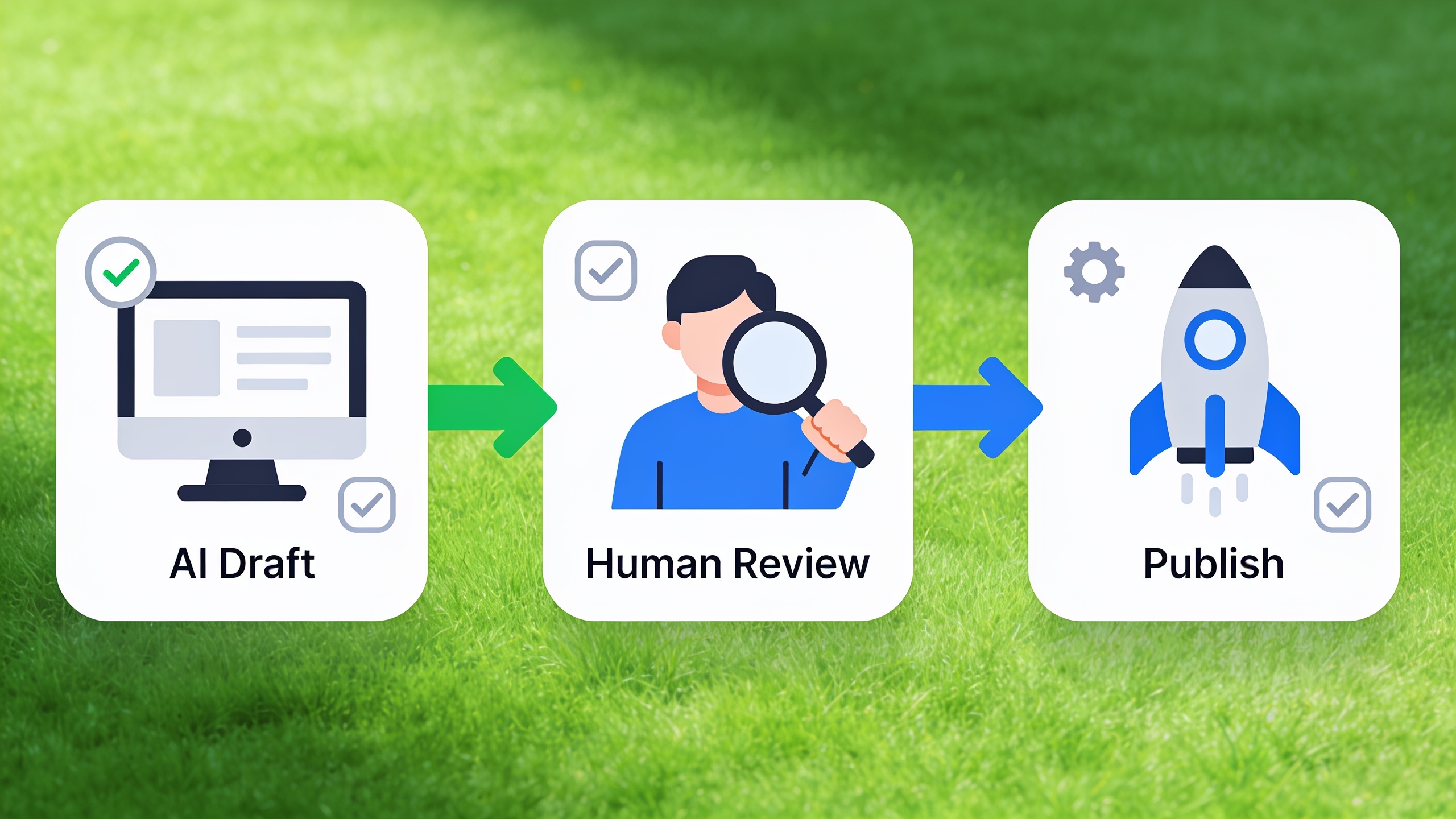
For most businesses in 2025, the smart move isn't picking a side. It's using AI for speed, structure, and scale, then layering human review on top for accuracy, real experience, and brand voice. You get the cost and speed of automation without torching the trust signals that keep content ranking over the long haul.
In practice a hybrid workflow tends to shake out like this. AI does the grunt work of drafting, so the keyword research synthesis, the first-pass structure, the meta descriptions, the internal link suggestions, the copy that follows the SEO rules consistently on every single article. Then a human comes in for the parts a model can't do, which usually means a subject-matter expert checking the technical claims, someone shaping the tone against a brand voice guide, or an editor dropping in a real customer story or a genuine data point the AI had no way to know. And automation handles the repetitive technical distribution, the schema, the publishing cadence, the internal link structures, all the rules-based stuff that machines do more reliably than a person clicking through it manually. That frees up the human hours for the strategy that actually needs a brain.
This is basically the model RobinRank is built around: automate the writing, optimizing, and publishing so the content comes out already structured and technically sound, which slashes the manual work needed before something's ready to rank. Agencies juggling a bunch of client accounts have really leaned into this, because it lets a small strategic team oversee an output that would otherwise need a way bigger writing staff.
Oh, and the backlink piece matters here too, don't sleep on it. Ranking isn't just about what's on the page. Off-page signals like backlinks are still one of the strongest things correlating with visibility in pretty much every major SEO ranking study from the last decade. A strategy that produces beautiful articles but never builds any authority around them will just quietly lose to one that pairs good content with a deliberate link-building plan.
How to Choose the Right Approach for Your Business
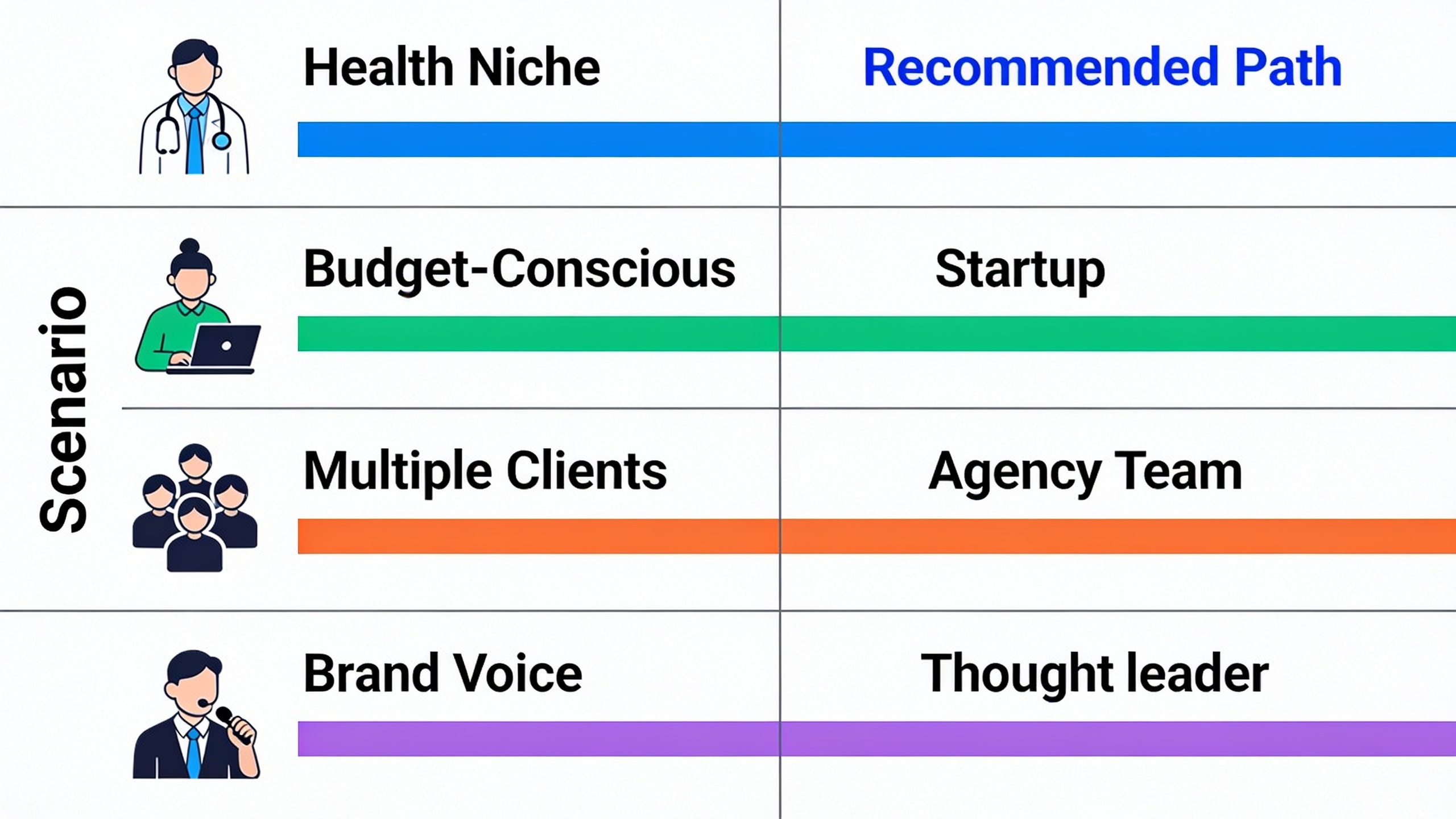
Your ideal mix of AI and human writers comes down to three things: how risky your topic is, what your budget looks like, and how fast you need to grow. A YMYL health site needs a lot more human oversight than a general how-to blog. A bootstrapped startup cares about cost efficiency in a way a well-funded agency with premium client budgets simply doesn't.
A few decision points I'd actually stand behind:
- If you're in a regulated or high-stakes niche (finance, health, legal), spend more on human expert review even if AI writes the first draft. The E-E-A-T bar is just higher, and Google's quality raters are trained to squint harder at these topics.
- If you're a small business or startup on a tight budget, an AI-first pipeline with occasional human spot-checks is honestly the most realistic way to compete on organic volume without a six-figure content budget.
- If you're an agency running multiple clients, hybrid automation lets you scale output across accounts without scaling headcount at the same rate, which is what actually protects your margins.
- If your edge is brand voice or thought leadership, tilt toward human writers or heavily edited AI drafts, because in a crowded niche the thing that sets you apart is usually perspective, not raw keyword coverage.
Whatever you land on, the underlying ranking factors don't budge: intent alignment, clean structure, factual accuracy, and demonstrated expertise. AI and human writers are just two tools for hitting those marks. The winning play is picking the tool, or the combo, that gets you there most efficiently for your niche and your appetite for risk.
Frequently Asked Questions
Does Google penalize AI content just for being AI?
Nope. Google's said publicly that appropriate use of AI or automation doesn't break its guidelines, and its ranking systems judge helpfulness and quality regardless of how something was made. The penalties go after patterns of mass-produced, low-value content, not AI as a method.
Can AI content actually outrank human writing?
Yeah, especially on informational and transactional queries where structure, keyword coverage, and thorough intent-matching count for more than personal experience. Where it struggles is YMYL topics that reward first-hand experience and real expertise, so it's less likely to beat strong human content there.
How much cheaper is AI content versus a human writer?
Human-written SEO articles usually run $150 to $500 or more per piece depending on the writer's expertise and the length, while AI content through automated platforms costs a fraction of that per article, which is what makes high-volume publishing realistic for small businesses and agencies.
Is a hybrid model really better than just picking one?
For most businesses, yeah, it is. A hybrid setup grabs AI's speed and consistency while adding human oversight for accuracy, brand voice, and the experience-based signals Google's E-E-A-T framework cares about, which matters most in competitive or sensitive niches.
What matters more for rankings, who wrote it or how it's built?
How it's built. Structure, intent alignment, and accuracy beat authorship every time. Content that directly answers the question, is organized with clear headings, and has accurate, specific info tends to win, no matter whether a person or an AI typed the first draft.
The AI vs human writers thing is going to keep shifting as the models get better and as search engines refine how they measure helpfulness at scale. But the core principle isn't going anywhere. Content that genuinely serves the reader, backed by clear structure and credible information, is exactly what search engines were built to reward. Regardless of who, or what, wrote the first draft.
Ready to stop writing content by hand? Start your free RobinRank trial and get a full month of SEO-optimized articles published on autopilot.