AI Writer vs Freelance Writer: A Real Cost Comparison

Table of Contents
- What's the Real Difference Between an AI Writer and a Freelance Writer?
- How Much Does a Freelance Writer Actually Cost?
- How Much Does an AI Writer Cost Per Article?
- AI Writer vs Freelance Writer: The Total Cost of Ownership
- Content Writing Cost Comparison at a Glance
- Editing, Ownership, and Quality Control: The Hidden Costs
- AI Writer vs Freelance Writer: Which One Should You Choose?
- Frequently Asked Questions
What's the Real Difference Between an AI Writer and a Freelance Writer?
An AI writer is software that spits out content from your prompts or keywords using a language model, while a freelance writer is an actual human you pay to research, draft, and revise, usually by the word, the hour, or the project. But the "human vs machine" framing misses the point. What really separates them is where the cost lands.
A freelancer brings judgment. They can call up a source, weigh two contradicting facts, and make an editorial decision about what a reader actually cares about. That judgment is the thing you're paying for, and it's already priced into their rate. An AI writer brings speed and volume instead. It'll draft a whole article in seconds and never once email you asking for two more days. But it has zero independent sense of what's accurate, what's on-brand, or what's just plain nonsense unless a human steers it and checks its work.
And that's why this matters for your wallet. With a freelancer, most of the work happens before the draft hits your inbox. With AI, a big chunk of the work, the editing, the fact-checking, the SEO cleanup, all of it, happens after. Whether you do that yourself or pay someone else to, the cost doesn't vanish. It just relocates to a different part of the process. Wrap your head around that and the rest of this comparison makes sense.
How Much Does a Freelance Writer Actually Cost?
A freelancer's real cost is never just the number on their invoice. It's that number plus the hours you burn briefing them, wrangling revisions, and chasing deadlines. Rates on Upwork, Contently, and the various niche writer directories are all over the map depending on experience, subject expertise, and how fast you need it, so anyone promising you a tidy "market rate" is guessing.
Most freelancers bill one of three ways. Per word is standard for blog posts and articles, and the rate climbs with experience and complexity (technical, financial, and legal writing all command a premium over general lifestyle stuff). Per hour shows up more on research-heavy or strategy work, where word count doesn't come close to reflecting the effort. And per project is a flat fee for a defined deliverable, common when the scope includes interviews or multiple rounds of revisions.
The Costs Nobody Puts in the Quote
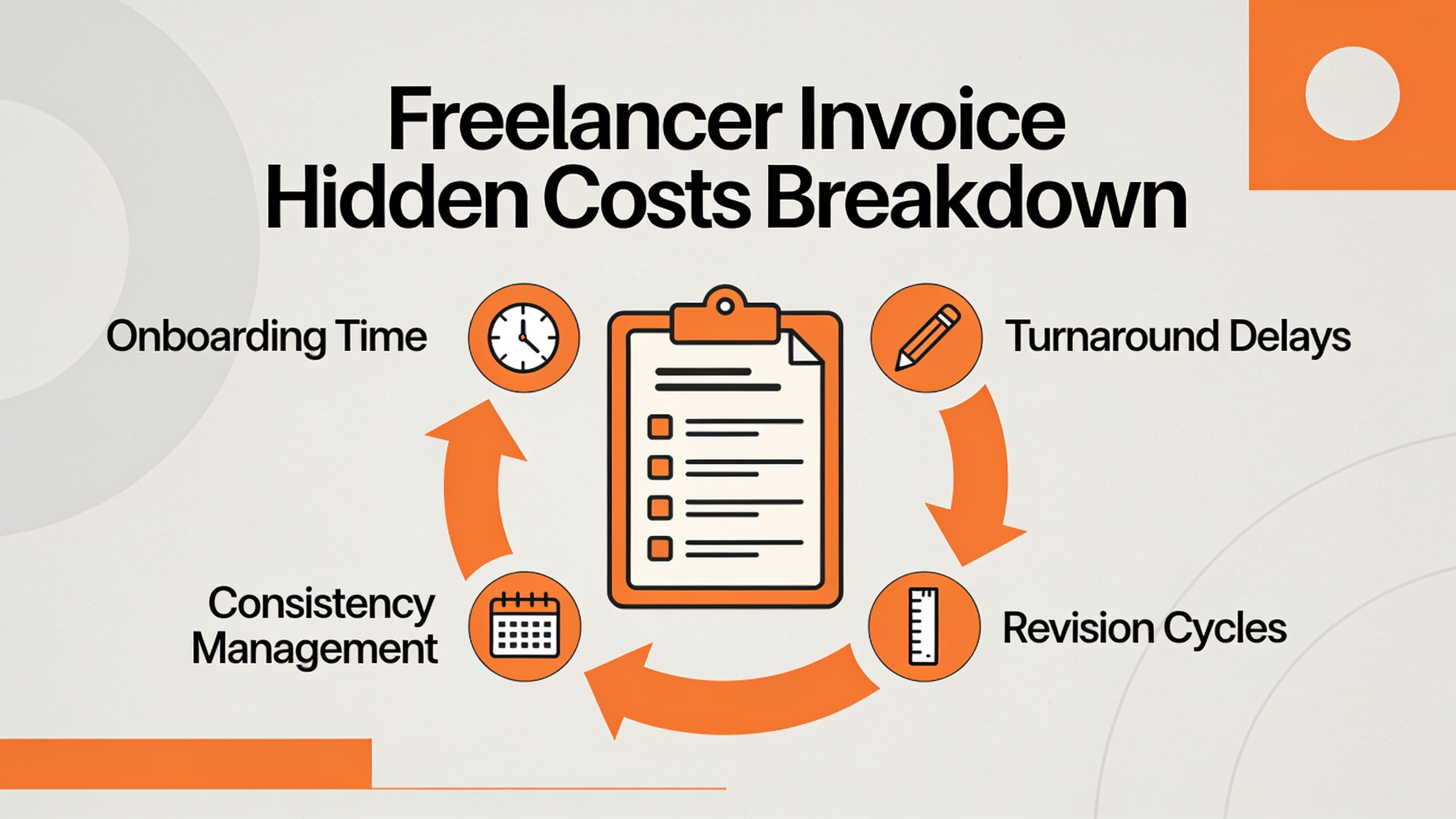
Here's where the invoice lies to you. Beyond the base rate, freelance writing drags along a bunch of costs that never make it into the proposal.
First, onboarding. Every new writer needs your style guide, some brand voice examples, and enough context to not embarrass you on the first draft. That's your time. Then there are revision cycles. Even a great writer usually needs a round or two of feedback to fully click with what you want, and each round costs your team time, even when the freelancer revises for free. Turnaround is another one. A single person only has so many hours a week, so if you need 20 articles this month, you're now managing several writers. And that leads to the last hidden cost: consistency. Scale up to a handful of freelancers and keeping voice and SEO structure aligned across all of them takes an editor riding herd full-time.
None of this makes freelancers a bad bet. Honestly, a strong one can deliver narrative skill, original reporting, and genuine authority that AI just can't fake. But the true cost per article is the fee plus the internal hours you spend babysitting the relationship and the output. That's the number that counts.
How Much Does an AI Writer Cost Per Article?
An AI writer's direct cost is usually a flat monthly subscription split across however many articles you crank out, which is why the per-article price can look absurdly cheap next to a freelancer's rate. But that number only covers the drafting step, not the whole journey to publish-ready. Most tools price by tier (word count, article count, or seats) rather than per article, so your real per-article cost hinges entirely on how much you produce.
Take RobinRank as an example. The Pro plan starts with a 14-day free trial and no credit card, then runs $19 per month. That plan includes Autopilot on one site, which bundles AI-written articles with access to RobinRank's community backlink network. So the subscription isn't just paying for content, it's also covering a way to earn verified backlinks, which is two things under one fee. If you're publishing several articles a month through Autopilot, the effective cost per article on the content side is tiny compared to what a freelancer charges for the same volume.
What the Subscription Price Conveniently Leaves Out
A cheap sticker price doesn't mean the article is free to finish. Depending on the tool, you might still be on the hook for a few things. Fact-checking is the big one. Language models will hand you confident, fluent, completely wrong statements, especially around stats, dates, and named sources, so somebody has to verify claims before you hit publish. There's voice and structure editing too, because raw output rarely nails a specific brand tone, particularly for technical or niche audiences. You'll usually want an SEO and formatting pass to confirm your heading hierarchy, internal links, and keyword placement actually match your strategy. And then there's the legal side. Businesses publishing AI content really should know who owns the output and whether it risks originality problems, a rabbit hole worth going down in AI Content Copyright: Who Actually Owns What You Publish? before you scale anything.
Tools that automate more of this pipeline, drafting and optimizing and publishing in one flow like an Autopilot-style feature, cut the ongoing labor cost per article versus a bare-bones AI writer that just hands you raw text. That's a distinction people miss inside the whole "AI writer" bucket. Not every AI tool leaves you with the same editing hangover.
AI Writer vs Freelance Writer: The Total Cost of Ownership
The real comparison isn't subscription price versus per-word rate. It's the total cost of getting one accurate, on-brand, publish-ready article live, counting every single hour spent after that first draft exists. This is exactly where most comparisons fall apart. They line up an AI tool's list price against a freelancer's invoice, call it a day, and completely ignore the labor sitting on either side of those numbers.
Editing Time and Quality Control Costs
Editing time is the biggest variable in this whole thing, and it swings in opposite directions for each option. A skilled, well-briefed freelancer usually needs a lighter edit because a human already applied judgment while writing. AI needs more structured editing because it has no clue when something is factually wrong, repetitive, or off-brand. It'll produce beautiful fluent sentences whether they're true or not.
That said, the AI editing burden isn't a fixed number. It depends hugely on the tool. A generic AI writer with no SEO or brand context baked in needs way more cleanup than a platform built specifically to optimize and structure content for your site and keywords. The editing gap between "AI" and "freelancer" shrinks a lot once the AI tool is actually purpose-built for publishing instead of just spitting out drafts.
Turnaround Speed and Opportunity Cost
Speed has a cost too, even when nobody bills you for it. A freelancer on a single article might need anywhere from a few days to a couple of weeks depending on research, availability, and revisions. An AI writer produces a full draft in minutes. That matters a lot if your business lives or dies by publishing frequently to fight for search visibility or jump on a timely topic.
Want content like this running on autopilot for your own site? Try RobinRank free — AI-written, SEO-optimized articles generated and published automatically, no credit card required.
And that speed carries a genuine dollar value. Every week your target article isn't live is a week you're not competing for its traffic, and in a fast-moving niche, whoever publishes first often grabs the ranking. For teams trying to scale, say going from a handful of articles a month to dozens, freelancer turnaround turns into a bottleneck. You either hire more writers (more management cost) or slow your calendar down (opportunity cost). Neither one is free.
Content Writing Cost Comparison at a Glance
The table below lines up freelancers, standalone AI writers, and an integrated platform like RobinRank's Autopilot across the cost factors that actually move the needle.
| Cost Factor | Freelance Writer | Standalone AI Writer | AI + Editorial Platform (e.g., RobinRank Autopilot) |
|---|---|---|---|
| Upfront pricing model | Per word, per hour, or per project | Monthly subscription based on volume/seats | Monthly subscription ($19/mo for RobinRank Pro after a 14-day free trial) |
| Typical editing time needed | Low to moderate (depends on writer skill) | Moderate to high (fact-checking, voice, structure) | Lower than standalone AI tools, since publishing and optimization are built into the workflow |
| Turnaround speed | Days to weeks per article | Minutes per draft | Minutes to hours, including publishing |
| Consistency across volume | Depends on managing multiple writers | High (same model output style) | High, with SEO structure applied automatically |
| Built-in SEO optimization | Depends entirely on the individual writer | Not stated publicly for generic tools | Included as part of Autopilot's article generation |
| Backlink/promotion support | Not included; requires separate outreach | Not included | Included via RobinRank's manually reviewed backlink exchange network |
| Best suited for | Original reporting, opinion pieces, high-trust B2B content | Fast, low-stakes drafts needing heavy review | Scaling SEO content output without a full internal content team |
Obviously this isn't exhaustive, and your actual numbers will shift with business size, niche, and who you hire. But it captures the core trade-off. Freelancers front-load quality at a higher unit cost. Standalone AI tools front-load speed and hand you the editing bill later. Integrated platforms try to close that editing gap by folding optimization and publishing into the same workflow.
Editing, Ownership, and Quality Control: The Hidden Costs
The most overlooked cost in this entire debate is what happens after the draft. Who owns it, who verifies it, and who's on the hook if something's wrong. Those downstream questions carry real financial and legal weight, and they get heavier the more you publish.
Ownership is a genuinely open question with AI content, and I don't think enough people take it seriously. Depending on the platform's terms and your jurisdiction, the rights to AI-written text aren't nearly as clean as content a freelancer produces under a standard work-for-hire agreement. Before you scale AI content across a whole site, it's worth getting a handle on the legal picture in AI Content Copyright: Who Actually Owns What You Publish?. A low cost per article stops mattering fast if you're not even sure you own the thing.
Quality control runs deeper than proofreading, too. As answer engines like ChatGPT, Perplexity, and Google's AI Overviews increasingly summarize and cite web content directly, the bar for precision and clean structure has jumped. Vague, poorly sourced, structurally messy content just doesn't get surfaced or quoted by these systems. If part of your plan is getting cited in AI answers rather than only ranking in old-school search, it's worth reading through the sourcing and structure practices in Answer Engine Optimization: Ranking on Perplexity & Bing Chat, because both freelance and AI content have to clear that bar to earn any visibility in this newer flavor of search.
AI Writer vs Freelance Writer: Which One Should You Choose?
The right call depends on the type of content, the volume you need, and how much editing capacity you've got in-house. It's not about which one is universally "better." For most growing businesses, the smartest move is a hybrid, not an all-or-nothing bet.
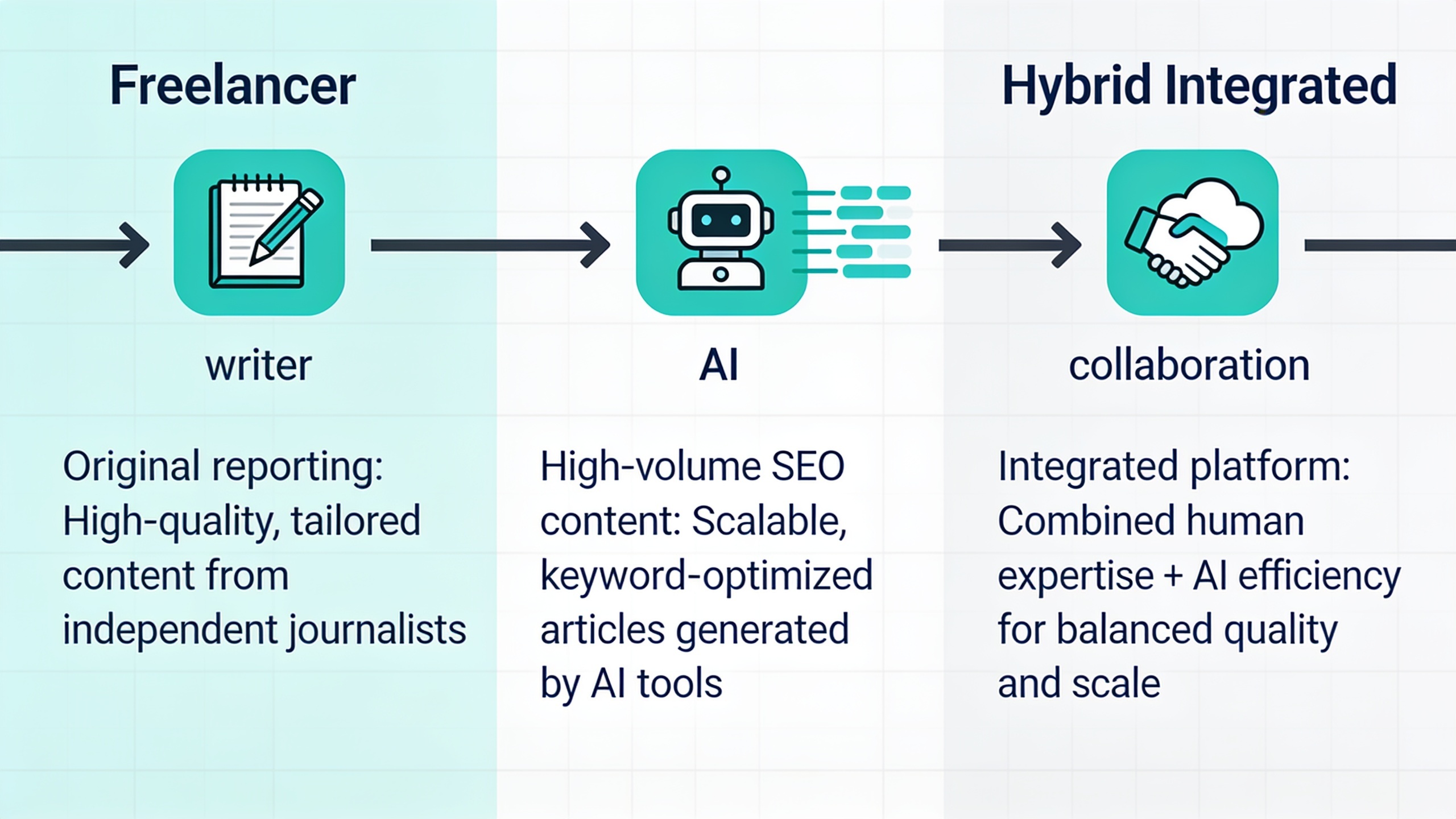
Go with a freelancer when the content needs original reporting, interviews, or deep expertise a general model can't fake. Same when brand voice and narrative nuance are the whole point, like thought-leadership or opinion pieces. And it makes sense when you're publishing a lower volume of high-stakes content, where the per-article cost is easy to justify because that one piece really matters.
Lean on an AI writer when you need to scale, publishing dozens of SEO articles a month without hiring a proportional army of writers. AI shines on content with a repeatable structure (how-to guides, comparison articles, definition explainers) where consistency beats individual voice. Just make sure you've got, or can build, a review process tight enough to catch the factual errors before they go live. That last part isn't optional.
And then there's the integrated platform route, which fits when you want AI's speed and low per-article cost without absorbing all the SEO and editing grind yourself. It especially makes sense if you're also trying to build backlinks and organic visibility, since a platform that pairs content generation with a link-building mechanism (RobinRank's Autopilot plus its manually reviewed backlink exchange network) handles two cost centers, content and links, under one subscription instead of two budgets.
Plenty of marketing teams just run both. Freelancers for the flagship, high-trust stuff, and AI-assisted publishing for the steady stream of supporting articles that keep the site's organic footprint climbing. Honestly, that's usually the setup I'd recommend.
Frequently Asked Questions
So is an AI writer actually cheaper than a freelancer?
On pure subscription cost, yeah, AI tools usually cost far less per article than a freelancer's per-word or per-project rate. But the total cost comes down to how much editing, fact-checking, and SEO structuring the output needs before it's ready. A bare AI writer producing raw drafts can soak up enough review time to close a big chunk of that gap.
Can AI-written content rank as well as freelance content?
It depends way more on structure, accuracy, and depth than on whether a human or a model typed the first draft. Search engines and answer engines reward content that's well-organized, factually solid, and genuinely useful, and both a good freelancer and a well-edited AI draft can hit that. The real deciding factor is the editorial process behind it, not where the draft came from.
AI or freelancers for SEO content specifically?
For high-volume, structure-driven stuff like comparison guides, how-tos, and definition pages, AI paired with human review tends to win on cost because the format repeats. For pillar content meant to establish real topical authority or original expertise, a freelancer's judgment and research usually earn the higher price.
How do I actually calculate the true cost per article?
Take the direct cost (freelancer invoice, or subscription fee divided by your article volume) and add the internal hours spent briefing, editing, fact-checking, and formatting, times your team's effective hourly cost. Comparing only the sticker price and skipping that internal labor is the single most common mistake people make here.
Does using AI create legal risk around ownership?
It can, depending on the platform's terms and how you use the content. Ownership and originality questions around AI content are still very much in flux, which is exactly why you should read the platform-specific terms before scaling, something RobinRank's guide to AI content copyright digs into.
At the end of the day... no, scratch that. Choosing between AI and a freelancer isn't really "cheap and fast" versus "expensive and good." It's a choice about where you spend your time and money, upfront in a skilled writer's fee, or downstream editing and checking AI drafts. The businesses seeing the best return are the ones who stopped treating it as either/or and built a workflow instead, a freelancer for the flagship pieces, an AI platform like RobinRank for the steady-volume SEO work and backlinks, matching each type of content to whatever's best suited to produce it.
Ready to stop writing content by hand? Start your free RobinRank trial and get a full month of SEO-optimized articles published on autopilot.