Answer Engine Optimization: Ranking on Perplexity & Bing Chat
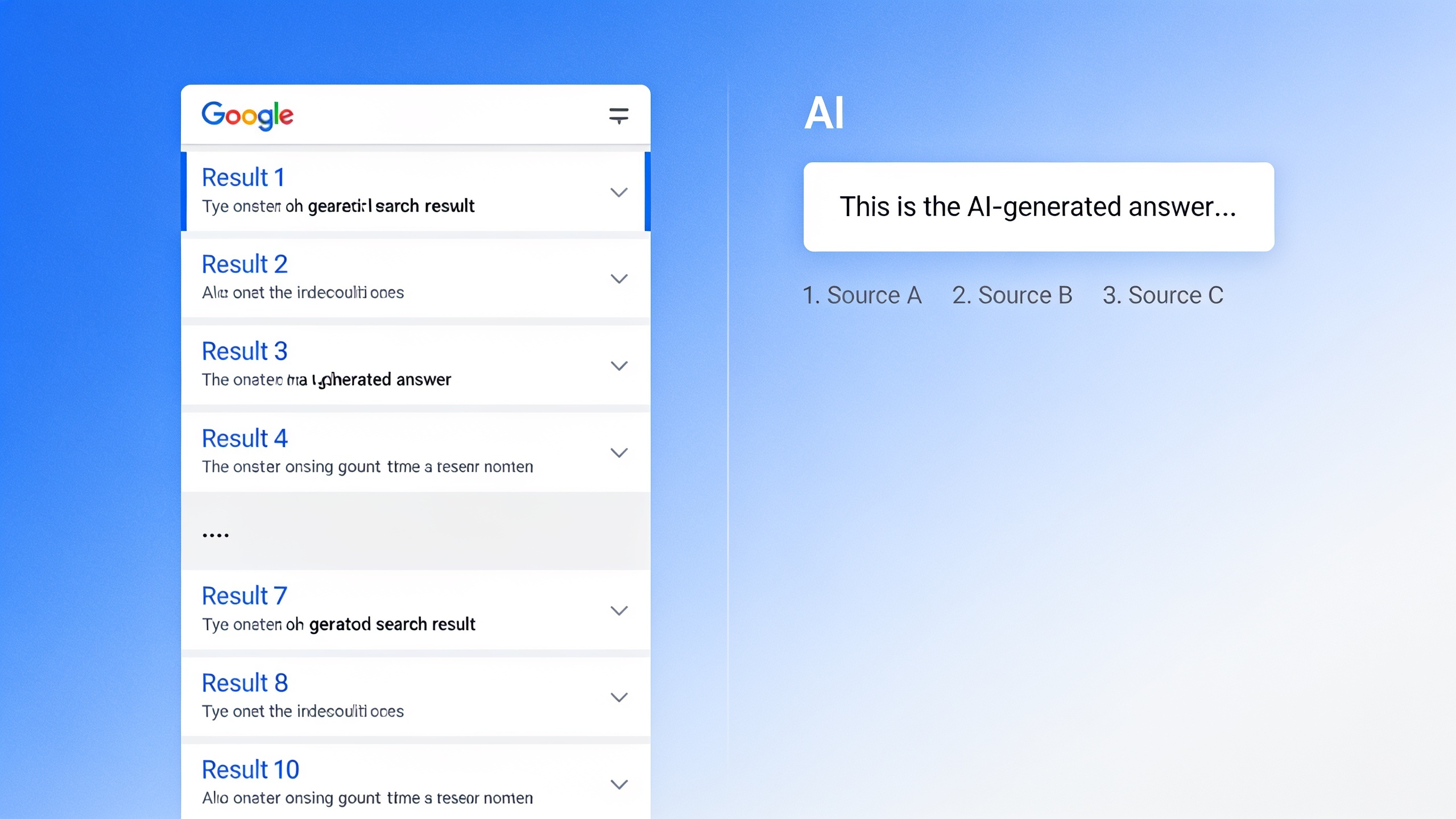
And it matters more than a lot of people want to admit, because the way people research things is quietly shifting. More and more of them start inside a chat window instead of a search bar. Which means you can be sitting pretty on page one of Google and still be completely invisible the moment someone asks an AI the same question. So let's get into how Perplexity and Copilot actually pull and cite content, why that's different from ranking, and what you can genuinely do about it.
Table of Contents
- What Is Answer Engine Optimization (AEO)?
- How Perplexity Surfaces and Cites Content
- How Bing Chat (Copilot) Surfaces and Cites Content
- AEO vs. Traditional SEO: What Actually Changes
- How Do You Optimize Content for AI Answer Engines?
- Content Formats That AI Engines Prefer to Cite
- Building the Authority Signals AI Models Look For
- Measuring Whether Your AEO Efforts Are Working
- FAQ: Answer Engine Optimization
What Is Answer Engine Optimization (AEO)?
Answer engine optimization is the work of prepping your content so AI systems that spit out direct answers, instead of a list of links, can find it, pull from it accurately, and give you credit. Think of it as classic SEO dragged into a world where the "results page" is more and more just a synthesized paragraph with a few footnotes hanging off it.
The real difference comes down to who does the synthesizing. In regular search, you get ten links and you do the work of piecing an answer together yourself. In an answer engine, the model does that for you and hands back one composed response, usually with three to six cited sources stapled on. So your content isn't competing to get clicked anymore. It's competing to become raw material for somebody else's answer. And winning that means your writing has to be clear, precise, and easy to lift out of context, because a language model might grab a single sentence and run with it, ignoring the rest of your beautifully crafted page entirely.
One thing worth saying loudly: AEO isn't a replacement for SEO. It rides on top of it. You still need crawlable, indexed, authoritative pages. What's new is the layer above that. How cleanly does one chunk of your content answer a specific question, all by itself, in a way a model can quote without second-guessing?
How Perplexity Surfaces and Cites Content
Perplexity is an AI search engine that answers questions in natural language and shows numbered citations right next to its response, so it feels less like a search results page and more like a research assistant that actually does footnotes. It does live retrieval, meaning it runs a web search in the background, grabs a batch of candidate pages, and then lets its language model write an answer with inline citations pointing back to whatever it pulled from.
The nice part? Perplexity shows its work. So you can literally run the same searches your customers would, look at which domains keep getting cited in your niche, and learn from it. A few patterns show up pretty consistently, at least in how retrieval-augmented systems like this tend to behave.
Pages that answer a specific question directly and without waffling are easier for the retrieval step to match against what the user typed. Fresh content wins on anything time-sensitive, since Perplexity is pulling from a live index instead of some cached ranking that's been sitting there for months. And content stuffed with clear facts, named entities, and actual numbers is way easier to lift as a quotable snippet than something buried under a pile of marketing fluff.
Here's the mindset shift, though. Because Perplexity cites several sources per answer instead of crowning one winner, you're not fighting for the top spot. You're trying to be one of the handful of references it feels safe quoting. For a lot of SEO folks that's genuinely liberating. The goal stops being "rank #1" and becomes "be trustworthy and clear enough to make the shortlist."
How Bing Chat (Copilot) Surfaces and Cites Content
Bing Chat, now wearing the Microsoft Copilot badge, writes conversational answers using Bing's search index plus a large language model, and it drops footnote-style citations back to the pages it leaned on. Since Copilot is built on the Bing index, getting crawled and indexed by Bing is non-negotiable. That means Bing Webmaster Tools and a proper XML sitemap. If Bing hasn't indexed your page, Copilot basically can't see it, let alone cite it. Full stop.
Once you're in, Copilot acts a lot like every other retrieval-augmented answer engine. It leans toward pages with clean headings, a direct answer near the top, and structured data (FAQ, Article, or HowTo schema) that tells a crawler what the page is actually about. Microsoft has also been more openly chatty than most about using structured data and E-E-A-T signals, that's experience, expertise, authoritativeness, and trust, to decide which pages are reliable enough to summarize in a chat.
So practically speaking, the on-page fundamentals you already know for Bing and Google still apply. Clean HTML, descriptive headings, schema, fast load times, a page that clearly matches the query. Those are your entry ticket. Optimizing for Copilot isn't some exotic new technique. It's the same fundamentals, just executed with more precision, because a chatbot summarizing your page has a much lower tolerance for vagueness than a human skimming a snippet does.
AEO vs. Traditional SEO: What Actually Changes
AEO and traditional SEO stand on the same foundation, crawlable and authoritative content, but they part ways on what "winning" looks like and how you have to structure things to get picked. Traditional SEO chases ranking position and click-through. AEO chases being extractable and getting cited, often with zero clicks involved.
| Dimension | Traditional SEO (Google organic) | Answer Engine Optimization (Perplexity, Bing Chat/Copilot) |
|---|---|---|
| Primary output | Ranked list of ten+ links | A single synthesized answer with a few cited sources |
| Success metric | Ranking position, CTR, organic sessions | Citation inclusion, share of voice inside AI answers |
| Content structure that wins | Comprehensive, keyword-optimized long-form pages | Direct, self-contained answers near the top, easy to quote out of context |
| Role of schema markup | Helps with rich snippets, not mandatory | Often used to confirm topical clarity and factual structure |
| Freshness sensitivity | Matters for some query types (news, YMYL) | Matters heavily; live retrieval favors recently updated pages |
| User action after seeing result | Click through to the site | Often no click; the answer itself satisfies the query |
| Backlinks' role | Strong ranking factor and trust signal | Still a trust/authority signal, but citation depends more on content clarity than raw link volume |
| Where visibility is tracked | Google Search Console, rank trackers | Manual query testing, brand-mention monitoring, referral traffic from AI tools |
The row that keeps me up at night is the "no click" one. An AI answer can fully satisfy someone's question, so you can get cited and still get zero traffic. That's still a win for brand visibility. But it wrecks the way most people measure ROI, because if you're only counting sessions, you're badly undercounting the value of being the source everyone's reading about.
How Do You Optimize Content for AI Answer Engines?
You optimize for AI answer engines by answering a specific, narrow question in the first sentence or two of a section, then backing it up with the kind of specifics a model can safely quote. This "answer-first" thing isn't a stylistic preference. It mirrors how these systems actually work. They don't read your page top to bottom hunting for meaning like a human does. They scan for a passage that matches the user's intent and yank it out.
A handful of things genuinely move the needle here, so let me walk through them.
Lead with the answer, not the runway. If your section is titled "How much does X cost?", the first sentence should just state the price. Put the caveats and context after. That gives the model a clean quotable answer while still giving humans the full story.
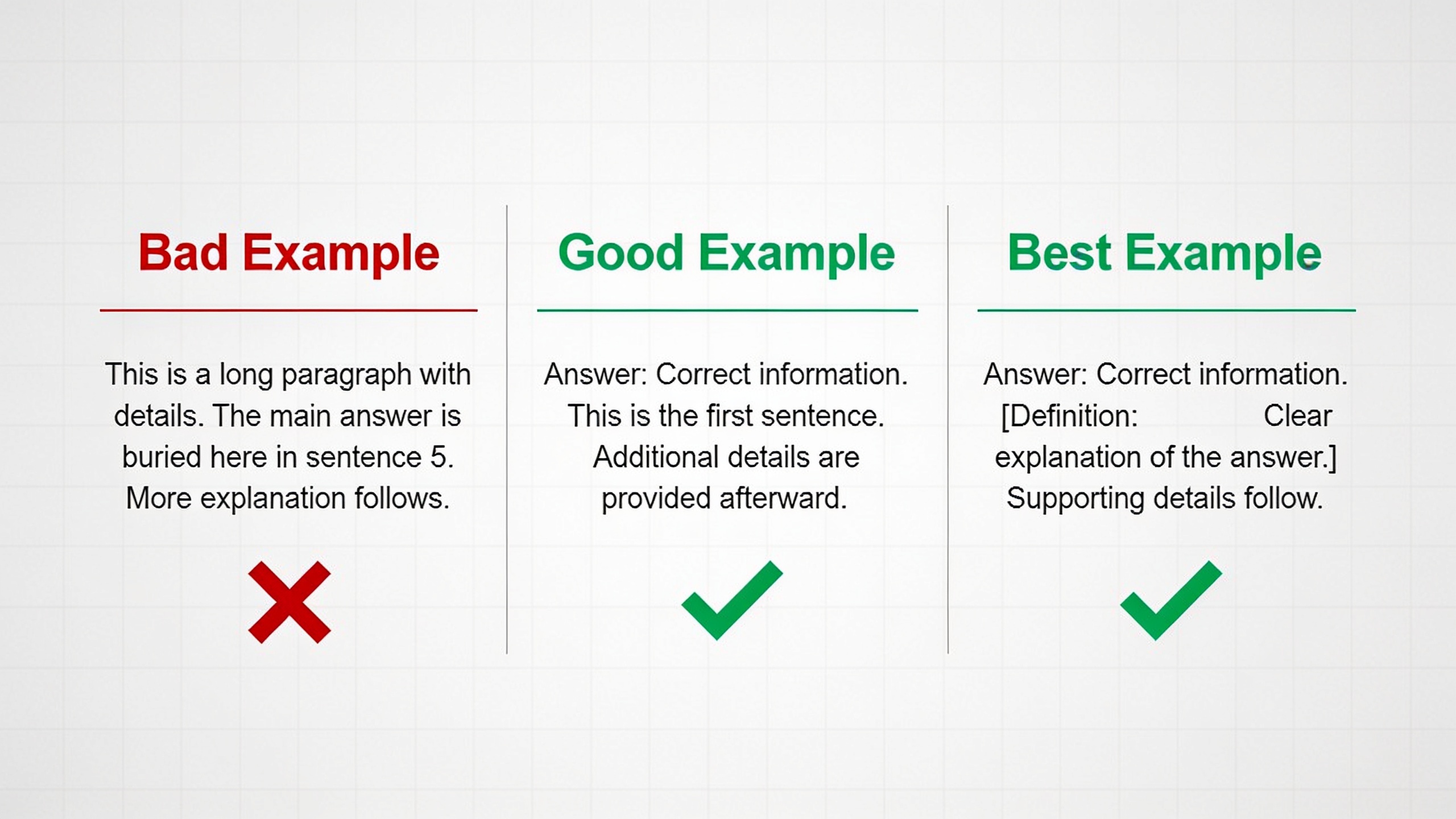
Define terms the moment they show up. Mention something like "structured data" or "domain rating"? Define it right there in the sentence. Something like "Domain Rating, or DR, is a metric that estimates a website's backlink authority on a 0–100 scale." Don't assume the reader has the earlier context, because AI models routinely grab one paragraph with none of the surrounding article attached. A self-contained definition keeps the model from either skipping you or, worse, misquoting you.
Use real entities and numbers, not mush. "Many businesses saw growth" is useless to a model looking for a citable fact. "Publishing weekly for six months" or "a DR increase from 12 to 34" gives it something to hold onto. And when you don't have a verified stat, just describe the relationship honestly. Say "backlinks from higher-authority domains tend to carry more weight than links from low-authority sites" instead of inventing a number to sound impressive. AI systems and sharp readers both catch fabricated stats eventually, and it poisons trust in your whole domain when they do.
Want content like this running on autopilot for your own site? Try RobinRank free — AI-written, SEO-optimized articles generated and published automatically, no credit card required.
Structure with real H2/H3 headings that sound like actual questions. Both Perplexity and Copilot seem to weight heading structure when deciding which passage matches a query, so writing "How much does answer engine optimization cost?" beats a lifeless "Pricing" header. It ups the odds your section gets matched to a similarly worded prompt.
And publish consistently. Keep pages current. These systems pull from an index that refreshes constantly, so a page you haven't touched in two years is fighting fresher, more recently verified content and usually losing. Teams that treat content as a one-and-done project fall behind fast. That's honestly why the story in how a broke SaaS startup built a content engine that actually worked rings true. A steady publishing cadence, not one lucky viral post, is what compounds over time in both regular search and AI answers.
Content Formats That AI Engines Prefer to Cite
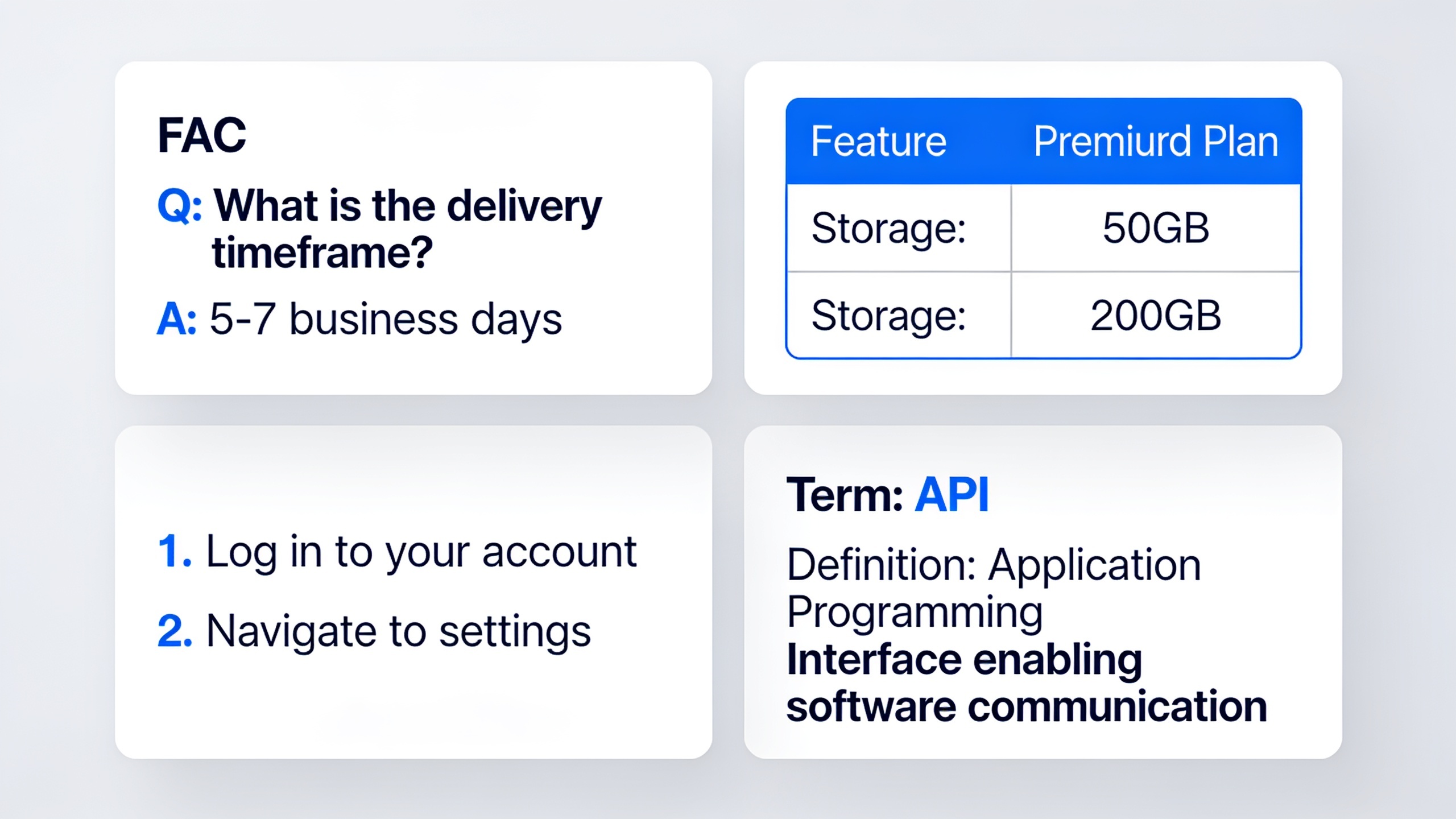
AI answer engines most reliably cite content that isolates a single clear answer inside a well-labeled section. FAQ blocks, comparison tables, numbered steps, glossary-style definitions. Stuff that's easy to extract without losing its meaning. Dense, unstructured prose that buries the answer three paragraphs down is a nightmare for a retrieval system to confidently lift and attribute, so it just... doesn't.
FAQ sections with question-style headings are the obvious one, because they map almost perfectly onto how people phrase prompts inside Perplexity or Copilot. Comparison tables are another gift to an AI model, since when someone asks "X vs. Y," a single table row is about the cleanest source it could ask for. Step-by-step numbered instructions are easy to squash into a short procedural answer. And definition-first glossary entries, the plain old "X is..." sentence, get lifted constantly because they require zero interpretation.
But the format I'd push hardest is original data and first-party examples. Content that reports something you actually observed or measured, rather than parroting what's already floating around the web, gives an AI model a specific reason to cite you instead of some bigger competitor covering the exact same ground. That's your unfair advantage, and almost nobody uses it enough.
If you're stuck deciding whether to build authority through your own writing or borrow it through outside placements, go read guest posting strategy in 2025. The math on where you put your content effort, owned pages versus guest contributions, has shifted as AI answer engines increasingly reward original, well-attributed source material over syndicated or duplicated stuff.
Building the Authority Signals AI Models Look For
AI answer engines trust content more when it comes from a site with recognizable topical authority, independent verification (other sites linking to or citing it), and a track record of getting facts right. These are basically the same trust signals search engines have rewarded forever, just filtered through a retrieval-and-synthesis lens instead of a ranking algorithm. One brilliant page rarely earns a citation on its own if the rest of the domain shows no depth on the topic. The context matters.
Two kinds of signal do the heavy lifting.
First, on-page clarity and structured data. Schema markup like FAQPage, Article, and HowTo JSON-LD won't guarantee you a citation, but it hands crawlers and retrieval systems an unambiguous map of what you cover. That cuts down the odds of getting misattributed or skipped in favor of a competitor page that labeled itself more clearly.
Second, independently verifiable mentions and backlinks. When other sites reference or link to you, it corroborates that your page is a real source and not some isolated unverified claim, and AI assistants seem to weigh that when picking which sources to trust. Which is exactly why backlink building didn't die in the AI era. It's just being read by a new audience now: retrieval systems, on top of human searchers and traditional crawlers.
This is the exact corner RobinRank plays in. It plans, writes, and publishes SEO-optimized articles automatically, and it connects sites through a contextual backlink exchange network where outbound links earn Domain Rating-weighted credits that fund inbound links from relevant sites in the community. Since AI assistants lean on indexed pages, recognized entities, and independently verifiable sources when forming answers, strengthening those underlying signals (more useful published pages, more verified referring domains) is the kind of foundational work that supports visibility across both classic search and answer engines like Perplexity, ChatGPT, Claude, and Gemini. I want to be straight with you, though: no platform, RobinRank included, can promise you a citation in any specific AI answer. That depends on the assistant's own retrieval logic, the exact query, and whatever else is competing for that spot at that moment. Anyone guaranteeing otherwise is selling you something.
Measuring Whether Your AEO Efforts Are Working
You measure AEO performance by manually testing representative queries inside Perplexity and Copilot, tracking whether your domain shows up in the citations, and cross-referencing that against referral traffic and brand-mention monitoring. Because, and this is the frustrating part, there's no standardized "AI answer engine ranking" dashboard yet. You're going to have to do some of this by hand.
Here's a routine that actually works:
- Build a query list. Take your top 20–30 target questions (the same ones you'd chase for featured snippets or FAQ schema) and run each one manually inside Perplexity and Copilot on a schedule. Weekly or biweekly is plenty for most teams.
- Log the citations. Note whether your domain appears, where it sits in the source list, and which specific passage got referenced if you can see it.
- Check your referral traffic. In your analytics, carve out referral traffic from perplexity.ai and bing.com/chat (or copilot.microsoft.com) as separate segments. These visitors behave differently from organic search folks, since they've often already gotten their answer and may convert or bounce in their own weird way.
- Watch for unlinked brand mentions. AI answers don't always drop a clickable citation for every fact, so track unlinked mentions with alerts, or just periodically ask the assistants directly ("What tools help automate SEO content publishing?") and see if your brand pops up even without a source link.
- Tie it back to cadence. Line up citation frequency against your publishing calendar. Teams that update and expand content regularly tend to hold a steadier citation presence than teams who publish once and never look back. Which, again, tells you AEO is an ongoing editorial habit, not a one-time optimization pass.
FAQ: Answer Engine Optimization
Is answer engine optimization the same thing as SEO?
No. AEO stands on the same foundation as SEO, indexing, crawlability, authority, topical relevance, but it specifically targets getting cited inside AI answers instead of ranking in a list of links. You generally need solid SEO fundamentals in place before AEO techniques do much, since a model can't cite a page it can't even find.
Do I need separate content for Perplexity versus Bing Chat/Copilot?
Not separate content, but you may need separate distribution and indexing steps. Copilot draws from the Bing index, so getting properly submitted and indexed in Bing Webmaster Tools matters specifically for that one. Perplexity runs its own live web retrieval, so standard crawlability and clear, well-structured answers matter most there. Good answer-first content tends to travel well across both, but confirming your Bing indexing is a distinct step you can't skip.
Does answer engine optimization replace the need for backlinks?
No. Backlinks and independently verifiable mentions still work as trust and authority signals that both traditional search engines and AI answer engines weigh when deciding whom to cite. AEO changes how content needs to be structured for extraction. It doesn't erase the value of earned links and mentions from credible sites.
Can I guarantee my content gets cited by Perplexity or Bing Chat?
No. And run away from anyone who says they can. The outcome depends on the assistant's retrieval logic, the exact phrasing of the query, and whatever else is competing for it right then. What you can control is making your content easy to find, index, and extract accurately, which improves your odds without ever being a sure thing.
How often should I update content for AI answer engines to keep citing it?
There's no magic universal number. But because systems like Perplexity rely on live retrieval and freshness signals, content on fast-moving topics (pricing, tools, stats, product features) benefits from more frequent review, often quarterly or whenever the facts actually change. Evergreen definitional stuff can go longer between updates, as long as it stays accurate.
Anyway, here's where I've landed on all this. Answer engine optimization isn't some separate discipline you bolt onto your content strategy. It's a sharper lens for writing content that was always supposed to be clear, well-structured, and genuinely useful in the first place. The teams that treat AI citation as one more measurable outcome of good, consistent publishing (rather than a mysterious algorithm to outsmart) are the ones who'll keep showing up, whether somebody types their question into Google or just asks Perplexity out loud.
Ready to stop writing content by hand? Start your free RobinRank trial and get a full month of SEO-optimized articles published on autopilot.