Guest Posting Strategy in 2025: Is It Still Worth the Effort?

And that's a real question. If you're an SEO person, a content marketer, a founder, or someone running a small business without a big content team behind you, "does guest posting work" isn't the thing keeping you up at night. What you actually want to know is whether the return justifies the labor when there are newer, more automated ways to get your content in front of people. So that's what I want to dig into: where guest posting still earns its keep, where it flat-out doesn't, and how it stacks up against alternatives like AI-assisted publishing and backlink exchange networks.
Table of Contents
- What Is a Guest Posting Strategy in 2025?
- Does Guest Blogging SEO Still Move the Needle?
- How Has Guest Posting Changed Since Google's Spam Updates?
- Guest Posting vs. Other Content Distribution Tactics
- How Much Does a Guest Posting Strategy Cost in 2025?
- Building a Guest Posting Strategy That Actually Works
- When Guest Posting Isn't Worth It
- FAQ: Guest Posting in 2025
What Is a Guest Posting Strategy in 2025?
A guest posting strategy is just a deliberate plan for finding, pitching, and publishing content on other people's websites in your niche, with the goal of earning exposure, referral traffic, and contextual backlinks. Notice what it's not: it's not blasting out a hundred "hey, I'll pay you $50 for a guest post" emails to any site with a heartbeat. That flavor of guest posting is dead, and honestly, good riddance. Search engines devalued it years ago and they were right to.
So what does a defensible strategy actually look like now? Three things have to line up. The host site needs to cover topics genuinely close to yours. It needs real editorial standards, meaning someone actually edits, fact-checks, or gatekeeps what gets published. And there has to be audience overlap, where the readers over there could plausibly become your customers or peers, not just some random domain with pretty metrics. Guest blogging SEO, using guest posts specifically to nudge your rankings, is only one part of this. The other part is the old-fashioned goal of building an audience, getting your name and your expertise in front of people who have no idea you exist yet.
Why does this distinction matter so much? Because Google has said, out loud and repeatedly, that links acquired purely to game rankings violate its spam policies. Doesn't matter how you got them. So the litmus test I use is simple: would this guest post still be worth doing if backlinks had zero SEO value? If the answer is yes, because it builds relationships, sends real referral clicks, and puts your name on a byline, then it's the kind of thing that survives algorithm scrutiny. If your only reason for doing it is "I need a dofollow link," you're building on sand.
Does Guest Blogging SEO Still Move the Needle?
Guest blogging SEO still helps your organic visibility when the placements are earned on relevant, reputable sites, but it's not a primary growth lever on its own anymore, and the returns drop off fast once you start prioritizing quantity over relevance. One good contextual backlink from a respected, on-topic publication will run circles around dozens of half-hearted placements on generic "write for us" directories.
The underlying mechanism hasn't really changed. Search engines still treat backlinks as one of many trust and relevance signals, and a link woven naturally into a solid article on a site your customers actually read carries more weight than a link jammed into a thin post on some placement mill. What's changed is everything around it. There's just way more competing for the same budget and hours now. Programmatic content, digital PR, podcast guesting, LinkedIn thought leadership, AI-assisted publishing tools that barely existed five years ago. Guest posting is now one option in a crowded room.
There's also a bigger shift happening that nobody talks about enough. As more people do their research and ask their questions through AI assistants like ChatGPT, Gemini, and Perplexity, visibility increasingly comes down to whether you get cited as a credible, independently referenced source, not just whether you rank on page one. Guest posts on reputable sites can still feed that, since AI systems tend to lean on indexed pages and recognized entities when they build answers. But if your whole strategy is chasing classic keyword-ranking backlinks and you're ignoring how your brand gets mentioned and cited elsewhere, you're only solving half the problem in 2025.
How Has Guest Posting Changed Since Google's Spam Updates?
Google's spam updates didn't kill guest posting, but they shrank the margin for error a lot. Sites that used to run their "guest post" sections as thinly veiled link marketplaces have watched those pages get devalued or deindexed, and any strategy leaning on buying placements at scale on that kind of site is now genuinely risky.
Here's the practical change for the rest of us. Outreach that used to filter for "domain authority" and nothing else now has to weigh editorial legitimacy just as heavily. A site with a gorgeous authority score but no real audience, a sporadic publishing schedule, or a visible track record of taking paid links for totally unrelated niches? That's a liability, not an asset, no matter what some third-party metric tells you. Actually reading a site's published content before you pitch, not just glancing at its numbers, isn't optional anymore.
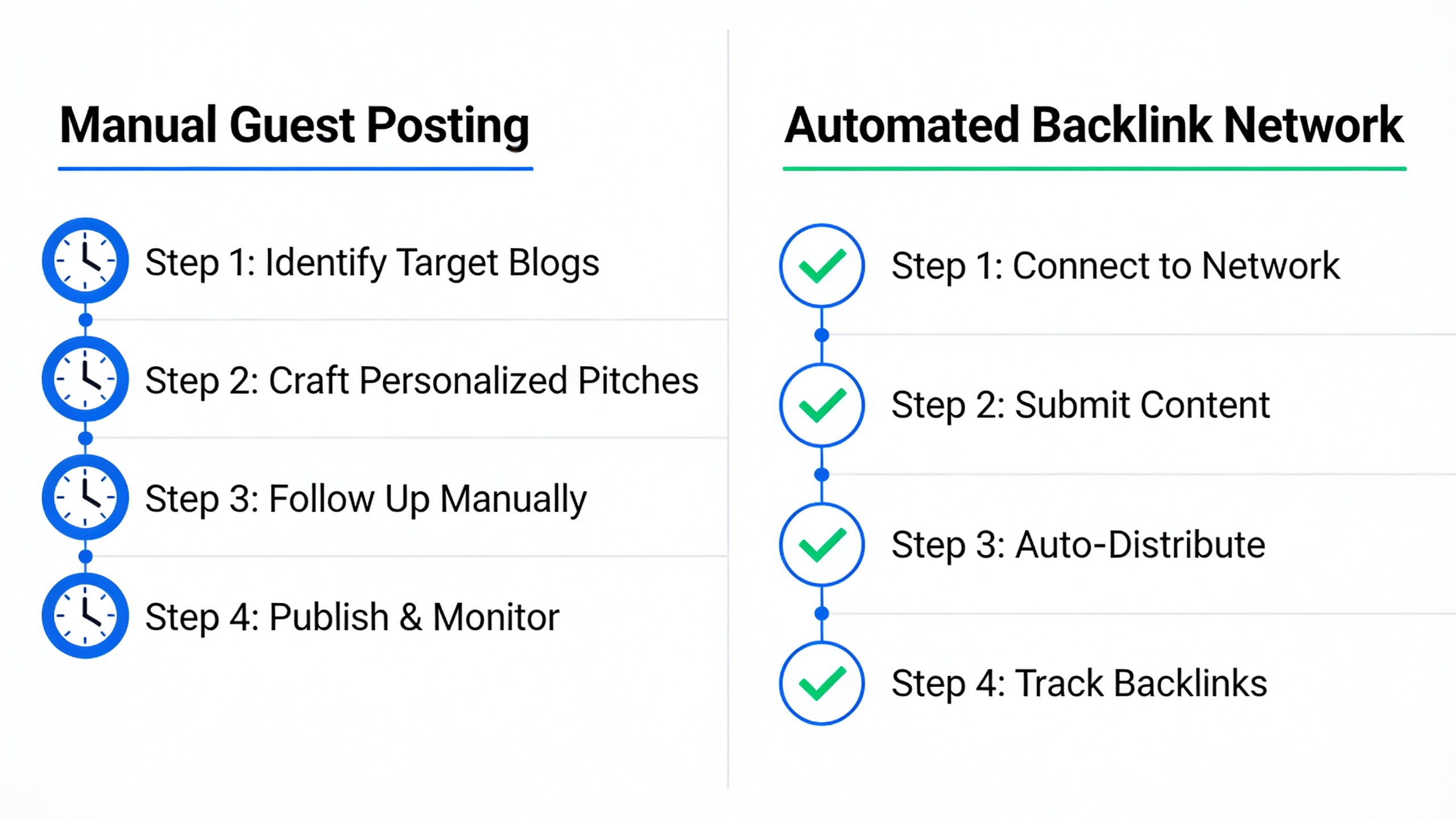
Which is also why manual outreach has gotten so much more labor-intensive relative to what you get out of it. Finding truly relevant, editorially credible sites, building a real relationship with an editor, getting the thing approved. That can eat weeks per link. And that labor cost is exactly why a lot of teams are supplementing or straight-up replacing manual guest posting with more systematic approaches, including AI-assisted content production paired with verified backlink networks, where outbound links get placed contextually inside genuine articles and actually checked to confirm they're live rather than just assumed to be.
One more thing worth remembering: guest posting doesn't live in a vacuum. A backlink pointing at a page with bad internal linking, thin content, or a clunky mobile experience won't do nearly as much as one pointing at a page that's technically solid. If you haven't audited your internal link structure lately, this guide to internal linking for SEO success walks through how to make sure the pages you're trying to boost are actually built to receive and pass along that authority. And since most of the referral traffic from guest posts lands on phones these days, it's worth skimming mobile SEO best practices for 2025 so the landing experience doesn't wreck all the work you put into earning the placement.
Guest Posting vs. Other Content Distribution Tactics
Guest posting is one of several solid distribution tactics in 2025, and it tends to do its best work alongside other methods rather than instead of them, because each one has its own cost structure and payoff timeline. The table below lines guest posting up against the other common tactics on the dimensions that actually matter when you're deciding where to spend limited time and money.
| Tactic | Typical Time Investment | Backlink Value | Audience Reach | Scalability |
|---|---|---|---|---|
| Manual guest posting | High (research, pitching, editing per placement) | Strong if placement is relevant and editorial | Limited to host site's existing audience | Low — bottlenecked by outreach capacity |
| Digital PR / HARO-style outreach | High, plus requires timely, newsworthy angles | Can be very strong (media-site links) | Broad but unpredictable | Low — dependent on journalist interest |
| Backlink exchange networks (e.g., community-based platforms) | Low once set up; content is written and matched automatically | Depends on verification and relevance matching | Depends on network size and niche overlap | High — designed to scale with content volume |
| Owned content + internal linking | Moderate (requires consistent publishing) | Indirect (supports link equity distribution, not new external links) | Depends on existing traffic/promotion | High — compounding over time |
| Social/LinkedIn thought leadership | Low to moderate, ongoing | Minimal direct SEO value (mostly nofollow platforms) | Can be broad and fast-growing | Moderate — depends on algorithm and consistency |
The lesson here isn't that guest posting is obsolete. It's that betting your whole distribution game on it is just inefficient. A backlink exchange network, for example, tackles the same core need (earning relevant, verified backlinks) but automates the matching and bookkeeping that make manual outreach such a slog. RobinRank's setup pairs AI-written articles with a community-powered network where your outbound contextual links earn Domain Rating–weighted credits after verification, and you later spend those credits when another eligible article links back to you. Structurally that's a completely different animal from classic outreach. Instead of cold-emailing dozens of editors, the credits and matching handle discovery, and only links confirmed to be live actually count toward anything.
Want content like this running on autopilot for your own site? Try RobinRank free — AI-written, SEO-optimized articles generated and published automatically, no credit card required.
How Much Does a Guest Posting Strategy Cost in 2025?
The cost of a guest posting strategy in 2025 swings wildly depending on whether you're paying for content creation, outreach labor, placement fees, or all three at once. And the honest answer nobody wants to hear is that "free" guest posting mostly vanished the moment quality editorial sites started demanding genuinely useful content instead of accepting anything with a link stapled to it.
Broadly, the money and time go into a few buckets. There's content creation, and writing something actually useful and well-researched eats real hours, often several per article if a subject expert does it, or a freelancer's fee if you outsource. There's outreach and relationship-building, which is basically pure labor and scales in a straight line: twice the placements means roughly twice the hours, because this stuff doesn't get cheaper with volume unless you automate it. Then there are placement fees, since some legit publications charge a contributor fee or make you buy a membership to submit; that varies enormously by site and industry, and you've got to judge case by case whether the audience and credibility justify the spend.
And then there's the one people forget: opportunity cost. Every hour you spend pitching guest posts is an hour you're not spending on some other distribution tactic. That's a big reason teams are shifting budget toward tools that automate chunks of the workflow (content production, publishing schedules, backlink verification) so their humans can focus on strategy and relationships instead of the repetitive grind.
This is also where the whole AI-assisted content conversation comes in. Tools built to analyze a niche, spin up SEO-structured drafts, and publish on a schedule cut the content-creation cost way down, even though they can't replace genuine relevance and editorial judgment. So the real trade-off isn't "guest posting versus automation." It's "how much of the guest posting workflow can I automate without gutting the relevance and quality that made it work in the first place?"
Building a Guest Posting Strategy That Actually Works
A guest posting strategy that works in 2025 starts with a short list of genuinely relevant, editorially credible sites, not a giant list of anywhere that'll take an outside contributor. Quality of placement beats quantity, consistently, both for search visibility and for the kind of independently verifiable mentions AI answer engines like to pull from.
Vet sites before you pitch, not after
Before you reach out, actually look at the site. Does it publish consistently? Does its existing guest content read like real expertise or like link-farmed filler? Does its audience overlap with your customers or your professional peers, or is it just a number on a dashboard? A site with a high authority score but a "Write for Us" page that reads like a link-selling storefront is a red flag. Skip it, whatever the metric says.
Write for the host's readers first, your link second
The best guest posts are the ones that would earn their place even with the link stripped out. Genuinely useful, specific, example-driven stuff that an editor would happily run regardless of your backlink. Editors are rejecting or heavily rewriting anything that smells like a disguised ad, and honestly, who can blame them? Their own credibility with their readers is on the line every time they hit publish.
Diversify anchor text and placement context
Guest blogging SEO likes natural-looking link profiles. That means varied anchor text, links dropped inside relevant paragraphs (not just parked in your author bio), and a mix of branded, topical, and generic anchors. A run of identical exact-match anchors across a bunch of placements is exactly the kind of footprint spam-detection systems were built to sniff out.
Track what actually happens after publication
A guest posting strategy with no measurement isn't a strategy, it's just activity. Watch your referral traffic. Check whether the link stays live, because plenty of sites quietly yank or nofollow links months later when nobody's looking. See whether the placement moved the needle on branded search volume or organic rankings for related terms. This is where automated verification really earns its keep too. A network model that only credits links it's confirmed are still live and published, instead of assuming a placement lives forever, gives you a far more honest picture of what you actually own.
Treat it as one channel among several
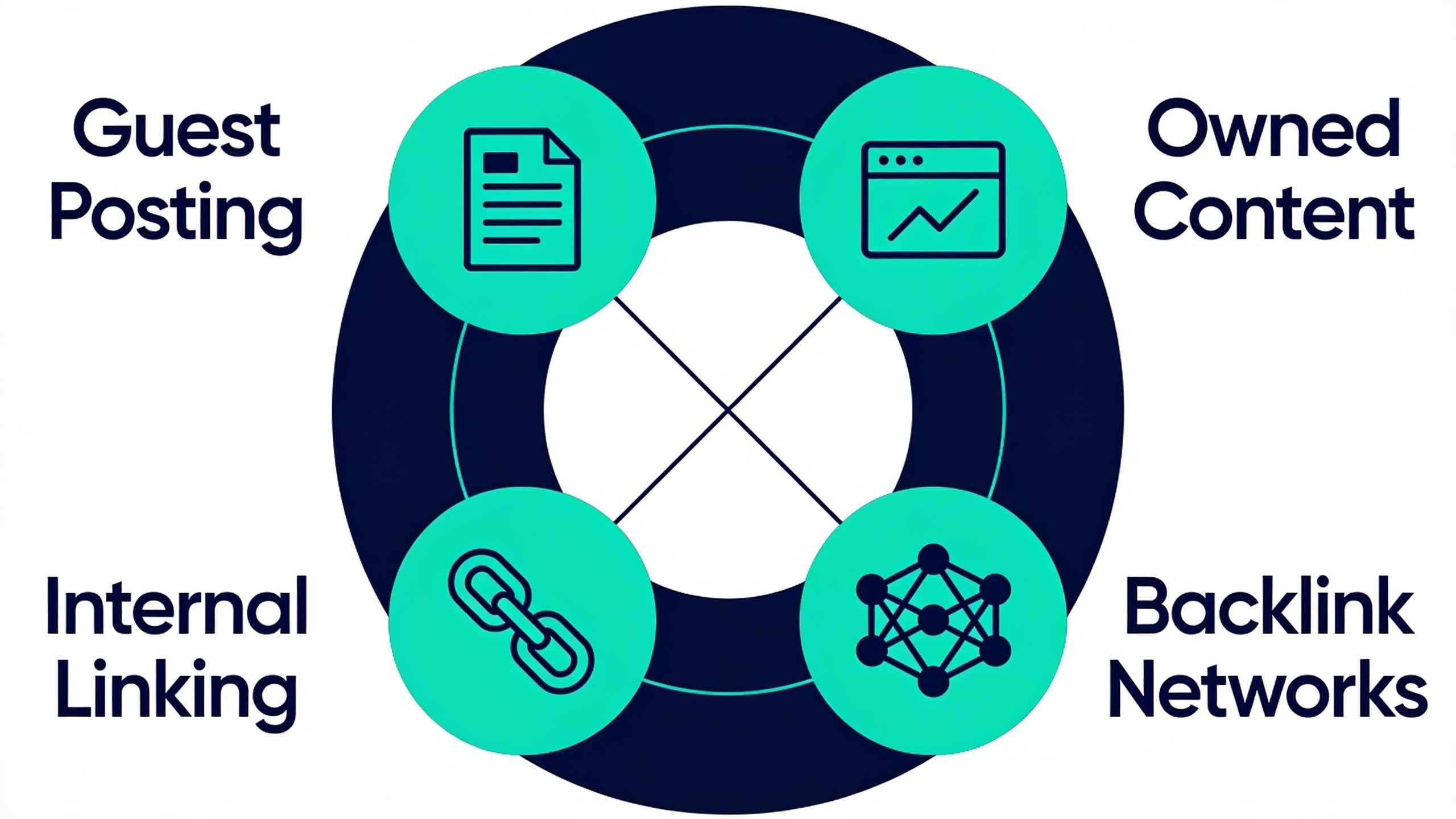
Because guest posting is so time-heavy per placement, it works best as part of a wider mix rather than your entire growth plan. Pair it with owned content, consistent internal linking, and where it fits your workflow, an automated backlink exchange network. That combination can cut the total labor needed to keep a steady flow of relevant referring domains coming in, instead of you white-knuckling one-off manual campaigns forever.
When Guest Posting Isn't Worth It
Guest posting stops being worth it the moment the time cost of manual outreach outweighs the realistic traffic, authority, or relationship value a placement can deliver. And that happens more often than most "guest posting still works!" advice wants to admit. There are a few pretty clear signals it's time to pump the brakes.
If your outreach success rate is dismal relative to the hours you're sinking into pitching, and the sites that do say yes have thin editorial standards or basically no real readership, you're eating an opportunity cost that some other tactic would put to better use. Same goes if you notice most of the guest post opportunities in your niche are on sites that clearly exist just to sell placements. You know the type: generic, low-effort "write for us" pages happy to take literally any topic. Chasing those risks tying your brand to exactly the kind of link network search engines are actively working to devalue. Not worth it.
Guest posting also makes less sense when your own site's foundation isn't ready to cash in on the traffic and authority a good placement could send. A backlink pointing at a page that crawls on mobile, has no internal links pulling visitors deeper, or offers thin content will underperform no matter how great the referring domain is. In that situation, the smarter move is fixing the foundation first, auditing your internal link structure, mobile experience, and content depth, before you burn more hours on outreach.
FAQ: Guest Posting in 2025
Is guest posting still good for SEO in 2025?
Yes, it can still support your SEO when the placements are on relevant, editorially credible sites and the links are earned rather than bought in bulk. It's just not the standalone growth lever people treated it as a decade ago. And low-quality placements can actively hurt you if they associate your site with spam-flagged link networks.
How many guest posts do I need per month for results?
There's no magic number, and honestly, chasing a fixed monthly quota is usually the wrong way to think about it. A handful of highly relevant, well-placed posts on credible sites beats a pile of low-quality ones, because search engines and readers both respond to relevance and editorial quality, not raw count.
What's the difference between guest posting and a backlink exchange network?
Manual guest posting means researching sites, pitching editors, and negotiating placements one at a time. Slow, labor-heavy work. A backlink exchange network instead matches sites by niche, language, and quality signals, then places contextual links inside published articles, with credits earned or spent based on verified, live links. Same goal, far less manual outreach, still leaning on genuine content and relevance matching.
Does guest posting help with visibility in AI tools like ChatGPT or Gemini?
It can, since AI assistants often lean on indexed pages, recognized entities, and independently verifiable mentions when they build answers, and a credible guest post on a reputable site can serve as one of those references. It's no guarantee any particular assistant will cite you, though, since that also depends on relevance, indexing, and each system's own sourcing quirks.
Should small businesses and startups bother with guest posting at all?
Depends on your time and budget, honestly. It can absolutely be worthwhile if you can find a handful of genuinely relevant, audience-appropriate sites and produce content good enough to be worth publishing. But if time is tight, you're probably better off nailing a strong owned-content foundation and a lower-effort backlink method first, then layering manual outreach on top later.
Guest posting hasn't disappeared in 2025. It's just been forced to grow up. The version that still works looks a lot less like mass outreach for cheap links and a lot more like selective, relationship-driven contribution to sites your actual audience reads, backed by a technically solid site ready to make the most of whatever traffic and authority comes back. Whether you do all that by hand, automate parts of it, or lean on a backlink exchange network to fill the gaps, the core principle hasn't budged: relevance and editorial credibility are the whole ballgame. They're what separates a strategy that compounds over the years from one that quietly turns into a liability.
Ready to stop writing content by hand? Start your free RobinRank trial and get a full month of SEO-optimized articles published on autopilot.