Anchor Text Strategy: Best Practices for Natural-Looking Links
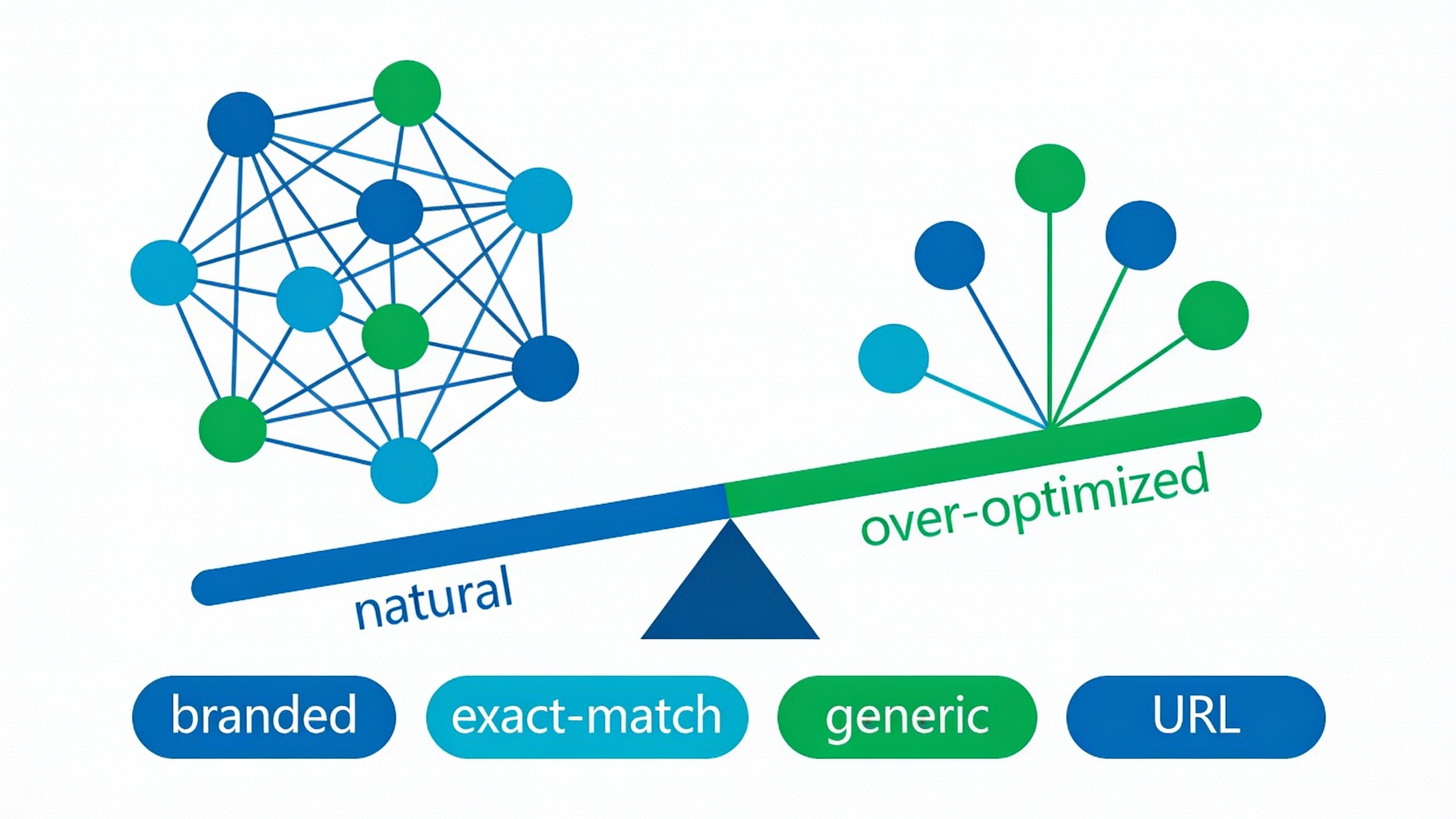
So let's talk about how anchor text actually works, what a natural distribution looks like in the wild, and how to build (or rescue) a backlink profile that supports your keyword goals without setting off alarms.
Table of Contents
- What Is Anchor Text Strategy?
- Why Does Anchor Text Matter for SEO?
- What Are the Main Types of Anchor Text?
- What Anchor Text Ratio Looks Natural?
- How Do You Build a Natural Backlink Profile with Anchor Text?
- Common Anchor Text Mistakes That Trigger Red Flags
- How to Audit and Fix Your Existing Anchor Text Profile
- Anchor Text in Link Building Partnerships
- Frequently Asked Questions
What Is Anchor Text Strategy?
An anchor text strategy is the plan you use to decide what clickable words point to your site from other domains, and in what proportions, so the whole thing looks like it grew on its own rather than getting assembled by a spreadsheet. Anchor text itself is just the visible, clickable part of a link. In the sentence "check out this SEO software," the phrase "SEO software" is the anchor. That's it. No mystery.
Search engines lean on anchor text as one of many clues about what a linked page is about. If dozens of sites point to your pricing page with the phrase "best CRM software," that repetition tells Google something about relevance. But if that same phrase shows up in 80% of your backlinks? Now it's telling Google something about your intent, and not the flattering kind. A good anchor strategy is really a balancing act between two things that pull against each other: giving search engines enough keyword context to understand your page, and keeping the pattern messy enough that it doesn't read as manufactured.
This matters way more than it used to. Back in the early 2010s, stuffing your anchors with keywords was one of the most dependable ways to shove a page up the rankings. These days, an anchor profile that leans too hard on exact-match keywords is one of the fastest ways to get a hard look from Google's spam systems. The tactic didn't just stop working. It flipped into a liability.
Why Does Anchor Text Matter for SEO?
Anchor text matters because it's a direct relevance signal search engines use to figure out what a linked page is about, but a weirdly high concentration of keyword-rich anchors is also one of the clearest fingerprints of manipulative link building. Google says as much in its own webmaster guidance: links meant to manipulate PageRank or a site's ranking, including those built on excessive keyword-rich anchor text, break its rules on link schemes.
The best historical example here is Penguin. Google launched it in 2012, and it went straight after sites with unnatural, over-optimized anchor patterns as part of a bigger crackdown on shady link schemes. And here's the part people miss: Penguin didn't just punish spammy links. It punished the pattern of anchor text those links carried. Sites that had built hundreds of links using the exact phrase "cheap car insurance quotes" got hammered, even when the linking domains themselves weren't obviously garbage.
That lesson still holds. Search engines don't just look at where your links come from. They look at what those links say. A profile with natural, human-looking anchor distribution correlates strongly with links that were genuinely earned. A profile drowning in commercial keyword phrases correlates with paid links, link networks, or outreach automation running at full tilt.
None of this means you should ignore anchor text and let the chips fall wherever. It means you manage it on purpose, the same way you'd manage any other ranking factor, with variety as the north star instead of repetition.
What Are the Main Types of Anchor Text?
There are six commonly recognized categories of anchor text, and a healthy backlink profile uses most of them instead of leaning on one or two. Knowing each type is really the foundation of everything else, because it gives you the vocabulary to audit what you've already got and spot what's missing.
| Anchor Type | Example | Typical Use Case | Risk Level If Overused |
|---|---|---|---|
| Branded | "RobinRank," "according to RobinRank" | Press mentions, brand citations | Low |
| Naked URL | "https://www.example.com/blog/post" | Citations, forum references, footnotes | Very low |
| Generic | "click here," "read more," "this article" | Blog roundups, resource pages | Low |
| Exact-match keyword | "anchor text strategy" | Editorial links to a specific target page | High |
| Partial-match keyword | "guide to anchor text best practices" | Contextual editorial mentions | Medium |
| Image/no-text | Alt text on a linked image | Image-heavy content, infographics | Low |
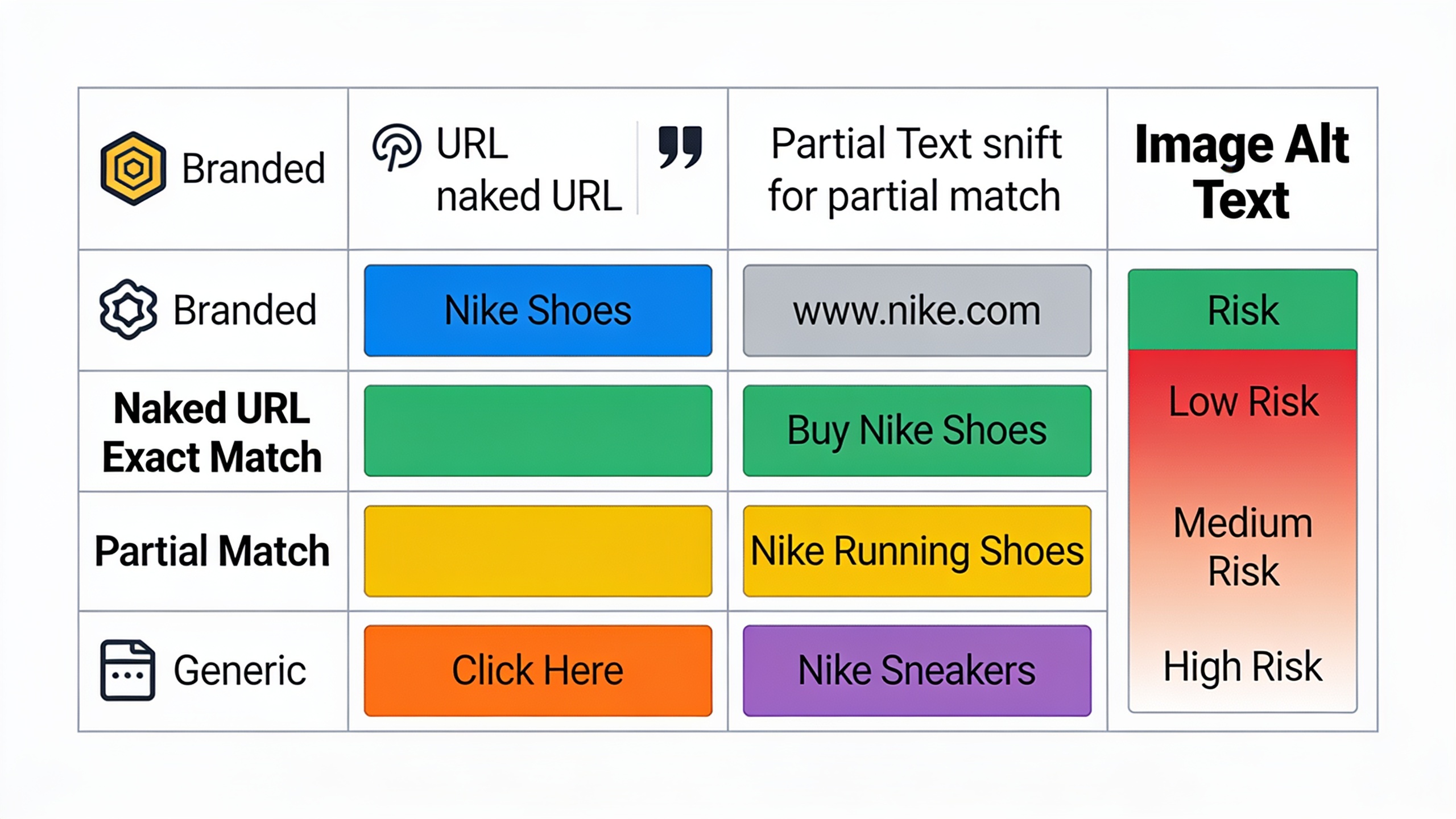
Branded anchors are the backbone of pretty much every healthy profile, because they mirror how real humans talk about a business. Journalists, bloggers, reviewers, they all reach for a company or product name, not a keyword phrase. Naked URLs and generic anchors like "this resource" or "click here" show up constantly in organic, unpaid linking too, mostly because the person copying the link isn't thinking about SEO at all. They just paste the URL or type a lazy phrase and move on.
Exact-match and partial-match anchors are the most valuable for signaling topical relevance, and also the riskiest in volume, because they almost never happen naturally at scale. One glowing review site linking to your "SEO software" page with the anchor "SEO software"? Totally normal. Fifty guest posts doing the exact same thing over a few months? That's a pattern. And patterns are precisely the thing spam-detection systems were built to sniff out.
What Anchor Text Ratio Looks Natural?
There's no single official percentage from Google for what a "natural" anchor ratio looks like, but the SEO world has more or less agreed on a rough consensus after years of watching real, unpenalized profiles: branded and naked-URL anchors should be the clear majority, generic anchors fill a decent secondary slice, and exact-match keyword anchors stay a small minority. Small. Really small.
A commonly cited rough distribution for a healthy profile looks something like this:
| Anchor Category | Typical Healthy Share | Notes |
|---|---|---|
| Branded | 40–60% | Should almost always be the largest single category |
| Naked URL | 10–20% | Common in citations, directories, and press |
| Generic | 10–20% | Natural for roundups, resource pages, forums |
| Partial-match keyword | 5–15% | Contextual, descriptive phrasing |
| Exact-match keyword | Under 5–10% | The category most likely to trigger scrutiny if it dominates |
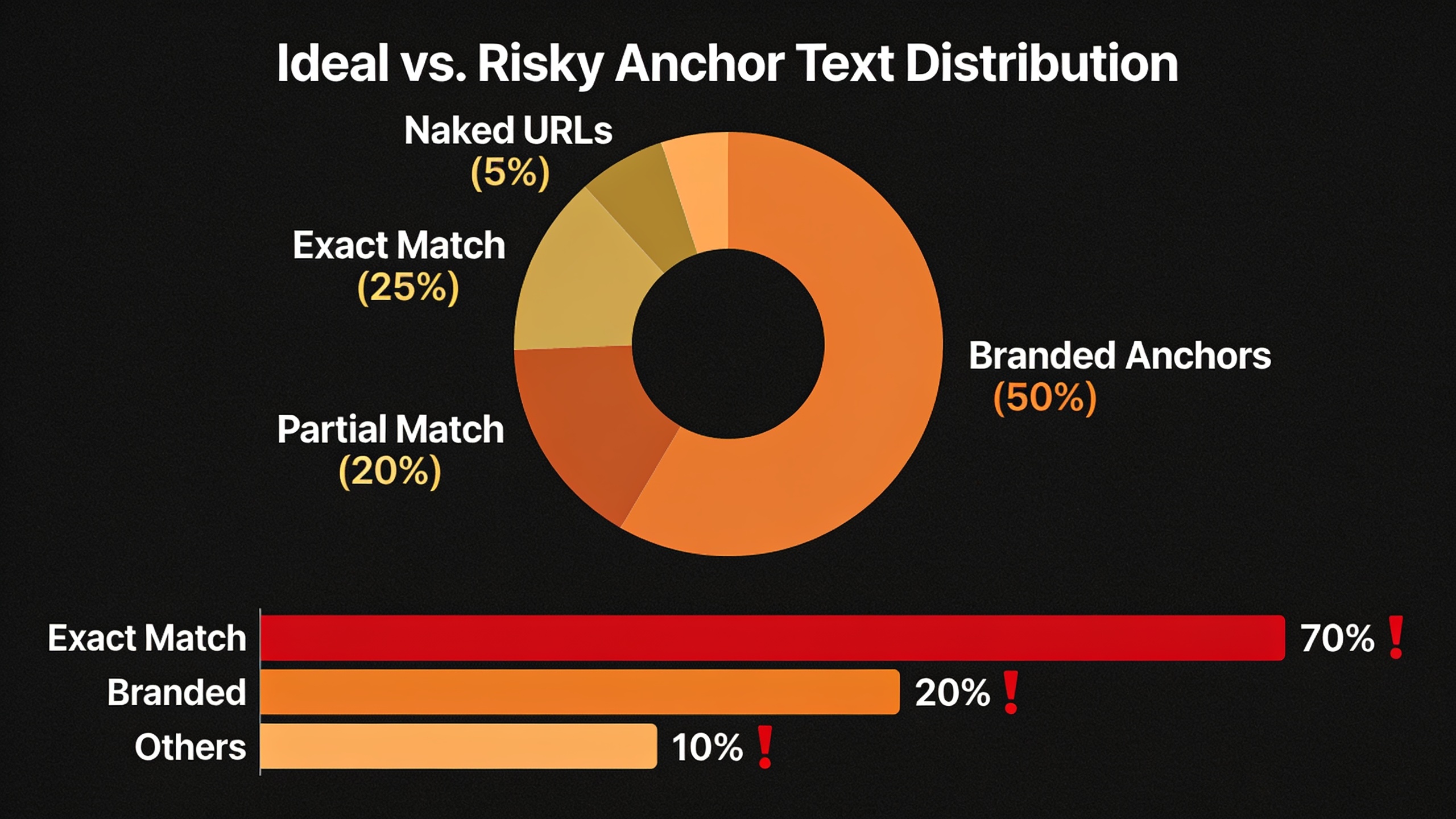
Treat those as directional, not a formula to hit down to the decimal. What search engines are actually looking for is variety and plausibility relative to your site's size and age, not some magic ratio. A five-page local business site with two backlinks doesn't need a spreadsheet. A 200-page SaaS blog with hundreds of referring domains does need to watch this stuff, because at scale, patterns get statistically loud whether you meant them to or not.
If you're actively building content to earn links, the anchor conversation ties in tightly with how often you refresh that content. Pages that go stale earn fewer new links over time, which quietly skews your anchor profile toward whatever anchors you built way back at the start. Going back and updating older posts (something I dig into in Content Freshness: When and How to Refresh Old Blog Posts) gives other sites a fresh reason to link again, which naturally introduces new anchor variety instead of just deepening an old, narrow rut.
How Do You Build a Natural Backlink Profile with Anchor Text?
You build a natural backlink profile by letting the anchor text bend to the source, the context, and the relationship behind each link, rather than requesting or writing the same keyword phrase every single time you land a placement. A natural profile is one whose anchors, referring domains, and link velocity look like what would happen if a bunch of independent websites linked to you organically over time. Even if you actively earned or asked for some of those links.
A few habits that actually help:
Vary the request, not just the record. When you ask a partner site for a placement, whether through outreach, a guest post, or an exchange, don't always ask for the same anchor. Rotate through your brand name, a descriptive partial-match phrase, and every so often just a naked URL. If you keep requesting "best project management software" over and over, congratulations, you've rebuilt the exact thing Penguin was designed to catch.
Let context call the shot. A link from a "best tools" roundup reads better with a branded or generic anchor. A link buried in a deep, topically relevant guide can carry a partial-match keyword without looking forced. Matching the anchor to the context usually matters more than matching it to your keyword wishlist.
Want content like this running on autopilot for your own site? Try RobinRank free — AI-written, SEO-optimized articles generated and published automatically, no credit card required.
And diversify the pages getting linked, not just the anchors. A natural profile spreads love across your homepage, blog posts, product pages, resource guides, not just one lonely target keyword page. If every backlink funnels to a single URL with slightly different keyword phrasing, that's still a pattern, even when the anchors themselves look varied. Google can see through that.
Build relevance at the topic level too, not just the anchor level. This one's big for local and service businesses, where topical and geographic relevance often outweighs keyword-exact anchors entirely. If you're building citations and backlinks for a local shop, the anchor advice pairs naturally with the broader on-page and citation work in the Local SEO Playbook: A Step-by-Step Guide for Small Businesses, where consistent business naming honestly matters more than nailing exact-match anchors.
Oh, and let time do some of the heavy lifting. Natural profiles don't materialize overnight. A profile that jumps from zero backlinks to a thousand in a month, all with tidy keyword anchors, looks nothing like organic growth. Nothing. Spreading acquisition out over time, with variety baked in from day one, beats trying to bolt on a fix for a lopsided profile after the damage is done.
Common Anchor Text Mistakes That Trigger Red Flags
The most common anchor text mistakes are over-optimizing exact-match keywords, repeating the same phrase across a pile of different domains, and just... ignoring anchor text entirely until a ranking drop forces a panicked audit. Every one of these is avoidable with a little planning before links go live.
The classic is exact-match overuse. This is the Penguin-era mistake, and it's still the most damaging one on the list. If your target keyword is "anchor text strategy" and that exact phrase shows up as the anchor in a big chunk of your backlinks, you've built something that reads engineered rather than earned. Doesn't matter how good the linking domains are.
Then there's anchor cloning across guest posts. A business runs a guest posting campaign, tells every writer to use the identical anchor and target URL, and ends up with dozens of unrelated domains all carrying the same link text. Site owners tend to think this is invisible. It really isn't. Cross-domain repetition is one of the easier patterns for search engines to spot.
People also forget about anchor text on reciprocal or exchanged links. In any exchange or partnership, it's tempting to just default to whatever keyword feels most valuable. But reciprocal networks that keep slapping exact-match anchors on both sides create a doubly obvious pattern: unnatural anchors plus a reciprocal structure. Varying the anchors within exchanges, and folding in branded and generic phrasing, keeps those placements looking like real editorial choices instead of a handshake deal.
Another one: treating anchor text as set-and-forget. It's not a one-time call you make when a link goes live. As your profile grows, the ratios shift, and something that looked perfectly balanced at 20 referring domains can look badly skewed at 200. Periodic audits should be part of your ongoing process, not a thing you do once and forget about.
Last, and this is a sneaky one, don't dump every keyword-rich anchor onto your single money page. Piling all your best anchors onto your highest-value URL, instead of spreading links and variety across a wider set of relevant pages, sticks out statistically even when each individual anchor looks perfectly reasonable on its own.
How to Audit and Fix Your Existing Anchor Text Profile
Auditing your anchor text profile means pulling your full backlink list, sorting every anchor into the types above, working out what share falls into each bucket, and then comparing that against the rough natural benchmarks. Most SEOs run this through a backlink data tool, because hand-classifying anchors across hundreds of referring domains is a fast track to losing your afternoon (and your mind).
The process usually goes like this:
- Export your full backlink list, including the anchor text, source URL, and target URL for every single link.
- Categorize each anchor as branded, naked URL, generic, partial-match, exact-match, or no-text/image.
- Calculate the percentage share of each category across your total links, and again per-page for your most important target URLs.
- Flag the anomalies, like any single exact-match phrase showing up in more than roughly 10% of your total links, or any target page where keyword anchors dominate way out of proportion with the rest of the site.
- Point new link acquisition at the thin categories. If the audit shows you're heavy on exact-match and starving for branded mentions, aim your outreach and promotion at getting your brand name linked, not at scoring more keyword anchors.
- Circle back quarterly, because a profile that looks fine today can drift as new links pile up, especially mid-campaign.
If the audit turns up a genuinely scary concentration of exact-match anchors, particularly if it lines up with a ranking drop, the fix usually isn't ripping out old links (that's often impractical, and in the case of an actual manual penalty, a disavow file might be the right move instead). The more sustainable play is to dilute the pattern going forward. Deliberately chase branded, generic, and naked-URL links until the ratio rebalances on its own. It's slower, but it actually sticks.
Anchor Text in Link Building Partnerships
Anchor text deserves extra attention in any link building partnership or exchange because both sides usually have a say in what phrase gets used, which means the anchor is a negotiated choice rather than an accident. And negotiated choices are much easier to keep natural if you plan for it. This is a totally different situation from earning a citation passively, where you have zero control over the anchor.
In a direct link exchange, where one owner agrees to place a link in return for one back, the anchor conversation happens right out in the open. One party asks for a specific page and anchor, the other agrees, declines, or counters. That kind of direct, verified negotiation, confirming the exact page and anchor before anything goes live and then checking the link actually got published, is the model RobinRank's exchange network is built around. It connects site owners directly instead of leaning on cold outreach or shady link brokers.
Everything I've said about anchor discipline applies straight to that kind of exchange. When you request a placement, fight the urge to reach for your top exact-match keyword every time. Treat each request as one data point in your overall distribution: ask for a branded mention on one, a naked URL or generic phrase on another, and a genuinely relevant partial-match keyword only when the linking page's content actually earns it. And because these exchanges are real conversations between real people rather than automated drops, the anchors tend to fit the linking page's actual content, which is itself a strong natural-look signal. Editorially placed anchors almost always match what's around them.
Frequently Asked Questions
So how much exact-match anchor text is actually safe?
There's no official Google line in the sand, but most experienced SEOs start treating anything above roughly 5–10% of your total profile as a risk zone, especially for competitive commercial keywords. Safer bet: keep exact-match anchors a small minority next to your branded, naked-URL, and generic anchors, and reassess as your link count climbs.
Does anchor text even still matter after Penguin?
Yep. Penguin, launched in 2012, changed how anchor text gets evaluated rather than making it irrelevant. Google's own guidelines on link schemes still treat excessive keyword-rich anchor text as a signal of manipulative link building, so anchor diversity is very much a live part of any safe SEO strategy today.
Can I actually ask for a specific anchor in a guest post or exchange?
Yes, and it's completely normal in editorial link building and direct exchanges. The trick is not asking for the same exact-match keyword every single time. Rotate between branded, partial-match, and generic anchors so the aggregate pattern across all your placements looks varied instead of copy-pasted.
How often should I be auditing this?
Quarterly is a sensible rhythm for most growing sites, and more often during active campaigns when new backlinks are stacking up fast. Waiting for a ranking drop to check usually means you're now cleaning up a mess that's already had months to compound.
Is it bad to have a ton of branded anchor text?
Honestly, no, quite the opposite. A high share of branded anchors is one of the strongest signs of a healthy, natural profile, because it mirrors how independent sites, journalists, and reviewers actually refer to the businesses they mention. Branded being your largest single category is a good sign, not a weakness.
---
Anchor text strategy isn't about crowning the "best" keyword phrase and repeating it until you're hoarse. It's about managing variety on purpose so your backlink profile reads the way a genuinely earned one would. Whether you're negotiating placements through an exchange, running outreach, or just keeping half an eye on how other sites cite your stuff, the goal never changes: enough keyword relevance to help search engines understand your pages, and enough natural mess that no single pattern jumps out as engineered.
Ready to stop writing content by hand? Start your free RobinRank trial and get a full month of SEO-optimized articles published on autopilot.