B2B Content Marketing vs. B2C Content Marketing: What Actually Works for Each
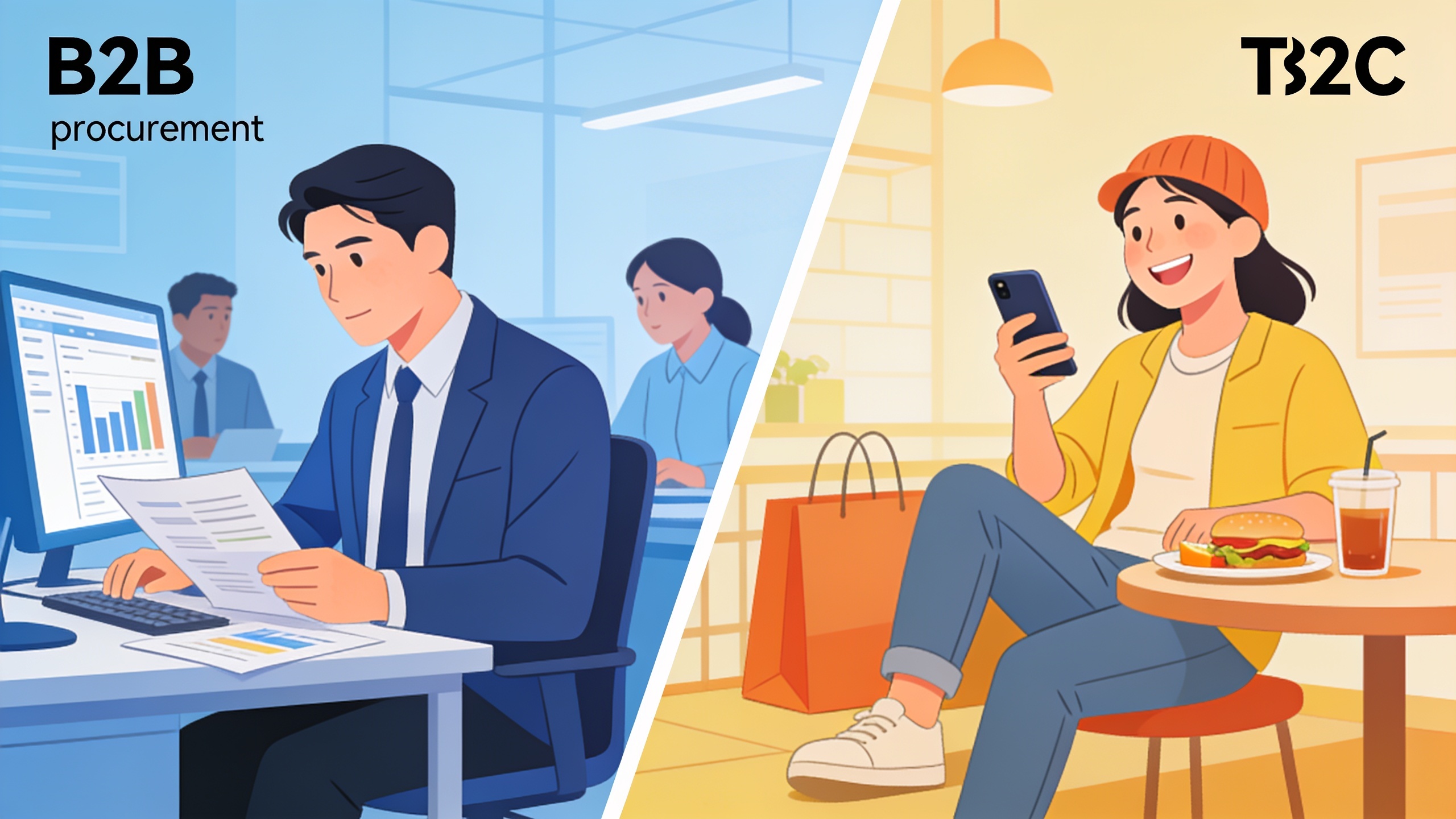
Both B2B content marketing and B2C content marketing sit on the same foundation, useful content that earns trust. But once you actually look at how each audience buys, the two split apart fast. Tone, format, where you distribute it, how it converts. All different. A procurement manager sweating over a six-figure software contract does not behave like someone deciding between two pairs of sneakers on their lunch break. And content that pretends otherwise tends to flop, no matter how nicely it's written.
So let's get into where these two strategies overlap, where they part ways, and how to build a content engine that respects those differences instead of jamming everything into one mold.
Table of Contents
- What Is the Real Difference Between B2B and B2C Content Marketing?
- Tone and Voice: How B2B and B2C Content Marketing Speak Differently
- Content Formats That Work Best for B2B vs. B2C Audiences
- Where Should You Distribute B2B Content vs. B2C Content?
- How Do B2B and B2C Content Marketing Convert Readers Into Customers?
- How Long Does It Take to See Results From B2B Content Marketing?
- B2B vs. B2C Content Marketing at a Glance
- Building a Content Engine That Works for Your Buyer
- Frequently Asked Questions
What Is the Real Difference Between B2B and B2C Content Marketing?
The core difference comes down to who's buying, and why. B2B content marketing is written for a buyer or a whole buying committee making a rational, usually high-stakes call on behalf of an organization. B2C content marketing is written for one person making a personal decision, and that decision is often driven by emotion, convenience, or price.
That one distinction ripples through everything else. A B2B purchase usually drags in multiple people. A marketing director. A finance approver. Some IT reviewer who wasn't in the first three meetings but suddenly has opinions. Each one needs different proof before they'll sign off. B2C? Usually one person, sometimes making the call in a matter of seconds. Which is exactly why B2C content can lean hard into urgency, aspiration, and straight-up entertainment.
Neither one is "better" content marketing in some abstract sense. They're just tuned for different decision-making processes. And honestly, mixing them up is one of the most common reasons a content program racks up traffic without ever moving revenue.
Tone and Voice: How B2B and B2C Content Marketing Speak Differently
B2B content leans measured and credibility-driven because the reader is weighing risk, not scratching an itch. B2C content gets to be warmer, chattier, more emotionally charged, because the reader is basically looking for a reason to feel good about buying something. Tone isn't just a style choice here. It's a trust signal, and it either matches where the reader's head is at or it doesn't.
B2B tone: precise, evidence-based, low-hype
B2B buyers are usually reading on behalf of a team, which means any claim you make might get repeated in a meeting you'll never sit in. So B2B content has to be specific. Named case studies. Cited data. A clear explanation of how something actually works. Language that doesn't oversell.
Take an article about "AI content marketing tools." It'll almost always do better when it lays out exactly how a workflow runs and what results are realistic, instead of promising some vague transformation. Empty superlatives erode credibility way faster in B2B than in B2C, and I think that's because the B2B reader is accountable to somebody else. Get them burned once and they remember.
B2C tone: relatable, emotional, fast-paced
B2C content can be punchier and more personality-forward, because the reader isn't building an internal business case. They're deciding for themselves, and usually fast. Humor, storytelling, a distinct brand voice, all of that does real work here, because half the job is building an emotional connection to the brand rather than just answering a technical question.
A skincare brand can open a post with a personal anecdote and it feels right. A cybersecurity vendor tries the same move and it just undercuts their own authority. Different rules.
Content Formats That Work Best for B2B vs. B2C Audiences
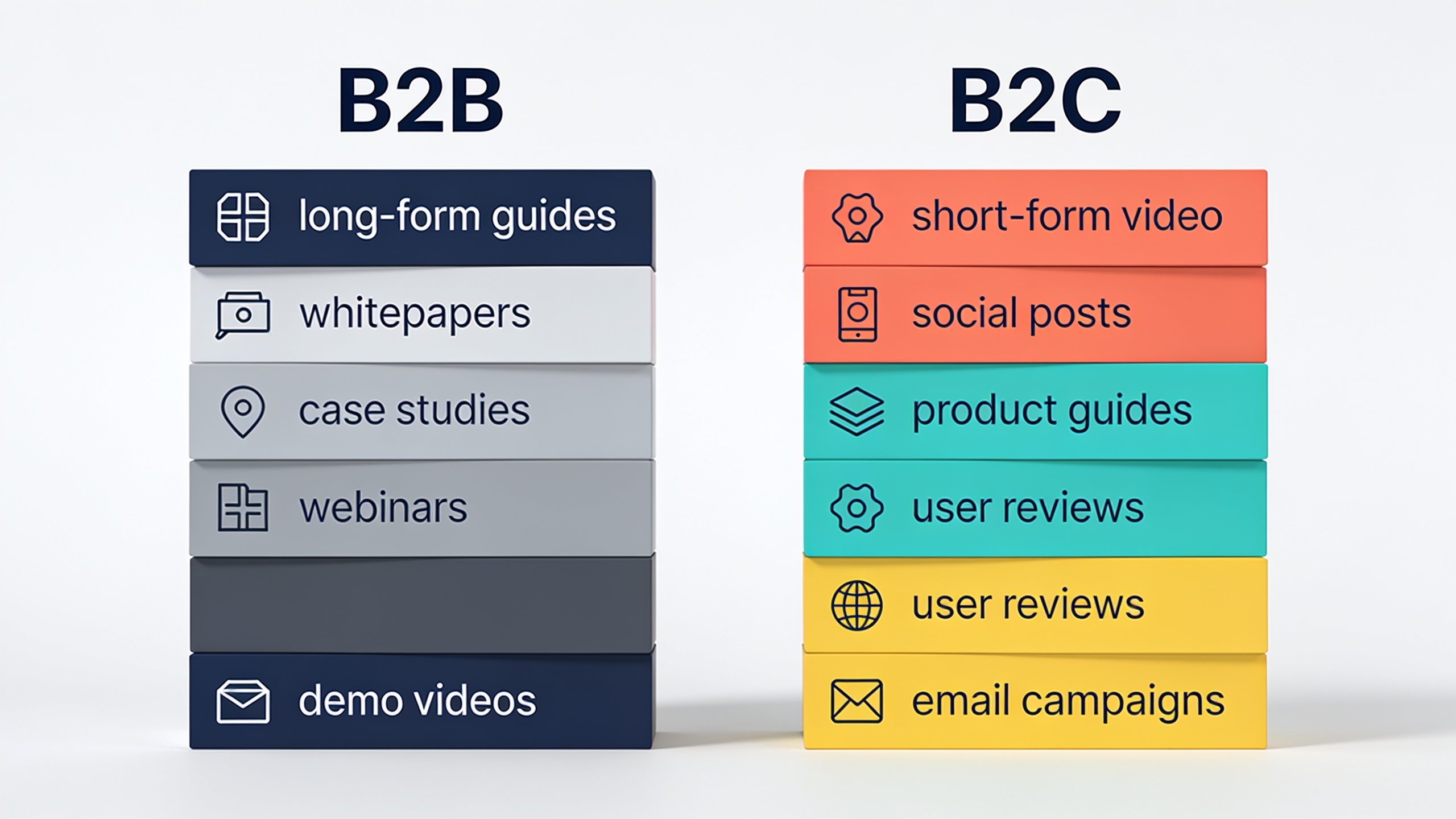
B2B content thrives in formats that support deep evaluation: long-form guides, whitepapers, webinars, case studies. That's because B2B buyers research obsessively before they commit. B2C content thrives in formats built for quick consumption and visual appeal: short videos, social posts, product-focused blog stuff. The rule of thumb? Let the buyer's actual research behavior pick the format, not whatever medium your team happens to like making.
For B2B, the workhorses are long-form guides and playbooks that walk through a process step by step, case studies that show real measurable outcomes (buyers want proof it worked for someone like them), webinars and demo videos that let a committee see the product without booking a sales call, and whitepapers or original research that stake out authority in a category. That last one gets used a lot to prop up an internal business case.
B2C runs on different fuel. Short-form video built for platforms where attention is measured in seconds. Product-led blog content like buying guides, comparisons, and "best of" roundups that sit right next to a purchase decision. User-generated content and reviews, which build trust with individual shoppers faster than anything a brand says about itself. And email and loyalty content that nurtures repeat buyers rather than chasing one big decision.
Both can support SEO, sure. But the search intent underneath is totally different. B2B queries skew toward "how to," "vs.," and "best tools for [use case]," all research-stage stuff. B2C queries skew toward "best," "near me," and transactional phrasing tied to buying right now.
Where Should You Distribute B2B Content vs. B2C Content?
For B2B content, your best bets are LinkedIn, email newsletters, and organic search, because B2B decision-makers do their research in professional contexts. B2C content usually performs better on visually driven, high-reach platforms like Instagram, TikTok, and YouTube, plus paid social, since consumers discover and decide in much more casual, high-volume environments.
Content Marketing Institute's annual B2B benchmarking research has consistently found LinkedIn ranked as the top-performing organic social platform among B2B marketers, which tracks with how business buyers actually use it. They're vetting vendors, following industry chatter, quietly forming opinions. That's a completely different world from a B2C brand, which usually sees stronger returns from platforms built for visual discovery and impulse.
Organic search is the one channel both share, but even there the intent splits. A B2B company ranking for "best AI content marketing tools for agencies" is grabbing a reader mid-evaluation, probably comparing a handful of vendors before requesting a demo. A B2C brand ranking for "best running shoes for flat feet" is usually catching someone a lot closer to hitting buy. This is exactly why a startup's early SEO needs to be built around how people actually research, not lifted from some generic content calendar. There's a good breakdown of that in how a bootstrapped SaaS startup built a content engine that actually worked, which digs into prioritizing content around real buying questions instead of vanity topics.
How Do B2B and B2C Content Marketing Convert Readers Into Customers?
Want content like this running on autopilot for your own site? Try RobinRank free — AI-written, SEO-optimized articles generated and published automatically, no credit card required.
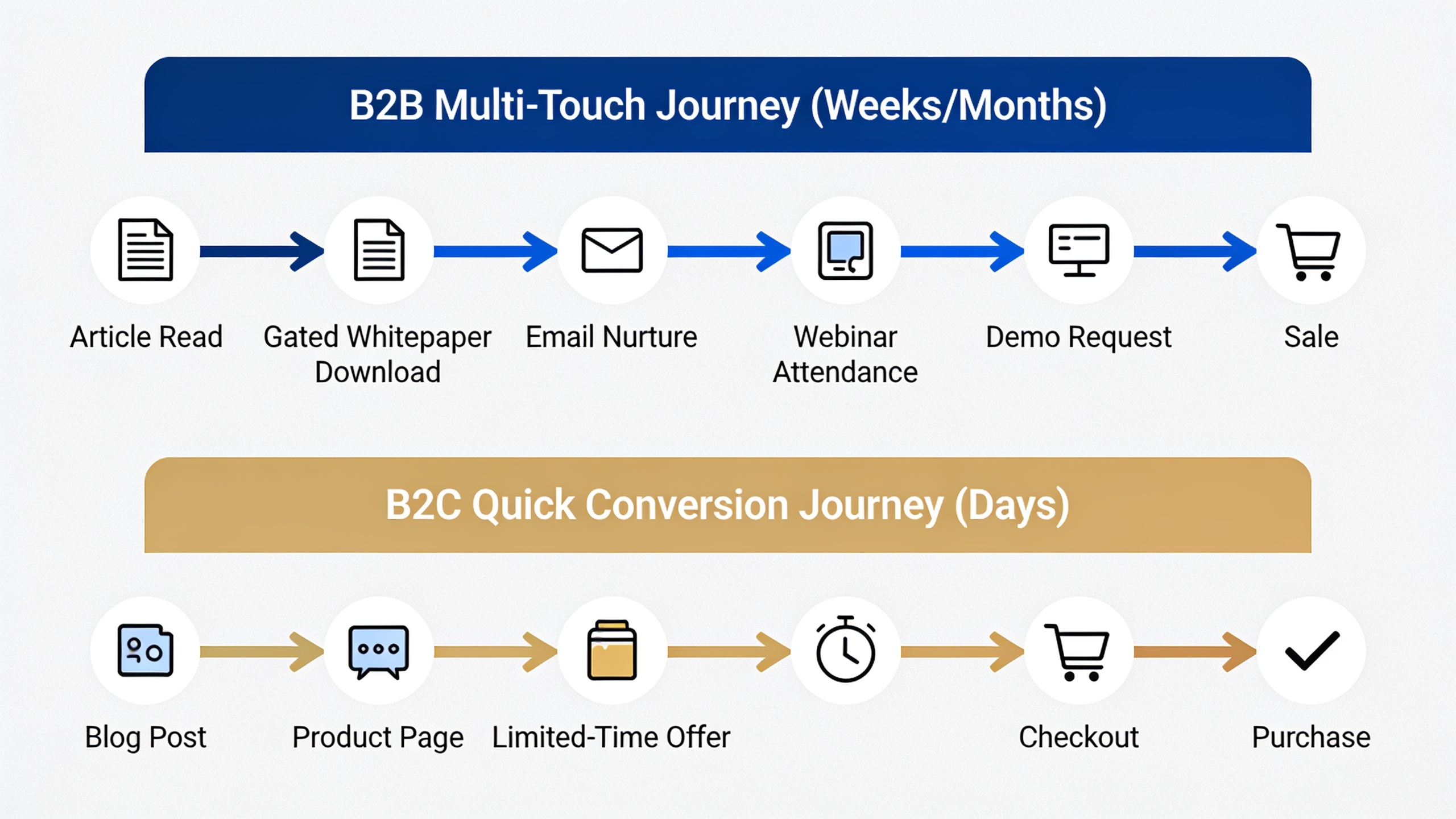
B2B content converts mostly through gated resources, demo requests, and nurture sequences built for a long, multi-stakeholder sales cycle. B2C content converts through direct CTAs, limited-time offers, and streamlined checkout paths designed for a single person deciding on the spot. The conversion mechanics just mirror the length of the sales cycle and how many people are in the room.
B2B conversion: nurture before you ask
A B2B purchase can take weeks or months and involve several people, so your content usually turns a reader into a lead long before it turns them into a customer. The usual tools:
- Gated whitepapers or templates that trade a genuinely useful resource for an email.
- "Talk to sales" or "book a demo" CTAs sitting on high-intent pages like pricing or comparison content.
- Email nurture sequences that keep re-engaging a lead over time with case studies, ROI data, product updates.
The tricky part is figuring out whether any of it is actually earning its keep, and pageviews won't tell you that. You need to track which pieces influence pipeline and closed revenue, which is exactly what how to measure ROI on AI content marketing tools gets into, breaking down the metrics that start to matter once content moves past the traffic stage.
B2C conversion: reduce friction, act now
B2C content usually converts close to first contact, so the whole game is removing friction rather than nurturing for months. What tends to work: direct "shop now" or "add to cart" CTAs baked right into the content, not just parked at the bottom. Urgency and scarcity cues, like limited stock or a discount clock, that nudge a lone decision-maker to move. And a dead-simple, mobile-first checkout, because a huge chunk of B2C content gets read and converted on a phone.
How Long Does It Take to See Results From B2B Content Marketing?
B2B content marketing takes longer to show measurable results than B2C, full stop. The sales cycles are longer and involve more people, so a single piece might influence a purchase months after it went live, long after that reader first showed up. This is one of the biggest sources of frustration for founders who expect content ROI to look the same across every business model. It doesn't.
A B2C brand can sometimes trace a blog post or a social video straight to a sale within days, since nobody needs internal sign-off to buy. B2B is a slog by comparison. A prospect reads your comparison article. Two weeks later they download a guide. A month after that they show up to a webinar. Eventually, finally, they book a demo. And that original article? It quietly nudged every single step, but it barely gets credit for any of it.
That's why last-click, single-session attribution models built for B2C consistently undersell B2B content. B2B teams really need multi-touch attribution or CRM-linked reporting to see what's actually happening. And content published consistently through an automated workflow, where topics, drafts, and publishing schedules just run rather than depending on sporadic manual effort, tends to compound over that longer cycle instead of delivering one quick spike. It stacks up the layered proof points, comparisons, case studies, FAQs, that a buying committee chews through over weeks.
B2B vs. B2C Content Marketing at a Glance
| Dimension | B2B Content Marketing | B2C Content Marketing |
|---|---|---|
| Buyer | Committee or multiple stakeholders | Individual consumer |
| Decision driver | Logic, risk reduction, ROI | Emotion, convenience, price |
| Sales cycle | Weeks to months (sometimes longer) | Minutes to days |
| Tone | Precise, credibility-driven, low-hype | Conversational, emotional, brand-driven |
| Top formats | Guides, whitepapers, case studies, webinars | Short video, product content, user-generated content |
| Primary channels | LinkedIn, email, organic search | Instagram, TikTok, YouTube, paid social |
| Conversion mechanic | Gated content, demo requests, nurture sequences | Direct CTAs, urgency offers, streamlined checkout |
| Attribution challenge | Multi-touch, long lag between content and close | Often traceable within a single session |
Building a Content Engine That Works for Your Buyer
The businesses that get the most out of content marketing, B2B or B2C, are the ones that build the whole strategy around how their specific buyer researches and decides. Not around some default "post twice a week" plan somebody found in a template. In practice that means a B2B software company should probably pour more into comparison content, case studies, and LinkedIn distribution, while a direct-to-consumer brand should lean into short-form video and visually driven product content.
And here's something marketers underrate: the two models can steal from each other more than people assume. B2B brands are getting more human and story-driven to stand out in crowded categories. B2C brands are building longer buying guides to grab research-stage search traffic. The line between "B2B content marketing" and "B2C content marketing" is really a spectrum of buyer sophistication and decision length, not two separate universes. Which is why the fundamentals of good content, clarity, evidence, actual usefulness to the reader, hold up no matter where a business sits on that spectrum.
For teams trying to keep this kind of tailored, consistent output going without standing up a whole content department, tools like RobinRank are built right around that tension. It's an AI-driven workflow that plans topics based on your niche and competitors, writes SEO-structured articles in a natural tone, and publishes on a schedule, while also plugging your site into a backlink exchange network to build the kind of independently verifiable signals that both search engines and AI answer engines are looking for.
Frequently Asked Questions
Is B2B content marketing more expensive than B2C content marketing?
Cost depends way more on format and production quality than on whether your audience is B2B or B2C. B2B content usually eats more research time per piece (interviews, data, getting the technical stuff right), while B2C often eats more budget on visual production like video and photography. Neither is universally cheaper. The money just moves toward different needs.
Can the same company run both a B2B and B2C content strategy?
Yep, and it's pretty common for companies with mixed customer bases. Think of a software company that sells both to individual freelancers (who behave more like B2C) and to enterprise teams (full B2B). In those cases it's almost always smarter to split the content tracks by tone, format, and funnel rather than trying to write one piece that serves both audiences equally well. That middle-ground content usually pleases nobody.
Which is harder to measure, B2B or B2C content marketing ROI?
B2B, generally. The sales cycle is longer and there are more touchpoints between someone's first exposure and closed revenue, so the trail gets murky. B2C tends to show a more direct, short-term line from content to purchase, which makes attribution comparatively simple.
Does SEO work differently for B2B and B2C content marketing?
The mechanics are the same, keyword research, on-page optimization, backlinks. What changes is the queries you're going after. B2B SEO tends to chase research- and comparison-stage keywords tied to a longer evaluation. B2C SEO tends to chase higher-volume, more transactional keywords tied to buying soon.
Should a B2B company use social media the way a B2C company does?
Not really. B2B companies usually get more from LinkedIn and professional communities where decision-makers actually engage with industry content, while B2C companies get more out of visually driven, high-reach platforms built for product discovery and entertainment. Copy a B2C social playbook onto a B2B brand and you'll often generate plenty of engagement and almost no qualified leads.
---
B2B and B2C content marketing are both answering the same quiet question, "why should I trust this business?" They're just answering it for very different readers under very different time pressures. The strategies that actually work are the ones built around how a specific buyer researches, who else is in the room for the decision, and how long that decision honestly takes. Not a one-size-fits-all template borrowed from someone else's business model.
Ready to stop writing content by hand? Start your free RobinRank trial and get a full month of SEO-optimized articles published on autopilot.