Broken Link Building: A Step-by-Step Outreach Playbook

This guide covers the whole thing. Finding the dead links, figuring out which ones are worth your time, writing emails people actually reply to, and turning those replies into real backlinks that stick.
If you've ever handed your team an outreach process and then watched the open rates trickle in while replies flatlined, broken link building is worth another look. It's a volume-for-relevance trade. You're not firing off two hundred generic pitches. You're solving one specific, visible problem on one specific page.
Table of Contents
- What Is Broken Link Building and Why Does It Still Work?
- How Do You Find Broken Links on Relevant Websites?
- Qualifying Broken Links Before You Reach Out
- Building the Replacement Content
- Crafting the Outreach Email: A Step-by-Step Template
- Follow-Up Sequences That Don't Feel Pushy
- Broken Link Building vs. Other Link Building Tactics
- Tracking, Verifying, and Reporting Results
- Frequently Asked Questions
What Is Broken Link Building and Why Does It Still Work?
Broken link building works because it turns a cold outreach email into a helpful bug report instead of a request for a favor. A broken link (a dead link, a 404, whatever you want to call it) is a hyperlink on a live page pointing to a URL that no longer loads. Usually the target page got deleted, moved, or the domain just expired and nobody noticed. When you spot one on a relevant site and offer a working replacement, you're fixing a problem the owner probably doesn't even know exists.
Two things make this land. First, broken links genuinely hurt the linking site. They mess with user experience and leak internal link equity, so fixing them is in the webmaster's own interest, not just yours. Second, the ask is tiny and specific. "Hey, this one link is dead, here's a replacement" is a lot easier to say yes to than the open-ended "would you mind linking to my article?" that lands in every editor's inbox forty times a week.
Don't mistake it for a shortcut, though. It needs decent research tools, a replacement resource that's actually comparable, and outreach you tailor page by page. Do it lazily (mass emails pointing at content that barely relates) and it gets ignored or flagged as spam just as fast as any other cold pitch. Do it right and you walk away with contextual, editorially earned backlinks from pages that already have topical relevance and, a lot of the time, real authority behind them.
How Do You Find Broken Links on Relevant Websites?
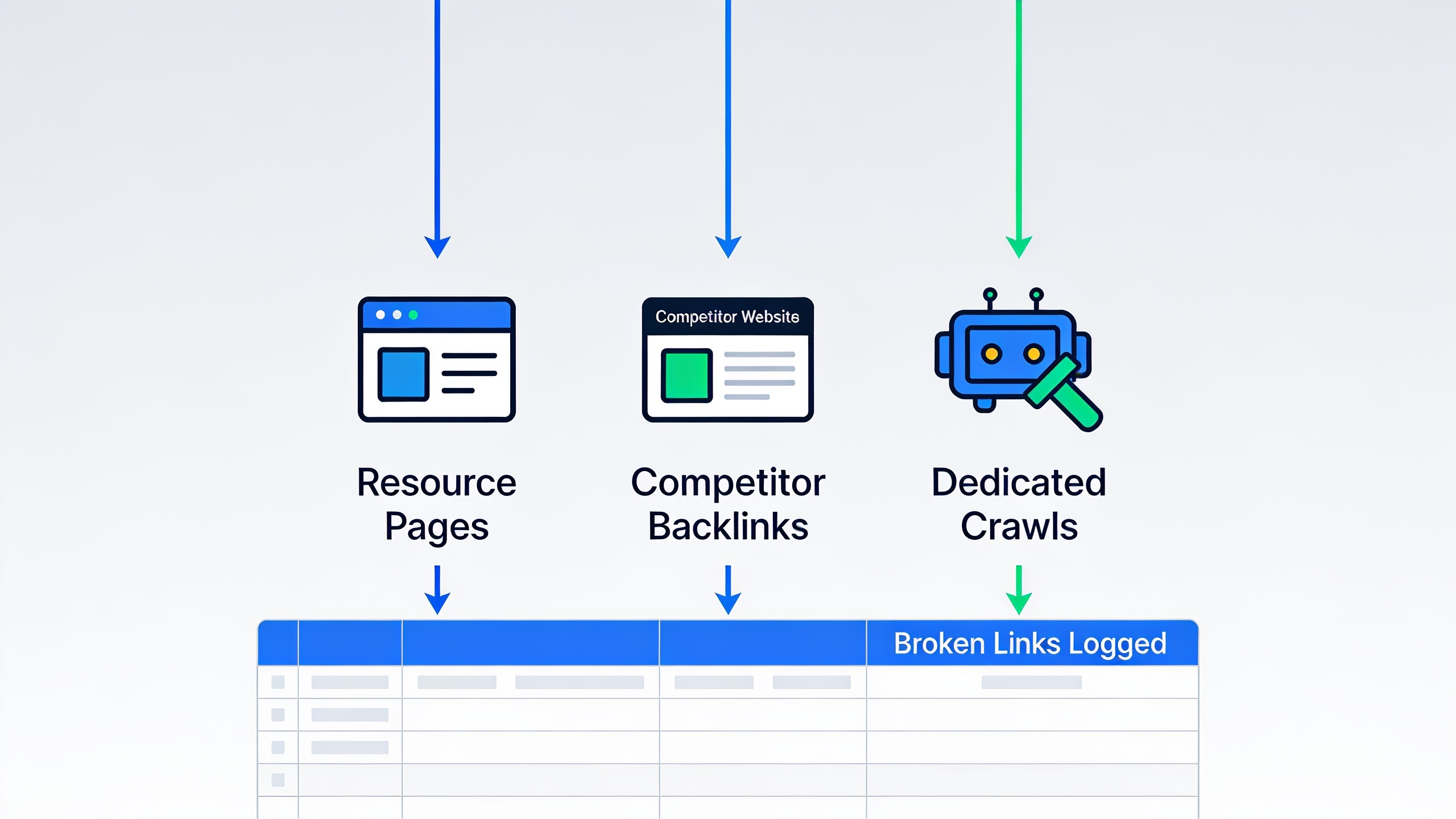
You find them by stacking three approaches: auditing competitor and resource pages with a backlink tool, crawling specific pages you already know are strong link targets, and manually poking at "resources" or "further reading" pages in your niche. There's no magic tool that surfaces every dead link on the internet, so basically every successful campaign uses a mix.
Resource pages are the obvious place to start. You know the ones. "Helpful Links," "Further Reading," "Recommended Tools." Blogs, universities, and nonprofits love these pages, and here's the beautiful part: they get updated almost never, so they collect dead links like a windowsill collects dust. Try search strings like `intitle:"resources" + your keyword`, `"helpful links" + your topic`, or `"further reading" + your topic`, then run each candidate through a browser extension or crawler to see what's broken.
Then there's the competitor angle. Take your closest competitors, or honestly just a big authority site in your niche, and run their domains through Ahrefs, Semrush, or Moz. Export the referring pages and check which of those pages link out to URLs that now 404. The logic here is simple: anyone already linking to a competitor on this topic is, by definition, relevant to you too. That's half the qualifying work done for free.
For your high-value targets (industry associations, well-known blogs, .edu and .gov pages) run a dedicated crawl with a broken link checker. Most SEO suites bundle one, and there are free browser-based checkers for smaller sites. It's slower per site, but it catches dead links the backlink tools miss entirely, especially the ones buried deep in some ancient blog post nobody's touched since 2018.
Oh, and one more thing that people skip: the Wayback Machine. When you find a broken link, drop that dead URL into the Internet Archive and look at what the original page used to be. Now you know exactly what you're competing with. Same headings, same data, same angle. Your pitch stops being a guess about what the site originally valued and becomes a match.
Qualifying Broken Links Before You Reach Out
Not every dead link is worth chasing. Before you draft a single email, check the linking page's relevance, its authority signal, and whether you can realistically match or beat whatever it used to point to. Emailing about every 404 you stumble across is the fastest way to torch your sender reputation and burn hours on links that'll never move the needle.
Here's what I actually check on each candidate. Does the surrounding paragraph relate to a page I have or could plausibly write? Does the linking page itself have any backlinks, traffic, or a halfway respectable Domain Rating? (A dead link on an abandoned, unindexed page is worth exactly nothing.) Is the link sitting in the body content, where it counts, or drowning in a sidebar list of fifty other links? Has the site published anything in the last year, or has it been frozen in amber since 2021? And can I find a real name and email, or am I stuck with a generic contact form that goes into a void?
Once a link clears that gauntlet, log it. Spreadsheet, CRM, whatever you like, but capture the linking URL, the dead target URL, the anchor text, and a contact name. You'll need all four when you write the email, and hunting them down twice is a waste of a good afternoon.
Building the Replacement Content
Your replacement has to match or beat what the dead page offered, on the same core topic, before you send anything. Pitching a page that only sort of fits the original context is the single biggest reason this whole tactic falls flat. If the dead link pointed to "10 Tips for Remote Team Onboarding" and the closest thing you've got is a vague general HR guide, that's not a match. That's a stretch, and the webmaster will smell it.
This is where broken link building genuinely differs from resource-page or guest-post outreach. Somebody else's old, dead page sets your content requirement, not your own content calendar. Which means the work usually goes like this:
Start by auditing what you already have. Search your own site for something that's already close. Sometimes all you need is a small update, a missing section, refreshed stats, maybe a table, and you're there. Only write brand new content when there's a real gap and the number of broken-link opportunities in that topic actually justifies the effort. And when you do make something, make it a genuine upgrade over the archived version you pulled from the Wayback Machine. More recent data, better examples, cleaner structure. Not a photocopy.
One thing that trips people up: don't create your own future dead link. The entire premise of this tactic is that URLs are fragile. So pick a page structure that isn't going to change six months from now. Evergreen slug, stable path.
Honestly, producing this much qualifying content by hand is where most teams grind to a halt. It's the bottleneck. This is one spot where AI-assisted publishing tools earn their keep, since a platform that drafts and publishes optimized articles can spin up a comparable resource in the time you'd otherwise spend writing a brief and waiting on a draft to land in your inbox.
Crafting the Outreach Email: A Step-by-Step Template
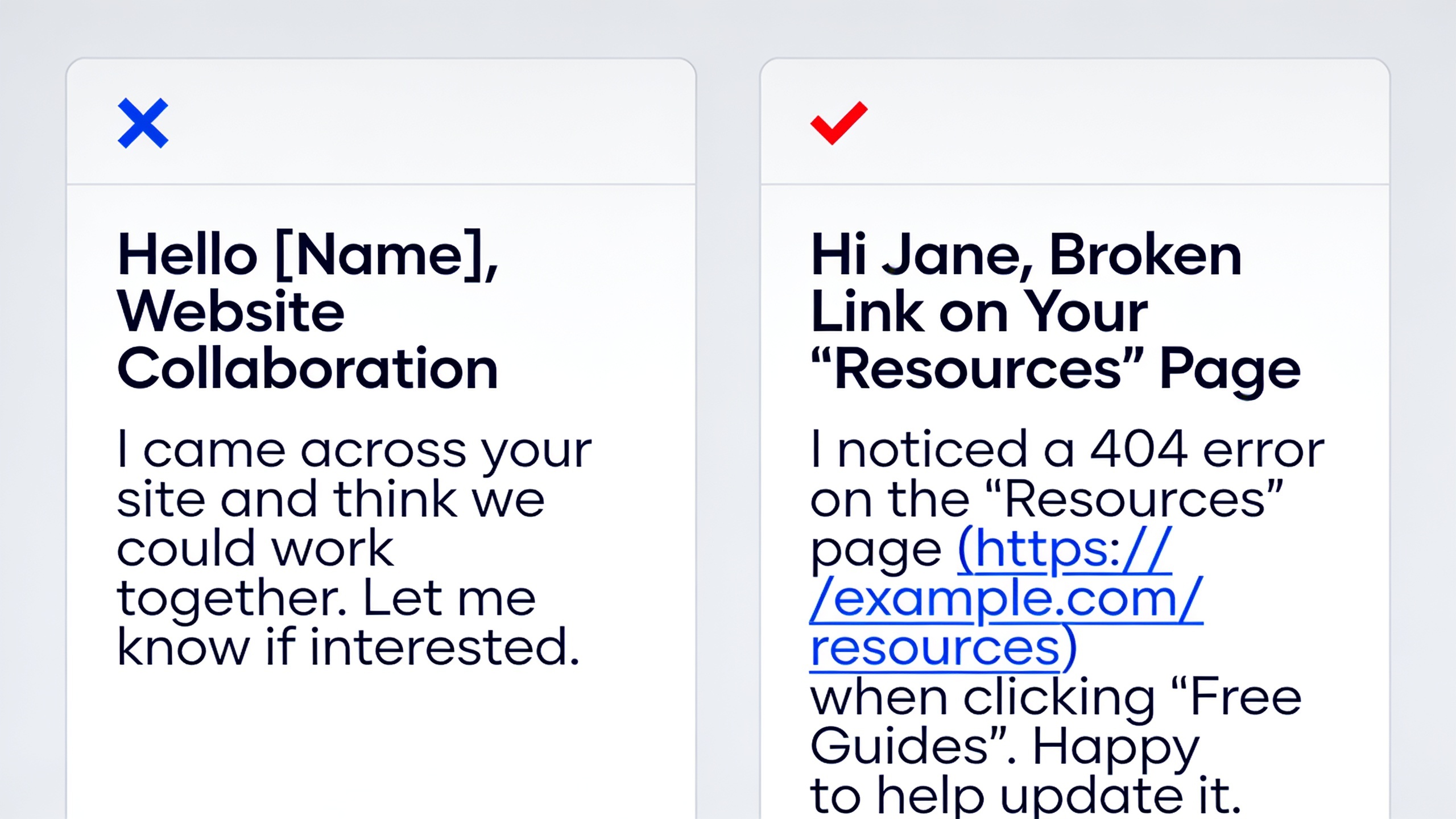
A good broken link email names the exact dead link, says where it lives on the page, and offers your replacement in two sentences or less. Go longer than that and it gets skimmed, then ignored. This is the whole game with outreach: being specific and brief beats being flattering and wordy, every single time.
Want content like this running on autopilot for your own site? Try RobinRank free — AI-written, SEO-optimized articles generated and published automatically, no credit card required.
The subject line should be factual and low-key. Skip the vague "Quick question!" nonsense. Stuff like "Broken link on your [Page Topic] page," "Found a dead link on [domain.com]/[page-slug]," or "Quick fix for your resources page" tends to do the job.
Your opening line needs to prove you actually read the page. Not a canned compliment. Something like:
> "I was reading your guide to [topic] and noticed the link to [anchor text] under the [section name] heading returns a 404."
Then state the problem plainly. Give the exact broken URL and where it sits, so they don't have to go hunting:
> "It looks like [old-domain.com/old-page] has been taken down. The link currently points there from your [section] section."
Offer the fix in one line and link straight to it:
> "We recently published an updated version covering the same ground plus [specific improvement, e.g. 2024 data / a comparison table / step-by-step screenshots]: [yoursite.com/your-page]. Happy for you to swap it in if it's useful."
And close with zero pressure:
> "Either way, thought you'd want to know about the dead link. Thanks for putting together such a useful resource."
Here's the whole thing stitched together:
> Subject: Broken link on your remote onboarding resources page
>
> Hi [Name],
>
> I was going through your "Remote Team Resources" page and noticed the link under "Onboarding Guides" pointing to [olddomain.com/onboarding] returns a 404 — looks like that site's been taken down.
>
> We put together an updated onboarding guide that covers similar ground, plus a 2024 checklist and template downloads: [yoursite.com/remote-onboarding-guide]. Feel free to swap it in if it's a good fit.
>
> Either way, wanted to flag the dead link — great resource list overall.
>
> Thanks,
> [Your Name]
Keep every email under 120 words. Personalize the opening line and the fix line for each site. Everything else in that structure can stay the same across your whole campaign, and that's fine. Nobody's grading you on originality here.
Follow-Up Sequences That Don't Feel Pushy
One polite follow-up, sent five to seven business days after the first email, is plenty. Broken link outreach doesn't need those aggressive five-touch sequences because the ask is small and the value is obvious. Stack three or four reminders on a webmaster and you're not persuading them, you're irritating them.
Something this short works fine:
> Subject: Re: Broken link on your remote onboarding resources page
>
> Hi [Name], just following up in case this got buried — happy to answer any questions about swapping in the updated link. No worries if it's not a fit!
No response after that? Move on. Log it and let it go. But do revisit the site in a few months if the broken link's still sitting there, because editors sometimes crawl back to their maintenance backlog, and a well-timed second nudge months later can land where the first one didn't. I've seen it happen more than once.
Broken Link Building vs. Other Link Building Tactics
Broken link building is one white-hat option among several, and it's worth comparing it honestly so you know where to spend your team's hours. It's got a lower volume ceiling than something like digital PR or resource-page swaps, no question. But it also carries less risk of coming across as self-serving, because you're fixing something that's broken instead of straight-up asking for a placement.
| Tactic | Effort per link | Typical relevance | Scalability | Risk profile |
|---|---|---|---|---|
| Broken link building | Medium-high (research + content matching) | High — link already exists in a topically relevant context | Low-medium — limited by how many relevant dead links you can find | Low — framed as a helpful fix |
| Guest posting | High (full article per placement) | Medium-high, depends on host site | Medium | Low-medium, depends on host site quality |
| Resource page outreach | Medium | Medium-high | Medium | Low |
| Reciprocal link exchange | Low-medium once a relationship exists | Depends on niche match | High if done through a managed network | Depends heavily on execution — see below |
| Paid link placements | Low effort, high cost | Varies | High | High — against Google's guidelines |
Reciprocal exchanges get a bad rap, and I think it's mostly unfair. Whether they're safe comes down almost entirely to how you run them. If you want the actual line Google draws between a natural, editorially relevant swap and a manipulative pattern, Is Link Swapping Safe? Google's Real Stance on Reciprocal Links lays it out.
Plenty of teams pair broken link building with a managed exchange network to keep their backlink profile diverse rather than leaning on one tactic and praying. If you're trying to figure out how a manually reviewed network is structurally different from a private blog network (and that difference matters a lot), How Backlink Exchange Networks Work (And Why They're Not PBNs) walks through it.
Tracking, Verifying, and Reporting Results
Tracking a broken link campaign means logging every prospect, every email, every reply, and, this is the part people skip, actually verifying that the accepted placements went live and stayed live. A "yes" in your inbox is not a backlink. It only counts once the link is crawlable on the page and pointing at the right URL.
Your tracking sheet needs the linking domain and the specific URL, the original dead target and its anchor text, a contact name and email, your first outreach date plus follow-up date and response status, the placement URL once it's live along with the date you verified it, and the anchor text the site owner actually used. That last one matters because they'll sometimes change it from what you asked for, and you want to know.
Verification is where most campaigns underinvest, and it bites them later. Links get placed and then quietly vanish weeks down the line during a redesign. An editor swaps in a different anchor than you agreed on. Recurring automated checks that confirm the href is still there, instead of one hopeful glance right after the email thread, catch this drift before it turns into a mysterious dip in your backlink profile that nobody can explain.
Frequently Asked Questions
How long before a broken link campaign actually shows results?
Most campaigns need a few weeks of prospecting before the first batch of emails even goes out, and after that, timing's all over the map. Some webmasters reply in a couple of days, others take weeks, plenty never respond at all. Because the whole thing depends on manually matching dead links to replacement content, it's slower to scale than tactics that don't require finding a specific gap first.
Does broken link building even work anymore, with how much link building has changed?
Yeah, it does, because the core mechanic (offering a genuine fix to a real problem on someone's page) hasn't changed one bit. What's changed is that spammy outreach made webmasters way more selective about who they respond to. So it works best when your replacement is a real match, not a thin excuse to shove in a link.
What tools do I actually need to run one?
At a minimum, a backlink analysis tool (Ahrefs, Semrush, or Moz) to find competitor and resource-page opportunities, a broken link checker to confirm which links are genuinely 404ing, and some way to dig up contact emails. For small-to-medium scale, a spreadsheet or a lightweight CRM handles the tracking just fine. You don't need a fancy stack.
Should I offer a reciprocal link when I pitch the replacement?
Usually not. The value to them (fixing a dead link) already stands on its own two feet. Bolt a reciprocal ask onto the email and suddenly it reads like a trade instead of a helpful heads-up, which kills the tactic's whole advantage.
How's this different from a backlink exchange network?
Broken link building is a one-off tied to a specific dead link on a specific page. A backlink exchange network is an ongoing system where site owners request and offer placements to each other on a recurring basis. And they're not either-or. Loads of marketers run broken link campaigns for the occasional clean win while also using a managed exchange network for steadier flow.
Broken link building rewards patience and precision, not volume. A tight shortlist of ten well-qualified dead links with genuinely comparable replacements will beat a hundred generic pitches to loosely related pages nearly every time. Treat each email like a small favor to a busy person, verify every placement once it's live, and you end up with backlinks that are both editorially earned and durable. The kind you don't have to go re-earn every few months.
Ready to stop writing content by hand? Start your free RobinRank trial and get a full month of SEO-optimized articles published on autopilot.