Is Link Swapping Safe? Google's Real Stance on Reciprocal Links

So let's sort out what Google's docs actually say, why "excessive" reciprocal linking gets flagged while the occasional swap doesn't, and how you can build these relationships in a way that reads as natural to both the algorithm and any human reviewer who happens to poke around.
Table of Contents
- What Is Reciprocal Link Building, Exactly?
- What Do Google's Link Swapping Guidelines Actually Say?
- Why Some Reciprocal Links Get Penalized and Others Don't
- Is Link Swapping Safe in 2024 and Beyond?
- Safe vs. Risky Reciprocal Linking: A Side-by-Side Comparison
- How to Swap Links Without Triggering a Penalty
- Alternatives to Traditional Reciprocal Link Building
- Frequently Asked Questions
What Is Reciprocal Link Building, Exactly?
Reciprocal link building is just two website owners agreeing to link to each other's stuff, usually because their content overlaps and it genuinely helps both audiences. It's not the same as one-way link building (site A links to site B, gets nothing back) and it's definitely not the same as those sneaky three-way or "triangle" setups where A links to B, B links to C, and C loops back to A just to hide the fact that it's really a swap.
None of this is new, by the way. Back in the early 2000s, "link exchange" pages listing dozens of totally unrelated partner sites were everywhere. It was a whole thing. Google's algorithms have grown up a lot since then, and that first generation of reciprocal linking (link directories, footer swaps, sitewide exchanges) is now recognized for what it is: spam. Modern reciprocal linking looks nothing like that. It happens between two relevant, editorially solid sites that probably would've referenced each other anyway, deal or no deal.
The thing Google really cares about? Intent and scale. One contextual swap between two niche blogs that genuinely cover the same ground is a completely different animal from a network of hundreds of sites trading links just to pump up each other's authority scores.
What Do Google's Link Swapping Guidelines Actually Say?
Google's link swapping guidelines, laid out in its Search Central documentation on link spam, classify "excessive link exchanges" as a link scheme. That's a category of practices that violates Google's spam policies and can land you either a manual action or a quiet algorithmic devaluation. The guidance even calls out the phrase "Link to me and I'll link to you" by name, treating it as a tell for manipulative reciprocal linking.
Google's spam policies for Search say link schemes include any links meant to manipulate PageRank or a site's ranking in results. That covers a bunch of stuff beyond swaps, buying or selling links that pass ranking credit, massive guest posting campaigns stuffed with keyword-rich anchors, automated link-building programs. But reciprocal exchanges get named directly as an example.
Here's what matters though: the word Google leans on is "excessive." That one word carries a lot of weight. Google has never said a site gets penalized for having a single reciprocal link, or even a handful scattered across an otherwise natural profile. What it's hunting for is the pattern. Big volumes of exchanged links, especially when they're irrelevant, buried in footers or sidebars, or arranged through bulk outreach instead of real editorial relationships.
Google's Search Advocate John Mueller has said this more or less on repeat in public forums and office-hours sessions: a small number of reciprocal links between relevant sites probably won't cause you grief, but building your whole strategy around large-scale, non-editorial swaps is asking for trouble. That distinction (a few relevant exchanges versus a systematic swap machine) is basically the entire question of whether Google's link swapping guidelines actually come after your site.
Why Some Reciprocal Links Get Penalized and Others Don't
Reciprocal links get penalized when they reek of manipulation, irrelevant anchors, sitewide footer placements, bulk swaps across unrelated niches, or coordination through paid link networks. They tend to be fine when they happen between genuinely relevant sites, sit inside real content instead of some boilerplate template, and make up a small slice of your overall backlink profile.
Google's ranking systems, including its link spam detection, look at way more than "does a two-way link exist." They're reading contextual signals, and a few of them matter more than the rest.
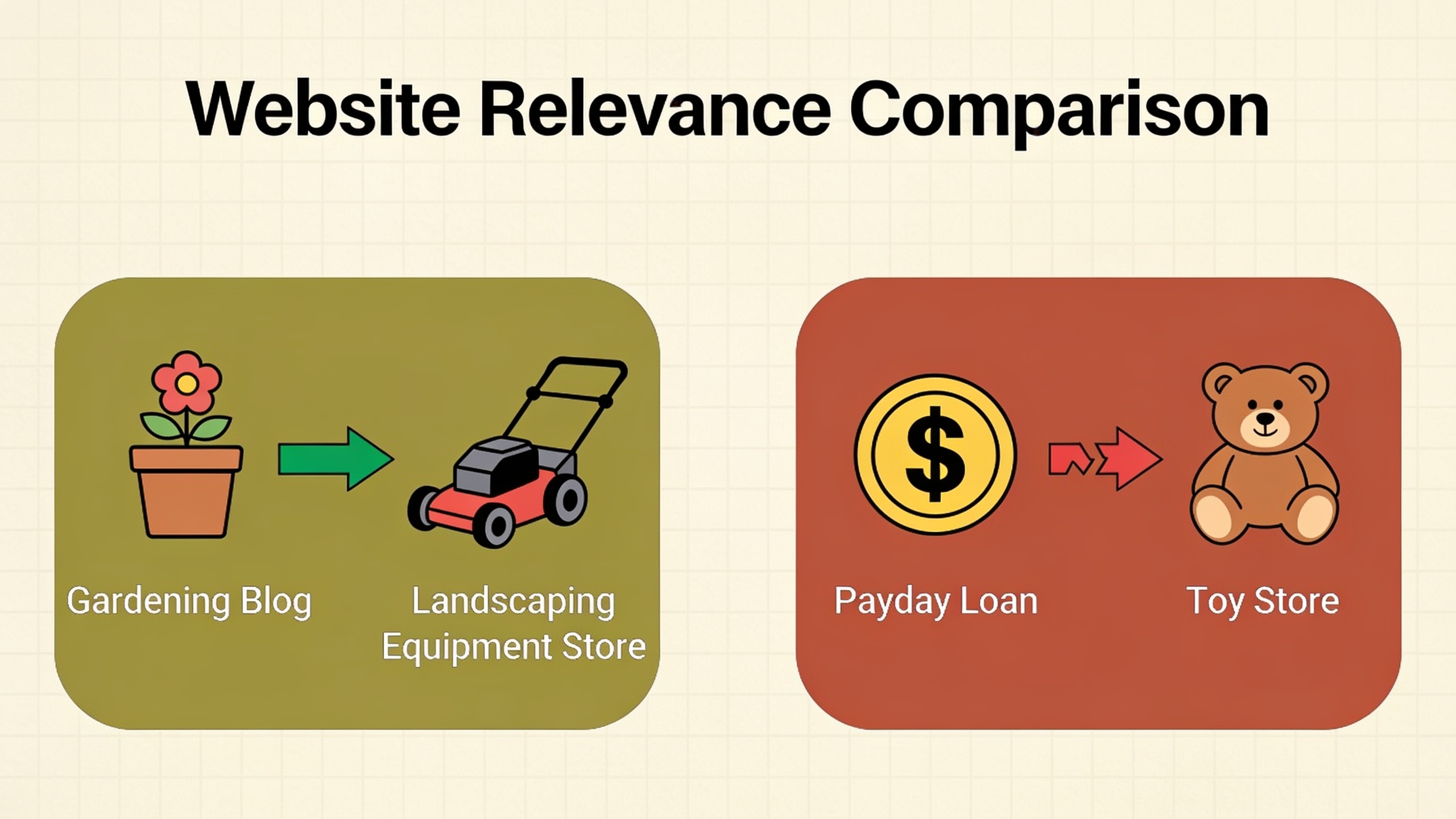
Relevance is the big one. A gardening blog and a landscaping equipment retailer linking to each other? Totally coherent. A payday loan site swapping links with a children's toy store? That mismatch is exactly the kind of thing link-spam detection was built to sniff out.
Then there's placement and anchor text. A link that shows up naturally inside a relevant paragraph of actual content signals something wildly different from a link crammed into a sitewide footer next to two dozen other "partners." And exact-match, keyword-stuffed anchors repeated across a bunch of reciprocal links? That's a louder red flag than varied, descriptive anchor text.
Volume and pattern come into play too. A site with two or three reciprocal links out of a profile full of hundreds of organic mentions looks nothing like a site whose backlinks are mostly tit-for-tat trades. Google's systems are pattern-matching at enormous scale, and a profile that's disproportionately reciprocal is a statistical weirdo worth flagging.
Finally, transparency. Schemes that route through middlemen (three-way exchanges, link brokers, private link networks) exist specifically to hide the reciprocity from Google's crawlers. And that hiding is itself the signal. Legitimate editorial links don't need a disguise. If you're going to that much trouble to obscure a link, Google reads the effort as a confession.
This is also why manual conversations between actual site owners, where both people size up relevance before agreeing to anything, tend to be safer than automated or brokered swap marketplaces. When a real human checks whether a placement makes sense for their readers, the resulting link looks and behaves a lot more like an organic citation than a manufactured one.
Is Link Swapping Safe in 2024 and Beyond?
Link swapping is safe when it happens occasionally, between relevant sites, with a human using actual judgment. It gets risky at scale, when it's automated, when it's irrelevant, or when it becomes the dominant thing propping up your backlink profile. Google hasn't shifted its core position on this. What's shifted is how good its detection has gotten.
Google's spam-fighting systems, including the SpamBrain machine-learning system it's mentioned in its own Search Central blog posts on link spam, are built specifically to spot unnatural link patterns, including large-scale reciprocal and three-way exchanges. So the old move of joining a "link exchange directory" with hundreds of unrelated sites is way riskier now than it was ten years ago, because automated detection has gotten scary good at recognizing exactly that footprint.
But at the same time, Google keeps saying, in its help docs and in public statements from the Search Relations team, that not every reciprocal link is a violation. The line is drawn on intent. Links that exist to help people find genuinely relevant content are fine. Links that exist only to manipulate rankings are not. Which means the "safety" of link swapping right now depends far more on how you do it than on whether you do it at all.
If you're an SEO or a small business owner deciding whether to bother with reciprocal links, here's the honest takeaway: treat every request like any other content decision. Ask yourself whether you'd still want that link on your site if there were zero reciprocal benefit attached. If the answer's no, it's a liability, whether or not Google ever notices.
Safe vs. Risky Reciprocal Linking: A Side-by-Side Comparison
The table below lays out the practical differences between reciprocal linking that tends to play nice with Google's guidelines and the kind that invites scrutiny.
| Factor | Lower-Risk Reciprocal Linking | Higher-Risk Reciprocal Linking |
|---|---|---|
| Topical relevance | Both sites cover related subject matter | Links exchanged between unrelated niches |
| Volume | A small share of overall backlink profile | Dominant or majority of backlink profile |
| Placement | Contextual, within relevant editorial content | Sitewide footers, sidebars, or link directories |
| Anchor text | Varied, descriptive, natural phrasing | Repeated exact-match keyword anchors |
| Discovery process | Manual review by real site owners | Bulk automated outreach or paid brokers |
| Structure | Direct two-way exchange, disclosed implicitly through content | Three-way or multi-hop exchanges designed to hide reciprocity |
| Scale over time | Occasional, organic pace | Rapid, large batches added simultaneously |
| Stated intent | To help users find genuinely useful resources | To manipulate rankings or pass PageRank |
Want content like this running on autopilot for your own site? Try RobinRank free — AI-written, SEO-optimized articles generated and published automatically, no credit card required.
This isn't a checklist for gaming Google, to be clear. It's just a reflection of the same criteria Google's own link spam guidance uses when it explains why "excessive link exchanges" get treated as a scheme while incidental reciprocal links don't.
How to Swap Links Without Triggering a Penalty
The safest way to swap links is to treat every exchange as an editorial call first and a link-building tactic second. Only link to sites you'd actually recommend, keep exchanges a small part of your overall profile, and stay away from the bulk, automated, or brokered networks that hide the reciprocity from search engines. That's the whole philosophy. Everything below is just detail.
Start with relevance, not opportunity. Before you agree to anything, ask whether the destination page would genuinely help your readers. If a marketing agency's blog gets asked to swap with an unrelated gambling site, the relevance mismatch alone should kill the deal, no Google guideline required.
Mix up your anchor text and placement. Reciprocal links should read like naturally cited references, not keyword vehicles you built in a lab. Don't repeat the same exact-match anchor across a bunch of placements, and please don't dump links into a templated footer that appears on every single page.
Keep reciprocal links a minority signal. A profile built mostly on one-way editorial mentions, digital PR, and organic citations, with swaps as a smaller supporting layer, is way more resilient than one leaning hard on exchanges. It also just performs better, honestly. Links buried in relevant content get more clicks than footer links nobody sees.
Favor manual, verified relationships over automated marketplaces. Exchanges that come out of direct conversations between real site owners, where both people can see the actual page, confirm it's live, and decide whether the placement even makes sense, carry a completely different risk profile than links bought through some anonymous broker. That's part of the thinking behind RobinRank's exchange network, which connects real site owners so they can request a placement, offer one back, and have the live link verified on both ends, instead of relying on cold outreach or a black-box marketplace.
Spread your distribution beyond swaps. Reciprocal links work best as one channel out of many, not your whole plan. Publishing content built for syndication and getting it in front of people through channels other than direct exchanges cuts your reliance on any single tactic. The piece on 10 content distribution channels beyond your company blog runs through several ways to earn organic mentions and links without a formal exchange, which naturally dilutes how much of your profile is reciprocal.
Look for underused formats that pull in natural backlinks. Not every link opportunity is a blog post. Podcasts, for instance, tend to attract citations and mentions organically, partly because they're less saturated with reciprocal-link tactics than written content is. If your brand makes or contributes to audio content, the guide on podcast SEO and getting your show discovered on Google covers how to set up show notes and transcripts so they earn organic backlinks instead of relying on swaps.
And audit your existing reciprocal links now and then. If a site you traded with three years ago has changed hands, pivoted into some spammy niche, or gotten penalized itself, that link is now a liability sitting on your site. Reviewing your outbound and inbound reciprocal links periodically, and cleaning up the stale ones, keeps your profile aligned with what's relevant today, not what was relevant back when you shook hands.
Alternatives to Traditional Reciprocal Link Building
Reciprocal link building doesn't have to mean firing off awkward one-off emails or signing up for some link directory. Verified exchange networks and diversified content distribution can hit the same link-earning goals with more oversight and a lot less manual grunt work.
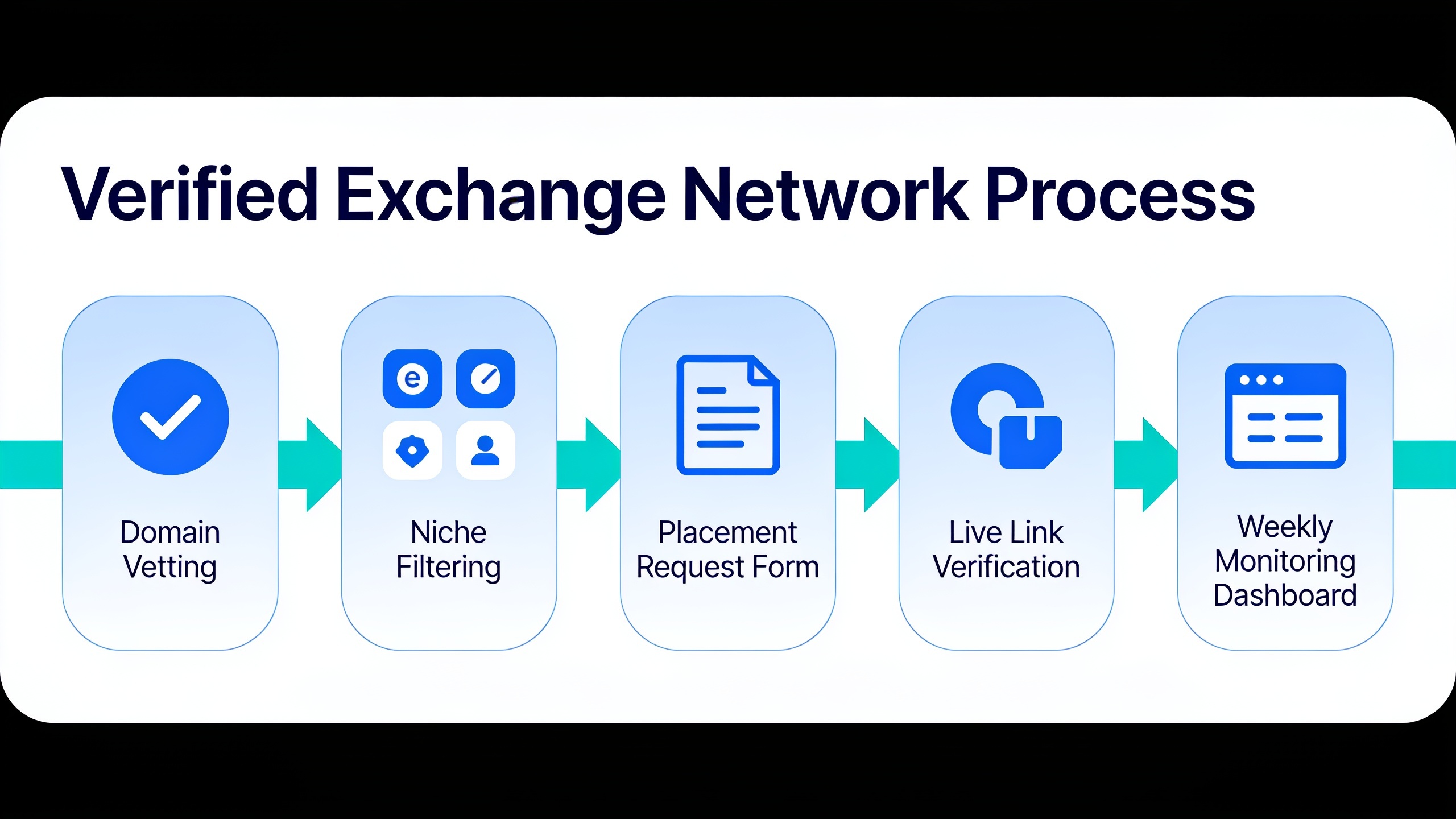
One structural alternative to ad hoc swapping is a manually reviewed exchange network, where every participating site gets vetted before it's allowed to request or offer placements. RobinRank's backlink exchange network works this way, for example. Each listed site has to pass a review before it shows up in the directory, checking for an ownable domain (not some free host or public platform), real content instead of thin doorway pages, and no spam signals like adult content or obvious link farms. From there, site owners can browse potential partners by niche and Domain Rating, request a placement on a specific page with a specific anchor, and offer a link back when it actually makes sense. Every placement then gets verified by crawling the live page to confirm the link is really there, with ongoing weekly checks rather than a one-and-done confirmation.
What this kind of setup fixes is two of the biggest risk factors in old-school reciprocal linking: irrelevance (sites get filtered by niche before anyone even talks) and lack of verification (placements get checked programmatically, not taken on faith). It doesn't remove the need for judgment. Site owners still have to decide whether a given placement is genuinely relevant to their audience. But it does kill the anonymous-broker dynamic that makes so many swap deals sketchy in the first place.
Beyond exchange networks, the bigger-picture alternative is just leaning on reciprocal links less by investing in content and distribution that earns links without any trade at all. Think original research, tools, resources other sites want to cite regardless of whether you scratch their back. And think expanding into channels like newsletters, syndication partners, industry roundups, and podcasts that generate mentions on their own. A profile built on a mix of organic citations, a modest layer of verified reciprocal links, and diversified distribution is structurally far tougher to shake than one riding on any single tactic, especially if Google decides to tighten its link spam detection down the road.
Frequently Asked Questions
Does Google penalize all reciprocal links automatically?
Nope. Google's guidelines specifically go after "excessive" link exchanges and schemes designed to manipulate rankings, not the simple fact of two relevant sites linking back and forth. A small number of contextual reciprocal links inside a broader organic profile is unlikely to trigger a manual action on its own.
How many reciprocal links are too many?
Google hasn't published a specific number, and it'd be misleading to pretend one exists. Instead of counting links, look at proportion and pattern. If swaps make up a small share of your profile and each one is relevant, your risk is low. If reciprocal links dominate your profile or follow an obvious repeated pattern (same anchor, same placement, unrelated niches), that pattern itself is the thing Google's systems are built to catch.
What's the difference between a link exchange and a link scheme?
A link exchange crosses into "link scheme" territory, in Google's words, when its main purpose is to manipulate PageRank or rankings rather than genuinely help users. Google's link spam docs specifically name "excessive link exchanges" and phrases like "link to me and I'll link to you" as examples of link schemes. One relevant, editorially reviewed exchange between two topically related sites generally gets treated very differently than a large-scale or automated exchange program.
Can three-way link exchanges help avoid detection?
Google's guidance addresses three-way (or multi-hop) exchanges head-on, where site A links to B, B links to C, and C loops back to A, treating them as a variation of the same link scheme problem precisely because they're built to obscure the reciprocity. Trying to hide a link relationship behind a middleman doesn't make the underlying link legit. It mostly just adds complexity without touching the relevance and intent problems Google's systems are actually evaluating.
Is it safer to use a managed exchange platform than to negotiate swaps over email?
A managed, manually reviewed platform can cut down on certain risks, like accidentally linking to a site that turns out to be a spam network or a PBN, because sites get vetted before they can request or offer placements, and live links get verified rather than assumed. It doesn't remove the need for judgment about relevance and placement quality, which still fall on whoever agrees to the exchange. But it does add a layer of verification that informal email swaps almost never have.
Reciprocal link building isn't a violation by nature. It becomes risky the moment you sacrifice relevance, transparency, and proportion for raw volume. The sites that pull this off safely are the ones that treat every exchange as an editorial decision, keep swaps as one modest piece of a much bigger, more varied backlink strategy, and pick verified, human-reviewed relationships over anonymous automated marketplaces. That's really all there is to it.
Ready to stop writing content by hand? Start your free RobinRank trial and get a full month of SEO-optimized articles published on autopilot.