Podcast SEO: How to Get Your Show Discovered on Google
Here's the annoying catch, though. Podcasts have a discoverability problem baked into their DNA: audio files aren't readable by search engines. Google can't "listen" to your MP3 and figure out what you said. So every scrap of organic visibility your show earns has to come from the text, the structured data, and the web plumbing around the episode, not the episode itself. This guide is basically me walking you through how to build that plumbing so your show stops living and dying by app-store algorithms.
Table of Contents
- What Is Podcast SEO and Why Does It Matter?
- Why Doesn't Google Index Podcast Audio Directly?
- How to Write Show Notes That Actually Rank
- Podcast Transcripts: Your Most Underrated SEO Asset
- Metadata and Structured Data for Podcast SEO
- Building a Podcast Website That Google Can Actually Crawl
- How Do You Measure Podcast SEO Success?
- Common Podcast SEO Mistakes to Avoid
- FAQ: Podcast SEO Questions Answered
What Is Podcast SEO and Why Does It Matter?
Podcast SEO is the practice of optimizing the text, code, and web presence around a podcast episode so it ranks in Google and gets picked up by AI answer engines. Why bother? Because search, not app browsing, is more and more how people stumble onto niche audio. Somebody Googling "best productivity habits for founders" is way more likely to land on a blog post than to crack open a podcast app and start typing into a search bar.
And the app ecosystem is a rough neighborhood for smaller shows. Discoverability inside Apple Podcasts and Spotify runs on their own internal ranking systems, which reward stuff you already have: popularity, ratings, listener retention. It's a chicken-and-egg loop that new and mid-sized shows struggle to crack. Google is a different animal. More open. A tiny show with genuinely great show notes and a well-built episode page can absolutely outrank some monster podcast that never bothered to publish a word of text. That's the whole opportunity here. Quality and technical effort actually get to compete on something closer to even ground.
There's a compounding thing going on too. A good blog post ranks once and keeps sending you traffic for years. An episode with no text attached? It's relevant right up until it drops off the "new" feed, then it basically vanishes. The shows that build durable organic traffic are the ones that treat each episode as a piece of writing, not just an audio file. Everybody else is stuck grinding out social promotion and praying to the app gods every single week.
Why Doesn't Google Index Podcast Audio Directly?
Google's crawlers can't turn spoken audio into searchable text on their own, so an MP3 or WAV with no text around it is essentially invisible to search, no matter how brilliant the content is. Google indexes web pages made of HTML. An audio file sitting inside a page adds nothing to what Google understands about that page unless there's readable text riding along with it.
This is exactly why the directories, Apple Podcasts, Spotify, Google Podcasts (which has since been folded into Google's broader search and Podcasts features), lean on RSS feed metadata to sort shows. Titles, descriptions, category tags, that kind of thing. It's fine for app discovery. But it's usually thin, generic, and copy-pasted across every single episode of a show, which gives Google almost nothing unique to tell one episode apart from another.
So the takeaway is pretty blunt: your podcast's web page, the one on your own site or your host, has to work like a standalone article. Unique text, real headings, internal links, structured data. Same as any blog post you'd ever write. If you've read up on how Google's Latest Algorithm Update: What Marketers Need to Know has shifted the content-quality signals, none of this will surprise you. Google keeps rewarding depth, originality, and pages that are actually useful. That bar now applies to podcast episode pages too, not just traditional blog content.
How to Write Show Notes That Actually Rank
Show notes are the written summary that runs alongside your episode, and you need to treat them like real SEO content, usually 300 to 800 words, not a lazy two-liner tacked on at the end. Something like "In this episode, we talk about marketing tips with our guest" gives Google nothing to index and no reason to rank you for anything.
So what actually works? A keyword-focused summary of the episode's core topic, phrased the way a real person would search it. Think "how to price a SaaS product" instead of a vague "pricing discussion." Timestamped highlights help a ton, too. Break the episode into scannable chunks with descriptive subheadings, which also makes the page eligible for Google's key moments feature in audio and video results. Toss in a proper guest bio with context, especially if the guest has some name recognition, because that helps you rank for branded searches like "[Guest Name] podcast interview."
Two more things I'd never skip. Pull a few killer quotes straight from the episode and format them as blockquotes. That gives Google unique, citable text and hands AI answer engines a specific passage to reference when they summarize you. And put a clear takeaway right near the top, answering the episode's implied question in a sentence or two before you get into the weeds. That mirrors exactly how AI Overviews and featured snippets like their content structured.
One rule I'd tattoo on people if I could: each episode's show notes should target one primary keyword tied to that episode's actual topic, not your show's brand name. A true-crime episode about a specific case should optimize for that case's name. Not "true crime podcast." Because that's what people are typing into Google, not your show title.
Podcast Transcripts: Your Most Underrated SEO Asset
A podcast transcript is a full, word-for-word text version of your audio, and honestly it's the single most powerful SEO asset you've got because it hands Google thousands of words of unique, keyword-rich, indexable text for every episode. A 45-minute episode can spit out 6,000 to 9,000 words of transcript. That's more raw text than most blog posts. And it's text that naturally contains long-tail phrases, questions, and casual conversational language, which is exactly how people actually search.
Transcripts pull off things show notes just can't. Because they capture natural spoken language, they tend to rank well for those long-tail, question-shaped queries. The exact phrasing people use with voice search and conversational AI tools like ChatGPT, Gemini, and Perplexity, all of which favor sources that answer a question clearly and completely in plain text.
Full Transcripts vs. Summarized Transcripts
Now, not every show needs to dump a full, unedited transcript on the page. Here's how the two main approaches stack up for SEO:
| Factor | Full Transcript | Summarized/Edited Transcript |
|---|---|---|
| Word count per episode | Typically 5,000–9,000+ words | Typically 800–2,000 words |
| Keyword coverage | Very broad, captures natural phrasing and tangents | Narrower, focused on core topics |
| Readability | Lower — includes filler words, false starts | Higher — cleaned up for readers |
| Production effort | Low if using automated transcription tools | Higher — requires editing and condensing |
| Best use case | Shows prioritizing maximum organic search surface area | Shows prioritizing user experience and dense pages |
| Risk of thin content flags | Low, due to length and topical depth | Higher if not paired with detailed show notes |
Plenty of successful setups just do both. A clean, well-structured summary near the top of the page for readability, then the full transcript further down (often tucked into a collapsible "read more" section) so the page keeps human readers and search crawlers happy at the same time.
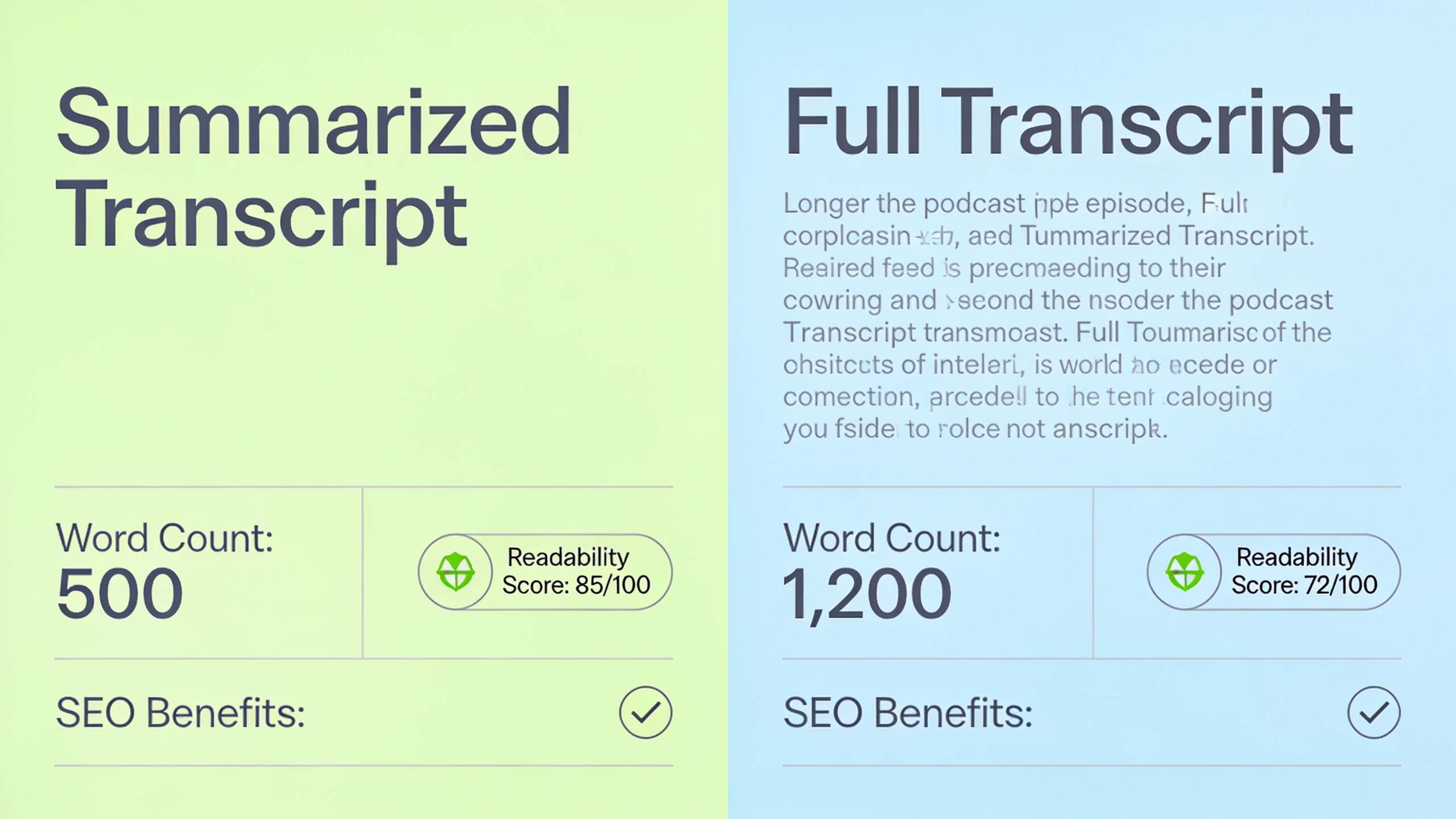
Whatever you go with, format the thing. Proper paragraph breaks, speaker labels where you can manage them. A giant wall of unbroken text is painful for readers and harder for Google to parse, even when every word is stuffed with juicy keywords.
Metadata and Structured Data for Podcast SEO
Metadata is the behind-the-scenes info that tells Google what a page is about before it even renders the visible stuff, and for podcasts that means the page title, meta description, URL slug, and, this one matters most, Schema.org structured data using PodcastEpisode markup. Without that structured data, Google's basically guessing that your page is podcast-related. With it, you open the door to rich results, including episode carousels in search.
A few things worth locking down on every episode page. Your title tag should carry the specific topic keyword, not just "Episode 47 — [Show Name]." Something like "How to Negotiate Freelance Rates | Episode 47 of The Freelance Files" gives Google and humans a lot more to work with. Your meta description wants to be a tight 150–160 character summary that echoes the episode's core promise or question, the thing that makes someone click. And please, clean up your URLs. Descriptive slugs like `/episode-47-negotiate-freelance-rates` beat the default numeric IDs your host coughs up every time.
Want content like this running on autopilot for your own site? Try RobinRank free — AI-written, SEO-optimized articles generated and published automatically, no credit card required.
Then there's the technical layer. PodcastEpisode schema markup explicitly tells Google the episode title, description, duration, publish date, and which series it belongs to. It's the bridge between your audio and Google actually understanding it. Oh, and don't sleep on alt text for your episode artwork. Descriptive, keyword-relevant alt text on cover art and any embedded images gives you a shot at Google Images, a discovery surface almost every podcaster ignores completely.
If you've got an international audience, or you're translating episodes into other languages, the same structured-data thinking applies across markets. But now hreflang tags, localized metadata, and region-specific keyword research become non-negotiable. Those are the exact fundamentals covered in International SEO: How to Actually Show Up in Search Around the World, and they apply to a multilingual podcast's web presence just as much as any other kind of site.
Building a Podcast Website That Google Can Actually Crawl
Your podcast needs a real, crawlable website with a dedicated, unique page for every single episode, not just a profile on a hosting platform with a generic RSS embed. A lot of hosts auto-generate basic episode pages, sure, but they're usually thin, templated, and nowhere near deep enough to compete in search for anything past your exact show name.
Internal Linking Between Episodes
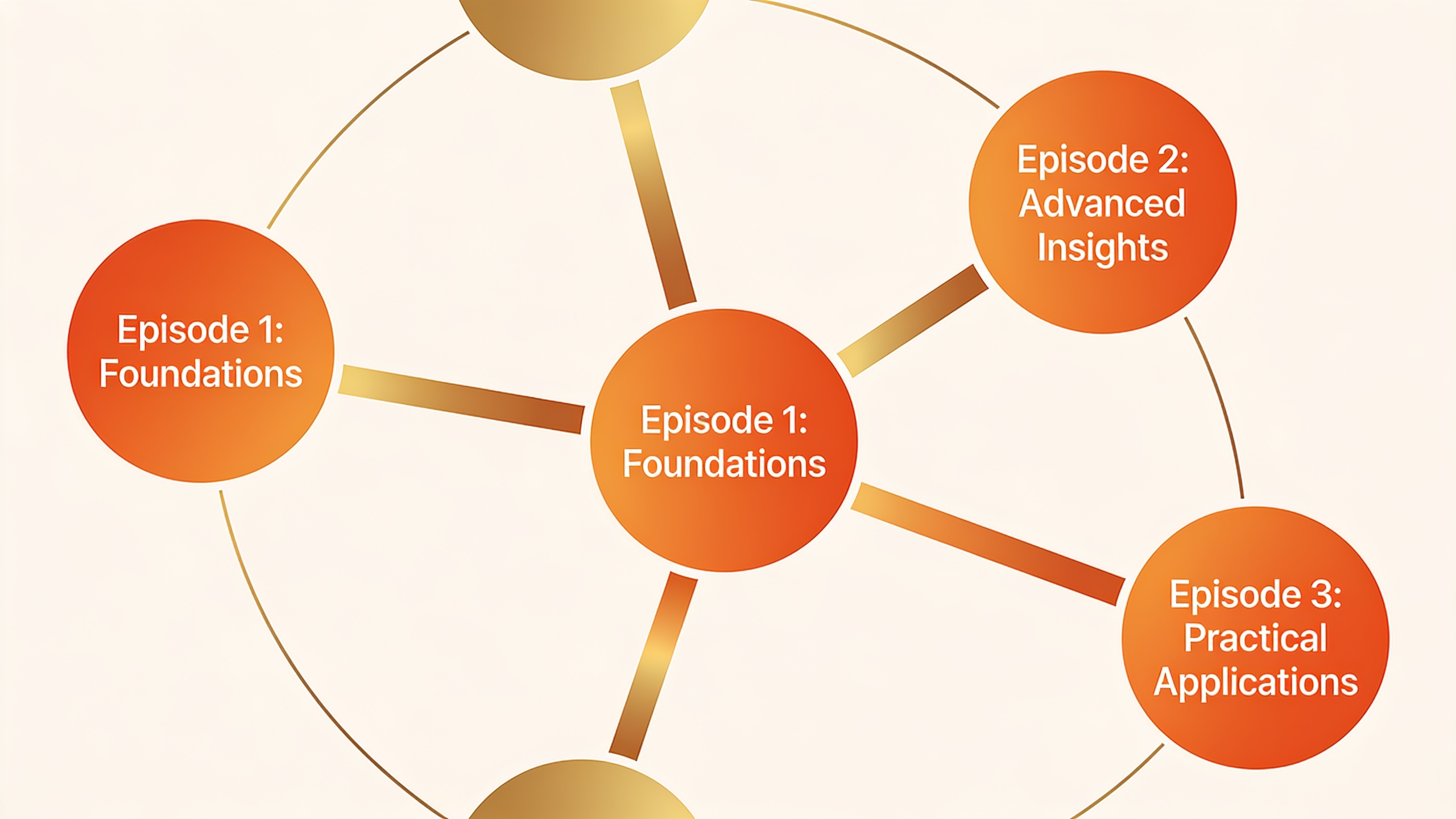
Every episode page should link out to related past episodes, guest appearances, or the resources you mentioned in the conversation. This helps Google map the topical relationships across your content, and it spreads ranking authority around your site instead of leaving each episode marooned on its own little island with zero supporting context.
Category and Topic Hub Pages
Group your episodes into topic-based hub pages, something like "Episodes About Marketing" or "Interviews With Founders," so Google can see your show actually has depth in specific areas. This is way more powerful for ranking on competitive topic keywords than one lonely episode page trying to carry the whole load by itself.
Site Speed and Mobile Usability
Episode pages tend to pile on audio players, images, and long transcripts, so load speed can tank if you're not careful. Compress your images, lazy-load the embedded players where you can, and double-check the page renders cleanly on mobile. A huge chunk of podcast-related searches happen on phones, and a sluggish page loses people fast.
Sitemap Submission
Every new episode page should drop automatically into your XML sitemap and get submitted to Google Search Console, so fresh content gets discovered and crawled quickly instead of you sitting around hoping Google trips over it eventually.
Now, cranking out this much unique, well-structured episode content week after week, for every single episode, is exactly the kind of grinding content workload that gets brutal to sustain by hand over time. That's part of why some marketing teams lean on AI-assisted publishing setups like RobinRank's, which plans, writes, and publishes SEO-structured articles on a schedule straight into a connected CMS like WordPress. It takes a lot of the manual weight off keeping a big content library, say, a steadily growing podcast archive, consistently optimized and freshly indexed.
How Do You Measure Podcast SEO Success?
You measure podcast SEO mainly through organic search traffic to your episode pages, keyword rankings for episode-specific terms, and indexing status in Google Search Console. Not through app download numbers, which reflect a totally different discovery channel. The two sets of metrics are related, but they're not interchangeable, and mixing them up is one of the most common mistakes I see.
So what should you actually watch? Organic impressions and clicks per episode page in Search Console, which tell you whether your metadata and content are showing up and pulling clicks. Indexed page count, so you can confirm Google has genuinely crawled and indexed your pages (check the URL Inspection tool or just run a `site:yourdomain.com` search). Average position for your target keywords, to see whether your show notes and transcripts are ranking for the specific topics each episode goes after. And engagement signals like time on page and scroll depth, which hint at whether search visitors are actually reading your transcripts or bouncing on arrival, something that can nudge how Google grades your page quality over time.
One more I'd track: referral traffic from episode pages back to your app listening links, which confirms your SEO is converting searchers into actual listeners rather than just eyeballs on a page.
And keep all of this separate from the download and listener counts your podcast host reports, because a spike in organic search doesn't map one-to-one onto audio plays. Some visitors will read a transcript or skim the show notes and never press play. That's still a win, brand exposure, backlinks, email signups, even if your listener analytics never registers it.
Common Podcast SEO Mistakes to Avoid
The number one mistake is publishing episodes with a one- or two-sentence description and no transcript, leaving Google basically nothing to index or rank. That's the foundational sin. But there's a whole family of smaller ones that quietly cap your discoverability even when you do write show notes.
Duplicate or templated descriptions are a big one. Slapping the same boilerplate paragraph about your show onto every episode with only the guest name swapped out gives Google no unique signal at all. On the flip side, don't keyword-stuff your titles either. Something like "Best Marketing SEO Tips Growth Hacks Episode 12" reads like a bot wrote it, and it chips away at trust signals instead of helping you rank.
Then there's the stuff people just forget. Ignoring image alt text, so all that cover art and those guest headshots go up naked, forfeiting free Google Images visibility. Having no internal linking strategy, which leaves every episode page as an island and starves your show of topical authority. And a sneaky one: publishing your show notes only inside the podcast app's episode description field. That text often isn't crawlable by Google the way a real web page is, because it lives inside the app's own walled garden, not on an open, indexable page.
Last one, and it's the quiet killer: neglecting Search Console. If you never check whether your pages are actually getting indexed, problems like accidental noindex tags or crawl errors can sit there undetected for months, silently capping your traffic the whole time.
None of this takes a big team to fix, by the way. It just takes treating every episode page with the same editorial care you'd give a standalone blog post. Because functionally, that's what it has to become to stand a chance in Google.
FAQ: Podcast SEO Questions Answered
Does Google actually rank individual episodes, or just the show page?
Yep, Google can and does rank individual episode pages, as long as each one has its own unique URL with enough unique text, like detailed show notes or a transcript. Episodes without a dedicated, content-rich page of their own rarely rank for anything beyond a branded search of your exact show name.
How long should a transcript be for SEO?
There's no hard minimum, but transcripts naturally land at 5,000–9,000+ words for a 45–60 minute episode, and that length is generally a good thing for search. It hands Google a lot more unique, topically relevant text to index than short show notes ever could on their own.
Do I have to pay for professional transcription, or can I use automated tools?
Automated tools can churn out a solid base transcript pretty efficiently, and a light human edit for accuracy and readability is usually worth it before you publish. Accuracy problems in a transcript make for a confusing read even if the SEO benefit mostly survives.
Will podcast SEO help my show get picked up by AI tools like ChatGPT or Perplexity?
AI answer engines like ChatGPT, Perplexity, and Gemini generally lean on indexed, crawlable web content to build and cite their answers. So a podcast with detailed, well-structured transcripts and show notes has a far better shot at getting cited than one that's audio-only with no text attached. That said, citation is never guaranteed and depends on a bunch of factors specific to each tool.
Should every episode target a different keyword, or can they all chase the same core topic?
Each episode should generally go after its own specific topic keyword based on what that particular conversation actually covers, rather than every episode fighting over the same broad show-level term. This keeps your own pages from cannibalizing each other and lets each episode rank for the distinct long-tail queries it's genuinely relevant to.
---
Podcast SEO isn't a set-it-and-forget-it task. It's an ongoing editorial habit that treats every episode as a piece of writing in its own right, unique show notes, a real transcript, proper metadata, the whole thing. The shows that commit to that kind of consistency end up with a searchable back catalog that keeps working long after an episode falls off the "new releases" feed. And that's the payoff: Google becomes a genuine, compounding way to find new listeners instead of an afterthought sitting behind the app charts.
Ready to stop writing content by hand? Start your free RobinRank trial and get a full month of SEO-optimized articles published on autopilot.