Google's Latest Algorithm Update: What Marketers Need to Know
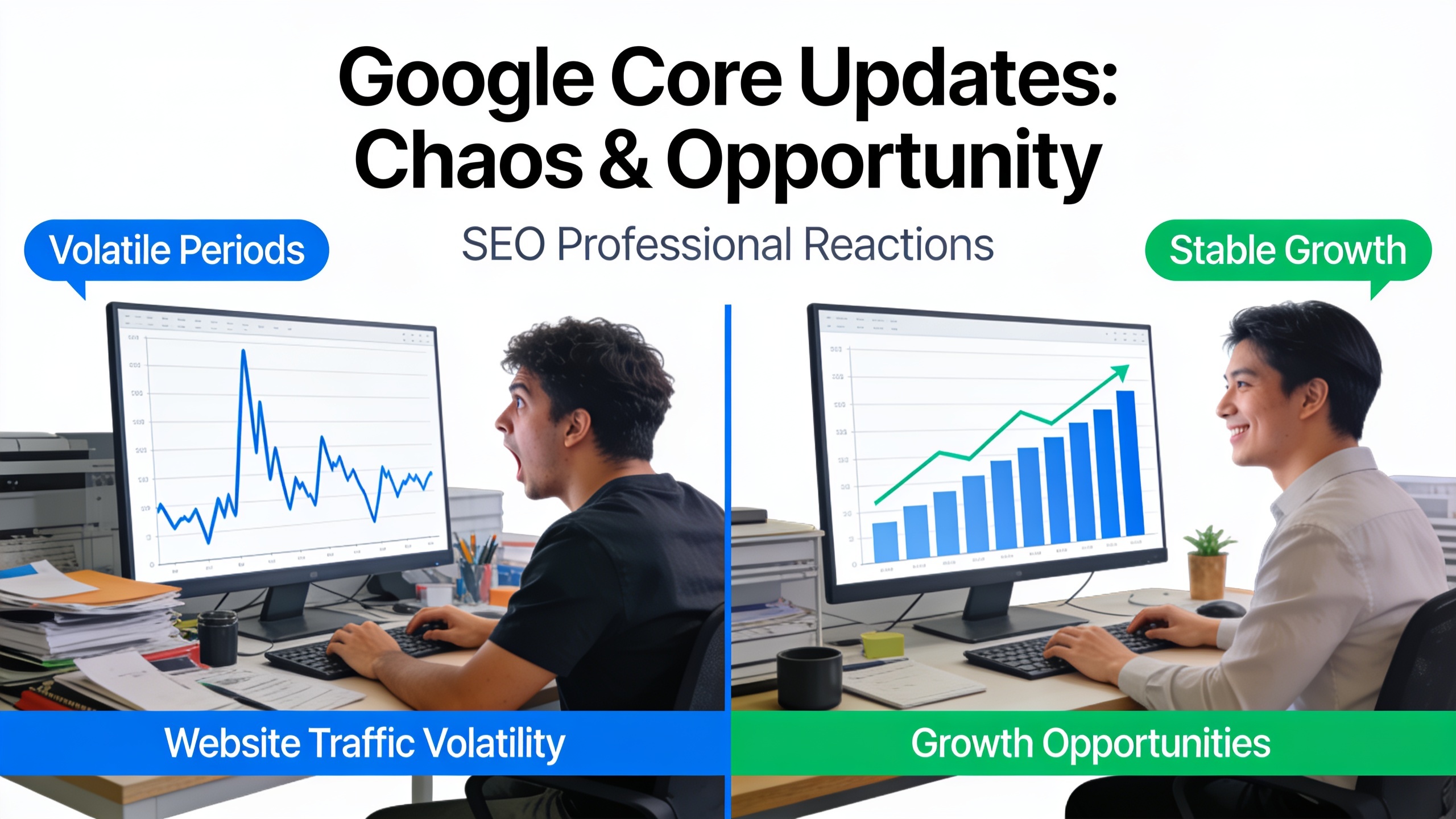
That's a Google core update in action. If you're responsible for organic growth in any capacity, knowing how these things work (and what to do when one lands) has basically become part of the job. So let's get into what a core update really is, what the recent ones have gone after, and what you should actually be doing before and after the next one hits.
Table of Contents
- What Is a Google Algorithm Update?
- How Often Does Google Roll Out a Core Update?
- What Is the Core Update SEO Impact on Rankings?
- Why Do Some Sites Lose Traffic After a Google Algorithm Update?
- E-E-A-T and Helpful Content: What Google Is Really Rewarding
- What Should Content Teams Do Right Now?
- How Long Does It Take to Recover From a Core Update?
- Frequently Asked Questions
What Is a Google Algorithm Update?
A Google algorithm update is a change to the systems Google uses to rank pages, and it can range from a tiny unannounced tweak to a giant "core update" that Google officially confirms through its Search Status Dashboard and the @googlesearchc account. Core updates are the big ones. They're broad changes to Google's overall ranking systems, not fixes aimed at any single site or problem. And Google has said this over and over: they're not penalties. They're recalibrations of how the whole search engine judges relevance, quality, and usefulness across the entire web.
There are really two flavors of updates worth telling apart. Core updates are the sweeping ones, rolled out a handful of times a year and announced publicly. Then you've got targeted updates, which zero in on one specific thing like spam, unhelpful content, or product reviews, and Google might not even bother to announce those.
Here's what's changed, though, and it's a big deal. Since 2023, Google has been folding its previously separate signals (the Helpful Content System being the obvious one) straight into the core ranking systems. Which means one core update can now touch everything at once. Content quality, E-E-A-T signals, spam detection, all of it in a single pass. That's a huge part of why recent core updates have felt heavier than the older ones. A single rollout can reward genuinely good, original content and demote thin AI slop at the same time. No more separate events for each.
How Often Does Google Roll Out a Core Update?
Google usually confirms two to five core updates a year, though honestly the cadence is all over the place and Google reserves the right to run one whenever it feels like it, no heads-up required. A single rollout can take anywhere from about a week to several weeks to finish, and here's the fun part: your rankings can keep bouncing around the entire time as the update spreads across data centers. So if you see chaos on day three and think it's settled, it isn't.
Here's how the recent confirmed core updates stack up:
| Update | Rollout Window | Approx. Duration | Publicly Stated Focus |
|---|---|---|---|
| March 2024 Core Update | Mar 5 – Apr 19, 2024 | ~45 days | Reduce low-quality, unoriginal, and unhelpful content; Google stated it expected to cut such content in search results by 45% |
| August 2024 Core Update | Aug 15 – Sep 3, 2024 | ~19 days | Improve ranking of content Google considers genuinely useful; part of ongoing recovery signals for sites hit in March |
| December 2024 Core Update | Dec 12 – 18, 2024 | ~6 days | Broad relevance and quality adjustments; no specific stat disclosed |
| March 2025 Core Update | Mar 13 – 27, 2025 | ~14 days | Refresh of ranking systems; Google described it as a routine core update with no major new guidance |
| June 2025 Core Update | Jun 30 – Jul 17, 2025 | ~17 days | Broad core ranking refresh; Google again offered no site-specific new guidance |
What Google won't tell you is the stuff you actually want to know. The exact factors weighted in each rollout, which sites or content types got hit by name, the precise traffic shifts by industry. Google has never shared that level of detail and probably never will. That's exactly why the third-party tracking tools and SEO forums exist. They fill the gap with observed volatility data because the official numbers just aren't there.
What Is the Core Update SEO Impact on Rankings?
The impact on rankings is almost never uniform. Some sites see big traffic swings within days of a rollout kicking off, others notice nothing until it fully wraps weeks later, and a chunk of sites see zero measurable change at all. Google has been crystal clear that core updates don't target specific websites, industries, or business types. They just change how the ranking systems as a whole size up relevance and quality. So the sites that actually move are usually the ones sitting right on a quality threshold that the algorithm just nudged.
In my experience, the sites reporting the wildest swings after a core update tend to have a few things in common:
- Content written to look like it matches search intent but with no firsthand experience or real insight behind it
- Piles of thin, templated, or near-duplicate pages that exist for keyword coverage and nothing else
- A dependence on tired old SEO tricks like keyword stuffing or exact-match anchor text link schemes
- Being in a "your money or your life" (YMYL) category like health, finance, or legal, where Google is way stricter about trust
The flip side is pretty predictable too. Sites that hold or grow through core updates tend to publish original research, clearly attributed expertise, and content that actually answers the question instead of dancing around it for 800 words. Which is exactly what Google has been saying forever: the systems are built to reward content that helps real people, not content engineered for a crawler.
Why Do Some Sites Lose Traffic After a Google Algorithm Update?
Sites lose traffic when the content or technical signals that used to earn them rankings no longer clear the bar the updated systems now apply. And it's rarely one single thing. It's usually a messy combination of content gaps, weak authority signals, and technical issues that were already borderline to begin with. When you drop after a core update, that's Google reassessing where your page sits against the competition. It is not a manual penalty. Nobody at Google flagged your site by hand.
A few patterns show up again and again.
The most common one is content that answers the query but adds nothing. Pages that rehash the same widely-available info without any original analysis, data, or actual point of view. These are the first to go. Google's search quality raters (whose guidelines feed the automated systems) are literally told to watch for "a lack of firsthand expertise" as a sign of low quality. If a robot can tell you've never actually done the thing you're writing about, you've got a problem.
Then there's weak trust and authority. A page can be beautifully written and still slide backward if the site has no author info, no citations, nothing independent to verify it's trustworthy. This is where structured data starts to matter. Proper schema markup helps search engines figure out who wrote a piece, what organization stands behind it, and how it connects to other trusted entities. The nuts and bolts of that are laid out in this breakdown of how structured data helps you rank.
And finally, technical debt that quietly compounds during a rollout. Slow pages, clunky mobile experience, shaky Core Web Vitals. On their own these usually won't tank you. But they can absolutely tip a borderline page the wrong way when Google reassesses everything at once, a relationship that gets more attention in this piece on how page load time impacts rankings.
E-E-A-T and Helpful Content: What Google Is Really Rewarding
E-E-A-T stands for Experience, Expertise, Authoritativeness, and Trustworthiness, and it's the framework Google's Search Quality Rater Guidelines use to describe what separates genuinely useful content from content that just happens to target a keyword. It's not a direct ranking factor with some numeric score attached, no matter what anyone on LinkedIn tells you. It describes the qualities Google's automated systems are trained to spot and reward. And since the Helpful Content System got merged into core ranking back in 2024, it's become pretty central to how these updates judge content.
Want content like this running on autopilot for your own site? Try RobinRank free — AI-written, SEO-optimized articles generated and published automatically, no credit card required.
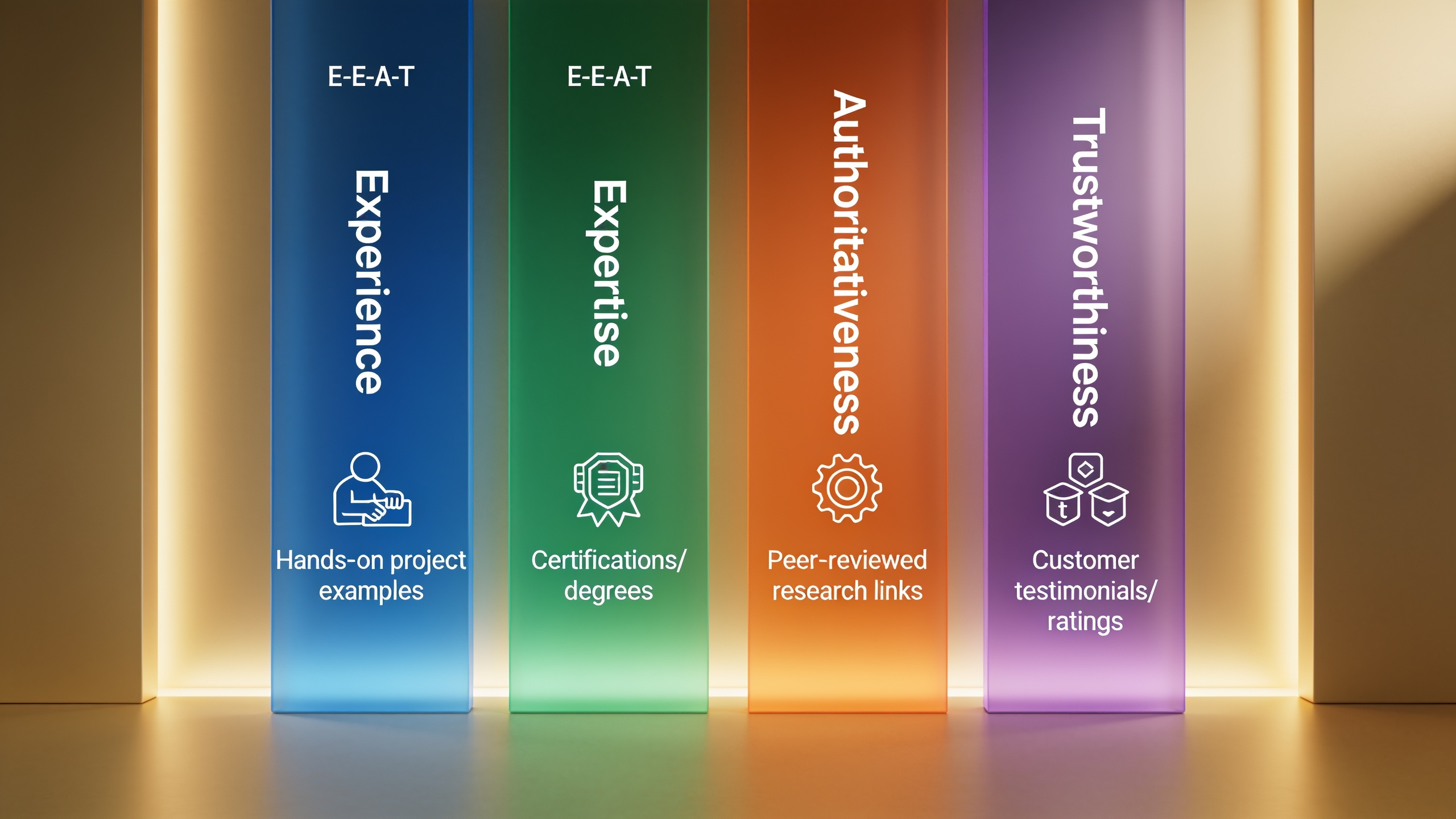
That first "E," Experience, got added to the framework in December 2022, and it's the one people underrate. It asks a simple question: does the person creating this content actually have firsthand, real-world experience with the topic? A product review by someone who genuinely used the thing. A how-to written by someone who's actually done it. This is the whole reason generic surface-level content tends to crater after core updates, while content full of specifics, real examples, and demonstrated expertise holds steady or climbs.
For content teams, translating E-E-A-T into practice is honestly pretty simple to describe, even if it's a grind to pull off consistently. Attribute your content to real people with real credentials, and make that easy to find. Back your claims with specific data, named sources, and examples instead of vague hand-waving. Keep things accurate and current, and update your older stuff instead of letting it rot. And make your trust signals machine-readable, because structured data is how search engines (and increasingly AI systems) correctly tie content to its author, publisher, and topic.
What Should Content Teams Do Right Now?
Audit your content and technical health on a regular schedule instead of waiting for a core update to embarrass you. That's the whole game. The sites that barely flinch during an algorithm change are the ones that were already lined up with Google's quality guidance before the rollout even started. Reacting after your traffic falls off a cliff is way more expensive than just keeping your baseline quality high the whole time.
Here's roughly what a sane response plan looks like.
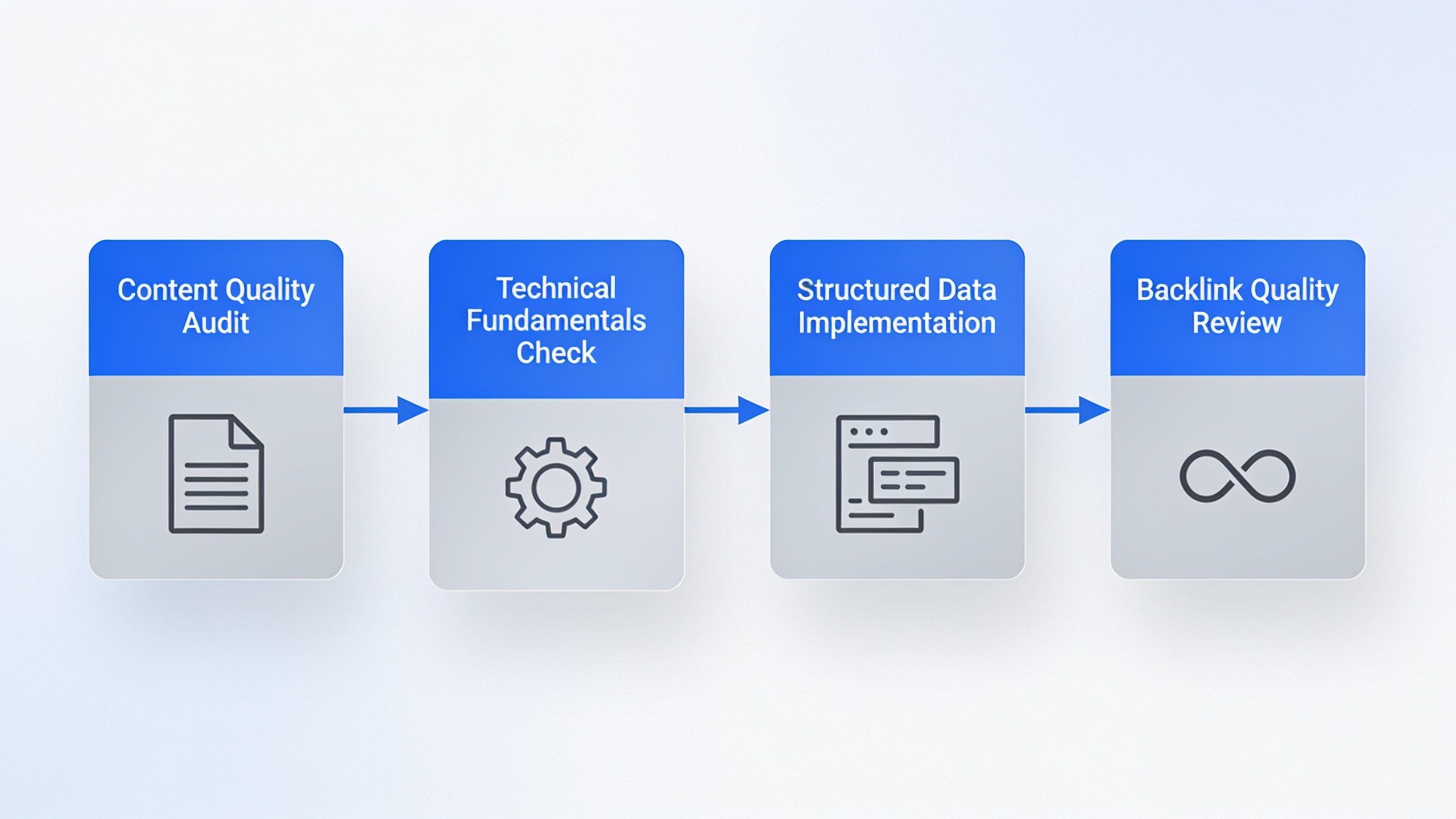
Start with a content quality audit. Find the pages you wrote for keywords rather than for actual humans, then either seriously improve them, merge them together, or kill them. Google has said more than once that pruning low-value pages can lift the overall quality signal of a domain. Sometimes deleting is the move.
Next, check your technical fundamentals before you go blaming the writing. Page speed, mobile usability, Core Web Vitals. These are foundational, not nice-to-haves, and a technically weak site can drag down even great content when a quality reassessment hits. It's worth understanding how load time and rankings actually relate before you assume a drop is purely an editorial problem.
Then strengthen your structured data on the pages that matter. Good schema markup makes it easier for Google (and, more and more, for AI systems like ChatGPT, Gemini, and Perplexity) to correctly parse who wrote something, who published it, and what it's about. That helps both traditional rankings and your shot at showing up in AI-generated answers.
Keep an eye on backlink quality too, and diversify. Manual or junky link schemes are still squarely in the crosshairs of Google's spam systems, and a link profile built on genuine, contextually relevant placements holds up far better through core updates than one built on sheer volume.
Oh, and publish consistently instead of in random bursts. Sites that keep a steady cadence with real editorial oversight build authority more reliably than the ones that dump ten posts in a week and then vanish for four months.
If your team doesn't have the bandwidth to run all this by hand, that's exactly the gap RobinRank is built to fill. It plans, writes, and publishes SEO-optimized articles on autopilot, including JSON-LD schema markup generated automatically for every piece. It also plugs your site into a verified backlink network, where outbound links to community members earn credits that fund inbound links back to your own domain. The point is that content quality, technical structure, and link-building actually work together instead of living in three separate silos, which matters most in the weeks after a core update when every single quality signal is getting reassessed at the same time.
How Long Does It Take to Recover From a Core Update?
Recovery can take anywhere from a few weeks to several months, and here's the part that stings: Google has flat-out said that some sites hit by one core update won't improve until a later core update rolls out. The changes don't get reversed individually. They get reassessed the next time the ranking systems get broadly updated. So there's no fast-track, no appeal button, because a core update isn't a manual action in the first place. You kind of just have to wait.
That said, it's not entirely a waiting game. Google's own guidance, published alongside the update announcements, suggests that real content improvements can influence how a page is judged over time, even before the next core update lands. Google keeps pointing people toward content that demonstrates "who, how, and why" it was created. Who wrote it, how it was made, why it exists. That's it. Chasing narrow ranking-factor theories is mostly a waste of energy. Sites that make substantive, sustained improvements to quality and trust are the ones more likely to bounce back in later updates, not the ones making cosmetic tweaks and refreshing Search Console every hour.
Because those timelines are long and genuinely uncertain, prevention beats cure every time. Treat each core update as a checkpoint that confirms your ongoing quality work, not an emergency that sends everyone scrambling.
Frequently Asked Questions
Wait, does a Google update mean my site got penalized?
No. Google has said this repeatedly: core updates aren't penalties against specific sites. They're broad recalibrations of how the ranking systems weigh relevance and quality across the whole web. A drop after a core update just means the update reassessed where your content sits against competitors. It's not punishment.
How can I tell if a core update actually caused my traffic drop?
Line up the timing of your traffic change against Google's Search Status Dashboard, which lists the confirmed start and end dates of every announced core update. If your drop lands neatly inside a rollout window and it's hitting a bunch of pages rather than one lonely URL, a core update is the likely culprit rather than a technical bug or a manual action.
Can I ask Google to take another look after a core update hit me?
Nope, there's no manual review for core update impacts, because they aren't manual actions and can't be appealed like a manual penalty. Your only real path forward is improving content and site quality and then waiting for the next update or refresh to reassess your pages. Annoying, but true.
Should I rewrite all my content after every core update?
Please don't. Wholesale rewrites are rarely necessary and can actually backfire if you do them reactively without diagnosing anything first. The smarter move is auditing which specific pages are underperforming relative to their potential, then improving depth, accuracy, and originality on those, while leaving your strong performers alone.
Does site speed really matter for core update impact?
Site speed usually isn't the main driver of a core update ranking change, but it works as a supporting quality signal that can swing outcomes for pages that are otherwise borderline. A fast, stable site gives strong content its best possible shot at getting rewarded when Google reassesses quality across the board.
Google's algorithm is going to keep changing, and no article, this one included, can tell you exactly what the next rollout will go after. But the teams that consistently come out ahead all do the same thing: they treat content quality, technical health, and link signals as an ongoing discipline instead of a fire drill that only kicks off when the next update announcement drops.
Ready to stop writing content by hand? Start your free RobinRank trial and get a full month of SEO-optimized articles published on autopilot.