International SEO: How to Actually Show Up in Search Around the World
Here's a number worth sitting with: 76% of online shoppers prefer to buy products with information in their own language, according to CSA Research. A big chunk of them will rarely or never buy from an English-only site when a local-language option exists. That one stat explains a lot. It's why so many companies translate their homepage, pat themselves on the back, and then wonder why they're invisible in the exact markets they were trying to crack. Translation without the technical and strategic scaffolding underneath it is basically shouting into a void.
So this guide covers the whole stack. The plumbing (hreflang tags), the strategy (a real multilingual plan, not a translation dump), and the structural call you have to make early: subdirectories, subdomains, or country domains. Get these three right and global expansion actually shows up in search. Get them wrong and you've built a beautiful ghost town.
Table of Contents
- What Is International SEO?
- Why This Actually Matters for Growth
- Hreflang Tags: Telling Google Which Page to Show
- Building a Multilingual Strategy That Converts
- How Should You Structure a Multilingual Site?
- Localization Is Way More Than Translation
- Mistakes That'll Cost You (And How to Dodge Them)
- FAQ
What Is International SEO?
International SEO is the mix of technical and content practices that help search engines match the right language and regional version of your site to the right searcher. It lives at the intersection of technical SEO, content strategy, and localization. And no, it's not just "SEO plus translation," even though half the internet talks about it that way.
At its core, it's answering three questions for both search engines and users. Which language is this page written in? Which country or region is it for? And is there an equivalent version somewhere for other languages or regions?
Google says as much in its Search Central docs: it leans on signals like hreflang annotations, content language, server location, and country-specific domains to decide which version of a page to serve. Skip those signals and you're forcing Google to guess. It guesses wrong more than you'd think. A French user gets shown a Spanish page, or worse, Google sees a bunch of near-identical pages, shrugs, and dilutes your ranking signals across all of them.
And to be clear, having a multilingual website is not the same thing. You can have ten language versions and still flop internationally if there's no hreflang, no localized keyword research, and you're just running the same playbook that worked back home in every single market. Language coverage isn't a strategy. It's a checkbox.
Why This Actually Matters for Growth
International SEO matters because search behavior, language preference, and buying intent swing wildly from country to country, and search engines reward sites that respect those differences. Ignore this layer and you're leaving organic traffic (and money) on the table in every market outside your home base. Full stop.
The CSA Research language preference number is the headline, but there are a few practical reasons this deserves its own plan instead of getting bolted onto an existing content calendar as an afterthought.
For one, search engines aren't the same everywhere. Google runs the show across most Western markets, sure, but Baidu leads in China, Yandex still holds real share in Russia, and Naver matters a lot in South Korea. Build your whole approach around Google's ranking factors and you can miss entire countries without realizing it.
Keyword volume and intent shift too. The direct translation of your best-performing English keyword often lands with a thud in German, Portuguese, or Japanese, either almost no search volume or a totally different competitive fight than you expected. Then there's the trust stuff that compounds over time: reviews, backlinks from local domains, currency and contact info that actually looks right to someone in that country. All of it feeds user trust and, indirectly, search visibility.
Oh, and one more thing that's newer. AI answer engines are changing the math. As ChatGPT, Gemini, and Perplexity increasingly stitch answers together from indexed pages, well-structured language-specific content improves your odds of getting cited there too, not just in the old blue-link results. Something worth keeping in the back of your mind.
If you're planning to scale content across a bunch of markets, this is where tooling starts to earn its keep. Platforms like RobinRank, which plan, write, and publish SEO content on a schedule, are built around that "set it up once, let it run" mindset. Honestly, that becomes less of a nice-to-have and more of a survival mechanism once you're juggling content across five or six languages instead of one.
Hreflang Tags: Telling Google Which Page to Show
A hreflang tag is an HTML attribute that tells search engines which language and, optionally, which country a page is meant for, so the engine serves the correct version to the correct searcher. It's the single most important technical piece of any international SEO setup. It's also, in my experience, the thing people screw up more than anything else.
The basic syntax
A hreflang annotation usually sits in the `
` of a page, in the XML sitemap, or in the HTTP header. The most common version looks like this:```
```
Each tag needs a language code (ISO 639-1 format, like "en" or "es") and optionally a region code (ISO 3166-1 Alpha 2, like "us" or "gb"). That `x-default` tag? It's the fallback, telling search engines what to show when nobody's language or region matches. Handy for a global landing page.
Where it all falls apart
Three mistakes cause most hreflang disasters, and they're weirdly consistent.
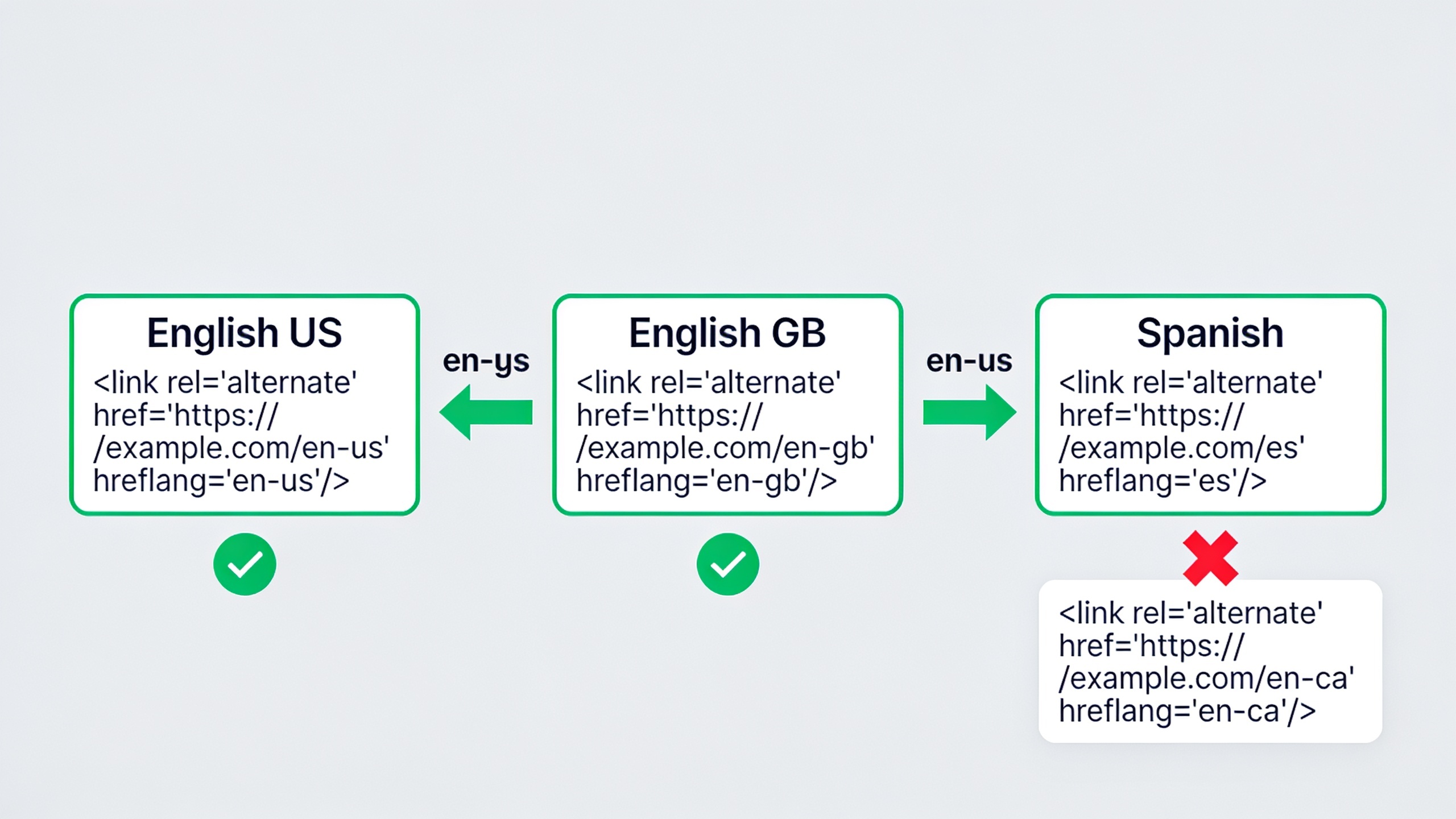
The big one is missing return tags. Hreflang is reciprocal. If your English page points to your Spanish page, the Spanish page has to point back. Google's own docs say annotations without matching return tags may just get ignored entirely. No error, no warning. It just quietly doesn't work.
The second is inconsistent URLs. Point a hreflang tag at a URL that redirects, throws a 404, or has a canonical tag aimed somewhere else, and search engines can toss the whole hreflang cluster for that page. And the third is mixing up your codes. Using a country code by itself (like `hreflang='us'`) is invalid. Language comes first, region is optional and comes second. Get that order wrong and the tag's dead.
Three ways to actually implement it
You've got three options, and you only need to commit to one, consistently. HTML link tags in the page `
` (like the example above) work best for smaller sites. HTTP headers are your move for non-HTML files like PDFs. And XML sitemap entries are what a lot of bigger multilingual sites prefer, because it corrals all the hreflang data into one file instead of scattering it across thousands of individual pages.Whatever you pick, validate it. Please. Google Search Console's International Targeting report (for legacy properties) or a decent third-party hreflang validator will catch broken reciprocal links before they quietly strangle your international visibility for six months while you have no idea why traffic's flat.
Building a Multilingual Strategy That Converts
A multilingual SEO strategy is a plan for researching, producing, and maintaining search-optimized content across every target language and market, not translating one master version of your site into a bunch of languages. That difference is everything, because keyword research, search intent, and even what a "good" piece of content looks like all shift from market to market.
Start with keyword research in each language, natively
Translating your primary keywords directly is the most common shortcut in international SEO, and probably the most expensive one. A phrase that ranks and converts beautifully in English can have a completely different search volume, a different set of competitors, or a different implied intent once it's in another language. E-commerce brands run into this constantly: the literal translation of a product category is rarely what shoppers in that country actually type. Local synonyms, brand names, even slang carry the real volume.
So do the research where the searches happen. Run keyword research natively in each target language using local data instead of translating an English list after the fact. Check for market-specific competitors, the ones who dominate locally even though nobody outside the country's heard of them. And confirm the intent hasn't drifted, because a keyword that's purely informational in one market can be transactional in another. That last one catches people off guard all the time.
Build a repeatable process, not a one-off translation project
Scaling content across languages without a real process is exactly how teams end up with wildly inconsistent quality, forgotten internal links, and pages that never get touched again after the first translation. Before any writer or translator opens a doc, they need clear direction: target keywords, search intent, internal linking, tone. That's what a proper brief is for. If your team doesn't have a standard for this yet, it's genuinely worth reading 15 SEO content briefs every writer needs before hitting publish, which lays out a reusable template that adapts nicely to multilingual work too.
Want content like this running on autopilot for your own site? Try RobinRank free — AI-written, SEO-optimized articles generated and published automatically, no credit card required.
Think about how people talk, not just how they type
Search is getting more conversational, especially on mobile and voice, and that shift doesn't politely stop at language borders. If anything, voice and conversational patterns can vary even more by culture and dialect than typed queries do. So think about how a question actually gets phrased out loud in each language rather than obsessing over short-tail keywords. The stuff covered in voice search optimization: writing content people can actually ask for maps straight onto this: question-based headings, direct answers near the top of a section, natural phrasing. It travels well across markets precisely because it's built around how humans talk, not how algorithms parse.
How Should You Structure a Multilingual Site?
Your three main structural options are country-code top-level domains (ccTLDs), subdomains, and subdirectories, and the right pick depends on your resources, your brand strategy, and how much SEO authority you want each market to inherit from your main domain.
There's no universally "correct" answer here, which is annoying but true. Each option comes with real trade-offs around cost, control, and how search engines treat authority across your versions.
| Structure | Example | SEO Authority Sharing | Setup & Maintenance Cost | Best For |
|---|---|---|---|---|
| ccTLD | example.de | None — each domain builds authority independently | High (separate hosting, domains, sometimes legal entities) | Large enterprises with dedicated regional teams and budgets |
| Subdomain | de.example.com | Partial — some authority may pass from the root domain | Medium | Companies wanting some separation between markets without full independent domains |
| Subdirectory | example.com/de/ | Strongest — full authority of the main domain is shared | Low | Most small and mid-sized businesses expanding internationally |
For most small businesses, startups, and agencies wrangling a bunch of client sites, subdirectories are the practical default. They pool all your backlink and domain authority under one root, they're the cheapest to run, and one CMS handles every language version. ccTLDs earn their higher cost when a company genuinely needs to signal deep local presence for legal, cultural, or trust reasons, and has the budget to babysit multiple domains, hosting setups, and sometimes local business registrations.
Whatever you land on, consistency beats the specific choice. Mixing structures for no clear reason (some markets on subdirectories, others on ccTLDs) turns hreflang management and reporting into a headache you didn't need.
Localization Is Way More Than Translation
Localization is adapting your content, design, and functionality to the cultural, legal, and practical expectations of a specific market. Translation is just one slice of it. A page can be grammatically perfect in the target language and still fail to convert because it ignored local currency formats, payment methods, imagery, or plain old cultural context.
There's a batch of technical details that get overlooked constantly. Currency and pricing display, for one. Show prices in the visitor's local currency, formatted the way that market actually expects (comma versus period as the decimal separator, which sounds trivial until it isn't), and you strip friction out right at the point of conversion. Same energy with date and number formats. The MM/DD/YYYY versus DD/MM/YYYY thing is tiny, but it quietly erodes trust the second it shows up on a shipping estimate or an event date. Then there's local contact info and legal disclosures. A lot of markets expect, or legally require, local business registration numbers, VAT details, or region-specific privacy disclosures. And imagery matters more than people admit. Photos, testimonials, and case studies that reflect the local market almost always beat one global image set copy-pasted everywhere.

Local backlinks and local signals
Search engines weigh trust signals that are often tied to geography, at both the domain and page level. A backlink from a well-regarded domain inside your target country can carry more relevance for local results than an equally authoritative link from some unrelated market. Which is exactly why backlink strategy needs to be planned market by market instead of run as one big global campaign. A link-building approach that ignores geography and relevance just misses the local trust signals search engines are actually hunting for.
Don't localize once and walk away
Here's a failure pattern I see over and over: teams pour everything into the initial localization push, then let those translated pages rot while the home-market content keeps evolving. Six months later the non-primary versions are stale and slipping in the rankings. Multilingual sites need the same refresh cadence in every language that the primary market gets. Otherwise the other versions slowly drift out of relevance, and you won't notice until the traffic's already gone.
Mistakes That'll Cost You (And How to Dodge Them)
The most common international SEO mistakes are auto-translating content with zero human review, skipping hreflang entirely, and copy-pasting one market's content strategy across every other market without adjusting for how people actually search there. All avoidable with a bit of planning. All painfully expensive to fix once search engines have indexed and ranked the broken version.
Leaning entirely on machine translation is the classic one. The tools have gotten genuinely good, but nuance, idiom, and search-intent alignment still need a human in the loop, especially on your money pages like product descriptions and landing pages.
Then there's the canonical-versus-hreflang collision. When those two tags contradict each other, search engines tend to side with the canonical, which can quietly cancel out all your international targeting. Nasty little bug to track down.
A few more worth flagging. Treating every market as a smaller version of home is a trap, because content depth, format preferences, even ideal length can vary a lot by culture and by which search engine dominates locally. Ignoring page speed and mobile experience for other regions is another. Hosting and CDN setup change load times depending on where your servers sit relative to your audience, and a sluggish page in a given region can undercut otherwise great content without you ever seeing it. And finally, launching a dozen markets at once when you can only realistically maintain three. A handful of well-kept, properly localized markets will beat a dozen thin, neglected ones every single time. It's not close.
FAQ
Do I need a separate domain for each country?
No. A separate ccTLD per country is a legit option, but subdirectories on one domain (like example.com/fr/) are common and often way more resource-efficient, especially for small and mid-sized businesses, because they keep all your SEO authority under one roof instead of splitting it across a pile of separate domains.
Is hreflang a ranking factor?
Not in the "boost my position" sense, no. It's a targeting signal that helps Google serve the right language or regional version to the right user. Getting it wrong doesn't automatically penalize you, but it can show the wrong page to the wrong audience, or set your near-duplicate pages competing against each other in the results. Neither is fun.
How is international SEO different from regular SEO?
Regular SEO optimizes for a single language and audience. International SEO stacks on a whole extra layer: technical signals like hreflang, market-specific keyword research, and localization calls like site structure and currency display, all aimed at multiple language or country audiences at the same time.
Can I just run Google Translate on my existing pages?
As a starting point, sure. But published pages really need human review for accuracy, tone, and search-intent alignment. Both search engines and actual readers can sniff out low-quality or unnatural translated text, and that undermines trust and dents the engagement metrics that indirectly feed into rankings.
How many languages should a business start with?
There's no magic number. It depends on where your existing traffic, customer inquiries, or market research already point to real demand. Most companies do better starting with one or two well-researched, well-maintained language versions than firing off five markets they can't actually localize or keep current.
Expanding globally through search is less about translating what already works and more about rebuilding the strategy from the ground up, keyword by keyword, market by market, around how each audience genuinely searches. Nail the technical foundation with hreflang, treat localization as more than translation, and pick a site structure you can realistically maintain. Do that, and the rest of your global content plan finally has something solid to stand on.
Ready to stop writing content by hand? Start your free RobinRank trial and get a full month of SEO-optimized articles published on autopilot.