Can AI-Generated Content Actually Rank on Google?
Google's been pretty clear about this for a while now. They reward good content, not a particular way of making it. But the confusion sticks around, and I get why. Early automated content was genuinely garbage, and some people are still using AI carelessly today and watching their rankings crater. So the fear isn't irrational. It's just aimed at the wrong target.
Let me walk you through what Google actually says, what the real ranking data shows, why some AI content flops while other AI content quietly prints traffic, and how to make AI-assisted stuff that holds up in search over the long haul.
Table of Contents
- What Google Actually Says About AI Content
- Does AI Content Rank? What the Data Shows
- Common Myths About AI Content Penalties
- Why Some AI Content Fails to Rank
- How to Make AI Content Rank: A Practical Framework
- AI Content vs. Human Content: A Side-by-Side Comparison
- Tools and Workflows That Support Ranking Success
- Frequently Asked Questions
What Google Actually Says About AI Content
Google does not penalize content just because AI helped make it. Full stop. Their Search Central documentation says it plainly: they judge content on quality signals, not on how it was produced.
The exact line from Google's guidance, folded into their broader helpful content framework, is this: "Using automation, including AI, to generate content with the primary purpose of manipulating ranking in search results is a violation of our spam policies." Read that again and notice the qualifier. The problem is the manipulative intent. Not the AI. Those are two completely different things, and people conflate them constantly.
And this distinction matters way more than most folks realize. Both John Mueller and Search Liaison Danny Sullivan at Google have said, out loud, in public, that the ranking systems (including the helpful content system that got baked into core ranking in 2024) are built to reward content showing experience, expertise, authoritativeness, and trustworthiness. That's E-E-A-T, the framework Google lays out in its Search Quality Rater Guidelines. Whether a human typed every word by hand or an AI spat out a draft that a person then edited, fact-checked, and published? Not something Google's algorithms directly measure. They can't, really.
What the spam policies do go after is "scaled content abuse." That's Google's term for cranking out huge volumes of pages with basically no editorial oversight, mostly to game rankings instead of helping anyone. This policy landed with the March 2024 core update, and it wiped out a bunch of content farms that had been mass-producing thin AI articles with zero human review. People remember that as "Google penalized AI content." What actually happened was "Google nuked low-value, unedited, scaled junk, and a lot of it happened to be AI-made." Big difference.
If you want to go deeper on how these quality frameworks apply specifically to machine-assisted writing, the complete guide to E-E-A-T for AI-generated content gets into how you signal experience and trust even when most of the drafting is automated.
Does AI Content Rank? What the Data Shows
AI content ranks when it's well-researched, properly edited, and built to actually answer what someone searched for. And it tanks when it's generic, wrong, or dumped online with nobody checking it first. That's not a hunch. Multiple independent studies since 2023 back it up.
Take the analysis Originality.AI ran back in 2023. They looked at a batch of AI-generated articles published without any real editing, and a meaningful chunk of them still landed on page one within weeks. So much for the idea that Google could reliably sniff out and bury AI text at scale. Meanwhile, SEO folks tracking the Helpful Content Update and the March 2024 core update kept noticing the same thing: the sites that got hammered weren't defined by AI use. They were defined by thin content, duplicated structures spread across hundreds of pages, and basically no original thought. Which, funny enough, describes bad human content just as well as bad AI content.
Google itself has confirmed, through Search Central docs, that there's no classifier specifically hunting down "AI-written" text to demote it. Instead the systems judge the finished piece against the exact same yardsticks used on any page. Does it match intent? Does it offer accurate, original value? Does it come from a source that clearly knows the subject?
So here's the thread running through nearly every rank-tracking study I've seen: content origin isn't the variable that predicts success or failure. Quality, depth, and editorial rigor are. That lines up with what most agencies and in-house teams notice when they put AI-assisted articles head-to-head against fully human ones in the same content cluster. There's a fuller breakdown of exactly that in AI vs. human writers: what actually ranks better in SEO.
Common Myths About AI Content Penalties
The biggest myth going around is that Google has some blanket "AI penalty" that automatically buries machine-written text. It doesn't. Google's own published guidelines say otherwise. Let me knock down the ones that refuse to die.
Myth 1: Google Can Detect and Penalize "AI Writing Style"
Google has never confirmed it runs a widely deployed classifier that flags text as AI-written and demotes it for that reason alone. And the AI detection tools being sold to writers? They're notoriously unreliable, throwing false positives on human-written text all the time, especially the dry, formulaic business writing that ironically sounds a lot like AI. Google's people have said repeatedly they care about outcomes (does the page help someone) rather than playing forensic detective about who wrote it.
Myth 2: Any Use of AI Violates Google's Spam Policies
Nope. The spam policies target "scaled content abuse," which is specifically about mass-producing garbage to manipulate rankings. A business publishing 10 to 20 carefully reviewed AI-assisted articles a month, with real expertise behind them, is a completely different animal from a content farm dumping 5,000 unedited pages overnight to milk ad revenue. Google knows the difference.
Myth 3: AI Content Can Never Show Real Experience (the "E" in E-E-A-T)
This one's my favorite to argue about, honestly. "Experience," per Google's Quality Rater Guidelines, means first-hand knowledge showing up in the content: original data, screenshots, case studies, actual product testing. And you can absolutely pull that off with AI in the loop. A human expert supplies the source material, the data, the firsthand insight, and the AI helps structure and draft around it. The experience signal comes from the input and the editorial process, not from whether human fingers physically hit each key.
Myth 4: AI Content Always Ranks Worse Long-Term
Some studies do show AI content being volatile over time. But dig in, and that volatility tracks with content being thin and never updated, not with AI as some isolated variable. Well-maintained AI-assisted content that gets refreshed with new data and internal links holds its rankings about as well as well-maintained human content in the same niche. Maintenance is the thing. Not the tool.
Why Some AI Content Fails to Rank
AI content usually fails when it's published without fact-checking, brings zero original insight, ignores what the searcher actually wanted, or gets pumped out faster than anyone can possibly review it. Notice something? These are all process problems. None of them are baked into AI as a writing tool.
Raw, unedited AI drafts tend to read vague and repetitive. That's not a bug so much as how the models work. They're trained to produce statistically likely text, not necessarily the most accurate or specific answer for some weird niche query. And if a human doesn't come in and add proprietary data, real examples, or an actual point of view, the article just melts into the sea of identical content already out there. Nothing to differentiate it. Nothing to rank.
Then there's the hallucination problem, which is the scary one. AI models will confidently generate stuff that sounds totally plausible and is flatly wrong. Publish those errors and you're damaging trust signals, and if a user or reviewer catches them, your brand credibility takes a hit before rankings even enter the picture. Fact-checking isn't optional here. I'd call it the single non-negotiable step in any AI publishing workflow.
The content farms that got wrecked in Google's 2024 updates were typically shoving out hundreds or thousands of pages a week with almost no human touch. That's textbook scaled content abuse, and it wouldn't matter if the pages came from AI, cheap outsourced writers, or automated templates. Scale isn't the villain. Scale with no quality control is.
There's also the intent problem. AI can write technically fluent paragraphs that still completely miss what the searcher wanted, like answering "what is X" when the query clearly signals someone's ready to compare products and buy. Content that doesn't map to intent underperforms, period, human-written or not.
Want content like this running on autopilot for your own site? Try RobinRank free — AI-written, SEO-optimized articles generated and published automatically, no credit card required.
And finally, staleness. Static content decays. Always has. Competitors publish fresher, deeper resources, and your never-updated page slowly slides down the results. AI-assisted content you write once and forget rots the exact same way a neglected human blog post does.
How to Make AI Content Rank: A Practical Framework
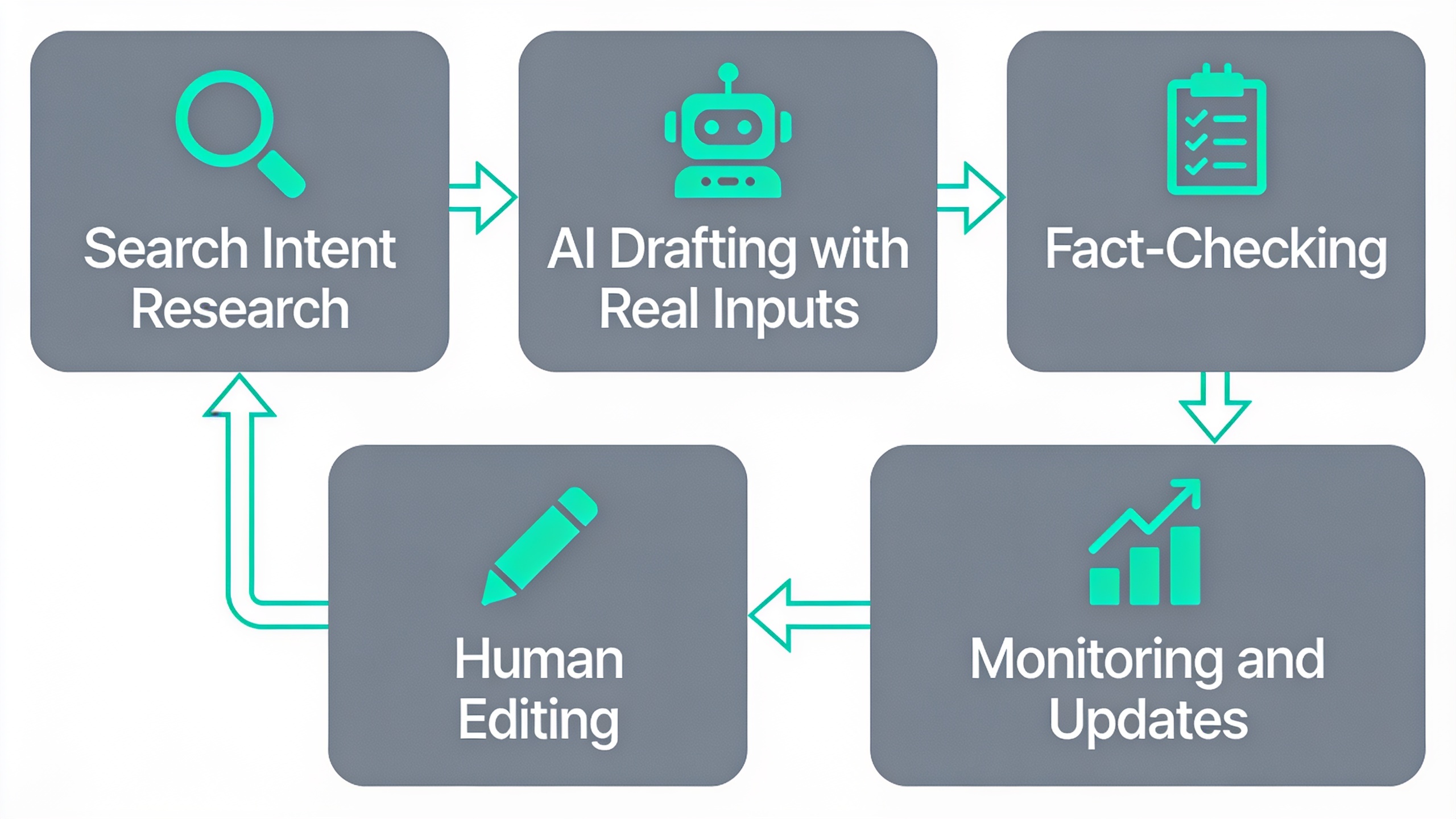
AI content ranks reliably when you treat the AI as a drafting accelerator inside a genuinely rigorous editorial process, not as a magic replacement for research, fact-checking, and strategy. Here's the framework that keeps showing up in ranking case studies and in Google's own docs.
Start with real search intent research. Before you generate a single word, figure out what people actually want for your target query. Informational? Transactional? Comparative? Navigational? Use SERP analysis, "People Also Ask" boxes, and gaps in competitor content. AI can help with the research grunt work, but the judgment call about intent should stay human-directed.
Feed the model real, specific inputs. The ceiling on your output is basically set by the quality of what you put in. Hand it proprietary data, original quotes, internal stats, firsthand product experience, and then tell it to build around that instead of regurgitating generic filler from its training data. Garbage in, garbage out. Good stuff in, decent stuff out.
Fact-check every statistic and claim. Every number, every study reference, every factual assertion the AI produces gets independently verified before it goes live. This one step kills the most reputation-destroying failure mode of AI content, and it feeds straight into the trustworthiness leg of E-E-A-T.
Edit for voice, depth, and originality. A human should be adding specificity, cutting the redundant phrasing, and injecting an actual point of view. Google's Quality Rater Guidelines specifically reward content with unique insight you can't just find everywhere else, and generic AI drafts almost never clear that bar on their own.
Structure for both humans and AI answer engines. Clear headings, direct answers up near the top of each section, well-organized comparison data. That stuff helps human readers and helps generative features like Google's AI Overviews actually parse and surface your content. This matters more every month as search traffic keeps shifting toward AI summaries instead of the classic ten blue links.
Publish at a sustainable, reviewed pace. Don't mass-dump hundreds of pages overnight. The strategies that work scale gradually, with review checkpoints, roughly matching the cadence of a well-run editorial team even when AI's handling the first drafts.
Oh, and one more thing that people skip constantly. Monitor performance and update regularly. Track your rankings, click-throughs, and engagement after publishing. When a page underperforms, refresh it with new data, expanded sections, better internal links. Don't just abandon it and write something new. Fixing beats replacing more often than you'd think.
AI Content vs. Human Content: A Side-by-Side Comparison
Both AI-assisted and fully human-written content can rank great on Google. The deciding factors are editorial quality, accuracy, and demonstrated expertise, not the production method. Here's how the two typically stack up across the things that actually move rankings.
| Factor | AI-Assisted Content (Edited) | Fully Human-Written Content | Unedited Raw AI Content |
|---|---|---|---|
| Production speed | Fast (hours to a day per article) | Slow (days to weeks per article) | Very fast (minutes) |
| Factual accuracy | High, if fact-checked | Depends on writer expertise | Inconsistent; hallucination risk |
| Demonstrated experience (E-E-A-T) | Strong, if fed real inputs/data | Strong, naturally from writer's expertise | Weak; lacks firsthand detail |
| Scalability for small teams | High | Low without hiring | High but risky |
| Risk of Google spam policy issues | Low, if reviewed and not mass-produced | Very low | Higher, especially at scale |
| Typical ranking outcome | Comparable to strong human content | Comparable to strong AI-assisted content | Often underperforms or fails |
| Cost per article | Low to moderate | High (writer/editor time) | Very low |

Look at that table for a second. The real gap isn't "AI" versus "human" as categories. It's edited, well-sourced content versus rushed, unedited content, no matter which tool produced it. That's exactly what turns up in AI vs. human writers: what actually ranks better in SEO, where matched comparisons of AI-assisted and human-only articles on similar topics showed rankings driven mostly by depth and polish, not authorship.
Tools and Workflows That Support Ranking Success
For most businesses, the winning move is combining AI drafting speed with structured SEO optimization and human review. Not pure manual writing (too slow, too expensive) and not pure unsupervised automation (too risky). Somewhere in the middle. This is the gap platforms like RobinRank are built to fill, drafting, optimizing, and publishing articles while applying the structural and quality signals search engines reward, so businesses without a full in-house content team can still fight for organic visibility.
A workflow that actually holds up tends to include a few things. You want keyword and intent research so every article targets a real, well-matched query instead of some vague topic. You want structured drafting that follows SEO best practices from the start (clear headings, direct answers, internal links) rather than bolting structure on afterward. And you absolutely want fact-checking or human review checkpoints before anything publishes, because that's where hallucinations and outdated claims get caught.
Beyond that, ongoing performance tracking so weak articles get refreshed instead of left to rot, plus natural backlink building, since authority signals from other reputable sites are still one of Google's most consistent ranking factors no matter how the linked content was made.
Honestly, the people who gain the most from this are small businesses, startup founders, and marketing agencies without dedicated writing staff. They get to compete for the same keywords as much bigger players without the overhead of hiring and managing a whole editorial team. That used to be impossible. Now it isn't.
Frequently Asked Questions
Does AI content rank as well as stuff written by humans?
Yes, when it's well-researched, fact-checked, and edited for depth and originality, AI-assisted content ranks right alongside human-written content going after the same keywords. Rankings correlate way more with quality and E-E-A-T signals than with whether a person or an AI wrote the first draft.
Will Google penalize my site just for publishing AI articles?
No. Google won't ding you for using AI, according to its own Search Central documentation. Penalties hit "scaled content abuse," meaning mass-produced, low-value pages built mainly to game rankings, and that can involve AI, human writers, or automated templates equally.
How do I know if my AI content is actually going to rank?
Judge it against the same criteria Google's Quality Rater Guidelines use for anything. Does it fully answer the search intent? Does it bring original insight or data you can't easily find elsewhere? Is it factually accurate? Does it show real expertise? If a piece can't clear those bars, it won't rank, and it wouldn't matter who wrote it.
Do I have to disclose that I used AI?
Google doesn't require you to disclose AI assistance for standard blog or article content, though some jurisdictions and certain content types (AI-generated images or deepfakes, for instance) come with their own disclosure expectations. Generally, being transparent about your editorial standards and sourcing builds more reader trust than announcing which writing tool you used anyway.
Is 100% AI content with zero human editing ever a good idea?
It's risky, and I'd steer you away from it. Even fast, high-volume workflows benefit from a human review step to catch factual errors, add real expertise, and dodge the patterns that look like scaled content abuse. Nearly every sustained ranking success story I've seen pairs AI drafting with human oversight, not fully hands-off publishing.
AI-generated content isn't some inherent ranking risk, and it's definitely not a shortcut. It's a production method, and it inherits the exact same rules every piece of web content has always lived by: answer the searcher, prove you know your stuff, keep it accurate and current. The businesses treating AI as a serious editorial tool, backed by real data and real human review, are finding they can build organic visibility at a pace manual writing could never touch. That's the whole story, really.
Ready to stop writing content by hand? Start your free RobinRank trial and get a full month of SEO-optimized articles published on autopilot.