The Complete Guide to E-E-A-T for AI-Generated Content

Quick refresher for anyone who's fuzzy on the acronym. E-E-A-T stands for Experience, Expertise, Authoritativeness, and Trustworthiness. It's the lens Google's Search Quality Rater Guidelines uses to decide whether your content actually deserves to show up. And here's where AI hits a wall: it can research fast, draft fast, and format beautifully, but it cannot hand you lived experience or accountable expertise. It just can't. That gap is where most AI content operations quietly fall apart, and it's exactly what I want to walk through here.
Table of Contents
- What Is E-E-A-T and Why Does It Matter for AI Content?
- Does Google Penalize AI-Generated Content?
- How to Add Real Experience to AI-Written Articles
- Building Expertise Signals Into an AI Content Workflow
- Establishing Authority for AI Content at Scale
- Trust Signals That AI Can't Fake
- A Practical E-E-A-T Checklist for AI Content Teams
- How RobinRank Approaches E-E-A-T AI Content
- Frequently Asked Questions
What Is E-E-A-T and Why Does It Matter for AI Content?
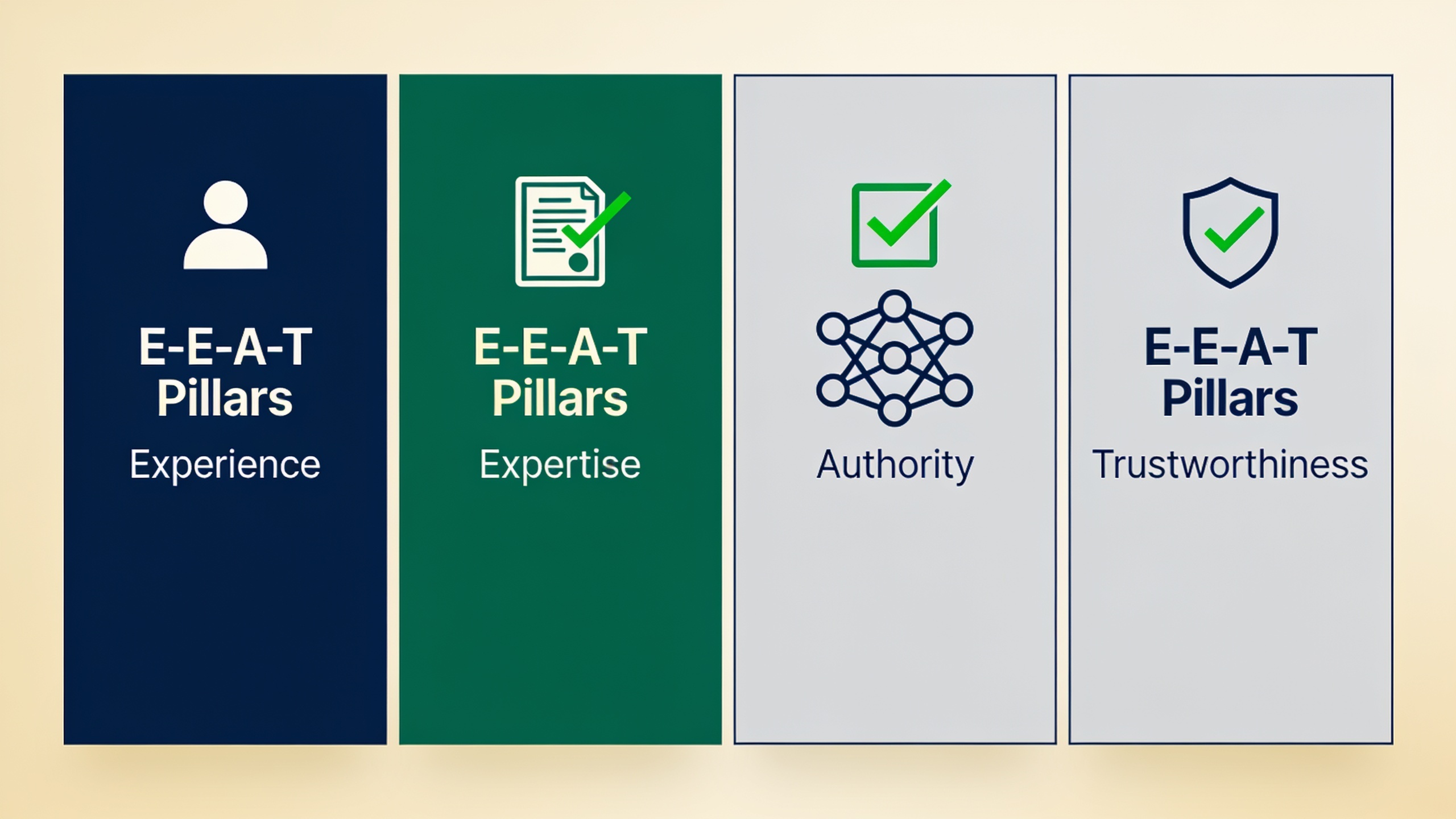
E-E-A-T is Google's evaluation framework, spelled out in its Search Quality Rater Guidelines, and it breaks into four parts. Experience asks whether the creator has actually done the thing they're writing about. Expertise asks whether they've got the knowledge or skill to speak on it. Authoritativeness asks whether they're recognized as a go-to source. And Trustworthiness asks whether the content is accurate, honest, safe, and upfront about itself. For AI content specifically, all of this matters because both the algorithms and the human quality raters are getting scary good at sniffing out generic, unverified, misleading text. Which, let's be blunt, is exactly what AI churns out when nobody's supervising it.
Google has said out loud, more than once, that it doesn't penalize content just because AI helped make it. What it penalizes is content built primarily to game the rankings, regardless of who or what wrote it. That distinction is everything if you run an AI content program. The tool doesn't matter. The output does. If the finished piece is genuinely helpful, accurate, and clearly backed by a credible source, you're fine.
Here's a detail people forget: the second "E," experience, only got added to the framework in December 2022. And it was added specifically to catch content that sounds like it knows what it's talking about but was never actually lived. Which is, uh, the entire personality of a language model. A chatbot will describe changing a car battery in confident, fluent prose without ever having gotten grease under its nonexistent fingernails. Closing that particular gap is the whole ballgame.
Why This Matters More Now
The sheer volume of AI content getting published every single day has gotten so absurd that just being different is now a ranking advantage in itself. When a thousand nearly identical AI articles are all fighting over the same keyword, the winners are the ones with verifiable experience, named experts, and original data baked in. Those are what search engines and AI answer engines (think Google's AI Overviews, ChatGPT, Perplexity) actually want to cite. If you want the deeper mechanics of how these AI search surfaces pick and quote their sources, I'd read this breakdown of how to write SEO content that ranks in AI search engines.
Does Google Penalize AI-Generated Content?
No. There's no blanket penalty for AI content. What Google does demote is content that's low-quality, unoriginal, or built to game the rankings, and it does not care whether a human or a machine produced it. Google's own helpful content guidance frames the whole thing around "is this helpful to people," not "did a robot type this."
That said, in the real world, raw AI output flunks Google's quality bar constantly, and for pretty predictable reasons. It skips specific examples. It parrots the same generic advice that's already plastered across the web. It cites nothing. And it invents facts, those confident little lies we politely call "hallucinations." A 2023 NewsGuard study tracking AI-generated misinformation sites found hundreds of low-quality, basically unsupervised AI content operations pumping out false or unverifiable claims at scale. That's the exact pattern search engines have spent years learning to detect and bury.
So the practical takeaway is simple. Raw AI output and publish-ready, E-E-A-T-solid content are two completely different animals. What closes the distance between them is human review, real fact-checking, original insight, and honest sourcing. Not clever disguises. Not pretending AI stayed out of it.
| Content Type | Typical Risk Level | Common Weaknesses | Fix |
|---|---|---|---|
| Fully unedited AI draft | High | Generic claims, no sources, possible hallucinations | Human fact-check and edit pass |
| AI draft + human editor | Medium | May still lack original experience or data | Add first-hand examples, expert quotes |
| AI draft + expert review + original data | Low | Occasional formatting or tone inconsistencies | Light editorial polish |
| AI-assisted, expert-authored, cited | Low | Minimal | Maintain update cadence |
How to Add Real Experience to AI-Written Articles
The single most effective move is to drop in first-hand details a language model could never have produced, because they literally never happened to it. Specific outcomes. Screenshots. A personal anecdote. Case data. Named examples. Remember, Google defines experience as "having personally used a product, visited a place, or lived through the situation" you're describing.
AI works by predicting statistically likely text based on patterns it soaked up during training. Which means it can talk about experience all day but can't actually supply any. So a decent AI workflow treats adding experience as a required step, not a nice-to-have you get to when there's time.
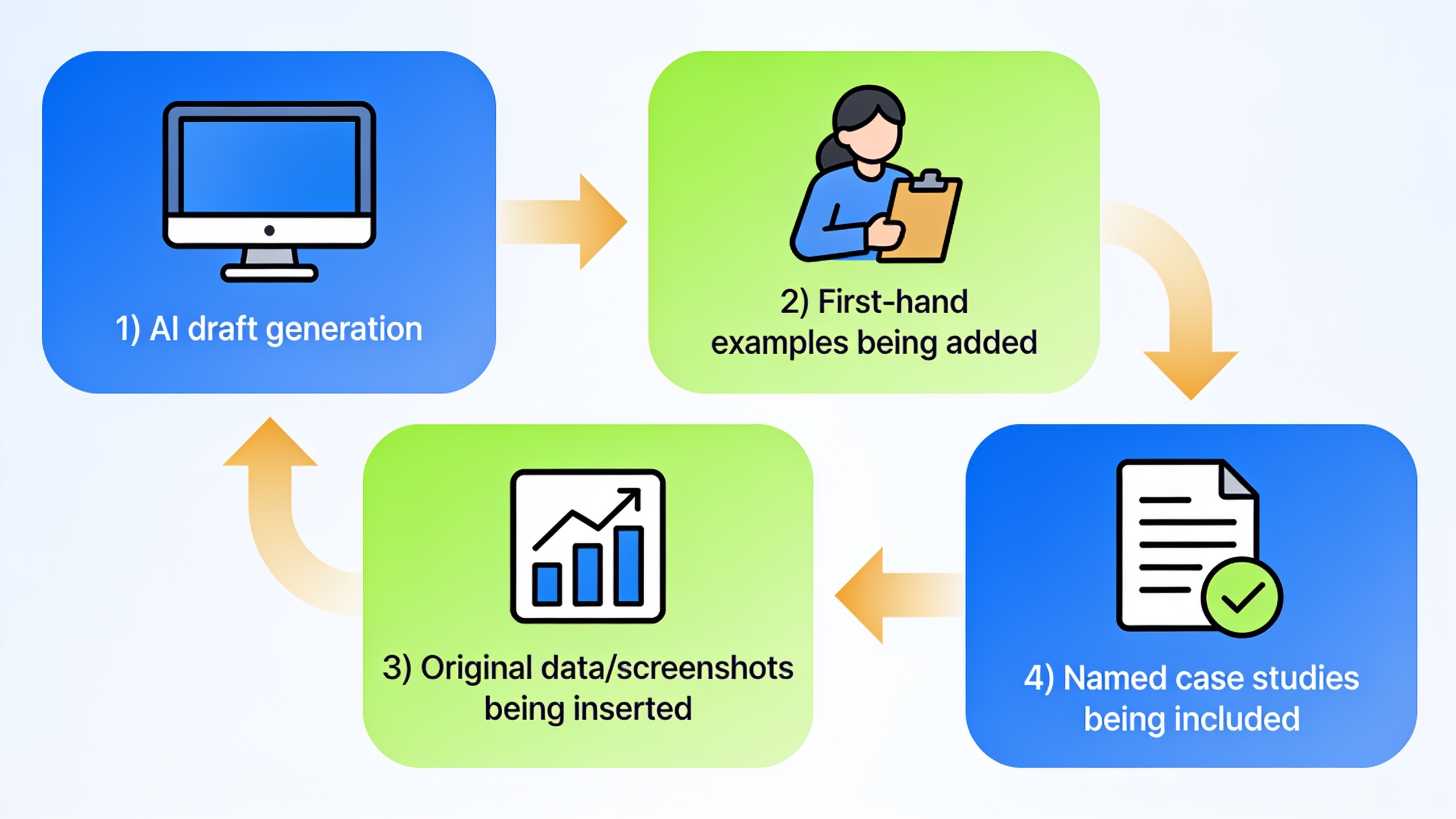
A few things that genuinely work here. Add a "what we tested" section whenever you're covering a tool, method, or product, and get specific about what happened, what caught you off guard, and the actual numbers (something like "we ran this prompt structure across 40 client articles over 90 days and watched average time-on-page climb from 1:12 to 2:04"). Swap out lazy phrasing like "many businesses have found success with..." for a named company, campaign, or client result you've got permission to publish. Build a chart from your own analytics, because a homegrown data visualization is evidence a model can't fake convincingly. Attribute a quote, even two lines, to a real in-house strategist or client. And this one's underrated: describe the edge cases and the failures. AI content is relentlessly, suspiciously upbeat. Real practitioners know exactly where a method falls apart, and saying so out loud reads as authentic instantly.
This is also, honestly, where a lot of content teams bleed out slowly. As I got into over in 5 content marketing mistakes that are quietly wrecking your SEO, publishing advice that's technically correct but experientially hollow is one of the fastest ways to flatline your organic growth, even if you're cranking out posts constantly.
Building Expertise Signals Into an AI Content Workflow
Expertise signals are the credentials, the precise terminology, and the depth that prove a real qualified human made or checked the piece. For AI content, that means bolting a defined human expertise layer onto your workflow at one or more points: sourcing, drafting, review, or publication. Somewhere a real expert has to touch it.
Google's rater guidelines get especially twitchy about "Your Money or Your Life" topics, which is their term for health, finance, legal, and safety content. The expertise bar there is sky-high because bad information can actually hurt people. For YMYL stuff, expert review isn't a suggestion. It's the line between content that can rank and content that gets algorithmically strangled no matter how polished the prose.
So what does building expertise actually look like in practice?
- Assign a subject-matter reviewer. Every AI-drafted piece, and definitely anything technical or YMYL, should get checked by a named human with real credentials or professional experience before it publishes.
- Fact-check every specific claim. Every number, stat, date, and cited source the AI spat out needs verifying against a primary source. Models are famous for inventing citations that sound totally legit and are completely made up.
- Use precise, correct terminology. AI drafts love language that's approximately right. An actual expert catches the subtle wrongness that a casual reader (or an algorithm) might glide past but that makes informed readers cringe.
- Add author bios with real credentials. A visible byline with actual background, years in the field, certifications, past roles, strengthens the expertise signal for readers and raters alike.
- Update on a schedule. Expertise goes stale. Set a recurring review cadence, usually every 3 to 6 months for fast-moving topics like SEO or AI, and clean out the outdated claims.
Want content like this running on autopilot for your own site? Try RobinRank free — AI-written, SEO-optimized articles generated and published automatically, no credit card required.
AI Content Quality Depends on the Review Layer, Not Just the Model
Here's a myth I'd like to kill. People assume content quality is mostly about which model wrote the draft. It isn't. Output quality is shaped way more by everything wrapped around the model: the prompts, the sources you feed in, the fact-checking discipline, the editorial standards you actually enforce. Two teams can use the exact same model and land in completely different quality universes based on nothing but their review process. The model is the cheap part. The workflow is where it's won or lost.
Establishing Authority for AI Content at Scale
Authority shows up when other credible sources, websites, publications, experts, platforms, start treating your content or brand as a reliable reference point. Usually that means backlinks, citations, and mentions from reputable sites. And for AI content published at volume, you have to earn this stuff on purpose. It does not just pile up because you're posting more often. If only.
According to Ahrefs' 2023 analysis of ranking factors, the number of unique referring domains pointing to a page is still one of the strongest correlates with higher organic rankings across the dataset they studied. That's a big deal for AI content programs. Publishing volume without a parallel plan to earn or exchange links tends to produce pages that flicker into the rankings and then vanish, because your domain never built up the external validation search engines lean on as an authority stand-in.
So how do you actually build authority around an AI content operation? Publish original research or data, even a tiny internal dataset like survey results or product usage stats, because that gives other sites a reason to cite you, which a rehashed "best practices" listicle never will. Get involved in a natural backlink network, earning links from relevant, topically-aligned sites in context rather than buying them by the truckload. Structure your pages to get pulled by AI answer engines like ChatGPT, Gemini, and Perplexity, which increasingly cite content with clear definitions, data points, and named sources. Stay topically consistent, because sprawling across unrelated subjects dilutes your authority while a focused content cluster concentrates it. And chase guest mentions and expert quotes, since being quoted elsewhere is something AI-only operations basically can't fake.
Trust Signals That AI Can't Fake
Trustworthiness comes from transparency: who made the content, how they made it, whether the info is accurate, and whether the sourcing is actually verifiable. And no model on earth can manufacture genuine trust, because trust is fundamentally a relationship between a reader and an accountable, named source. This is the pillar unsupervised AI publishing threatens most directly. It's also, thankfully, the most fixable, because most of the fixes are just editorial policy.
Every AI content program needs a handful of trust basics locked down. Have an AI disclosure policy, even a short note on an editorial page, because being upfront about using AI builds credibility rather than wrecking it (readers and search engines both prefer honesty to hiding). Put clear author and editorial attribution on everything, ideally linked to a bio page with credentials. Cite a source for every factual claim, meaning stats and studies link to or name where they came from, not just a number that "feels about right." Keep publish and update dates accurate, since both humans and algorithms use them to judge freshness, and never fudge them. Run secure, professional infrastructure: HTTPS, real contact info, a privacy policy, an about page. The rater guidelines name these explicitly. And keep a visible correction policy, because a track record of fixing errors signals the kind of accountability pure AI output simply can't demonstrate.
A Practical E-E-A-T Checklist for AI Content Teams
Before you publish any AI-assisted piece, running it through a structured checklist is the fastest way to catch E-E-A-T gaps that would otherwise only announce themselves via a nasty ranking drop weeks later. Here's the checklist I'd use, ordered so it actually fits a workflow.
| Pillar | Checklist Item | Who's Responsible |
|---|---|---|
| Experience | Includes at least one first-hand example, test, or case detail | Editor / SME |
| Experience | Contains original data, screenshot, or visual not available elsewhere | Editor / SME |
| Expertise | Fact-checked against primary sources | Fact-checker |
| Expertise | Reviewed by a named subject-matter expert (especially YMYL) | Reviewer |
| Authority | Links out to credible, relevant sources | Writer / Editor |
| Authority | Fits within a topical content cluster on the site | Content strategist |
| Trust | Author bio and credentials visible | Publisher |
| Trust | AI use disclosed per editorial policy | Publisher |
| Trust | Publish/update date accurate and visible | CMS / Publisher |
Teams that push every AI draft through something like this consistently report fewer factual errors and stronger early rankings than teams that publish straight from the model. Mostly because the checklist forces the human accountability layer into the process, which is exactly the thing Google's guidelines are built to notice when it's missing.
How RobinRank Approaches E-E-A-T AI Content
RobinRank is built on a pretty simple bet: AI should do the mechanical grind of drafting, optimizing, and publishing, while the platform's structure quietly protects the human trust signals that both search engines and readers care about. Instead of spraying generic filler everywhere, the approach leans toward structured, well-sourced articles that slot into a coherent topical strategy, and it pairs that with a natural backlink exchange network so new content actually has a shot at earning the external authority signals we talked about earlier.
If you're an SEO pro, an agency, or a founder running content without a full in-house team, the useful thing to understand is that content quality and E-E-A-T compliance aren't rivals. They're the same goal seen from different angles. A platform-level workflow that enforces structure, sourcing, and topical clustering by default takes a lot of the manual checklist weight off your shoulders, while still leaving room for the human review layer, the expert quotes, the real examples, the editorial oversight, that no automation should ever fully skip.
Frequently Asked Questions
Will using AI to write content automatically tank my rankings?
No. Google has said this over and over: its ranking systems judge quality and helpfulness, not the method behind the text. AI-assisted content can rank great if it shows real expertise, accuracy, and value. Thin, unoriginal, or inaccurate content can rank terribly whether a human or a machine wrote it.
How do I add "experience" to a topic I've never personally lived through?
Borrow someone who has. If you're covering ground outside your own experience, interview a practitioner, cite a documented case study (with permission), or run a small original survey or test. The point is to tie the content to a real, specific source of first-hand knowledge instead of leaning on the AI's fuzzy general description.
Should I actually disclose that AI helped write an article?
Yeah, generally. Do it through an editorial or AI-use policy page rather than slapping a disclaimer on every single post. Being transparent about how you make content is itself a trust signal, and Google's guidelines favor honest disclosure over trying to hide AI involvement, which tends to blow up in your face if it ever comes out.
What's the quickest way to find E-E-A-T gaps in my existing AI content?
Audit for four things. Does each article cite verifiable sources? Does it include any first-hand example or original data? Is a named human credited as author or reviewer? And is the info still current? Any page missing two or more of these jumps to the front of the rewrite-or-review line.
Is E-E-A-T a direct Google ranking factor?
Not exactly. E-E-A-T isn't a single isolated factor with its own little algorithmic score. It's a framework in Google's Search Quality Rater Guidelines used to train and evaluate the systems that do move rankings, especially the helpful content system. But the underlying signals it describes, accurate sourcing, real expertise, credible authorship, site trustworthiness, correlate strongly with the pages Google's algorithms actually reward. So in practice, chasing E-E-A-T and chasing rankings point you in the same direction.
---
E-E-A-T for AI content isn't a box you tick once and forget. It's an ongoing editorial habit, and it's the thing that separates content shops built for a quick traffic spike from the ones built to grow for years. The businesses genuinely winning with AI tools right now? They're not the ones publishing the most. They're the ones pairing automation with real sourcing, expert review, and transparent publishing, giving both readers and search engines an honest reason to trust what they put out.
Ready to stop writing content by hand? Start your free RobinRank trial and get a full month of SEO-optimized articles published on autopilot.