Case Study: How a Legal Services Firm Tripled Organic Leads

What follows is a composite example. It's stitched together from patterns I've seen play out again and again when legal firms pair automated content publishing with a keyword strategy that actually has some discipline behind it. Names and identifying details are generalized, because confidentiality matters in this space, but the strategy, the timeline, and the decisions along the way all reflect what real content and SEO teams do in regulated, trust-heavy industries like law.
I'm going to walk through where the firm started, which keywords actually moved the needle, the publishing rhythm that made the difference, and the two things that nearly blew the whole thing up. If you run marketing for a law firm, work at an agency serving legal clients, or you're just trying to figure out whether automated publishing is worth the risk in a compliance-sensitive niche, this is meant to be useful. Not a victory lap.
Table of Contents
- What Does This Legal Industry SEO Case Study Actually Show?
- The Firm's Starting Point: Traffic, Leads, and Content Gaps
- The Keyword Strategy Behind the Organic Leads Growth
- How Automated Content Publishing Changed Content Velocity
- Timeline of Results: An Eight-Month Breakdown
- What Made the Strategy Work — and What Nearly Derailed It
- How Other Legal Services Firms Can Apply This Case Study
- FAQ
What Does This Legal Industry SEO Case Study Actually Show?
The short version: consistent, topic-clustered content plus keyword targeting that actually matches search intent can take a law firm from random blog posts to a predictable stream of organic leads in about six to nine months. That's it. No magic.
The firm in this example was a mid-sized personal injury and family law practice covering two metro areas. They went from publishing roughly one article a month to three to five optimized articles a week. And their organic leads (form submissions plus call-tracked phone calls) climbed from a baseline around 40 per month to about 120 per month by month eight.
What's interesting is that none of this came from a single viral post or a paid campaign. It came from volume plus specificity. The firm covered the long tail of questions people actually type into Google before they ever get around to searching "personal injury lawyer near me," and they did it consistently enough that Google started treating the site as a genuine authority for those practice areas in that region. That compounding effect, where broad coverage of specific low-competition questions eventually builds up your authority on the big competitive terms, gets unpacked more in this piece on long-tail keywords as an overlooked path to faster organic growth. It's worth a read if you're skeptical that niche queries can out-convert the broad ones firms obsess over.
The Firm's Starting Point: Traffic, Leads, and Content Gaps
Before any of this started, the firm had a website that worked fine but was barely earning its keep. Solid core practice-area pages. Decent local citations. And almost nothing answering the questions clients ask before they're ready to pick up the phone.
This is such a common gap it's almost boring to point out. Firms pour money into the "money pages" (practice areas, attorney bios) and then leave the informational layer basically empty. Which means Google has no reason to rank them for the dozens of specific questions that come before a legal search.
Here's what the site looked like at the start. Roughly 35 indexed pages, most of them service pages, attorney bios, and a thin little "resources" section. Around 40 organic leads a month. A blog that got updated whenever someone remembered it existed, sometimes once a month, sometimes not for a full quarter. And no real internal linking to speak of, so related legal topics just sort of floated around disconnected from each other.
| Metric | Before Campaign (Month 0) | After Campaign (Month 8) |
|---|---|---|
| Monthly organic leads | ~40 | ~120 |
| Indexed content pages | ~35 | ~180 |
| Ranking keywords (any position) | ~210 | ~1,450 |
| Keywords ranking in top 10 | ~18 | ~140 |
| Publishing cadence | ~1 article/month | 3-5 articles/week |
| Organic sessions/month | Baseline (indexed to 1x) | Roughly 3.1x baseline |
The thing to understand is that the problem was never legal expertise. These attorneys had plenty to say. What they didn't have was a system to capture that expertise and turn it into content search engines could find. That's the gap automated content publishing was brought in to fill.
The Keyword Strategy Behind the Organic Leads Growth
The keyword strategy came down to three tiers: high-intent transactional terms, mid-funnel comparison and process terms, and a big fat base of long-tail informational questions specific to each practice area and jurisdiction. A tier is just a way of grouping searches by how close someone is to actually hiring a lawyer. Transactional terms convert fastest but are the bloodiest to compete for. Informational terms convert slower per visit, but there are way more of them and hardly anyone's fighting over them.
So instead of only chasing the obvious "[practice area] + [city]" terms, where you're going up against directory giants and the biggest firms in town, the team mapped out what clients actually ask at each stage of a legal problem. Things like "what happens after a car accident if the other driver has no insurance," or "how long does a custody modification take in [state]," or "do I need a lawyer for a small workers' comp claim." Individually, sure, only a handful of firms compete for each one. But add them all up and they represent a huge chunk of total legal search volume.
| Keyword Tier | Example Query Type | Competition Level | Role in Funnel |
|---|---|---|---|
| Transactional | "car accident lawyer [city]" | High | Bottom-of-funnel, direct conversion |
| Comparison/process | "personal injury settlement vs. lawsuit" | Medium | Mid-funnel, builds trust and clarifies options |
| Long-tail informational | "what to do if insurance denies my claim after a rear-end collision" | Low | Top-of-funnel, high volume in aggregate, feeds topical authority |

Roughly 70% of the content published over those eight months went to the mid- and long-tail tiers. The other 30% went toward beefing up the practice-area and location pages, which is where the conversions actually happened once the supporting content had built up enough topical trust. It's the same pattern I keep coming back to: long-tail queries look tiny on their own, but in aggregate they routinely beat head terms on both volume and conversion. The long-tail keyword growth strategy article I mentioned goes deeper on why.
Matching Content to Local and Practice-Area Intent
Legal search is intensely local, so every keyword got cross-referenced against the firm's actual service areas rather than being treated as generic national content. Take a question like "how does comparative negligence affect my settlement." Instead of writing one bland explainer, the team published jurisdiction-specific versions wherever the underlying law differed by state.
This matters more in law than almost anywhere else. Statutes and procedural rules vary, and generic legal advice content doesn't just perform badly in search. It can actually create accuracy risk for the firm. Not a great look.
How Automated Content Publishing Changed Content Velocity
Automated content publishing is just using AI-assisted writing and scheduling tools to plan, draft, optimize, and publish articles at a pace you couldn't realistically keep up by hand. For this firm, going from one article a month to three to five a week was the single biggest lever in the whole campaign. Search engines reward steady topical coverage over time way more than they reward the occasional heroic burst of content.
And the bottleneck was never ideas. The attorneys had years of client questions from consultations sitting right there. The bottleneck was production. Legal content also carries this extra layer of friction most industries don't deal with: every single article needs an accuracy check against current law. If each piece has to be written from scratch by a non-specialist and then heavily rewritten by an attorney, your output grinds to a crawl.
The workflow that actually held up looked like this:
- Attorneys and the marketing lead kept a running list of client questions and topic gaps, sorted by practice area
- An AI-assisted publishing workflow drafted structured, SEO-optimized articles against that list, matching intent and internal linking patterns
- A designated reviewer (a paralegal working closely with the attorneys) checked every draft for legal accuracy before it went live
- Articles got linked to the relevant service page, and internal links were added back into older posts as new supporting content went up
Want content like this running on autopilot for your own site? Try RobinRank free — AI-written, SEO-optimized articles generated and published automatically, no credit card required.
This split, where AI handles structure and drafting and optimization while humans handle the accuracy review, lines up with how the whole AI SEO software category is being used across regulated industries in 2025. There's a good breakdown of that in this industry report on the state of AI SEO software, which digs into adoption patterns and where firms are drawing their lines between automation and human oversight.
Let me be blunt about one thing. Platforms like RobinRank, which automatically write, optimize, and publish articles and also plug your site into a manually reviewed backlink exchange network, are built for exactly this kind of consistent-output, human-in-the-loop workflow. But that accuracy review step? In a field like law it still needs a qualified human. Automation kills the writing bottleneck. It does not, and cannot, take over your compliance responsibility.
Timeline of Results: An Eight-Month Breakdown
The results here did not show up in a nice straight line. They followed the pattern you always see with content-driven SEO: a slow, frustrating first quarter, a visible turn somewhere around month four or five, and then compounding growth after that. The lag is completely normal. New content needs weeks just to get crawled, indexed, and evaluated before it ranks, and topical authority builds up gradually rather than switching on overnight.
Months 1–2: Foundation and the indexing lag. Cadence ramped up to 3-4 articles a week, mostly the long-tail informational stuff. Organic leads barely budged (38-45 a month) because most of the new content simply hadn't been indexed long enough to rank yet. Indexed pages grew from 35 to about 70.
Months 3–4: Early movement. Some of the long-tail articles started showing up on page one for the low-competition queries. Total ranking keywords roughly tripled from baseline. Leads ticked up to around 55-65 a month, mostly from content that answered a question and then funneled the reader to a practice-area page through internal links.
Months 5–6: The inflection point. This is where it got fun. With over 100 supporting articles live and internally linked, several core practice-area pages started climbing for competitive mid-funnel terms, almost certainly riding the topical relevance signal from all those dozens of related, well-linked pages. Leads jumped to roughly 85-95 a month.
Months 7–8: Compounding. By now the site had about 180 indexed pages and around 140 keywords ranking in the top 10, up from just 18 at the start. Organic leads hit roughly 110-120 a month, about triple the starting baseline of 40. And here's a detail the raw numbers miss: the intake team said lead quality got better too, because so much of the long-tail content pre-qualified visitors by answering their specific situation before they ever filled out a form.
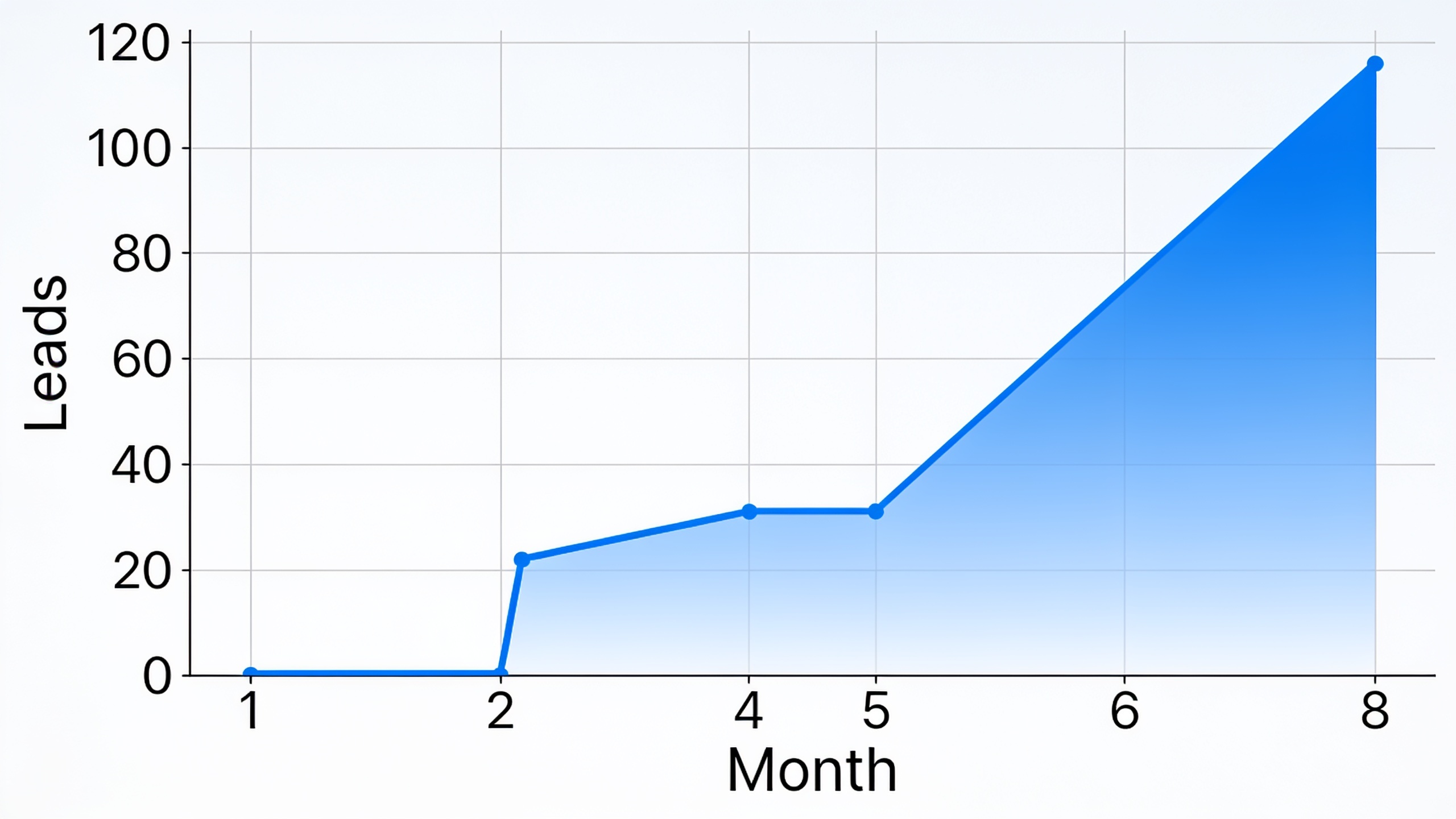
Flat, then inflection, then compounding. Anyone judging an SEO program at the 60-day mark, right in the middle of the flat part, is setting themselves up to kill a strategy that would've worked. This is honestly one of the most common reasons legal marketing teams give up on content that was about to pay off.
What Made the Strategy Work — and What Nearly Derailed It
The whole thing worked because of consistency and specificity. But it nearly died twice. Once over accuracy risk in AI-drafted legal content, and once over an internal linking structure that was too shallow to actually pass topical signals between pages.
The accuracy problem came first. Early drafts sometimes stated general legal principles without the jurisdiction-specific caveats that really matter in law. Describing a statute of limitations window, for example, without noting that it varies by state and by claim type. That kind of thing is a genuine liability, not just a quality ding. The fix wasn't some fancy tool. It was procedural: no article went live without a named human reviewer checking it against current statutes and the firm's own guidance, and everything got tagged by jurisdiction instead of published as generic national advice. That one change cut revision cycles way down after the first month.
The shallow internal linking was the second issue. For the first two months, new articles were linking to the homepage or a generic "contact us" page instead of the most relevant service page or related article. Which basically diluted the topical authority the content was supposed to be building. Once the team restructured everything into proper topic clusters, grouping all the car-accident content together and linking it densely to the personal injury service page, rankings for those connected pages improved noticeably within the next ranking cycle.
A few things that just worked from day one, though:
- Treating long-tail, low-competition questions as the foundation, not an afterthought
- Publishing at a real volume (3-5 a week) so topical clustering could actually happen in a reasonable window
- Keeping a human legal reviewer on every single piece, no matter how fast things were moving
- Measuring leads as the north star, not traffic or rankings
How Other Legal Services Firms Can Apply This Case Study
Any legal firm can steal the core mechanics here. Long-tail keyword mapping, high-frequency publishing, disciplined human review. That applies regardless of practice area. The timeline and the specific keyword openings will vary with how competitive your local market is, though. A personal injury firm in a huge metro fighting dozens of rivals should expect a longer runway to page one on transactional terms than a firm in a mid-sized market, even running the exact same playbook.
If you're thinking about trying this, here's where I'd start.
Start with your intake team's question log. The questions clients ask in consultations are usually the exact long-tail queries they Googled before calling. It's the fastest way I know to build a keyword list grounded in real intent instead of guesswork.
Separate drafting speed from accuracy review. Automated tools can crank up your output enormously, but a qualified reviewer needs to check every legal claim before it publishes, especially anything about deadlines, statutes, or jurisdiction-specific procedure. Don't cut this corner.
Cluster content around service pages, not around the blog in isolation. Your internal links should funnel authority toward the pages that actually convert.
Expect a lag, and measure leads over a full quarter instead of two weeks. That flat month 1-2 period in this case study is normal. It's not a sign anything's broken.
And pair your content with a link-building layer. Content alone builds topical relevance, but earning links from other legitimate, relevant sites (the kind of manually reviewed, verified backlink exchange platforms like RobinRank facilitate) adds the authority signal that helps your competitive practice-area pages finally break past page two.
FAQ
How long before a law firm's SEO content actually starts producing organic leads?
Going by patterns like this one, most firms should brace for a slow first two to three months while content gets indexed and evaluated, with real movement in rankings and leads usually kicking in around months four to six and compounding from there. Expecting meaningful lead growth inside 60 days is, frankly, unrealistic for organic content.
Is it actually safe to use AI-generated content on a law firm site, given all the accuracy and compliance stuff?
Yes, as long as every article passes through a qualified human reviewer before it publishes, especially anything touching statutes, deadlines, or jurisdiction-specific procedure. The risk was never the drafting tool. It's skipping the review step, which is the exact process failure that nearly wrecked this case study's early content.
Should a law firm chase high-competition terms first, or long-tail questions?
Long-tail, specific questions are almost always the smarter starting point. They face less competition and rank faster, and they build the topical authority and internal link structure that later helps your competitive, high-intent terms climb too. This firm put roughly 70% of its content into the long-tail and mid-funnel tiers before those gains started feeding stronger performance on transactional keywords.
How many articles a week does a firm need to publish to see real growth?
There's no magic number, but this firm went from about one a month to three to five a week and hit its inflection point around months five and six. The lesson isn't the exact count, it's that consistent, higher-frequency publishing sustained over months beats sporadic bursts every time.
Does content-driven lead growth improve lead quality, or just the volume?
In this case, the intake team reported that quality got better alongside volume, mostly because the long-tail content pre-qualified visitors by answering their specific situation before they ever hit submit. It's not a guarantee, but it's a pretty commonly reported side effect of intent-matched content.
Legal marketing rewards patience and precision more than almost any industry I can think of. The firms that win organic search are the ones willing to answer the small, specific questions consistently, month after month, not just the ones brawling over the obvious head terms. And the mechanics behind tripling organic leads here really aren't exotic. A clear keyword tier structure, a publishing cadence you can actually sustain, and a human accuracy check that never once got skipped, even as the volume climbed. That's the whole game.
Ready to stop writing content by hand? Start your free RobinRank trial and get a full month of SEO-optimized articles published on autopilot.