Content Agency Case Study: How One Agency Scaled Output by 5x with AI

They went a different route. Using RobinRank, an AI-powered SEO content platform, they pushed their monthly article output from about 40 pieces to over 200. That's a 5x jump. And they did it without hiring a single new full-time writer. This case study walks through how they pulled it off, and honestly, if you run an agency or lead an in-house content team, you've probably felt this exact squeeze.
The agency's a 14-person shop juggling 22 mid-market clients across e-commerce, B2B SaaS, and local services. Nothing exotic. Their problem wasn't exotic either. Their writers were good, but each one could realistically crank out maybe two or three properly researched articles a week. That's it. And that ceiling? It's probably the single most common thing holding content agencies back right now.
Table of Contents
- The Bottleneck: Why Content Agencies Struggle to Scale
- Why Did This Agency Choose AI Content Scaling Over Hiring?
- Inside the RobinRank Implementation
- The 90-Day Rollout Timeline
- The Results: Output, Quality, and Revenue
- Before-and-After Metrics Table
- Lessons Learned and What They'd Do Differently
- Frequently Asked Questions
The Bottleneck: Why Content Agencies Struggle to Scale
Most content agencies stall out not because they run out of clients, but because their whole production model is stuck in a straight line: output only grows as fast as you can hire, and hiring is slow and expensive. This particular agency was pushing out around 40 articles a month with six writers and two editors. Do the math and each writer was on the hook for roughly six or seven articles a month once you factor in research, drafting, revisions, and internal review. Which, if you've ever written to a deadline, you know is already a lot.
And the numbers just wouldn't stretch to fit growth. Every new client meant either spreading the existing writers thinner (hello, burnout and slipping quality) or hiring someone new. Their finance lead pegged the average new hire at 6 to 8 weeks from job posting to actually being productive, plus a 90-day ramp before that person matched a seasoned writer's output. Meanwhile, three prospective clients were sitting in the pipeline asking for a combined 60-plus extra articles a month. According to the agency's own internal cost modeling, hiring for all that would've crushed their margins by an estimated 18 to 22%.
This is exactly the spot where AI content scaling has started to change the calculus. The idea's simple enough: let generative AI handle the research, drafting, and optimization grind that used to eat most of a writer's day, and let the humans focus on the stuff machines are bad at. Strategy. Brand voice. Catching the thing that's technically accurate but reads wrong. Instead of grinding through content one article at a time, agencies are rebuilding their workflows so AI does the first 70 to 80% of the heavy lifting and people handle the rest.
Why Did This Agency Choose AI Content Scaling Over Hiring?
They chose AI content scaling because it let them add capacity in weeks instead of months, for a fraction of what hiring would've cost, without giving up editorial control. That last part matters. AI content scaling just means using automated tools to research, draft, optimize, and sometimes publish articles at a speed no human team could match, while still keeping editors in the loop to review and polish before anything goes live.
Before committing, the operations director looked at three options.
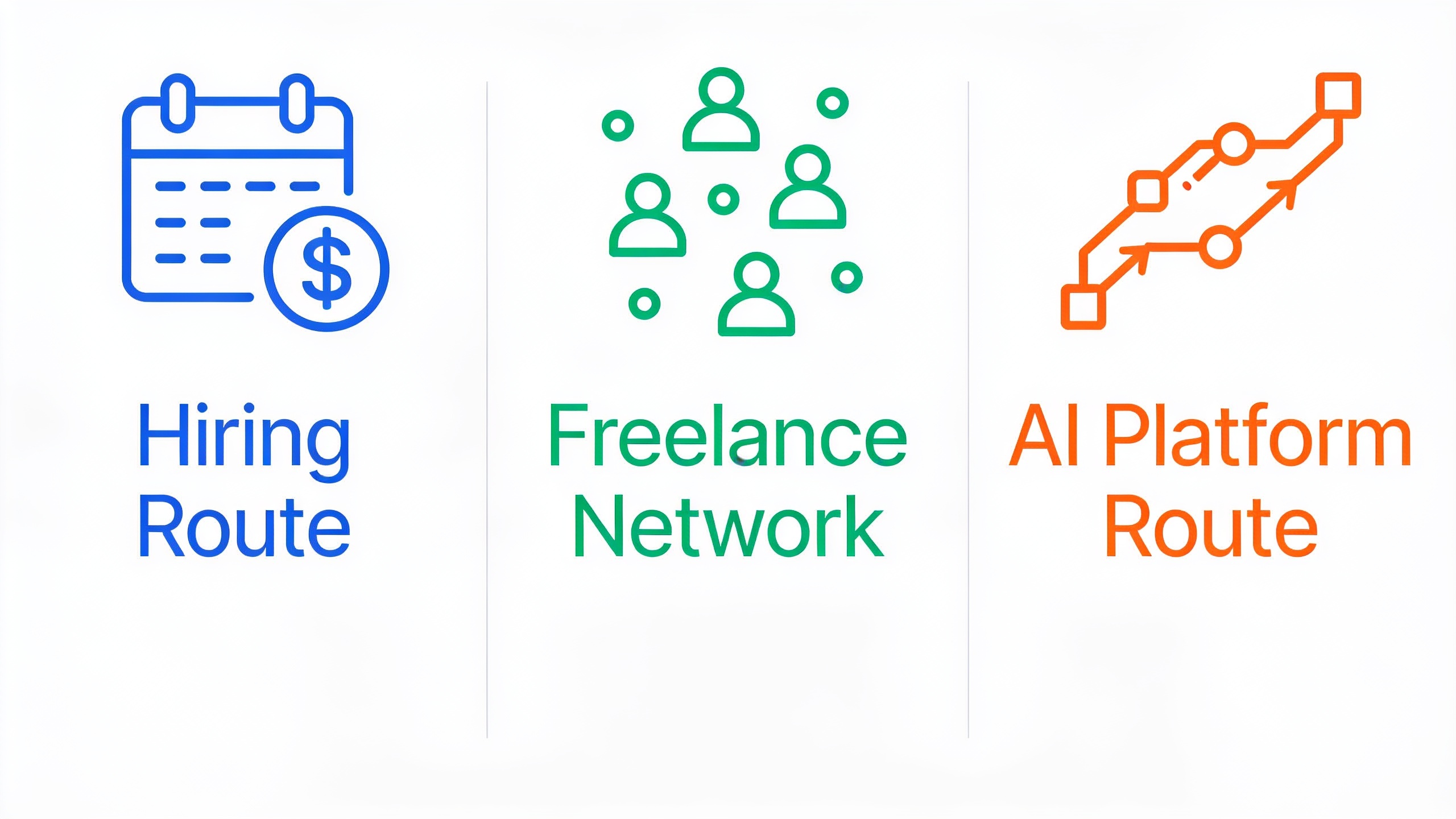
The first was traditional hiring. Two more writers would've tacked on somewhere between $95,000 and $110,000 in annual salary and benefits, and that's before you count the recruiting time and the ramp-up lag. All that, and they still wouldn't have hit their 60-article monthly target for months.
The second was building out a freelance network. Faster to scale, sure, but a nightmare to keep consistent. Getting dozens of freelancers to nail brand voice and SEO structure across every piece is genuinely hard, and per-word rates would've eaten the margins anyway.
The third was AI-assisted production through RobinRank. Lower cost per article, faster ramp, and, this was the clincher, built-in SEO optimization and publishing automation that took a big chunk of the boring formatting, internal linking, and metadata work off the editorial team's plate.
They didn't just dive in headfirst, though. They ran a four-week pilot on a single client account first. During that trial, RobinRank cranked out first-draft articles with keyword targeting, headings, and on-page SEO already baked in, and the editors just reviewed and lightly tweaked instead of writing from scratch. That pilot alone freed up about 30% of one writer's week, time they immediately funneled into onboarding a new client. Early proof the thing could actually scale. This whole "test on one account first" approach mirrors what happened in a related AI content case study on how a SaaS startup tripled organic traffic in six months, where a phased rollout came before full adoption too.
Inside the RobinRank Implementation
RobinRank is an AI-powered SEO platform that researches, writes, optimizes, and publishes articles built to rank, and it also links sites together through a natural backlink exchange network to help with off-page SEO. For this agency, it basically became a second production layer humming away underneath the human editorial team.
Setting Up Client-Specific Content Engines
Here's a smart move: instead of one generic content pipeline for everyone, they built a separate RobinRank workspace for each client. Every workspace got fed the client's brand guidelines, target keyword clusters, competitor URLs, and their best-performing existing content as reference. That meant the AI drafts came out sounding like the client from the very first pass, instead of needing a total gut renovation before they were usable.
For each account, the content strategist sat down with the client to lock in a few things: the target keyword clusters and search intent (informational, commercial, transactional), the article length and structure benchmarks based on whatever was ranking at the top, the brand voice guides plus any phrasing or claims that were off-limits, and the internal linking priorities pointing to existing cornerstone content.
Redesigning the Editorial Workflow
And honestly, the biggest change wasn't the AI at all. It was rethinking how editors spent their hours. Before, writers were burning something like 60% of their time on research and first drafts, with editors picking up the rest on structural revisions. After the switch, RobinRank took over research and first-draft generation, and the human team's attention shifted almost entirely to fact-checking, calibrating brand voice, and sharpening keyword strategy.
The agency wrote this workflow shift up internally and shared it with peers, and it lines up with the broader advice in how marketing agencies can scale client SEO with AI. The gist? The agencies winning big aren't the ones firing their editors. They're the ones pointing editorial time at higher-value oversight instead of grunt work.
Quality Control Checkpoints
To keep clients from panicking, they set up a three-stage quality gate. First, an automated SEO check ran RobinRank's built-in scoring for keyword placement, readability, and metadata. Then a human editor combed through each draft for factual accuracy, brand fit, and the kind of nuance software just misses. Finally, for retainer clients who needed to approve things, a streamlined review link went out before anything published.
Want content like this running on autopilot for your own site? Try RobinRank free — AI-written, SEO-optimized articles generated and published automatically, no credit card required.
So even with AI doing the grunt work, nothing went live without a human looking at it. That's a point the agency hammered home every single time a client got nervous about the change.
The 90-Day Rollout Timeline
Going from 40 to 200-plus articles a month wasn't an overnight flip of a switch. They phased it over roughly 90 days, partly to manage quality risk and partly to keep clients calm.
The first two weeks were about expanding the pilot from one account to five, and they deliberately picked clients with clear keyword strategies and simpler brand voices. Low-hanging fruit, basically. Output climbed from 40 to about 65 articles that month.
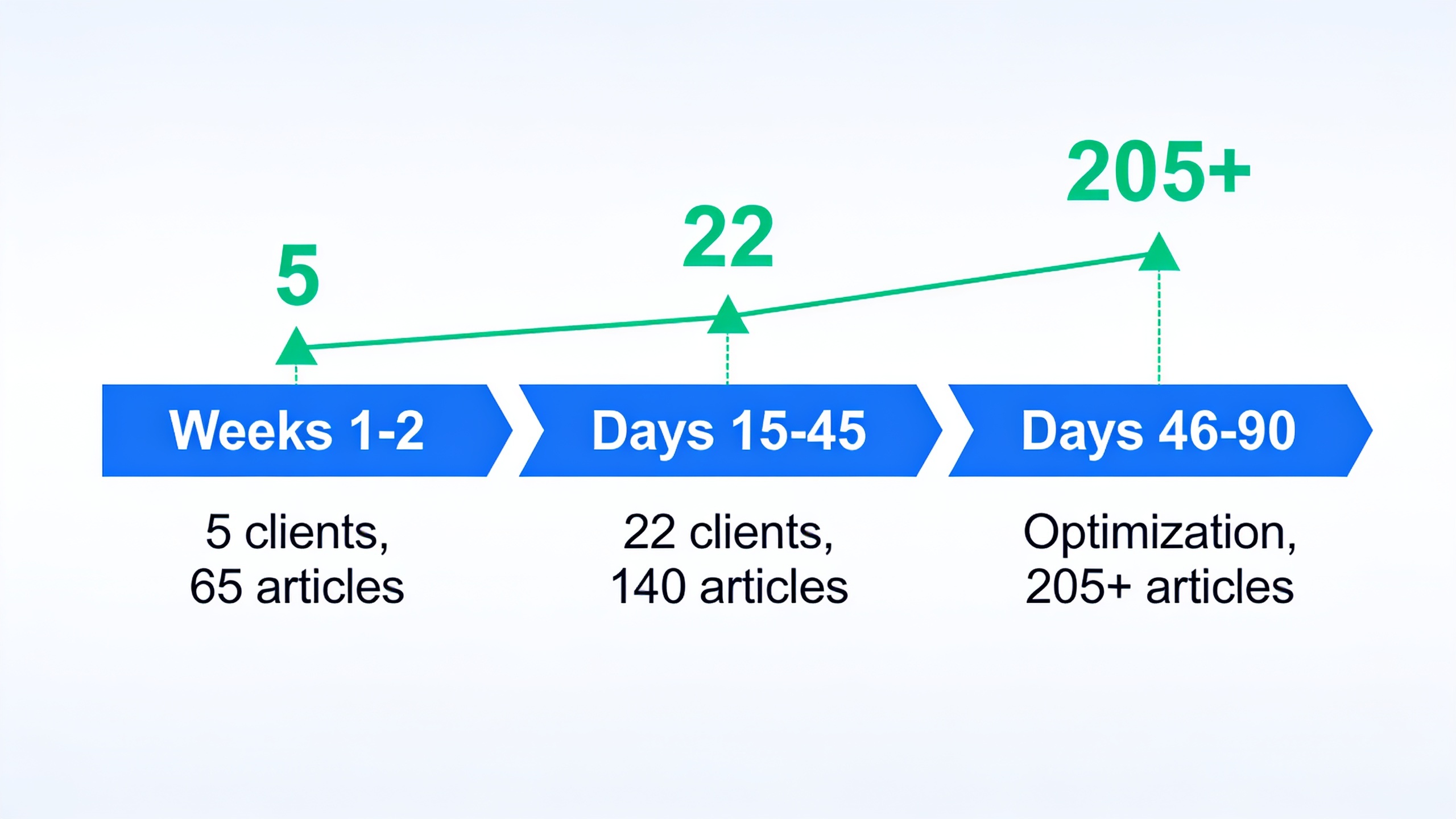
From day 15 to 45, they brought all 22 client accounts onto the platform, with strategists building out keyword clusters and reference materials for each one. This is also when two writers moved into "editorial lead" roles, overseeing AI-assisted output across multiple accounts instead of writing solo. By day 45, output hit around 140 articles a month.
The final stretch, days 46 through 90, was pure optimization. Refining prompts, tightening up reference materials, dialing in internal linking rules to cut down editor revision time. By day 90 they were reliably pumping out 205 to 215 articles a month, with editor revision time down to about 12 minutes per article. For comparison, that used to run 45 to 60 minutes. That's the real story hiding in the output numbers.
The Results: Output, Quality, and Revenue
The headline result is the one everyone remembers: from roughly 40 articles a month to over 200. A clean 5x, done in 90 days, with zero new writers on the payroll.
But volume means nothing if the quality tanks or the rankings die, so the agency tracked the downstream stuff over the next two quarters. Client retention held at 95%, with not a single client leaving over content quality during the transition. Average time-to-first-draft collapsed from about 3 days per article to under 4 hours. And their capacity to take on new work exploded. They onboarded 9 new client accounts across those two quarters, versus their old pace of 2 or 3 per quarter, and again, no new writers.
Revenue per employee jumped an estimated 34%, which makes sense when the same 14 people are supporting way more content and a bigger client roster. Organic traffic gains were messier to pin down since they varied by account and niche, but clients who kept a steady publishing cadence saw real bumps in indexed pages and organic sessions within two quarters. That tracks with what most SEO folks see when you crank up publishing frequency and stay consistent.
One more thing the account managers noticed: clients loved the faster turnaround. Especially the e-commerce ones who needed seasonal content on brutal deadlines, the kind of thing that would've been flat-out impossible under the old system.
Before-and-After Metrics Table
| Metric | Before RobinRank | After RobinRank (90 Days) |
|---|---|---|
| Monthly article output | ~40 articles | 200-215 articles |
| Writers on staff | 6 | 6 (no new hires) |
| Average time-to-first-draft | ~3 days | Under 4 hours |
| Average editor revision time per article | 45-60 minutes | ~12 minutes |
| Active client accounts | 22 | 31 |
| New clients onboarded per quarter | 2-3 | 9 (over two quarters) |
| Estimated revenue per employee | Baseline | +34% |
| Client churn during transition | N/A | 0% attributed to content quality |
Fair warning: these are internal agency numbers, not a third-party audit. But they paint a pretty clear picture of what's possible when you roll out AI content scaling with intention and keep editorial oversight in the mix instead of tossing it out.
Lessons Learned and What They'd Do Differently
If there's one takeaway here, it's this: AI content scaling works best as an upgrade to your editorial workflow, not a replacement for it. The leadership was refreshingly honest that their first assumption, that AI would basically make writers unnecessary, was flat wrong. The truer version is that AI killed off the most tedious, lowest-judgment parts of writing, which freed the humans up for the parts that actually take expertise.
A few lessons really stuck.
Client communication turned out to matter way more than they expected. A bunch of clients immediately asked whether "AI-written content" would tank their rankings or wreck their brand. The agency got ahead of it by walking through the three-stage quality gate and, in some cases, showing side-by-side comparisons of the raw AI draft next to the polished, human-edited final. Seeing the difference usually settled the nerves.
Reference material quality basically determined output quality. Full stop. Accounts where the strategist put in the upfront work building detailed keyword clusters, competitor analysis, and brand voice guides got dramatically better first drafts than the accounts where setup got rushed. So now they treat that setup phase as non-negotiable, usually 4 to 6 hours of strategist time per new client before any AI production kicks off.
And the editorial roles evolved instead of vanishing. Two writers grew into "AI content lead" roles, running quality and strategy across multiple accounts rather than grinding out articles solo. That created a career path the agency never had the bandwidth to offer before, which, bonus, helped keep people from leaving.
If they could rewind, they'd start the pilot with a more mixed bag of client types. The ops director admitted that testing only on simple, low-complexity accounts meant they didn't learn how the platform handled gnarly, technical B2B content until later, a gap they had to scramble to close during the day 15-45 rollout instead of dealing with it early.
For anyone watching this and wondering if it'd work in their own niche, the pattern seems to hold up: teams that pair AI first drafts with structured human review keep reporting faster timelines without the quality nosedive everybody's afraid of.
Frequently Asked Questions
What does it actually cost an agency to set up AI content scaling like this?
It depends on how many clients you've got and which pricing tier you land on, but the core logic in this case was dead simple. The RobinRank subscription cost way less than the fully loaded cost of even one new writer, while producing the output of several. If you're weighing this, compare the platform cost against what hiring actually costs you (salary, benefits, onboarding, management overhead), not just against freelance per-word rates. The freelance comparison misses too much.
Did the agency lose any clients by switching to AI-assisted content?
Nope. Zero client churn tied to content quality across the 90-day rollout and the two quarters after. Keeping a human editorial review on every article and being upfront with clients about the process changes did most of the heavy lifting on retention.
How fast did they see results after starting with RobinRank?
Pretty fast. Output improved within the first two weeks of the pilot, more than tripled by day 45, and hit the full 5x by day 90. The slower-burn stuff, like new client wins and the revenue-per-employee jump, showed up over the following two quarters.
Can a smaller agency or a solo marketer pull this off too?
Yeah, directionally. This was a 14-person agency with 22 clients, but the underlying workflow, using AI for research and first drafts and then applying focused human review, scales down just fine for solo operators and small teams. The time savings on research and drafting hold up regardless of size. Your absolute output numbers will just be smaller.
Does AI-generated content actually rank in search?
Search engines mostly care whether content is accurate, useful, and good for readers, not how it got made. This agency found that AI-assisted articles that went through real editorial review and proper SEO performed right alongside traditionally written pieces, as long as the content was well-researched and genuinely useful instead of thin and repetitive.
---
If there's a bigger trend hiding in all this, it's that the real bottleneck on agency growth has quietly shifted. It's not raw writing capacity anymore. It's editorial oversight capacity, and platforms like RobinRank are built specifically to attack that gap. The agencies that'll scale without torching the client trust that keeps contracts renewing? They're the ones treating AI as a research-and-drafting engine while keeping their strategists and editors firmly in the driver's seat.
Ready to stop writing content by hand? Start your free RobinRank trial and get a full month of SEO-optimized articles published on autopilot.