Content at Scale vs RobinRank: Pricing, Features, and Verdict
This is written for the people actually making the call: SEO folks, content marketers, founders, small business owners, agency people trying to figure out where the content budget should go in 2025. We'll get into how much each one automates, whether the output is any good, what it costs, and the backlink stuff. And where each tool genuinely earns its keep.
Table of Contents
- What Are Content at Scale and RobinRank?
- Content at Scale vs RobinRank: Core Feature Comparison
- How Much Do Content at Scale and RobinRank Cost?
- Automation Depth: Who Actually Publishes On Autopilot?
- Content Quality and SEO Results
- Backlinks and Off-Page SEO
- Which Tool Fits Your Team?
- Frequently Asked Questions
What Are Content at Scale and RobinRank?
Content at Scale is an AI writing platform built to spit out long, human-sounding blog posts that don't trip AI detectors. RobinRank is an end-to-end AI SEO platform that writes, optimizes, publishes, and builds backlinks for you, no content team required. That distinction matters more than it sounds, because "AI content tool" has turned into this catch-all label slapped on products that actually work at completely different layers of the SEO process.
Content at Scale started life around its "Content Automation" engine. It pulls from a bunch of data sources (SERP research, stats, outbound links) to draft articles that read less like generic robot mush. But at its core it's a drafting and research tool. It plugs into a workflow you already have, and it pretty much assumes a human is going to review, format, and publish the thing.
RobinRank, from the crew at robinrank.ai, took a different road entirely. It's meant for businesses that flat out don't have the time or people to run a whole content machine. So it handles keyword research, drafting, on-page optimization, internal linking, and it publishes straight to your connected CMS. Then it layers a natural backlink exchange network on top so your site builds authority without you emailing strangers begging for links. What that actually looks like day to day: a founder or a two-person marketing team can go from nothing to a real, growing content library without hiring writers, editors, or link builders.
Content at Scale vs RobinRank: Core Feature Comparison
Put them side by side and they overlap on the AI drafting part, then split hard on optimization, publishing, and links. Here's the quick version as of 2025.
| Feature | Content at Scale | RobinRank |
|---|---|---|
| AI long-form article generation | Yes | Yes |
| Human-sounding / AI-detection bypass focus | Primary selling point | Included, but not the main focus |
| On-page SEO optimization (structure, headers, keywords) | Partial, manual review recommended | Automated, built into generation |
| Direct CMS publishing (WordPress, Webflow, etc.) | Limited/integration-dependent | Native, automated publishing |
| Internal linking automation | No | Yes |
| Backlink building / link exchange network | No | Yes, built-in |
| Keyword and topic clustering | Basic | Automated topical clusters |
| Bulk content generation | Yes | Yes |
| Team collaboration tools | Yes | Yes |
| Analytics/reporting on rankings | Limited | Built-in SEO performance tracking |
| Best suited for | Editorial teams needing draft assistance | Founders, agencies, small teams wanting full automation |
If you want the truly granular version, the RobinRank vs Content at Scale: Full Feature Breakdown post goes category by category, with screenshots of both editing interfaces and actual sample outputs.
How Each One Actually Writes
Content at Scale usually kicks off when you give it a keyword or topic. The AI runs its research and drafts a full article in a few minutes. It's deliberately structured to dodge the repetitive patterns that AI detectors sniff for, which was a genuinely big deal when the product launched. That said, most people still push the draft through an editor, add internal links by hand, and handle publishing on their own.
RobinRank was built specifically to erase all of that. Once you connect a site and define your topics or a content calendar, it writes the article, applies the on-page basics (title tags, meta descriptions, header hierarchy, internal links), and pushes it live on a schedule. Nobody has to touch the CMS. That's the whole ballgame when you're doing an AI content tool comparison: one gives you drafts, the other gives you published, optimized pages.
How Much Do Content at Scale and RobinRank Cost?
Content at Scale generally starts in the low hundreds per month for individual and small business plans, climbing to custom-quote enterprise packages. RobinRank runs tiered plans built around content volume and backlink access, priced to be reachable for startups but still able to scale up to agency workloads. Both companies tweak their tiers now and then, so double-check the live numbers before you swipe a card. But the general shape below is accurate.
Content at Scale's plans are mostly built around how many articles you generate each month. Entry tiers cover a handful of posts, and the higher ones unlock bulk generation, more users, priority support, that kind of thing. Just remember: because there's no native publishing or link building, your real cost isn't the sticker price. You've got to add in a CMS workflow, an editor's hours, and whatever you spend on links. That's your actual cost per published article.
RobinRank prices the whole pipeline as one thing. Writing, optimizing, publishing, backlink access, all bundled. And this is where total cost of ownership gets interesting, because a cheap "per article" price on a drafting tool can quietly balloon once you bolt on an editor, a link-building retainer, and a publishing process.
| Cost Factor | Content at Scale | RobinRank |
|---|---|---|
| Base monthly cost | Mid-to-high, tiered by article volume | Tiered by content volume, positioned for SMBs and agencies |
| Publishing included | No (manual/CMS plugin dependent) | Yes, native |
| Backlink building included | No | Yes, via link exchange network |
| Editor/human review needed | Usually recommended | Optional |
| Hidden costs to budget for | Editing time, publishing setup, link building | Minimal — bundled pipeline |
Oh, and if Surfer SEO is also in your shortlist, the RobinRank vs Surfer SEO: Which Tool Fits Your Workflow? piece breaks down how a pure optimization tool like Surfer stacks up on price and workflow. Handy if you're torn between an all-in-one and a more piece-by-piece SEO setup.
Automation Depth: Who Actually Publishes On Autopilot?
RobinRank automates a lot more than Content at Scale, because it closes the entire loop from research to a live, indexed page. Content at Scale automates the writing and then mostly taps out before publishing and optimization. When I say "automation depth," I mean the number of manual steps a human still has to do between typing a topic and having a finished, ranking page online.
With Content at Scale, the automated part covers the topic input, the research aggregation, and the draft. After that, you're on your own: editing and fact-checking, formatting and dropping in images, publishing to the CMS, and then handling internal linking and technical SEO checks (probably in a separate tool). That's a decent chunk of manual labor.
RobinRank's version runs a lot further. It handles topic input or automated clustering, research and drafting, on-page optimization, internal linking, publishing to your connected site, backlink exchange participation, and then performance tracking on top of it all.
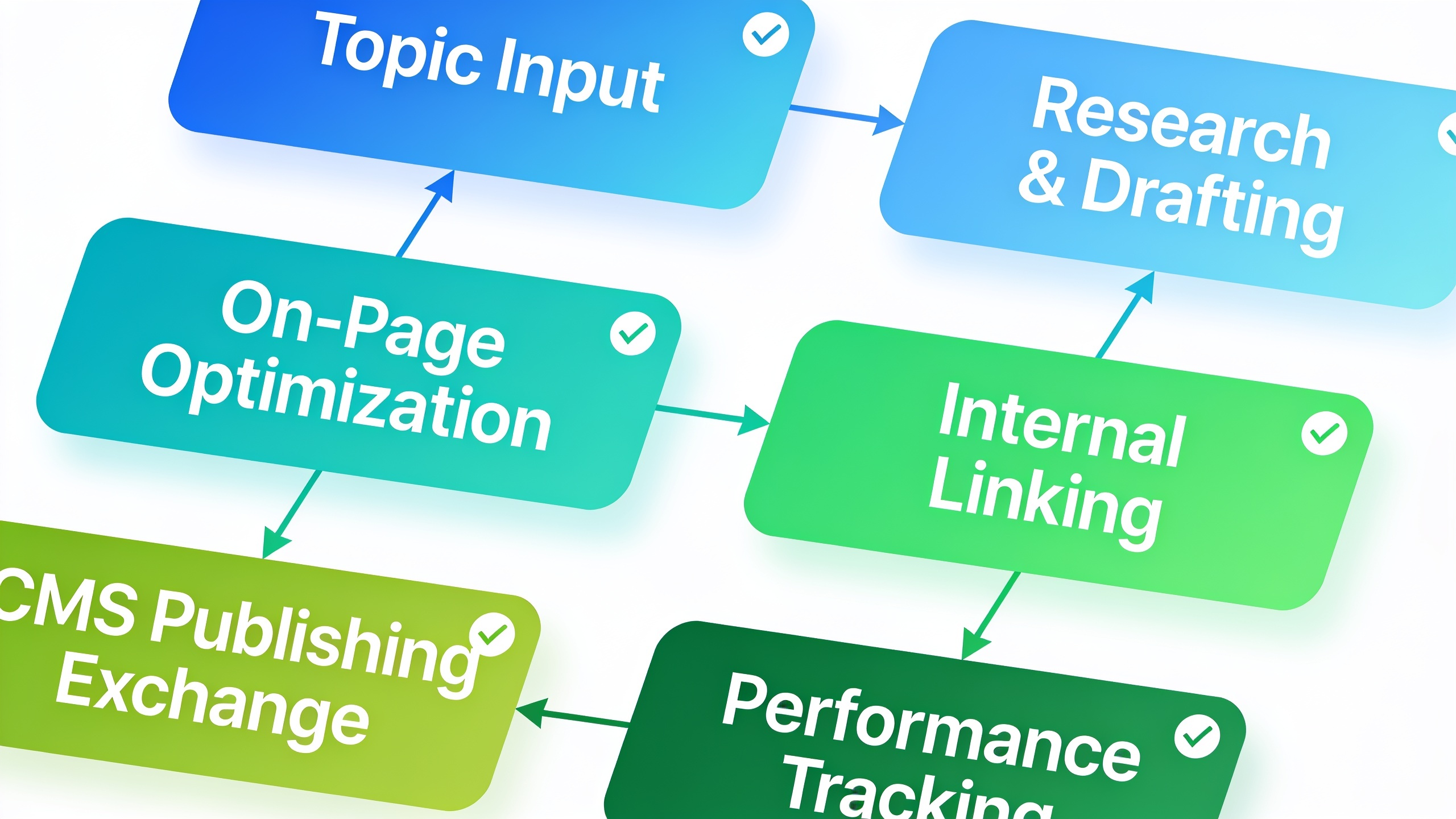
So you're looking at roughly three to four fewer manual steps per article with RobinRank. Doesn't sound huge until you're publishing weekly or daily, at which point it compounds fast. Think about an agency running content for 15 client sites. To match RobinRank's pipeline using Content at Scale plus separate publishing and link building, they'd either need a bigger editorial staff or a whole lot more hours a week. That's real money.
Where Content at Scale Still Wins
There's an upside to Content at Scale's narrower focus, though. If you've already got a solid in-house editorial process, a locked-in brand voice, and publishing infrastructure that works, you might actually prefer a tool that just drafts. It hands editors more control over the final product before anything goes public. And honestly, if you're in a regulated space like finance or healthcare where every draft gets reviewed anyway, a draft-first tool slots into your compliance workflow way more cleanly than a fully automated pipeline that publishes on its own.
Want content like this running on autopilot for your own site? Try RobinRank free — AI-written, SEO-optimized articles generated and published automatically, no credit card required.
Content Quality and SEO Results
Both tools can produce readable long-form content. The real difference in SEO results shows up after the words exist, in the optimization, the internal linking, the publishing consistency, and the backlink authority. Those are the things that actually move Google. Per Google's own helpful content documentation, ranking well depends on way more than nice prose. It comes down to structure, relevance, site authority, and user experience signals.
Content at Scale's writing reads naturally and is built to keep AI detectors quiet, which genuinely matters if your brand worries about the "is this AI?" perception. But since it doesn't auto-apply on-page optimization or manage internal linking at scale, how well the output ranks depends almost entirely on what a human does next. Two teams could start with the exact same Content at Scale draft and end up with wildly different rankings, purely based on their SEO execution.
RobinRank folds the optimization right into the writing. Keyword placement, header structure, meta tags, internal links, all applied before the thing publishes. Then it pairs that with the backlink exchange for off-page authority. And because it tracks performance after publishing, you can actually see which articles are catching on and adjust your calendar around them. That feedback loop is something a drafting-only tool just can't give you.
Keeping Old Content Fresh
Here's a factor almost nobody talks about in these comparisons: how painful is it to update old content? Google has said, more than once, that freshness and relevance affect rankings over time (Google Search Central, Helpful Content guidance). Content at Scale can regenerate drafts, sure, but re-publishing an updated piece means going through the same manual CMS steps as a brand-new one. RobinRank's automated publishing makes scheduling periodic refreshes of existing pages part of the normal routine instead of some dreaded one-off cleanup project.
Backlinks and Off-Page SEO
RobinRank has a built-in backlink exchange network that connects participating sites for natural link building. Content at Scale has zero native backlink functionality, so you'll need a separate tool or an agency for off-page SEO. Quick refresher: backlinks are links from other websites pointing to yours, and they're still one of the strongest signals search engines use to judge how authoritative and trustworthy a page is.
For most small businesses and startups, backlinks are the single hardest part of SEO to pull off in-house. It takes outreach, actual relationship building, and usually a budget for guest posts or PR. Content at Scale has always leaned toward content generation, not off-page work, so you're budgeting separately for links whether that's an agency retainer, an outreach tool, or your own team grinding through it manually.
RobinRank tucks link building into the same subscription. Sites in the network trade contextually relevant backlinks as part of how the platform normally runs, so there's no outreach campaign to manage. This is probably the biggest structural gap between the two products. It's also why people comparing Content at Scale vs RobinRank on total value, not just word count or article price, keep landing on RobinRank as the more complete SEO deal per dollar.
| Off-Page SEO Factor | Content at Scale | RobinRank |
|---|---|---|
| Native backlink network | No | Yes |
| Manual outreach required | Yes (via third party) | No |
| Additional budget needed for links | Typically yes | Typically no |
| Link relevance/context control | N/A | Managed via exchange criteria |
Which Tool Fits Your Team?
It comes down to this: do you need a writing assistant for an editorial team you already have, or a full replacement for a content and SEO department you don't? If you've got editors, a publishing workflow, and a link-building budget in place, Content at Scale slots in nicely as a drafting accelerator that saves your writers time on first drafts. If you're a founder, a small business owner, or an agency juggling multiple client sites with no room for a full content team, RobinRank's all-in-one automation solves a much wider set of problems in a single subscription.
Best For Content at Scale
- Established editorial teams with actual writers and editors on staff
- Brands with strict brand-voice or compliance review requirements
- Organizations that already run a mature link-building program
- Teams that want to control every published piece by hand
Best For RobinRank
- Startups and small businesses with no content team
- Agencies running SEO for a bunch of clients who need to scale output without drowning
- Marketers who want backlinks built in without juggling another vendor
- Teams that want one dashboard for writing, publishing, and tracking
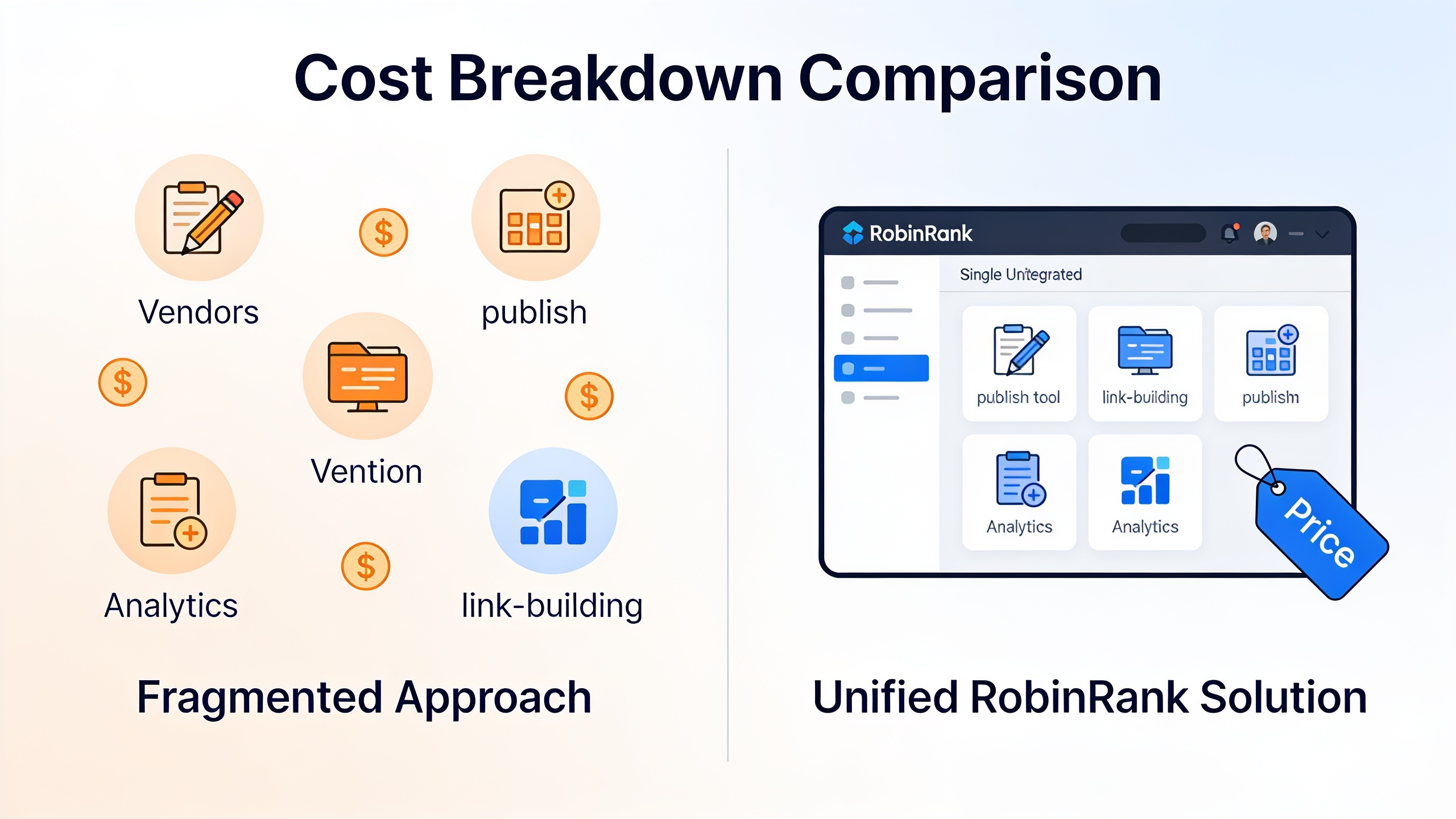
Agencies especially tend to think in cost per managed site, not cost per article, because their margins live and die by how much manual work each client eats up. Since RobinRank pulls drafting, optimization, publishing, and backlinks under one roof, agencies often say they need fewer specialized hires (a dedicated link builder or CMS manager, say) to service the same client load.
A Quick Gut-Check
Answer "yes" to most of these and RobinRank is probably your pick: Do you lack an in-house writer or editor? Do you need content published automatically on a schedule? Do you have no link-building process at all right now? Are you handling SEO for more than one website?
Answer "yes" to most of these instead and Content at Scale might be the better call: Do editors already review every draft before it goes live? Do you have a separate link-building process that actually works? Do you need tight control over voice and formatting before anything publishes? Is your real need just faster first drafts rather than full SEO execution?
Frequently Asked Questions
Is RobinRank actually cheaper than Content at Scale?
On the raw monthly subscription, the two can look pretty similar depending on which tier you're on. But RobinRank's total cost of ownership usually comes out lower, because it bundles the publishing and backlink building that Content at Scale users end up paying for separately through other tools or services. When you're weighing Content at Scale vs RobinRank on price, do yourself a favor and calculate the full cost of producing a live, optimized, linked article. Not just the drafting fee.
Can Content at Scale publish straight to my site the way RobinRank does?
Not really. Content at Scale is mainly a drafting and research tool. It has integrations that make moving content into a CMS smoother, but it doesn't natively handle full on-page optimization and automated publishing like RobinRank. Most people still do the manual bits, formatting, internal linking, publishing, before the article goes live.
Does RobinRank dodge AI detection the way Content at Scale claims to?
Content at Scale built a lot of its early rep on content designed to read naturally and slip past the common AI detectors. RobinRank cares more about overall SEO performance, so structure, optimization, backlinks, than marketing itself around detection avoidance specifically. Its output is still written to read naturally for actual humans, though.
Which one's better for a small business with no marketing team?
RobinRank, pretty clearly. It automates the whole pipeline from writing to publishing to backlinks, which is exactly what you need when there's nobody on staff to babysit it. Content at Scale still needs somebody to edit, format, and publish drafts, so it quietly assumes you've got at least a part-time content person around.
Do I need both, or just one?
Most teams only need one. Which one depends on how much of the workflow you want off your plate. Some agencies do run a drafting tool alongside a separate optimization and link-building stack, but that means managing multiple vendors and workflows, which is the exact mess RobinRank was built to kill with a single connected platform.
Final Thoughts
Content at Scale and RobinRank are both using AI to chase the same goal, producing enough good content to actually compete in organic search. They just work at different depths of the stack. Content at Scale is a solid drafting tool if you've already got the editorial and link-building machinery in place. RobinRank is for teams that want writing, optimization, publishing, and backlinks handled as one automated system.
Whichever way you're leaning, do this first: map out where your workflow actually breaks down. Is it drafting speed? Editorial bandwidth? Publishing friction? Links? Then pick the tool that fixes your real gap, not the one with the slickest demo. That's the mistake I see people make over and over.
Ready to stop writing content by hand? Start your free RobinRank trial and get a full month of SEO-optimized articles published on autopilot.