RobinRank vs Content at Scale: Full Feature Breakdown
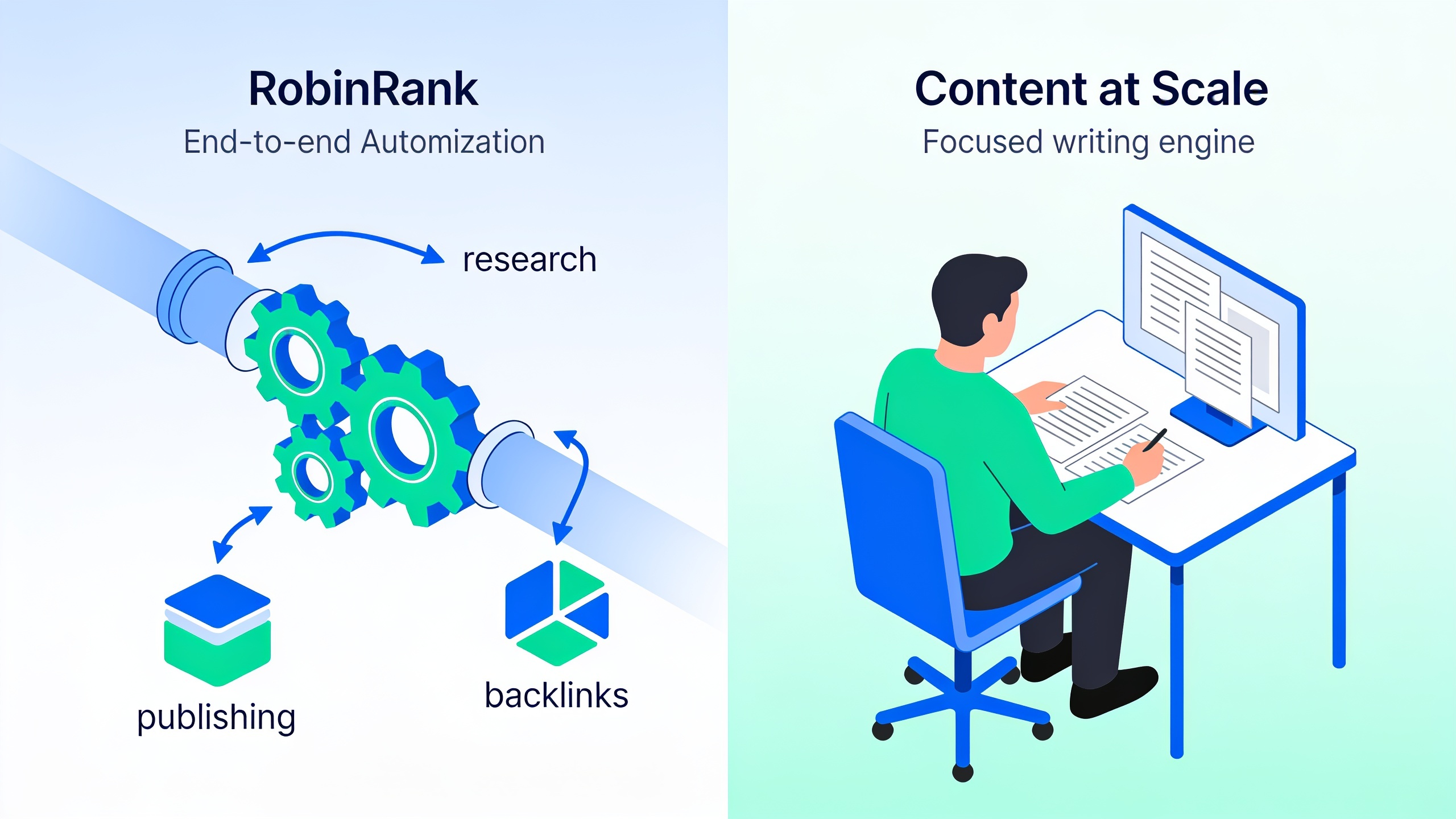
That's it. That's the fork in the road.
Both tools show up in every AI content tool comparison SEO teams have been running lately, because everyone's trying to do the same thing right now: get more organic traffic without hiring a full writing department. But these two platforms were built by people who clearly disagreed about how much work the software should do versus how much you should. And that difference shapes everything about how they feel to actually use.
Table of Contents
- What Are RobinRank and Content at Scale?
- RobinRank vs Content at Scale: Automation Depth Compared
- Which Tool Has Better Backlink Capabilities?
- How Much Do RobinRank and Content at Scale Cost?
- Ease of Use for Founders vs Agencies
- Content Quality and SEO Performance
- Which Tool Should You Choose?
- Frequently Asked Questions
What Are RobinRank and Content at Scale?
RobinRank is an AI SEO platform that writes, optimizes, and publishes articles straight to your website, then connects that site to a backlink exchange network to build up your domain authority over time. Content at Scale is, at its core, a writing tool. It cranks out long-form, SEO-structured blog drafts built to read like a human wrote them (and to slip past AI detectors).
Same category on the surface. Very different beasts underneath.
The confusing part is that "AI content tool" has become one of those umbrella phrases that means almost nothing. Some tools stop cold at the draft stage and hand you a Google Doc to edit, format, and publish yourself. Others try to run the whole thing, from keyword research all the way to a live, indexed page with links pointing at it. Knowing which kind you're buying matters more than any feature list.
RobinRank was clearly built by people who assumed most startups and small teams simply don't have the hours to babysit every step of content production. That assumption is usually right, honestly. As covered in Why Startups Struggle to Scale Content Without a Full Team, plenty of early-stage companies desperately want steady organic growth but can't justify hiring a writer, an editor, and a link-building person all in the same quarter. RobinRank's whole pitch is to automate that pipeline end to end. Topic research, drafting, on-page SEO, publishing to your CMS, backlinks through the network. The lot.
Content at Scale started somewhere else entirely. It was built for agencies and SEO consultants who needed to produce a mountain of blog posts fast, without the output screaming "a robot wrote this." Its real strength is the writing engine, which runs a multi-step process (research, outline, draft, then a human-editing pass) to produce chunky articles, usually landing somewhere between 1,500 and 3,000 words based on your target keyword. It's good at what it does. It just doesn't try to do everything.
RobinRank vs Content at Scale: Automation Depth Compared
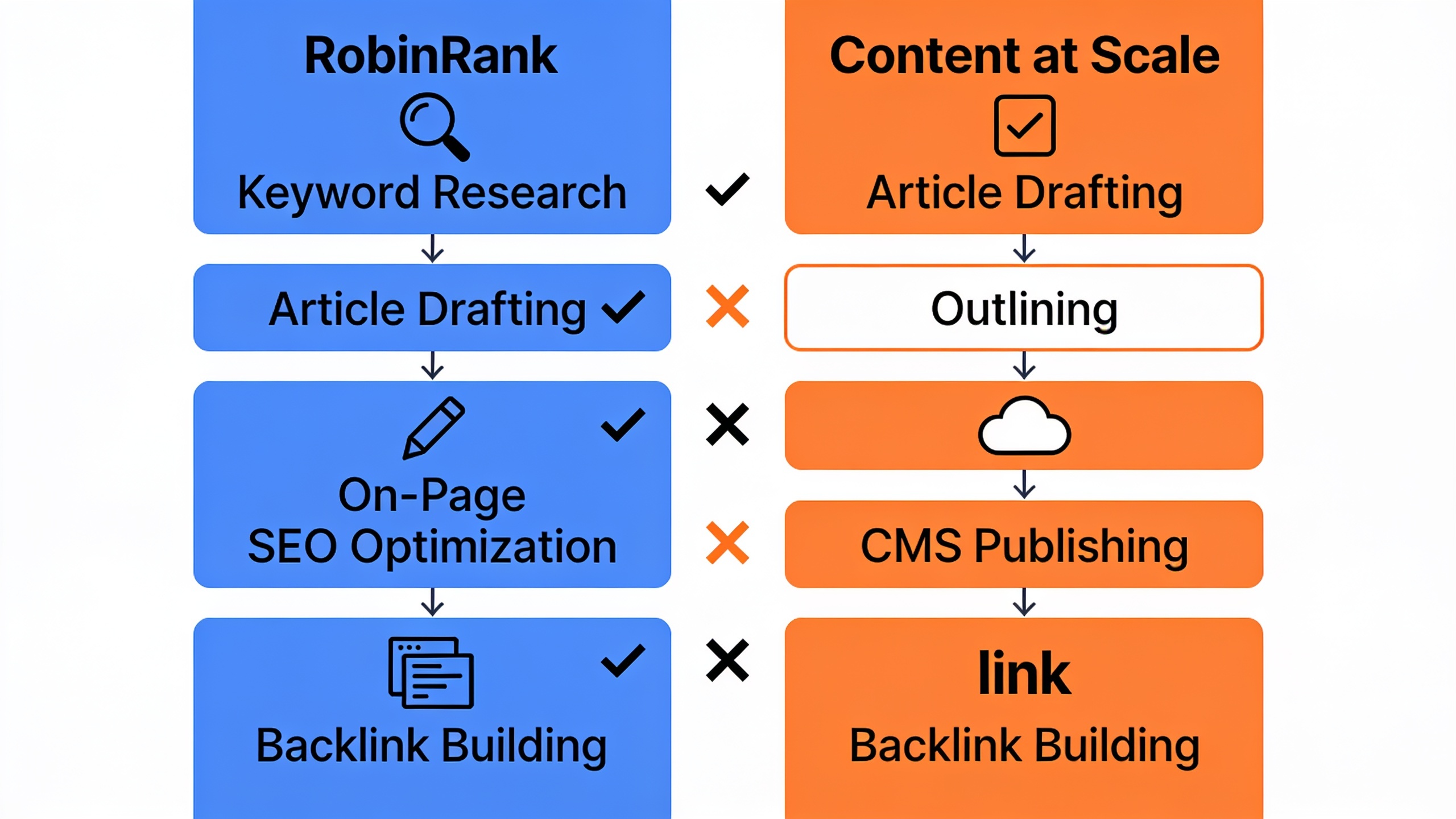
RobinRank automates the full content lifecycle, from research and writing through on-page SEO, publishing, and internal linking. Content at Scale mostly automates the drafting and outlining stage and leaves publishing, technical SEO, and distribution to you. That's the single biggest functional gap between them, and everything else kind of flows from it.
What RobinRank Actually Handles For You
RobinRank's pipeline usually covers keyword and topic clustering based on your niche and existing content, article generation optimized for your target keywords and search intent, on-page stuff like meta titles, descriptions, header structure, and internal link suggestions, direct publishing to a connected CMS (WordPress, for instance) on a schedule you set, and backlink placement through its exchange network with other sites in the ecosystem.
The practical upshot? Because it publishes for you, you can set up a content calendar and basically walk away. You check in now and then to review what's going out instead of manually formatting and uploading every single post. That's a genuinely different relationship with the software.
What Content at Scale Handles
Content at Scale packs almost all its horsepower into the writing stage. You get AI-generated long-form drafts from a keyword or topic, its "Bag of Words" and topic-cluster suggestions for better semantic relevance, an AI-detection bypass layer to make things read more naturally, and some CMS export integrations (though publishing generally takes more manual setup than RobinRank's direct-publish approach).
To be fair, newer plans have added a "Content at Scale AI SEO Agent" workflow that pushes beyond pure drafting. But let's be real about the reputation and the core use case here: this is a tool for producing a lot of long-form text, not for running your entire SEO operation.
Automation Depth at a Glance
| Automation Stage | RobinRank | Content at Scale |
|---|---|---|
| Topic/keyword research | Automated, ongoing | Manual input required for target keyword |
| Article drafting | Automated | Automated (core strength) |
| On-page SEO optimization | Automated (meta tags, headers, internal links) | Partial, guided by outline tools |
| Direct CMS publishing | Yes, scheduled | Limited/manual export in most plans |
| Backlink building | Built-in exchange network | Not included |
| Human review needed | Light editing pass recommended | Editing pass recommended, often heavier |
So if your goal is to shrink the distance between "we need more content" and "the article is live and starting to rank," RobinRank just closes more of that gap for you. But if you've already got an editor and a smooth publishing routine and you only need faster first drafts to feed into it? Content at Scale's narrower focus might be all you actually need.
Which Tool Has Better Backlink Capabilities?
RobinRank has built-in backlink capabilities through a link exchange network that connects participating websites. Content at Scale doesn't do backlinks at all. Full stop. This is probably the cleanest, least debatable difference in the whole comparison.
And it matters, because backlinks (links from other sites pointing at your pages) are still one of the heaviest ranking signals Google leans on to judge authority and trust. Google's own documentation and a stack of independent industry studies over the years have kept flagging backlinks as a top-tier ranking factor. That's exactly why any serious SEO strategy pairs content with some flavor of link acquisition. You can't really skip it.
How RobinRank's Backlink Exchange Works
RobinRank plugs your site into a network of other sites also on the platform, then sets up natural, contextually relevant backlinks between those domains. Instead of leaning on sketchy paid link marketplaces or slow manual outreach (both of which can eat your budget or blow up in your face if done badly), it automates the matchmaking so placements happen inside its managed network. For a startup or small agency with no dedicated link-building person and no budget for outreach campaigns, that's a big deal. It's basically the gap described in Why Startups Struggle to Scale Content Without a Full Team.
Content at Scale and Links (or Lack Thereof)
There's no link exchange feature here, and no link building baked in. If you want to build authority alongside your AI drafts, you're running link building as a totally separate project. That means manual outreach, hiring an agency, or subscribing to yet another specialized tool. For an agency juggling a bunch of client accounts, that's more vendors, more logins, more moving parts to keep track of just to deliver one complete SEO package.
This split shows up all over the AI content tool comparison space, actually. Most writing-first platforms treat content and links as two separate problems, and only a handful (RobinRank being one) try to shove both under a single roof. If you want to see how another popular tool handles the optimization side of this, RobinRank vs Surfer SEO: Which Tool Fits Your Workflow? goes deeper on the on-page comparison.
How Much Do RobinRank and Content at Scale Cost?
Both use tiered subscription pricing, but comparing them on price alone is a trap. Word count and article volume don't tell you much once you factor in publishing and backlinks. Content at Scale has historically started at a higher entry price, aimed at agencies and consultants pumping out content in bulk. RobinRank positions itself for founders, small teams, and agencies who'd rather have writing, optimization, and link building bundled instead of buying three separate things.
What you really want to look at is the total cost of running a working content operation, not the sticker price. A few things quietly drive that number up.
There's the real per-article cost once you add in research, editing, and formatting time. There's publishing overhead: does the plan actually publish for you, or does someone on your team have to copy, format, and upload every draft by hand? There's the link-building add-on, because if backlinks aren't included, that's a whole separate expense. And there's editing time, which is the sneaky one, since drafts that need heavy cleanup before they're publishable pile on labor costs that never show up on the invoice.
Want content like this running on autopilot for your own site? Try RobinRank free — AI-written, SEO-optimized articles generated and published automatically, no credit card required.
Pricing Comparison Snapshot
| Factor | RobinRank | Content at Scale |
|---|---|---|
| Core offering | Writing + optimization + publishing + backlinks | Long-form AI drafting |
| Backlinks included | Yes, via exchange network | No, separate purchase needed |
| Direct publishing | Yes | Limited, plan-dependent |
| Best suited for | Founders, small teams, agencies wanting an all-in-one system | Agencies/consultants needing high-volume drafts with existing editorial workflows |
| Additional tools often needed | Minimal | Link building, sometimes on-page SEO tools |
Plans and features shift around on both platforms, so check the current pricing pages before you commit to anything. But the structural point doesn't really move: if your monthly software budget was going to get split across a writing tool, an SEO tool, and a link-building service anyway, an all-in-one setup often ends up cheaper overall, even when the base subscription looks about the same on paper.
Ease of Use for Founders vs Agencies
RobinRank is built to run with minimal hands-on management once it's set up, which makes it a natural fit for founders and small teams without dedicated content people. Content at Scale works best when you already have an editorial process and just want faster first drafts to plug into it. The "which is easier" question really splits into two audiences who want completely different things.
For Founders and Small Business Owners
If you're a founder juggling product, sales, and ops, you do not have time to shepherd a five-step content workflow every week. Nobody does. The appeal of RobinRank here is that the work is front-loaded: connect the CMS, set your niche and target keywords, and let the pipeline handle research, drafting, optimization, and publishing on repeat. Backlinks happen quietly in the background through the network, so you're not managing outreach on top of everything else.
Content at Scale can still work for a founder, sure. But it asks more of you after each draft lands. You review the AI-detection score, format for the CMS, add internal links by hand, and handle publishing separately. For a solo founder or a two-person marketing team, that extra manual layer stacks up fast, especially when you're staring down a calendar of 8 to 20 articles a month.
For Marketing Agencies
Agencies care about different things. Consistency across clients, the ability to dial volume up or down, clean reporting. Content at Scale's bulk-drafting muscle is genuinely appealing if you've already built your own optimization and publishing machine and you just need a dependable engine feeding it first drafts across a bunch of accounts.
RobinRank tends to win over agencies who are sick of vendor sprawl and manual handoffs, particularly smaller shops or ones serving startup and SMB clients who need a full solution rather than a Frankenstein stack of specialized tools. Since RobinRank covers publishing and backlinks on top of drafting, an agency can realistically manage more accounts without adding headcount. That's the whole game for a lot of small agencies.
Learning Curve Comparison
| Ease-of-Use Factor | RobinRank | Content at Scale |
|---|---|---|
| Initial setup complexity | Moderate (CMS connection, niche configuration) | Low to moderate (keyword input, outline review) |
| Ongoing manual work | Low once configured | Moderate — review, format, publish each draft |
| Best fit team size | Solo founders, small teams, lean agencies | Agencies/consultants with existing editorial staff |
| Training time for new team members | Low | Moderate, due to manual publishing steps |
Content Quality and SEO Performance
Both platforms want to produce content that ranks, but they chase quality from opposite ends. RobinRank leans on SEO structure and topical optimization tied to your existing site architecture. Content at Scale leans on natural-sounding prose engineered to dodge AI-detection flags. Neither one can promise rankings, because no tool can. Google weighs hundreds of signals: backlinks, engagement, site authority, technical health, the works. But the emphasis is different enough that your priorities should probably decide the winner.
RobinRank bakes on-page optimization right into the draft. Header hierarchy, keyword placement, meta descriptions, internal links wired to the rest of your content. And because it also handles backlinks, it's trying to nudge both on-page and off-page factors at once instead of betting everything on the writing itself.
Content at Scale, meanwhile, obsesses over making the text pass as human-written, which genuinely matters if your team worries about how the content reads or about platform-specific detectors. Its multi-pass process (research, outline, draft, then a "human-content" pass) is built to sand down the repetitive rhythms you get from raw AI output. It does this well, in my experience.
Honestly, though? If you're running a real comparison, don't take anyone's word for it, mine included. Feed both tools a sample topic from your own niche and hold the drafts up against your actual editorial standards before you sign up for a long plan. You'll learn more in an afternoon of testing than in a week of reading feature pages.
Which Tool Should You Choose?
Choose RobinRank if you want one platform doing research, writing, on-page optimization, publishing, and backlinks so you're not stitching together separate vendors. That's the sweet spot for founders, small business owners, and lean agencies. Choose Content at Scale if your team already has solid editorial, publishing, and link-building processes and you mainly need a high-volume, natural-sounding drafting engine to pour into that existing setup.

There's no objectively "better" tool here, and anyone telling you otherwise is selling something. It's genuinely about how much of the pipeline you want automated versus how much you're set up to (or prefer to) run yourself. If you're already invested in something like Surfer SEO for on-page work, it's worth reading RobinRank vs Surfer SEO: Which Tool Fits Your Workflow? before you lock in a stack, because the choice between bundling several specialized tools and running one integrated platform hits both your budget and your team's daily workflow for a long time.
Frequently Asked Questions
Do I still need a separate link-building tool if I use RobinRank?
Usually, no. RobinRank has a built-in backlink exchange network connecting participating sites, so most businesses don't need to buy a separate link-building service to get going. Content at Scale doesn't offer this, so if you're on that platform and backlinks are part of your plan, you'll need a separate solution for it.
Can Content at Scale publish straight to my website?
Not really, at least not the way RobinRank does. Its publishing is more limited, and on most plans you're manually exporting or copying content into your CMS. RobinRank is built around direct, scheduled publishing to a connected CMS as a core part of how it works.
Which one's better for a solo founder with zero marketing team?
RobinRank, most of the time. Its automation covers the entire pipeline (research, drafting, optimization, publishing, backlinks) with very little ongoing manual work. Content at Scale is usable solo, but expect more hands-on editing and publishing for every article, which adds up when it's just you.
Will AI content from either tool actually rank on Google?
Depends on way more than the writing tool. Your backlink profile, site authority, technical SEO, and user engagement all matter. Google has said outright that it doesn't penalize content just for being AI-generated, but it absolutely judges quality and helpfulness no matter how the content was made. Neither tool can guarantee you'll rank. Both aim to give you well-structured, optimized drafts that support the bigger strategy.
Do agencies pick one tool, or use both?
Some do mix them. An agency might use Content at Scale for bulk drafting on certain accounts while leaning on RobinRank's backlink network (or another platform) for links. But agencies trying to cut down on vendors and manual handoffs often lean toward RobinRank's all-in-one setup, especially for smaller clients who can't fund a pile of specialized subscriptions.
In the end, choosing between these two comes down to how much of the SEO content pipeline you want handled in one place versus how much your team already does well on its own. Founders and lean teams tend to squeeze the most out of RobinRank's end-to-end automation, while agencies with established editorial and link-building habits may still get real value out of Content at Scale's focused drafting engine. And the most reliable way to decide? Run both on a real topic from your own calendar and see which one actually fits how you work. Everything else is just theory.
Ready to stop writing content by hand? Start your free RobinRank trial and get a full month of SEO-optimized articles published on autopilot.