RobinRank vs Surfer SEO: Which Tool Fits Your Workflow?

Both are popular with SEO folks, content marketers, and small business owners who want to scale organic traffic without building out a whole editorial team. But they're solving different parts of the puzzle. And picking the wrong one usually means you're paying for software that only handles half of what you need.
Table of Contents
- What Are RobinRank and Surfer SEO?
- Content Generation: Who Actually Writes the Article?
- On-Page Optimization Features Compared
- Publishing and Workflow Automation
- RobinRank vs Surfer SEO Pricing
- Which Tool Fits Your Team?
- Frequently Asked Questions
What Are RobinRank and Surfer SEO?
RobinRank is an AI SEO platform that writes, optimizes, and publishes full-length articles for you, then connects those articles into a backlink exchange network to build authority. Surfer SEO is a content optimization tool that analyzes the top-ranking pages for a keyword and hands writers a data-driven outline plus a scoring system to sharpen their drafts.
Why does the difference matter? Because it changes what you're actually paying for. Surfer assumes you (or somebody you hired) is going to write the draft, and its whole job is telling you how that draft stacks up against what's already ranking. Word count, keyword density, headings, structure, all of it. RobinRank assumes you don't want to write at all. It generates the article using AI that's been trained on SEO best practices, checks it against ranking signals, and pushes it live on your site. Usually with a link-building layer on top that Surfer (and most optimization tools) just don't have baked in.
So this is the first fork in the road. Are you buying a co-pilot for human writers, or a full pilot that flies the whole content plane? Get clear on that before you start comparing feature lists, or you'll end up weighing stuff that has nothing to do with your actual situation.
Content Generation: Who Actually Writes the Article?
Surfer SEO doesn't write full articles out of the box. It gives you a Content Editor plus an AI writing add-on (Surfer AI) that can draft based on its own SERP analysis, but let's be real: Surfer's identity is optimization, not authorship. RobinRank is the opposite. Automatic article generation is the whole point, with optimization and publishing built right into the same pipeline instead of bolted on afterward.
How Surfer handles writing
Surfer's Content Editor grabs the top-ranking pages for your keyword, pulls out the common terms, headings, and structural patterns, then drops you into this checklist-style interface. Target word count, "important terms" to include, and a content score (usually out of 100) that ticks up as you type. The Surfer AI add-on can generate a whole draft off that same data. But honestly? A lot of teams still use Surfer mostly to guide human writers and freelancers, not to fully automate the writing.
That makes it a great fit if you already have writers and you just want them hitting the right benchmarks more consistently. It's a lot less useful if your actual goal is to get human writing time out of the process entirely.
How RobinRank handles writing
RobinRank spits out complete, publish-ready articles using AI tuned specifically for SEO performance instead of generic prose. There's no checklist to hand off. RobinRank produces the draft, runs it through its own optimization layer, and gets it ready to publish. Three separate steps (research, writing, optimizing) collapsed into one.
That's a big deal for founders and small business owners who have no content team whatsoever. If you're a two-person startup trying to ship two or three SEO articles a week, hiring writers and then feeding every draft through a separate optimization tool is a genuine operational headache. RobinRank is trying to delete that headache, not just make it slightly smoother.
Now, is AI-generated content actually good enough? That's a fair fight, and it's worth reading a real breakdown of AI vs Human Writers: What Actually Ranks Better in SEO? before you assume either side wins automatically. The honest answer comes down to execution, not the label "AI" or "human" slapped on the byline.
On-Page Optimization Features Compared
Surfer's optimization engine is probably the most mature single piece of software either of these companies makes. You get granular keyword density targets, NLP-based term suggestions, the real-time content score, the works. RobinRank's optimization is less in-your-face, but it's applied automatically to every article it generates, so there's no manual scoring step for you to babysit.

How Surfer scores content
Surfer's content score comes from comparing your draft against the top-ranking pages (usually the top 20 to 50 results) for your keyword. It factors in a handful of things: word count relative to your competitors, use of "important terms" and related NLP keywords, your heading structure and where keywords sit inside those headings, plus some basic readability signals.
Watching that score climb in real time as you edit is oddly satisfying, and it creates a tight feedback loop. A lot of SEO folks swear by it for training junior writers on the fundamentals, which I get. It's a good teaching tool.
How RobinRank handles optimization
RobinRank bakes the optimization in during generation instead of grading it after. It analyzes the ranking patterns for your keyword and builds the article around them from the very first draft. Headings, keyword placement, internal linking, all structured automatically instead of asking a human to react to a score after the fact. That's a genuinely different philosophy. Surfer optimizes what a person already wrote. RobinRank builds the optimization into the writing itself.
The tradeoff is control versus convenience, and there's no free lunch here. Surfer shows expert users exactly why a page scores the way it does, which is catnip for SEO pros who want to fine-tune every last variable. RobinRank gives up some of that visibility in exchange for speed and hands-off execution, which lands better with founders and marketers who frankly don't have time to micromanage a number on a screen.
| Feature | RobinRank | Surfer SEO |
|---|---|---|
| Full article generation | Yes, built-in and automatic | Add-on (Surfer AI), optimization-first |
| Optimization method | Applied during generation | Applied after human drafting, via score |
| Real-time content scoring | Not the primary interface | Core feature, updates live |
| Auto-publishing to CMS | Yes | No native auto-publish |
| Backlink/link-building network | Yes, built-in exchange network | No |
| Best suited for | Founders, small teams, agencies scaling volume | Teams with existing writers needing SEO guidance |
| Learning curve | Low — mostly automated | Moderate — requires understanding scoring logic |
Publishing and Workflow Automation
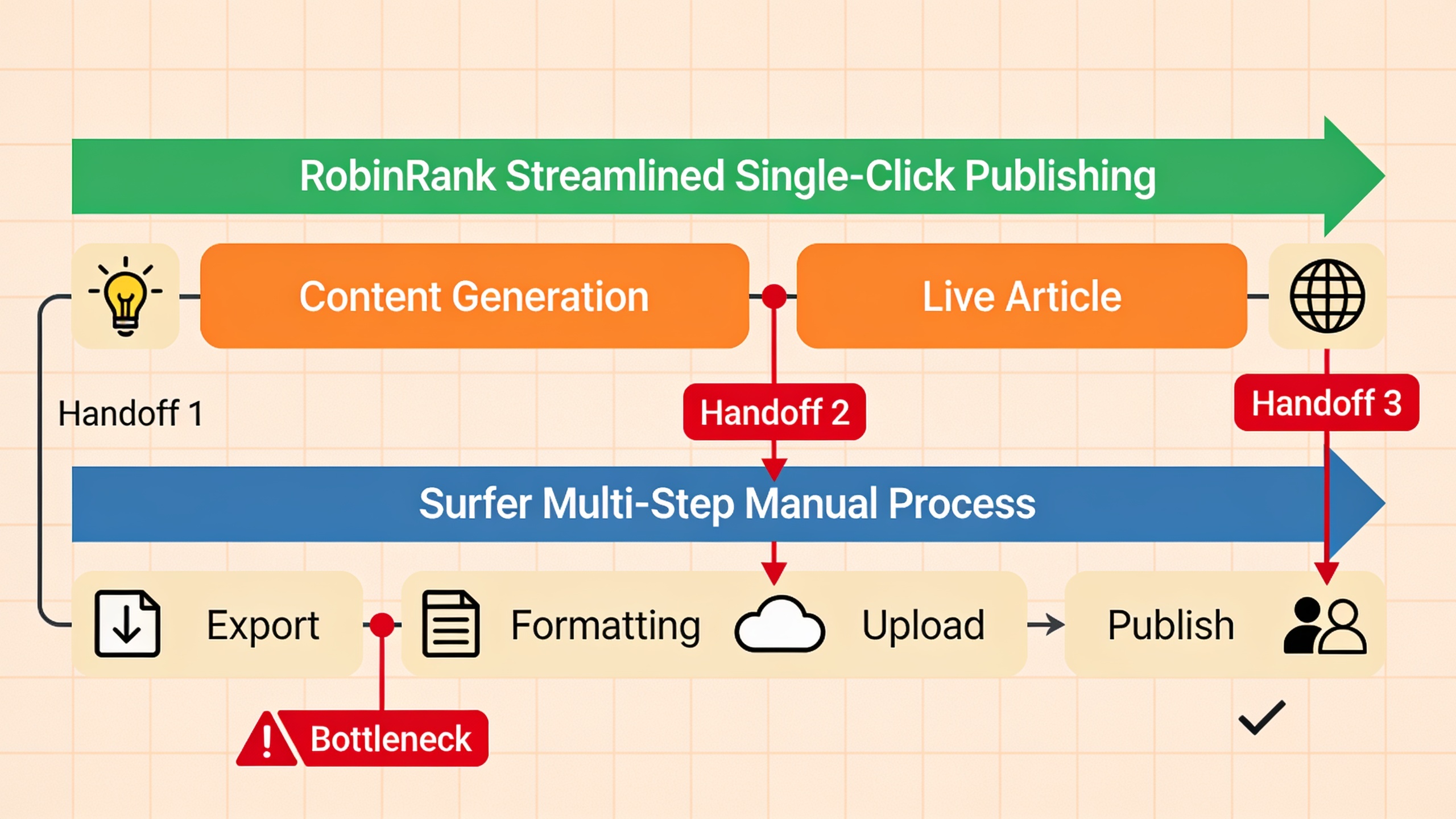
RobinRank publishes for you. It pushes finished articles straight to your connected website or CMS, no manual export-and-upload dance required. Surfer doesn't publish anything on its own. It integrates with certain CMS platforms so you can export, but pulling the trigger on publishing is still on you.
Want content like this running on autopilot for your own site? Try RobinRank free — AI-written, SEO-optimized articles generated and published automatically, no credit card required.
This is one of the most underrated differences between the two, because publishing friction is where content calendars quietly go to die. Picture a marketing team optimizing ten articles in Surfer over a month, and then... only four actually go live. Why? Because somebody still has to format each one, upload it, add images, and hit publish, and that somebody got busy. RobinRank treats publishing as part of the pipeline rather than a chore left for a separate person in a separate tool.
What this means for agencies
Agencies running a bunch of client sites know the "handoff" problem intimately. Content gets optimized in one tool, then handed to a developer or a VA to get it live, and things fall through the cracks in between. A platform that generates, optimizes, and publishes in one motion just cuts the number of handoffs, which cuts the number of places a campaign can stall out.
Surfer's edge here is flexibility, not automation. Since it doesn't publish anything itself, you can slot it into pretty much any content pipeline no matter what CMS or approval process a client insists on using. If you've already got a working editorial workflow and you just want a better optimization layer inside it, that flexibility is genuinely valuable.
What this means for solo founders and small businesses
For a solo founder with nobody handling content, the math flips entirely. Every extra manual step (export the Surfer draft, format it, upload it, schedule it) is time you're not spending on the actual business. RobinRank's auto-publish approach is aimed squarely at killing those steps, which is why it tends to click with lean teams that need their SEO content to basically run itself.
And publishing consistency matters more than people think, in an indirect way. Sites that publish sporadically build topical authority a lot slower than sites that publish steadily over time. There's a good discussion of that pattern in SEO Trends 2025: What's Actually Changing (And What to Do About It), which digs into how search engines increasingly reward sustained topical depth over a handful of one-off optimized pages.
RobinRank vs Surfer SEO Pricing
Surfer's pricing is generally built around how many content pieces you can optimize per month, scaling up for agencies that need more seats or audits. RobinRank's pricing is built around automated article output and publishing volume instead of per-piece optimization credits. Since they solve different problems, staring at the sticker price alone will mislead you. What you actually want to compare is cost per published article, not the monthly subscription line.
Here's the part people forget. With Surfer, your real cost is the subscription plus whatever you pay a human to write each draft (staff or freelance) plus the time to format and publish it. With RobinRank, the subscription is meant to cover generation, optimization, and publishing in one line item, no separate writer fee stacked on top.
What that looks like in real life
A content marketer comparing these should ask a sharper question than "which one's cheaper per month?" The better question: "What's my true cost per published, optimized article once I factor in labor?" If you've already got in-house writers you're paying anyway, Surfer's optimization layer might be the cheaper thing to add at the margin. If you don't have writers, or you're tired of the freelancer treadmill, RobinRank's bundled model often comes out cheaper per article once labor is in the equation.
Agencies juggling a bunch of client budgets tend to love predictable, bundled pricing too, because it's way easier to quote a client one number than to explain a patchwork of subscription plus freelance writer plus optimization tool plus publishing time. That's a big reason agencies keep drifting toward all-in-one platforms instead of duct-taping point solutions together.
Which Tool Fits Your Team?
The right pick depends on whether you already have writers you trust and just need better SEO guidance for them, or whether you need the whole pipeline handled without adding headcount. There's no universally "better" tool here. Just a better fit for a given team.
Go with Surfer SEO if you already have writers whose quality you're happy with and you just want a data layer to steer their SEO calls. It's also the right call if your team has SEO specialists who want granular control over keyword density and scoring mechanics, or if you need something that plugs into a more complex editorial workflow with multiple approval stages. And if you're an agency that wants a flexible tool that doesn't dictate how content gets published, Surfer stays out of your way.
Go with RobinRank if you're a founder or small business owner without a content team and you need articles produced and published consistently without you touching every step. It also makes sense if you'd rather have optimization built into the writing than applied as a separate review, if you want publishing automated so content actually ships on schedule instead of rotting in a queue, or if you want a built-in backlink exchange network for off-page SEO. That last one is worth flagging: Surfer doesn't offer link building at all. And if you just want fewer tools and fewer vendors involved in producing a single article, RobinRank's the leaner setup.
The messy truth nobody admits
Plenty of SEO pros actually use both, just for different jobs. They'll run an all-in-one platform like RobinRank for high-volume, lower-competition topics, then hold back human writers guided by Surfer for the flagship, high-competition pages where nuance and brand voice really matter. That's not a contradiction. It's just an honest recognition that not every page carries the same strategic weight, so it makes sense to use different tools depending on what the page is for.
Frequently Asked Questions
Does Surfer SEO write content automatically like RobinRank does?
Surfer can generate drafts through its Surfer AI add-on, but its core product is really about scoring and optimizing content, not automating the whole writing-to-publishing pipeline. RobinRank was built from day one to generate, optimize, and publish articles automatically, without needing a human draft to start from.
Can I use RobinRank and Surfer SEO together?
You can, though it's not common since the two overlap a fair bit. Some agencies use RobinRank for bulk, automated content and lean on Surfer to fine-tune a smaller batch of high-priority pages written by in-house specialists.
Which tool is better for a small business with no content team?
RobinRank, usually. It removes the need to hire freelance writers and handles publishing automatically. Surfer still needs someone to write the draft, and that's a labor cost and a time commitment a lot of small businesses just don't have the bandwidth for.
Does either tool help with link building?
RobinRank has a built-in backlink exchange network that connects participating sites to support off-page SEO. Surfer doesn't. Surfer sticks entirely to on-page content optimization and has zero native link-building features.
Can AI content from something like RobinRank actually rank?
Yes, when it's well-optimized, structured around real search intent, and published consistently, though results definitely vary by niche and how competitive it is. The bigger question of AI versus human authorship and ranking performance gets a proper look in AI vs Human Writers: What Actually Ranks Better in SEO?, which weighs the evidence instead of the marketing spin from either camp.
So, in the end the RobinRank vs Surfer SEO call isn't about which brand crams more checkmarks onto a comparison page. It's about matching the tool to how your team actually produces content right now. Have writers and want smarter guidance for them? Surfer's optimization engine is still a solid, focused choice. Need the whole pipeline (writing, optimizing, publishing) handled without hiring anyone? RobinRank was built for exactly that gap.
Ready to stop writing content by hand? Start your free RobinRank trial and get a full month of SEO-optimized articles published on autopilot.