Content Marketing Budget for Small Business: What to Spend in 2025

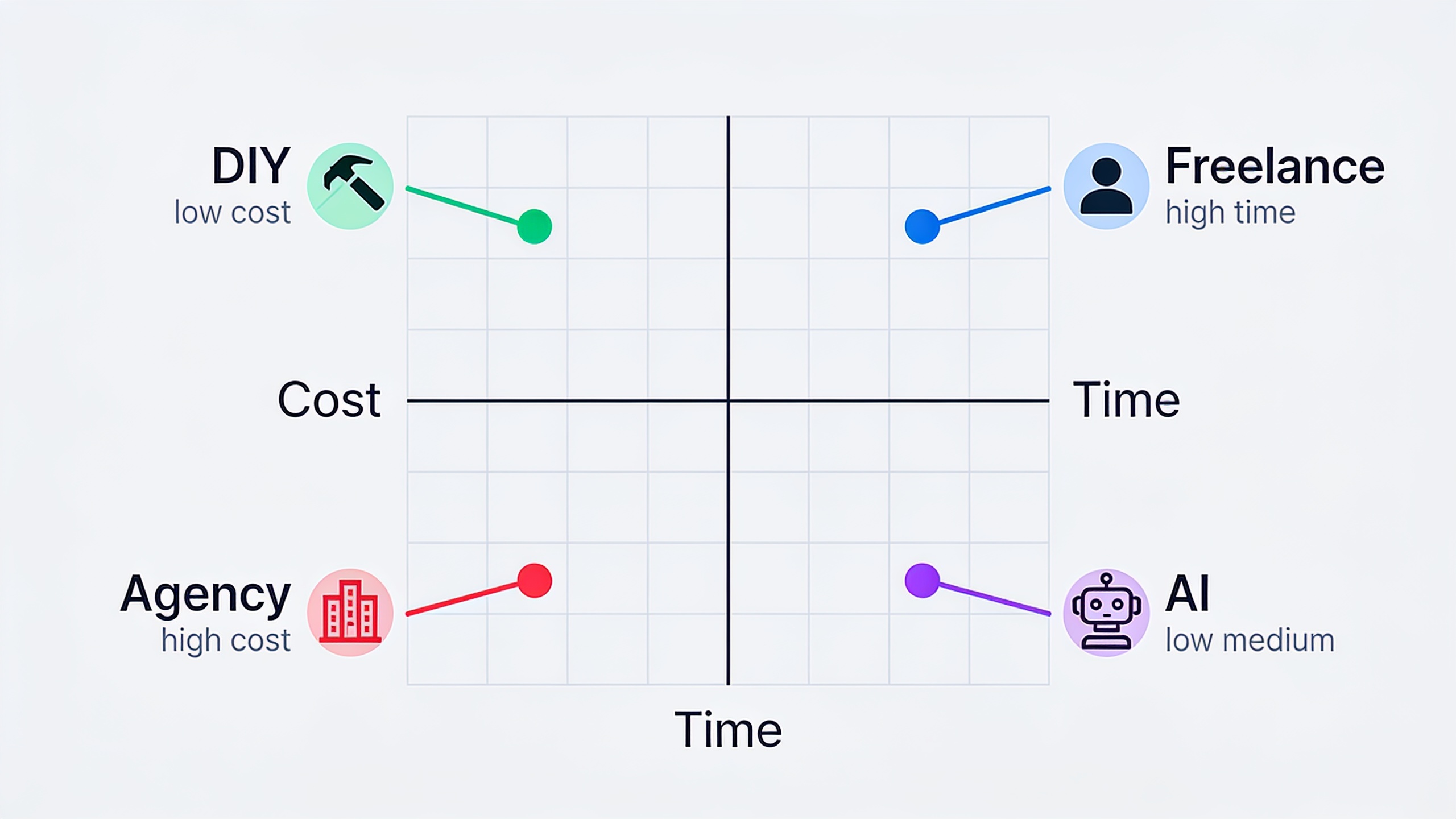
What I want to do here is walk through the four ways most small businesses actually get content made (DIY, freelance, agency, AI) so you can figure out a number that fits your revenue, your growth stage, and frankly, how much of this you want to touch yourself.
Table of Contents
- How Much Should a Small Business Budget for Content Marketing in 2025?
- What Actually Shapes Your Content Marketing Budget
- DIY Content Marketing: The Zero-Cash, High-Time Option
- Hiring Freelance Writers: A Middle-Ground Cost of Content Marketing 2025
- Working With an Agency: When Does It Make Sense?
- AI Content Tools: The New Line Item in Every Small Business Budget
- DIY vs Freelance vs Agency vs AI: Side-by-Side Comparison
- Sample Monthly Budgets by Business Stage
- Frequently Asked Questions
How Much Should a Small Business Budget for Content Marketing in 2025?
A realistic content marketing budget for most small businesses in 2025 runs between $500 and $10,000 per month, with early-stage and solo-run outfits sitting near the bottom and funded startups or multi-location businesses closer to the top. There's no single "correct" number here, and anyone who tells you there is probably wants to sell you something. Content marketing scales with the method you pick to produce it, full stop.
Now, you've probably heard the old rule of thumb. Small business marketing groups and the U.S. Small Business Administration have long suggested that businesses earning under $5 million a year, with healthy margins, should put roughly 7-8% of gross revenue toward marketing overall. Notice that's marketing overall, not content specifically. Content is usually just one line item sitting in that bigger bucket next to paid ads, email, and social. So if you're doing $500,000 in annual revenue, that 7-8% guideline lands you at $35,000-$40,000 in total marketing spend for the year, and content might reasonably grab 15-30% of it. Call it $400-$1,000 a month.
But here's what I've learned watching real businesses do this: the percentage formula isn't the thing that decides your actual number. Your production method is. A founder writing two blog posts a month herself spends basically $0 in cash and a chunk of her weekends. A boutique agency handling strategy, writing, editing, and distribution for that same volume might run you $3,000-$8,000 a month. And a business using an AI content platform to draft, optimize, and publish? Often more articles for a fraction of either cost, though you'll be doing more review yourself than an agency would ever ask of you.
What Actually Shapes Your Content Marketing Budget
Five practical things move your budget more than any industry average: how often you publish, how complex the content is, whether anyone on your team can already write, whether you need backlinks and distribution, and how much editing oversight you're willing to do yourself. I'd pay attention to these before I'd ever google "average content marketing spend," because two businesses in the exact same industry can need wildly different things.
Publishing Frequency
One article a month is a completely different animal than three a week. Volume is usually the single biggest lever on your budget. Double your publishing cadence and you roughly double your production cost, no matter which method you're using, unless you switch methods entirely. That last part matters. Moving from freelancers to an AI content platform is one of the few ways to absorb extra volume without watching your spend climb right alongside it.
Content Complexity
A 600-word local service page is cheap. A 2,500-word technical guide that needs subject-matter interviews, real data research, and a few editing passes is not. If you're in finance, healthcare, legal, or SaaS, just accept that you're going to pay more per piece. Accuracy requirements and research time are higher, and there's no way around it.
In-House Skill and Time
If your founder or an employee already writes well and gets the SEO basics, your cash cost drops through the floor, because that labor is "free" in dollar terms. It's not actually free, of course. There's an opportunity cost to every hour the founder spends writing instead of selling. But if you don't have that skill in the building, you have to buy it somewhere: freelancers, an agency, or software that lowers the bar for who can produce decent content.
Distribution and Link Building
Publishing content and then doing nothing to distribute it is one of the saddest things I see small businesses do. A lot of them budget separately for backlink outreach or digital PR so their new articles actually rank and get found, which is a whole topic on its own. If you want the deep version, Digital PR vs Link Building: Which Wins in 2025? breaks down the two main ways to earn off-site authority.
Editing and Quality Control
Whether you write it yourself, hire it out, or generate drafts with AI, somebody still has to check the thing before it goes live. Accuracy, brand voice, does-this-actually-make-sense. Budgeting zero time and zero money for this step is probably the most common mistake I see, and it doesn't matter which production method you chose. You still need a human with a red pen.
DIY Content Marketing: The Zero-Cash, High-Time Option
DIY means a founder or an existing employee writes, edits, and publishes everything with no outside help, and it's the cheapest option in cash terms by a mile. We're talking $0-$200 a month in hard costs, mostly for your website platform, some basic SEO tools, maybe a stock photo subscription.
The catch, obviously, is time. Writing a genuinely well-researched, SEO-optimized 1,500-word article from scratch eats up several hours once you count research, drafting, editing, and formatting it for the web. And if you're the founder who's also handling sales, operations, and that customer who won't stop emailing? Those hours cost you something real, even if no invoice ever shows up.
DIY works best when cash is genuinely tight and you need to hoard capital for other things, when the founder has real subject-matter expertise that's hard to hand off (think niche consultant, specialized tradesperson, boutique law practice), and when you only need one or two pieces a month rather than a dozen.
Where it falls apart is scale. The second you need more than a handful of articles a month, there just isn't enough founder time to keep it up without either the quality slipping or some other part of the business starting to smoke.
Hiring Freelance Writers: A Middle-Ground Cost of Content Marketing 2025
Freelance writers are independent contractors you pay per article, per hour, or per project, and they're the classic next step for a business that's outgrown DIY but isn't ready to swallow agency pricing. Rates are all over the map depending on experience, niche, and where the writer lives. I've seen everything from around $50 for a short, generic blog post to several hundred dollars for a long, meaty, SEO-optimized piece from an experienced niche writer who knows what they're doing.
The good part is flexibility. You can hire one person for a single project or build a steady thing with two or three writers who actually get your brand voice. The not-so-good part is management. Someone still has to brief them, review drafts, coordinate keyword targets, format for the web, and hit publish. And as your volume grows, all that coordination quietly turns into a part-time job you didn't sign up for.
If you're stuck deciding between freelancers and AI tools, AI Writer vs Freelance Writer: A Real Cost Comparison is worth a read. It gets into how the per-article economics really shake out once you factor in editing time, revision cycles, and turnaround speed, which honestly tend to matter more to a growing business than whatever number's printed on the invoice.
Want content like this running on autopilot for your own site? Try RobinRank free — AI-written, SEO-optimized articles generated and published automatically, no credit card required.
Freelancing makes the most sense when you need steady monthly output, say four to eight articles, but you don't have the budget (or the need) for the full agency package of strategy, link building, and performance reporting.
Working With an Agency: When Does It Make Sense?
An agency is the priciest, most hands-off option, and it usually bundles strategy, writing, editing, SEO, and sometimes distribution or link building into a monthly retainer. It starts to make financial sense once your content needs outgrow what a solo founder or a couple of freelancers can realistically handle.
Retainers for small businesses generally run from about $1,500 to $10,000+ a month. That's a big spread, and it's driven by how much you're publishing, how strategic the engagement is (a dedicated strategist versus a production-only crew), and whether stuff like link building, technical SEO audits, and performance reporting is baked in.
Agencies are worth it when the business has enough revenue to treat content as a serious growth channel instead of a side hustle, when there's nobody internal who can wrangle writers and SEO and publishing calendars, and when you need specialized muscle like technical SEO, competitive content gap analysis, or a coordinated link-building campaign that goes well beyond just writing.
They're a bad fit, though, for very early-stage businesses that are still figuring out whether content marketing even works for their industry. The retainer minimums usually blow right past what a pre-revenue or barely-revenue business can justify before it's seen a single result.
AI Content Tools: The New Line Item in Every Small Business Budget
AI content tools use large language models to draft, optimize, or publish articles, and by 2025 they've earned their spot as a legit fourth option alongside DIY, freelance, and agency work. They can slash your per-article cost dramatically, though I'll be straight with you: the quality and completeness of what comes out varies a lot depending on the platform.
Some of these tools are really just drafting assistants. They spit out a first draft that still needs a solid human edit before it's fit to publish. Others, like RobinRank, are built specifically around SEO content workflows, so they'll actually write, optimize, and publish the article rather than handing you a rough draft you then have to copy-paste into your CMS by hand. RobinRank also does something I find genuinely useful: it ties its AI content strategy to a separate backlink layer, a manually reviewed exchange network where site owners request and offer real backlink placements with each other, and every live placement gets verified and rechecked. That network runs on a Pro plan with a 14-day free trial, no credit card needed, then $19 a month, which gets you unlimited websites in the network, filtering by niche and Domain Rating, and automatic placement verification.
The real budget impact of AI tools is that they move your money away from per-article labor and toward a flat software subscription. That completely changes the math if you're trying to scale up how much you publish. A business that used to drop $1,500-$3,000 a month on freelancers for eight articles could potentially crank out similar volume through an AI platform costing a small fraction of that. The trade-off, as always, is more review work landing on your desk, because AI output still needs a human to check it for accuracy, tone, and whether it actually sounds like your brand before it goes live.
DIY vs Freelance vs Agency vs AI: Side-by-Side Comparison
Here's the quick-glance version. These are general market ranges, not figures pulled from one specific study, and your real costs will bounce around based on industry, location, and how complex your content is.
| Approach | Typical Monthly Cost Range | Time Commitment | Best Fit | Main Trade-off |
|---|---|---|---|---|
| DIY (founder/employee) | $0-$200 | High (several hours per article) | Very early-stage, low volume, niche expertise | Limited scalability; opportunity cost of founder time |
| Freelance writers | $500-$3,000+ | Moderate (briefing, review, coordination) | Businesses needing 4-8 articles/month without full agency scope | Requires ongoing management and quality control |
| Agency retainer | $1,500-$10,000+ | Low (mostly approvals and feedback) | Businesses ready to treat content as a core growth channel | Higher fixed cost; retainer minimums may exceed early-stage budgets |
| AI content platform | $19-$500+ (subscription-based) | Low-to-moderate (review and editing) | Businesses wanting to scale publishing volume affordably | Still benefits from human review before publishing |
Sample Monthly Budgets by Business Stage
Businesses at different growth stages tend to split their content budget differently. Earlier on, they lean toward the low-cash methods. As revenue grows and free time shrinks, they start paying for help. Makes sense when you think about it.
Pre-Revenue or Early-Stage (Under $100,000 Annual Revenue)
At this stage you've got the least cash and, relative to later on, the most founder time. A realistic budget is $0-$300 a month, usually DIY writing paired with a cheap AI content or SEO subscription to speed up drafting and publishing. No hiring anyone yet. You don't need to.
Early Growth ($100,000-$1 Million Annual Revenue)
Now the founder's got less spare time and a bit more cash flow. A realistic content marketing budget in this range is $500-$2,500 a month, often split between one or two freelance writers and an AI platform handling the optimization, formatting, and publishing at a higher volume than DIY alone could ever keep up with.
Established Small Business ($1 Million-$5 Million Annual Revenue)
Businesses here usually have a dedicated marketing hire or at least a fractional marketing lead, and they can typically justify $2,000-$8,000 a month. That might be an agency retainer, several freelancers, or an AI content platform plus a separate backlink or digital PR budget to actually get the content seen.
Growth-Stage or Multi-Location ($5 Million+ Annual Revenue)
At this scale content is a real growth channel with its own KPIs, and budgets commonly run $5,000-$15,000+ a month. Usually that's an agency or in-house content team, plus AI tools for speed, plus a dedicated link-building or digital PR budget to compound organic visibility across a lot of pages or locations.
Frequently Asked Questions
Can I actually do anything with $500 a month in 2025?
Yeah, for a very early-stage business, $500 a month can absolutely sustain a modest cadence of roughly two to four articles, especially if you pair it with a cheap AI writing and optimization tool instead of freelance or agency labor. What it won't do is fund aggressive publishing, link building, and professional editing all at the same time. Something's got to give.
What percentage of revenue should a small business put toward content marketing?
There's no rule specific to content alone, but the commonly cited small business guideline is roughly 7-8% of gross revenue on marketing overall for businesses under $5 million a year. Content is only a slice of that total, sharing the budget with paid ads, email, and social.
Are AI content tools really cheaper than a freelance writer?
On pure per-article cost, yes, AI platforms are usually cheaper, because you're paying a flat subscription instead of per-piece labor. But the honest comparison hinges on how much editing each one needs before the content's actually ready to publish, which is exactly what AI Writer vs Freelance Writer: A Real Cost Comparison digs into.
Do I need a separate budget for link building?
Most of the time, yes. Writing content and earning backlinks or PR coverage are genuinely different jobs with different costs, and lumping them into one line item is a great way to accidentally starve your distribution. Digital PR vs Link Building: Which Wins in 2025? can help you figure out how much of your budget should go toward off-site authority versus on-site content.
Where should a small business actually start: DIY, freelancers, agency, or AI?
Start with the lowest-commitment option that matches how much you actually need to publish right now, which is often DIY plus an AI content platform. Then move toward freelancers or an agency retainer only when volume, complexity, or time pressure make outsourcing genuinely worth the extra cost. Don't buy the Ferrari before you know you like driving.
At the end of it, building a content budget for 2025 isn't about copying what a competitor spends or hitting some industry average someone put in a chart. It's about matching your production method to your revenue stage, your available time, and how fast you actually need to grow. Maybe that's writing your own first ten articles. Maybe it's a freelancer for consistency, an agency for full-service strategy, or an AI platform handling drafting, optimization, and publishing at a lower cost per article. The right budget is just the one that lets you keep publishing consistently without bleeding resources you need somewhere else in the business.
Ready to stop writing content by hand? Start your free RobinRank trial and get a full month of SEO-optimized articles published on autopilot.