Digital PR vs Link Building: Which Wins in 2025?
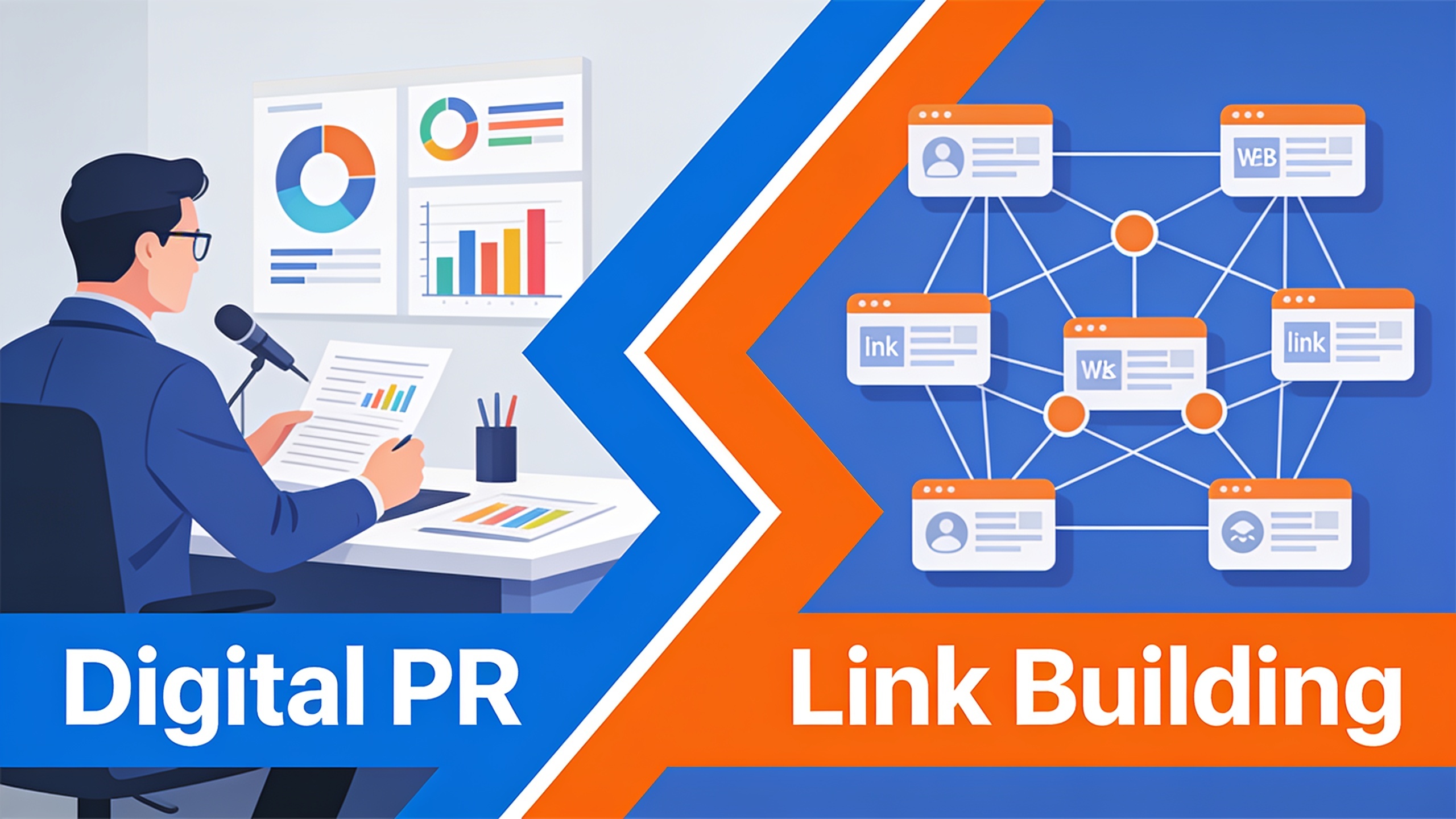
Let me walk through both properly so you can figure out where next quarter's effort (and cash) should actually go.
Table of Contents
- What Is Digital PR vs Link Building? Defining the Two Approaches
- Digital PR vs Link Building: Which Costs More?
- Which Scales Better in 2025: Digital PR or Link Building Tactics?
- Digital PR vs Traditional Link Building: Which Delivers Better Long-Term Rankings?
- Link Building Tactics 2025: What's Actually Working Now
- Is Combining Digital PR and Link Building the Best Strategy?
- Frequently Asked Questions
What Is Digital PR vs Link Building? Defining the Two Approaches
Digital PR is about earning media coverage, mentions, and backlinks by pitching newsworthy stories, data, or expert takes to journalists and publications. Traditional link building is the wider bucket of tactics you use to grab backlinks directly, often with no news angle whatsoever: guest posts, directory submissions, resource page outreach, broken link building, niche edits, link exchanges. Both live under off-page SEO. But the mechanics, the timelines, and honestly the skills you need are pretty different animals.
What Counts as Digital PR
Digital PR campaigns almost always spin around some kind of asset. An original survey, a proprietary dataset, a trend report, or a sharp expert opinion tied to something breaking in the news. A team (yours or an agency's) builds the thing, then pitches it out to journalists, bloggers, and industry pubs through email, HARO-style platforms (mostly folded into Connectively now), or good old-fashioned relationships with reporters. What you're chasing is coverage on high-authority sites. The kind that don't sell links and won't link to some random business unless you give them an actual reason.
What Counts as Traditional Link Building
Traditional link building covers the stuff you run week in, week out. Guest posting on niche blogs, submitting to relevant directories, reclaiming broken or unlinked mentions, getting onto resource pages, swapping links with other site owners in your niche or one next door. None of it needs a "story." It needs a relevant page, a halfway decent pitch, and a process for finding and vetting prospects at volume. That's why most SEO teams live here. It's repeatable, and it doesn't hinge on catching some overworked journalist at the right moment.
Digital PR vs Link Building: Which Costs More?
Digital PR usually costs more per campaign than traditional link building because it demands original research, creative assets, and outreach to people who genuinely don't have time for you. The payoff is a handful of very high-value links instead of a pile of small ones. Traditional link building runs cheaper per link and, honestly, way more predictably, since outreach templates, guest post fees, and exchange placements scale in a nice linear, budgetable line.
Think about what actually goes into a single PR campaign. You commission a survey, you design the data visualizations, you run a multi-week pitching cycle. That's usually a content writer, a designer, and a PR specialist or outreach lead all working together for weeks. And that cost is real whether or not the coverage lands. Campaigns flop. Good agencies will tell clients this upfront, because sometimes you spend all that money and the story just... doesn't catch. Traditional link building spreads its cost across a bunch of smaller transactions instead: an hour of outreach here, a modest guest post fee there, a reciprocal placement through a network you trust.
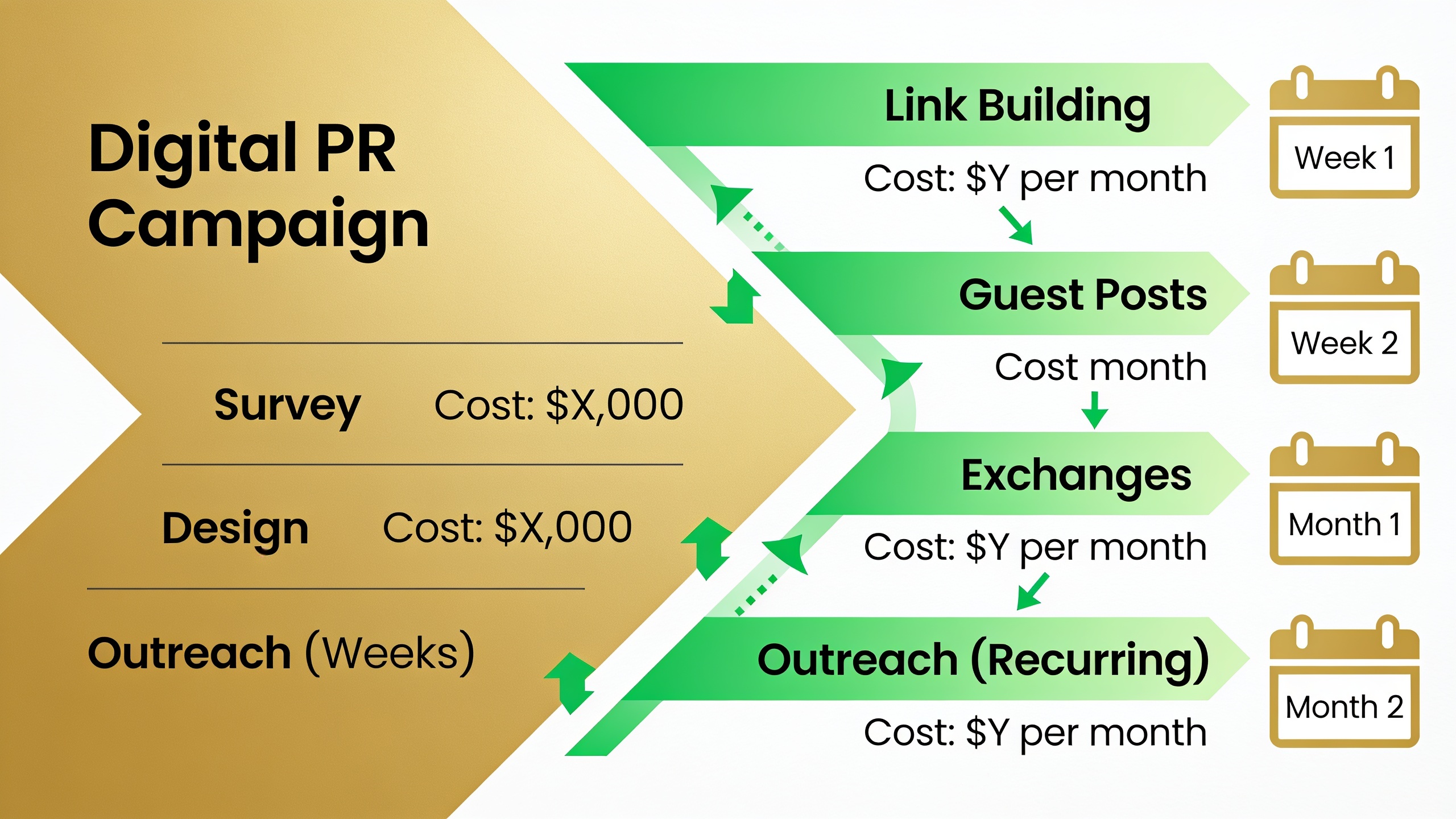
| Factor | Digital PR | Traditional Link Building |
|---|---|---|
| Typical cost structure | High upfront cost per campaign (research, design, outreach) | Lower cost per link, spread across many smaller efforts |
| Time to first result | Weeks to months, dependent on journalist response | Days to weeks, more predictable |
| Link authority potential | Very high when successful (national/trade media) | Moderate, depends on partner site quality |
| Volume of links per effort | Low-to-moderate; a handful of strong placements | Higher volume of moderate-strength placements |
| Repeatability | Harder to systematize; depends on newsworthy angles | Easier to systematize and repeat monthly |
| Risk profile | Low spam risk, but campaign can flop entirely | Risk varies by tactic; low-quality guest posts or paid links can trigger scrutiny |
| Best suited for | Brands with budget for research/creative and a PR narrative | Teams needing steady, budgetable link velocity |
I'm not saying one approach is objectively "worth more." That's the wrong way to look at it. It's just about where the money goes. Digital PR spends on creating assets and building media relationships. Link building spends on process, tooling, and managing partnerships. Different jobs, different bills.
Which Scales Better in 2025: Digital PR or Link Building Tactics?
Traditional link building tactics scale more predictably in 2025 because they don't wait around for a journalist's editorial calendar or hope some story goes viral. They just need enough relevant sites and a consistent outreach or exchange process. Digital PR doesn't scale in a straight line at all. One killer campaign might land coverage on dozens of sites in a single week, and then give you absolutely nothing for two months if your next story isn't sharp enough.
Scalability of Digital PR
Digital PR scales in bursts, and that's the whole problem. A well-timed data story tied to something trending can trigger a wave of coverage across news sites. But doing that again on command? Genuinely hard. You need a steady stream of fresh angles, and journalists get sick of hearing from the same brand over and over. Agencies running PR at any real scale usually keep dedicated researchers and a rotating list of story ideas going just to keep the pipeline from drying up. Which means each new campaign tends to cost more at the margin, not less.
Scalability of Modern Link Building Tactics 2025
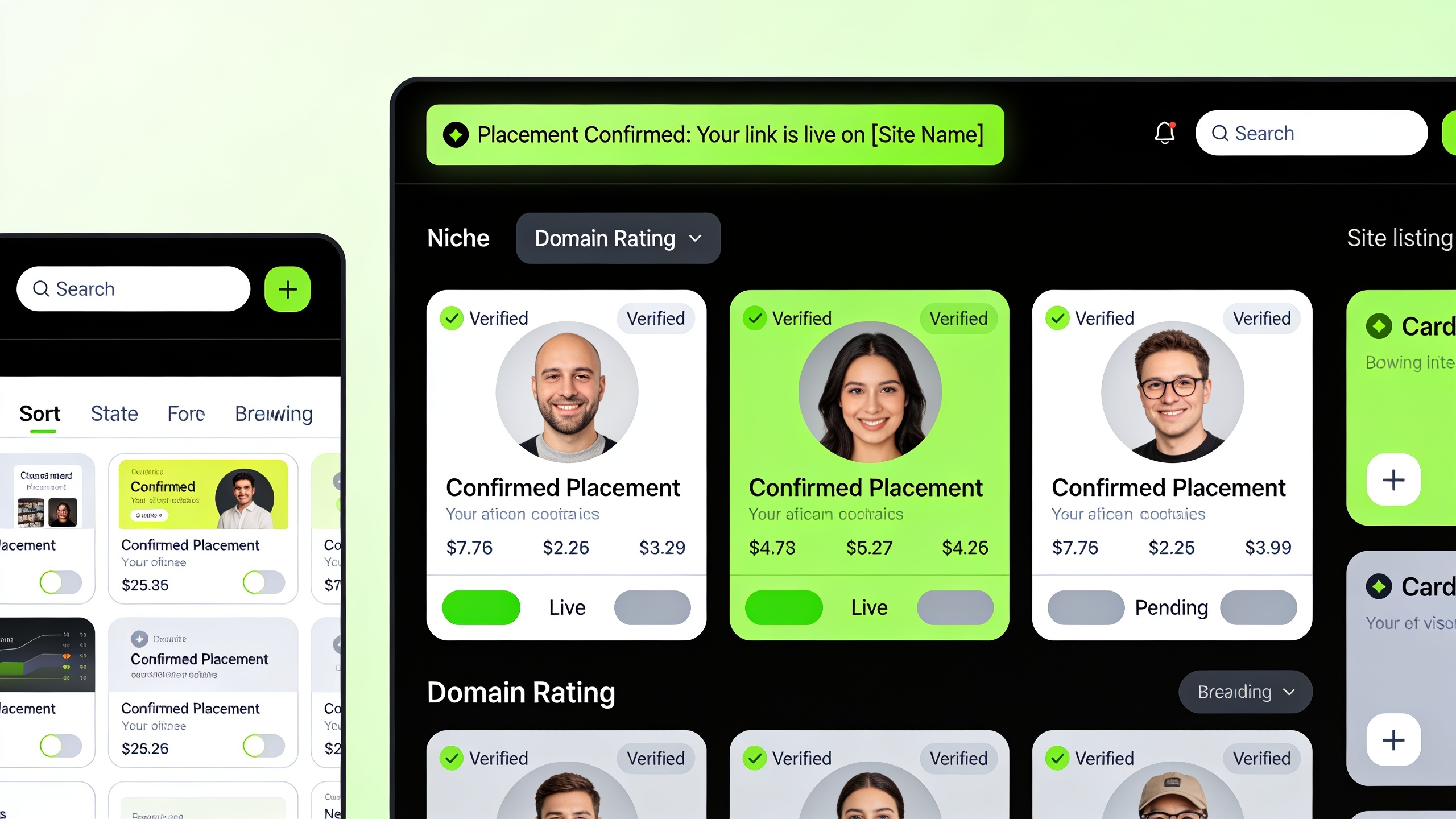
Modern link building in 2025 leans hard on relationships and platforms rather than mass cold email, mostly because inboxes are a warzone now and generic templates either get ignored or land straight in spam. So a lot of SEO teams are moving toward vetted backlink exchange networks, where site owners request and offer placements directly instead of firing off hundreds of emails into the void. This scales more smoothly for a simple reason: you've cut out the "will anyone even say yes" friction. You're talking to real site owners who already raised their hand to swap links in your niche and your Domain Rating range.
If you're thinking about going this route, do yourself a favor and read up on how backlink exchange networks work and why they're not PBNs before you sink time into any process. The gap between a manually reviewed exchange network and a private blog network is a big deal, both for link quality and for staying on the right side of Google.
Digital PR vs Traditional Link Building: Which Delivers Better Long-Term Rankings?
Digital PR tends to earn links from higher-authority, harder-to-manipulate domains, and those links usually hold their value longer because those sites rarely get deindexed, sold off, or quietly turned into link farms. Traditional link building can go the distance too, but it lives and dies by the quality of the partner site. A guest post on a well-maintained, topically relevant blog can hold value for years. A placement on some neglected, low-quality site can bleed value the second that site's authority slips or the page gets pulled.
Want content like this running on autopilot for your own site? Try RobinRank free — AI-written, SEO-optimized articles generated and published automatically, no credit card required.
The SEO studies from Ahrefs and Moz keep finding a correlation between the number of unique referring domains a page has and where it ranks. Both firms are careful about this, though, and I appreciate that. They flag that correlation isn't causation. Link count doesn't cause rankings, it's just one signal among many that Google weighs. And Google's own Search Central docs say the systems try to identify and, where they can, devalue or discount links built mainly to game rankings, rather than dropping a penalty on every unnatural link. That's a distinction worth sitting with. One sloppy backlink almost never tanks a site. A whole pattern of low-value, irrelevant links built purely for volume? That's exactly what Google's link-spam systems were built to sniff out.
This is where "which one lasts longer" stops being simple. A PR placement on a major news outlet isn't going anywhere fast. Those domains keep their editorial standards and their archives intact. But a link from a well-vetted exchange with a real, actively maintained site in your niche can be just as durable, as long as the site stays live and relevant. The links that scare me long-term are the ones from thin, purpose-built link farms and expired-domain networks. Those can evaporate overnight the moment the underlying site gets deindexed. If you're wondering whether reciprocal arrangements are safe for the long haul, seriously, go read Google's real stance on reciprocal links and link swapping first. The difference between a natural exchange and a manipulative scheme is exactly where your long-term risk hides.
Link Building Tactics 2025: What's Actually Working Now
The link building tactics winning in 2025 all share one thing: they care about relevance and verifiable placements more than raw volume. Search engines have gotten genuinely good at discounting junk links, so anything built on real relationships is pulling ahead of the mass-email approach. Guest contributions to active blogs, resource page mentions, PR-driven coverage, vetted exchanges. Those are working. Templated cold email? Not so much anymore.
A few tactics worth calling out by name:
- Journalist-facing PR outreach, usually through Connectively (which took over from HARO), where reporters put out calls for sources and quotes. It overlaps with digital PR but it's more reactive and a lot cheaper than a full research-driven campaign.
- Resource and broken-link outreach, where you spot dead links on relevant resource pages and offer a working replacement. This one's stuck around because it actually helps the site you're pitching.
- Vetted backlink exchange networks, where you browse listings by niche and Domain Rating, request a placement, and offer a reciprocal link back. The whole appeal in 2025 is speed and transparency. No guessing whether a cold email gets read. You're dealing directly with someone who already wants to swap.
- Original data and survey content, which honestly sits in both camps. A study or dataset becomes the hook you pitch to journalists and niche bloggers.
On the exchange side, platforms like RobinRank have built manually reviewed marketplaces specifically to close the trust gap in link building. Every site gets checked for a real, ownable domain and genuine content before it's let in. And once a placement goes live, the platform crawls the page to confirm the link is actually there, then keeps checking it on an ongoing basis. That verification step is a direct answer to one of the oldest headaches in traditional link building: placements that quietly vanish, get swapped out, or were never live to begin with. If you're managing links across a bunch of client sites, having a system that confirms a link exists and stays existing wipes out a manual QA chore that used to eat hours every single month.
Is Combining Digital PR and Link Building the Best Strategy?
For most teams, yeah, running both digital PR and traditional link building beats going all-in on one. They cover each other's weak spots. Digital PR gives you high-authority, hard-to-replicate links that show up whenever they feel like it. Traditional link building gives you steady, budgetable volume that keeps your backlink profile growing in between the big PR wins.
A practical way to split it: treat digital PR as a periodic investment. A quarterly or twice-a-year campaign built around something genuinely newsworthy. Then treat link building as the ongoing baseline that keeps placements flowing every month, no drama. Startups and small businesses without a real PR budget can lean way harder on the link building side, especially the relationship stuff like guest contributions and vetted exchanges, while still jumping on journalist queries through Connectively whenever a relevant story pops up. No reason not to.
Agencies juggling a bunch of client accounts usually run this hybrid by default anyway. A PR specialist handles the pitch-and-placement work for clients who can afford it, while a separate link-building workflow (more and more of it software-assisted now) handles the steady drip of niche-relevant placements for everyone else, big client or small. This is also where AI-assisted content platforms are quietly shifting the math. A platform that can write, optimize, and publish articles on its own drops the labor cost of producing the guest posts, resource pages, and linkable assets that both approaches depend on. Which narrows the gap between what a well-funded PR team can crank out and what one lean in-house marketer can actually manage alone.
Frequently Asked Questions
Is digital PR actually better than link building for SEO in 2025?
Neither one wins across the board. Digital PR tends to earn higher-authority links from news and industry pubs, while traditional link building is cheaper, faster to run, and way easier to scale consistently. Most SEO folks I know use both, just weighted differently depending on budget and how fast they need link velocity.
How much should a small business actually budget for digital PR vs link building?
There's no magic number, because it depends heavily on whether you run campaigns in-house or through an agency, plus how much research and design is involved. The general pattern holds, though: digital PR wants a bigger upfront chunk per campaign, while traditional link building (guest posts, resource outreach, backlink exchanges) can tick along on smaller, more predictable monthly budgets.
Are reciprocal link exchanges safe under Google's guidelines?
Google's guidelines go after link schemes built mainly to manipulate rankings, not every reciprocal relationship on principle. Whether an exchange is safe comes down to relevance, transparency, and whether the link genuinely helps users. There's a lot more nuance in Google's real stance on reciprocal links and link swapping if you want the full picture.
How long before I see ranking results from digital PR versus link building?
Digital PR results can show up quick if a campaign lands big coverage, but building a repeatable pipeline of those wins takes months. Traditional link building tends to give you a steadier, more incremental lift over weeks and months as referring domains pile up, rather than one dramatic spike.
Can AI tools help with digital PR or link building in 2025?
They can speed up the research, drafting, and optimization behind both, like generating the on-site content and linkable assets that support your outreach. And backlink exchange platforms now use verification systems to confirm placements are live instead of leaning on manual spot-checks. The pitching and relationship side of digital PR, though? Still very much a human job. Journalists don't build relationships with your software.
Look, picking between digital PR and traditional link building was never really about crowning a winner. It's about matching the tactic to what your site needs right now. Short on link velocity and want something repeatable that won't blow the budget? A vetted exchange network is usually the faster place to start. Got a genuinely newsworthy story and the money to pitch it properly? Digital PR can open doors that link building alone never touches. And most sites that actually grow their organic traffic year after year? They use a blend, and they adjust it as their budget and content pipeline shift. Do the same.
Ready to stop writing content by hand? Start your free RobinRank trial and get a full month of SEO-optimized articles published on autopilot.