Domain Authority Explained: What It Really Means for Your SEO
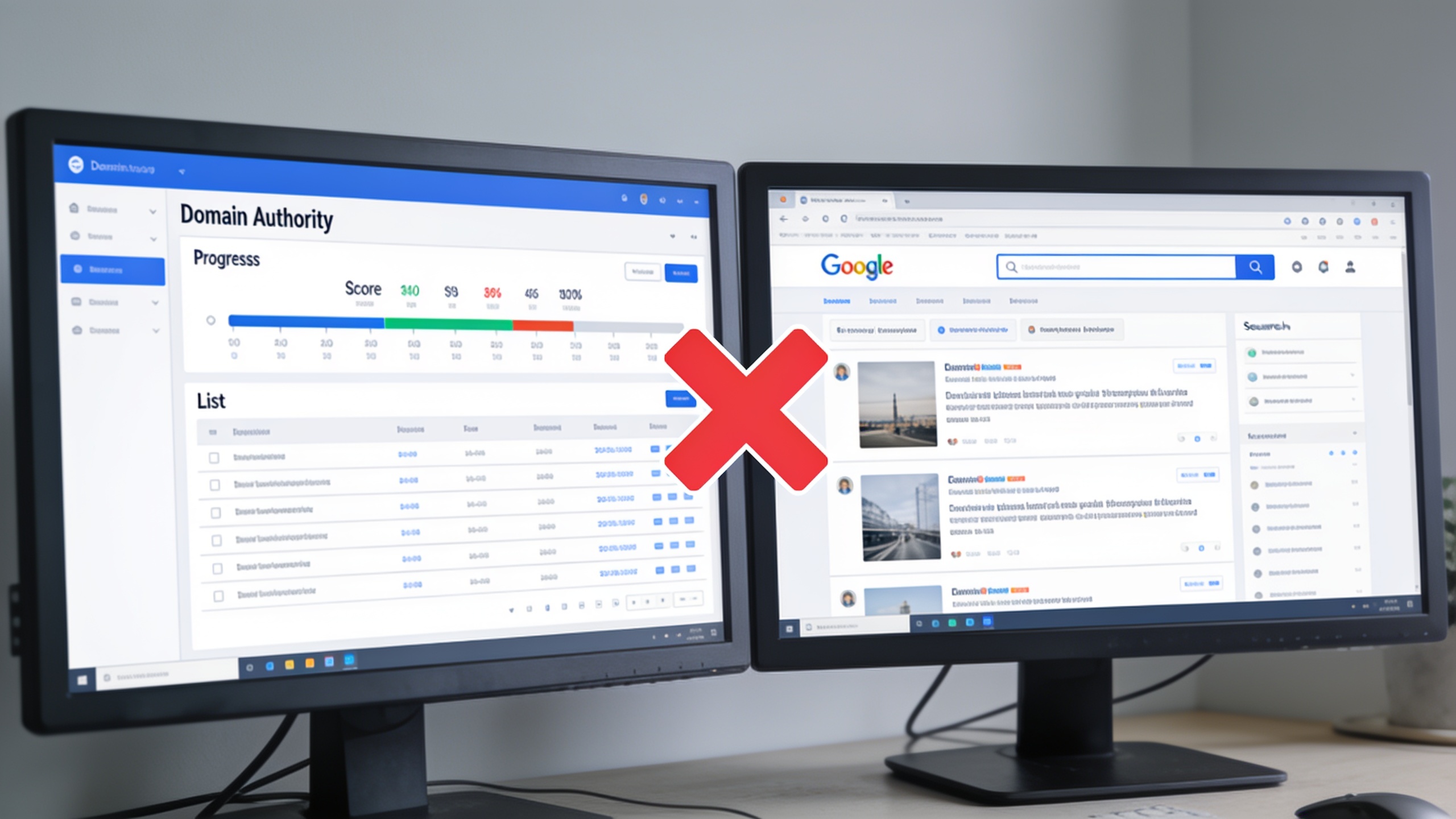
Quick version, so you're not left hanging: Domain Authority is a third-party score cooked up by the SEO software company Moz. It estimates how likely a site is to rank in search, based mostly on its backlink profile. Google doesn't use it. It's not standardized across tools. And it deserves to be treated as one directional signal among many, not a scoreboard you lose sleep over.
Table of Contents
- What Is Domain Authority?
- Domain Authority Explained: How the Score Is Calculated
- Domain Authority Explained: Why It Isn't a Google Ranking Factor
- DA vs. Other Authority Metrics
- The Real Limitations of Domain Authority
- How Much Weight Should Domain Authority Carry in SEO Decisions?
- How to Actually Improve Your Site's Authority (Beyond Chasing a Score)
- FAQ: Common Questions About Domain Authority
What Is Domain Authority?
Domain Authority is a proprietary metric from Moz that scores a website from 1 to 100 to predict its relative ability to rank in search results compared to other sites. That's it. It's not something Google produces, endorses, or even glances at. It's an independent, third-party estimate built from Moz's own crawl of the web and its own link graph.
And the word "relative" is doing a lot of heavy lifting there. A DA of 40 means basically nothing on its own. It's a comparative score, meant to be read against your competitors in the same niche or the same SERP. So if your site sits at 35 and your top three competitors are hanging out in the 55 to 60 range, that gap actually tells you something about the relative link-based muscle of your domain versus theirs. But 35 in a vacuum? It doesn't promise you a ranking, and it doesn't ban you from one either.
Here's the part people gloss over. Moz built DA using machine learning models trained on real Google search results, basically looking for patterns between link profiles and ranking outcomes. Read that again, because it matters: DA is Moz's attempt to reverse-engineer what tends to correlate with rankings. It's not a number Google hands them, and it's definitely not a number Google feeds into its own algorithm. Get that straight and the rest of this makes a lot more sense.
Domain Authority Explained: How the Score Is Calculated
Domain Authority is calculated from a mix of linking root domains, total backlinks, and the overall quality of those links, all run through a machine-learning model Moz keeps retraining against real search results. One detail that trips people up constantly: the score is logarithmic.
Why the Scale Isn't Linear
Because DA runs on a logarithmic scale, climbing from 20 to 30 is a much smaller lift than going from 70 to 80. The higher you get, the more link equity you need just to nudge the number. This is exactly why a scrappy local business site might jump ten points in a couple of months after a modest link push, while some giant enterprise brand grinds away for a full year and gains, what, two or three points?
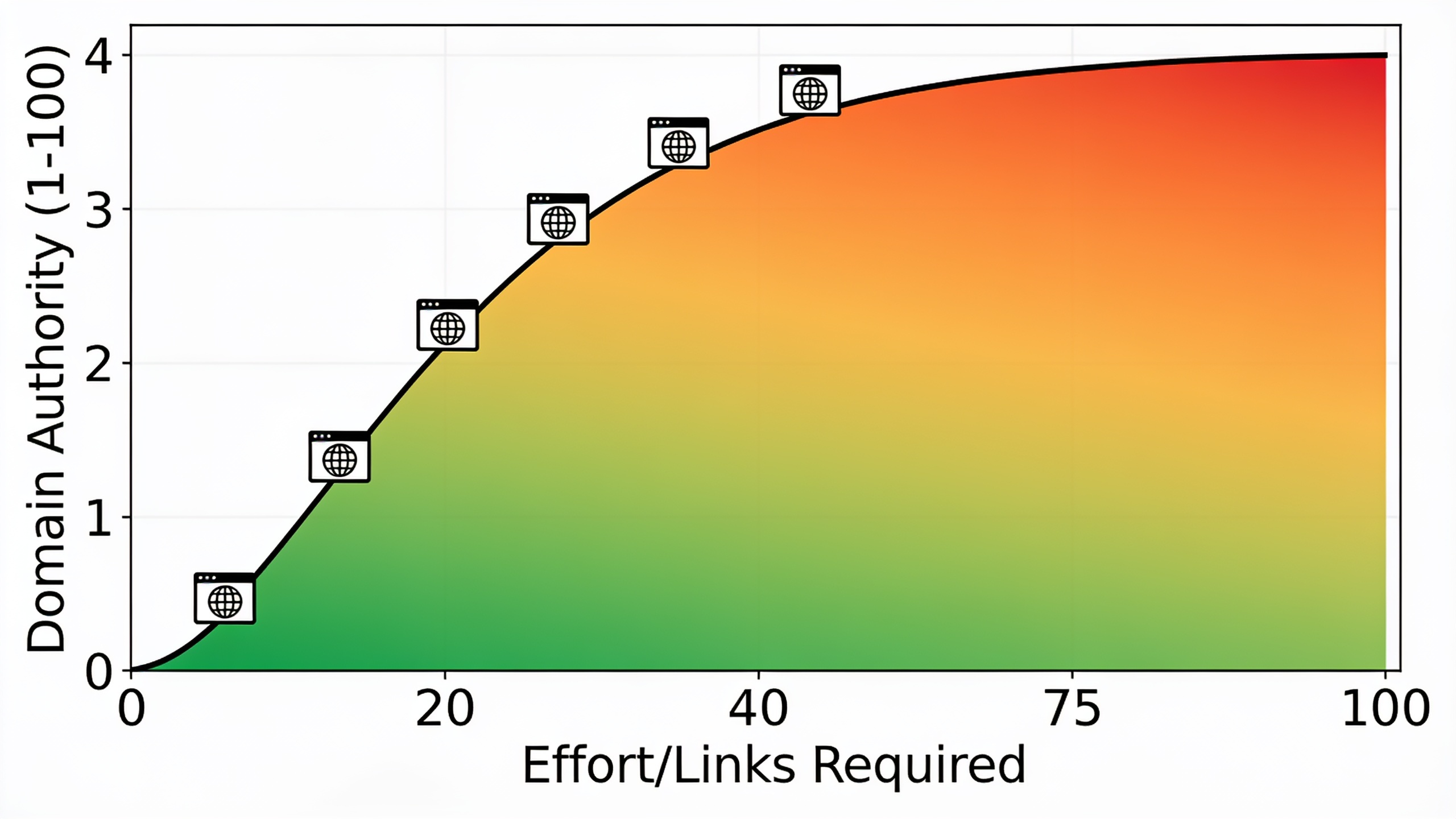
So if you're benchmarking progress, that curve matters way more than most people give it credit for. A flat-lining DA up near the top of the scale doesn't mean your link strategy died. It might just mean you've hit the part of the curve where movement gets brutally slow.
What Factors Feed Into It
According to Moz's own documentation, the model leans on a handful of things: the total number of linking root domains (the unique websites pointing at you), the overall quality of that link profile including how authoritative those linking domains are themselves, and historical patterns pulled from sites that already rank well in Google.
Oh, and one more wrinkle. Moz updates its DA model from time to time, which means your score can move even when nothing on your own site changed. A competitor gains a bunch of links, or Moz recalibrates the model, and suddenly your number ticks up or down without you lifting a finger. Keep that in your back pocket.
Domain Authority Explained: Why It Isn't a Google Ranking Factor
Domain Authority is not part of Google's ranking algorithm, full stop. Google reps, including Search Advocate John Mueller, have said publicly and repeatedly that third-party authority scores like DA aren't something Google uses to rank pages. Honestly, this is the single most important thing to understand about DA, because so much SEO strategy gets built around chasing a number that Google itself never looks at.
But hold on, that doesn't make DA useless. It makes it a proxy, not a cause. And that distinction is everything.
Backlinks from authoritative, relevant sites really do help a lot of sites rank better, because Google's own systems (including whatever's left of the PageRank-derived link signals) genuinely weigh link equity. DA is Moz's model of that underlying reality, built on its own crawl data. The two are correlated. They're just not the same thing. You can improve your real ranking signals without your DA budging much, and you can pump up DA without meaningfully moving your rankings at all.
So when a prospective client leans across the table and asks, "What's our DA, and can you get it to 50?" the honest answer is: DA's a handy shorthand for talking about relative link strength, but it should never be the target in a scope of work. The target is organic visibility, rankings for the query clusters that matter to your business, and qualified traffic. DA is, at absolute best, a leading indicator sitting upstream of all that.
DA vs. Other Authority Metrics
DA isn't the only authority score in town, and this is where a lot of newer marketers get tangled up. Different tools use different methodologies, different scales, and different underlying indexes. That's precisely why the same website can show wildly different numbers depending on where you look.
Take Ahrefs. It has its own metric, Domain Rating (DR), which also runs 0 to 100 but is calculated purely from backlink data in Ahrefs' own index, without the broader machine-learning correlation to search rankings that Moz layers on. Semrush has its Authority Score. None of these are interchangeable. And I'll say it one more time because it bears repeating: none of them are numbers Google generates or consults.
| Metric | Created By | What It's Based On | Scale | Used by Google? |
|---|---|---|---|---|
| Domain Authority (DA) | Moz | Link profile data + machine-learning correlation with search results | 1-100, logarithmic | No — third-party estimate only |
| Domain Rating (DR) | Ahrefs | Backlink profile data from Ahrefs' own index | 0-100 | No — third-party estimate only |
| Authority Score | Semrush | Backlink data, organic traffic data, and spam signals | 0-100 | No — third-party estimate only |
| PageRank (legacy concept) | Historically, link-based algorithmic signal; publicly deprecated as a visible metric | Not publicly shown | Was part of Google's algorithm historically |
Practical takeaway? When you're pitching a client or sizing up a backlink opportunity, don't mix and match scores from different tools like they're the same currency. A site showing DA 45 in Moz and DR 60 in Ahrefs isn't contradicting itself. Those are two different rulers measuring a related but not identical thing. This is also why a lot of backlink networks and outreach platforms just pick one metric and standardize on it internally. RobinRank's backlink exchange, for instance, evaluates opportunities using Domain Rating and issues DR-weighted credits when outbound links are verified live, which keeps the accounting consistent across every site in the community instead of blending numbers from a bunch of different tools.
The Real Limitations of Domain Authority
The biggest limitation of DA is simple: it measures link-based potential, not actual ranking performance, topical relevance, content quality, or user experience. And all four of those matter enormously in modern search. A site can carry a perfectly respectable DA and still faceplant on its target keywords if the content misses search intent, if technical junk is blocking the crawler, or if a competitor's page is just plain more relevant and thorough.
It Says Nothing About Relevance
DA gets calculated at the domain level, smooshing link signals across your whole site into one number. Which means a domain can flaunt a high overall score while individual pages on it are thin, outdated, or wildly off-topic and will never rank for anything competitive. Google increasingly evaluates pages and topical clusters, not domains floating in the abstract. That's a big part of why comprehensive, well-structured content matters at least as much as raw link volume.
Want content like this running on autopilot for your own site? Try RobinRank free — AI-written, SEO-optimized articles generated and published automatically, no credit card required.
It Can Be Gamed, and Moz Knows It
Since DA is link-driven, you can artificially pump it up with low-quality link schemes, private blog networks, or bulk directory spam. At least temporarily, right up until those links get devalued or the site gets swept up in a spam detection pass. A high DA built on manipulative tactics isn't an asset. It's a liability with a delayed fuse, especially since Google's spam-detection systems couldn't care less what any third-party metric says.
It Updates on Its Own Schedule
Because Moz periodically recalculates and retrains its model, your DA can wobble even when your own backlink profile hasn't changed at all. Maybe the algorithm shifted. Maybe competitors in your space gained or lost links. Treating month-to-month DA swings as a report card on your SEO team is a really common mistake, and a misleading one.
It Ignores On-Page and Technical Factors Entirely
DA doesn't know or care about page speed, mobile usability, structured data, content freshness, or E-E-A-T signals. All things Google's own guidance harps on, over and over. A technically excellent site with a modest DA can absolutely outrank a link-heavy but technically neglected competitor, particularly for competitive queries where user experience becomes the tiebreaker. If your site's fighting slow load times or clunky mobile behavior, it's worth digging into dedicated guidance like this rundown of mobile SEO best practices for 2025, because mobile problems can quietly undercut even a strong backlink profile.
How Much Weight Should Domain Authority Carry in SEO Decisions?
DA should carry moderate, directional weight. Genuinely useful for quick comparative snapshots and for prioritizing outreach targets, but it should never be the headline KPI you report to stakeholders or the thing that tips a major strategic decision. Think of it like the estimated resale value of a car you find online. Fine for a gut check. Not something you'd hand a buyer without actually looking under the hood.
Where's it actually pulling its weight? A few places. When you're staring down dozens of potential guest posts or link opportunities, DA (or DR, or Authority Score) gives you a fast way to filter out the obviously weak and spammy stuff before you commit to deeper manual review. It's also great for framing competitive conversations. Telling a client "our top three competitors average a DA in the 50s and we're at 30" is a clean, digestible way to explain why a link-building investment makes sense. And watching DA trend upward over six to twelve months, alongside your other metrics, can help confirm a campaign is compounding.
Now, where it should never be steering the ship. Don't make it a standalone success metric in a contract or a report. If an agency's core deliverable is "increase DA by X points," they're optimizing for the proxy instead of the outcome, which is traffic, rankings, and conversions. Don't let it override relevance either. A moderately authoritative site smack in your niche is usually a better link source than a very high-DA site in some unrelated industry, because Google weighs topical relevance independently of raw link authority. And please, don't use it to justify buying links. Since DA can be juiced short-term, leaning on it to rationalize purchases from junky networks is a strategy that tends to fall apart the moment those links get devalued or penalized.
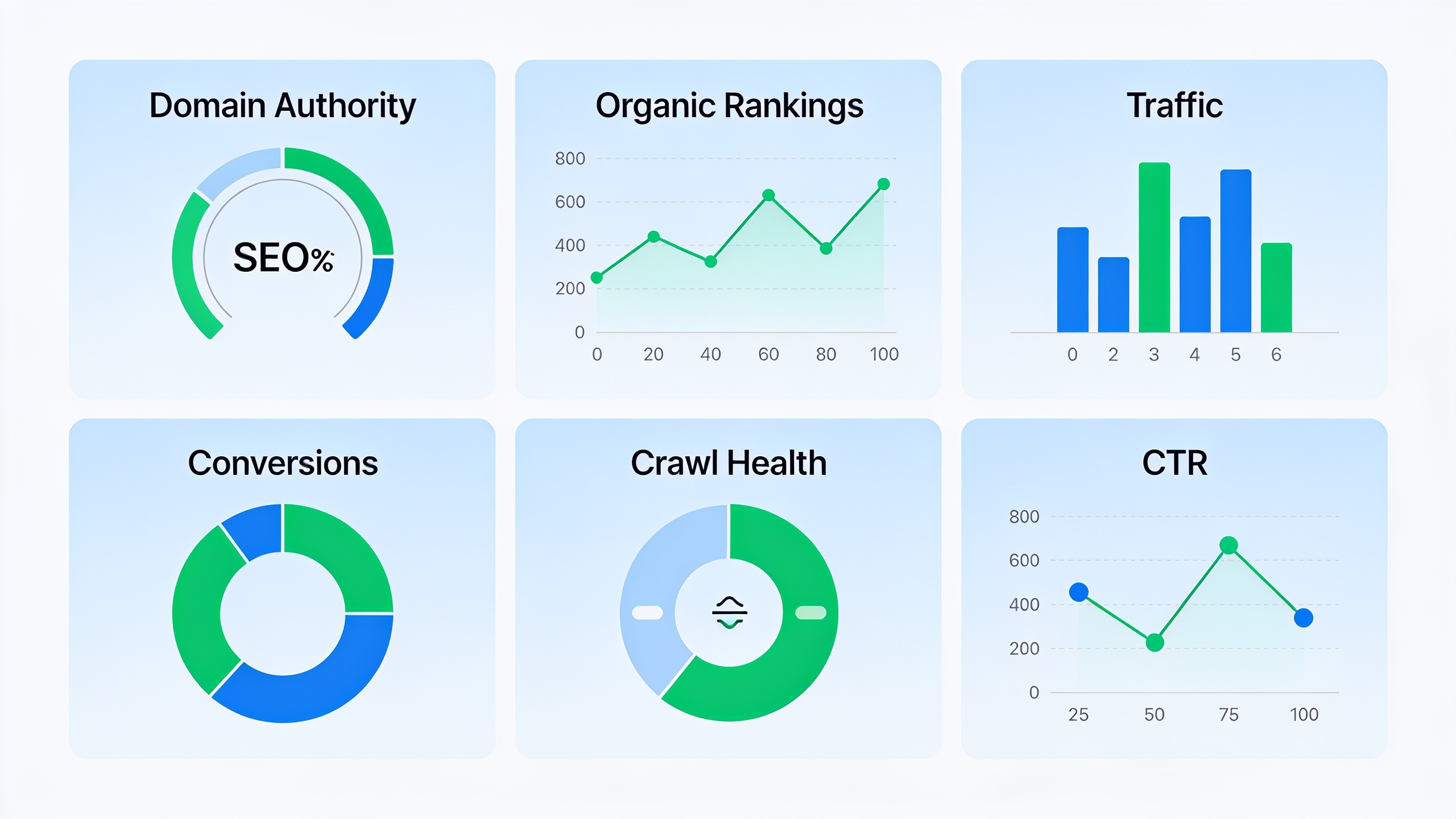
The healthiest way to use DA is as one column in a bigger dashboard that also tracks organic keyword rankings, indexed page count, crawl health, click-through rates, and conversion data. If DA is the only number your team watches, that's usually a sign the whole program is optimizing for vanity over results.
How to Actually Improve Your Site's Authority (Beyond Chasing a Score)
The most reliable way to improve real, underlying authority is to earn links from relevant, editorially legitimate sources while shoring up the technical and content foundations that let those links translate into rankings. Moving the number itself is a byproduct of doing that work well. It's not a target you can shortcut your way to and expect it to stick.
Publish Content Worth Linking To
Sites earn organic backlinks by publishing genuinely useful, well-researched stuff. Original data, practical guides, tools that actually solve a problem someone has. Generic, thin content rarely attracts natural links no matter how much outreach muscle you throw behind it. This is another reason structured, comprehensive content pays off: pages that are crystal clear about what they cover and back their claims with real explanation are simply easier for other publishers to cite.
Get the Technical Foundation Right
Structured data is worth prioritizing here, and I'd bump it near the top of the list. It helps search engines and AI systems understand exactly what a page is about, which supports both visibility and the kind of clean entity recognition that makes a page more citable. If you haven't touched structured data yet, the guide on how structured data helps you rank walks through the practical mechanics of adding schema markup without needing a developer team on speed dial.
Build Links Through Genuine Relationships and Exchanges
Manual outreach eats time. Low-quality link buying carries real risk. There's a middle path a lot of teams use: a structured, community-based exchange. You publish useful content that naturally links out to relevant sites, and in return you get contextual links back once your own outbound links are verified live. That's the model RobinRank's backlink network runs on. Outbound links earn Domain Rating-weighted credits after they're confirmed published and live, then those credits get spent when another member's article links back to you, with matching based on niche, language, Domain Rating, and contribution history. It's a way to build a real link profile without the labor cost of cold outreach or the risk profile of anonymous paid schemes.
Be Patient With the Metric, Not the Strategy
Since DA and its cousins update on their own cadence and follow that logarithmic curve, don't expect tidy linear month-over-month movement even when your strategy's clearly working. Track the leading indicators instead. New referring domains, published article velocity, keyword ranking movement. Let the third-party score catch up on its own timeline. It will.
FAQ: Common Questions About Domain Authority
So what is Domain Authority, in one sentence?
It's a 1-100 score from Moz that estimates, on a comparative basis, how likely a website is to rank in search results, mostly based on the strength and quantity of its backlink profile.
Is Domain Authority the same thing as Google's ranking algorithm?
No. DA is an independent, third-party metric Moz built using its own index and machine-learning model. Google has flatly stated it doesn't use DA, or any similar third-party score, in its own ranking systems.
Why does my site show a totally different score in different tools?
Because Moz's DA, Ahrefs' DR, and Semrush's Authority Score are each calculated with different data sets, different indexes, and different methods. Related concepts, different rulers. Discrepancies between them are completely normal, not a sign one tool is broken.
Can a low-DA site outrank a high-DA competitor?
Yes, and it happens all the time. Relevance, content quality, technical health, user experience, and search intent match all feed into real Google rankings. A lower-authority site that nails those can absolutely beat a higher-authority domain that doesn't.
How often does Domain Authority update?
Moz refreshes its DA model periodically, and because the calculation involves the entire web's link graph, your score can shift with zero change to your own site. Maybe competitors' link profiles moved, maybe Moz recalibrated. Either way, not on you.
Should I just stop tracking Domain Authority entirely?
Nah, not necessarily. It's still a reasonable quick-reference for competitive benchmarking and link-prospecting triage. The trick is never letting it become the main success metric, and always pairing it with real performance data like organic rankings, traffic, and conversions.
---
Domain Authority is a compass, not a destination. It gives you a rough sense of how your link profile stacks up against the competition, but it was never built to be, and Google never adopted it as, a measure of actual ranking power. The sites that consistently win in organic search treat authority as an outcome of good content, solid technical foundations, and genuine relevance, not a score to game or chase in a vacuum. Build the fundamentals well, and honestly? The number tends to take care of itself.
Ready to stop writing content by hand? Start your free RobinRank trial and get a full month of SEO-optimized articles published on autopilot.