E-E-A-T AI Content: How to Pass Google's Trust Test
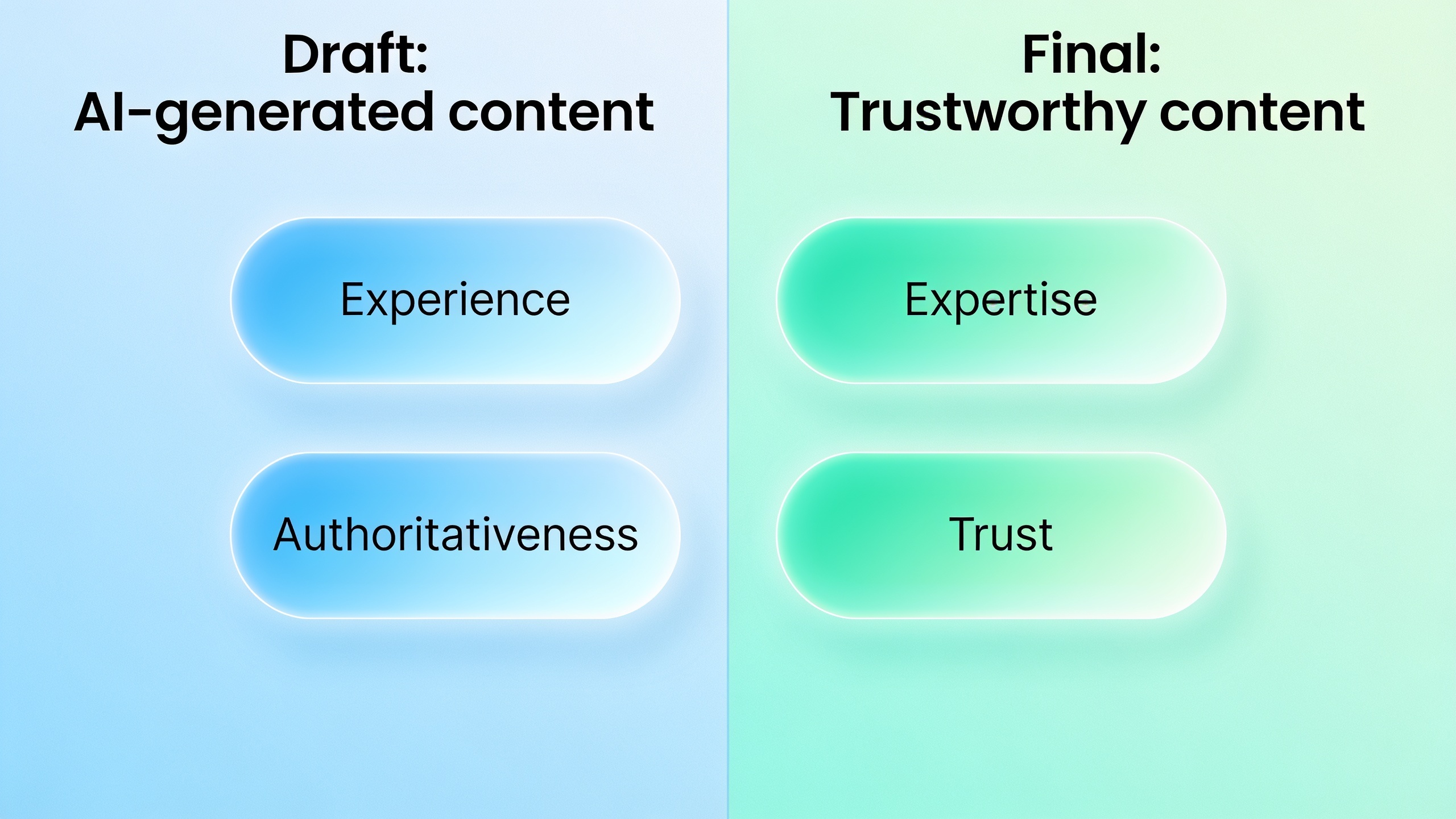
So this piece is about what E-E-A-T really means when a machine (or a machine plus a person) is doing the writing. Why some AI content sinks like a stone while other AI content ranks and stays ranked. And how to build a process you can actually repeat, one that keeps human readers and Google's Search Quality Rater Guidelines both happy.
Table of Contents
- What Is E-E-A-T and Why Does It Matter for AI Content?
- Can AI-Generated Content Actually Pass Google's E-E-A-T Test?
- How to Add Real Experience Signals to AI-Written Articles
- Building Expertise and Authoritativeness Into Automated Content
- Trust Signals: The Most Overlooked Part of E-E-A-T AI Content
- How Backlinks and Distribution Reinforce Trustworthy AI Generated Articles
- A Practical E-E-A-T Checklist for AI Content Workflows
- Frequently Asked Questions
What Is E-E-A-T and Why Does It Matter for AI Content?
E-E-A-T is the framework Google's human quality raters use to decide whether your content, and the site it's sitting on, deserves to be trusted. The letters stand for Experience, Expertise, Authoritativeness, and Trust. It comes straight out of Google's Search Quality Rater Guidelines, a public document Google hands to the actual people who manually grade search results. Basically it's the closest thing we've got to an official scorecard for "what good content looks like."
Fun bit of history: it used to be just three letters. E-A-T. Expertise, Authoritativeness, Trust. Then in December 2022 Google bolted on a second "E" for Experience, specifically to capture whether the person writing has actual, hands-on, real-world familiarity with the thing they're describing. And honestly, that one addition is a big deal for AI content. Because a language model has never experienced anything. It can tell you exactly what a good product review reads like. It has never once touched the product. That gap right there is what raters (and increasingly Google's ranking systems) are trained to sniff out.
Why does this matter so much for AI stuff in particular? Because Google keeps saying, over and over, that it doesn't care how the content got made. Human, tool, some blend of both, whatever. It only cares whether the result is helpful, original, and trustworthy. So AI-assisted content isn't automatically disqualified. But the flip side is the burden falls entirely on you, the publisher, to inject the things AI can't manufacture on its own. Real experience. Provable subject-matter authority. Transparent trust markers like sourcing, a real author, and someone actually accountable for what got published.
Can AI-Generated Content Actually Pass Google's E-E-A-T Test?
Yes, AI content can pass Google's E-E-A-T evaluation, but only when a human or an editorial process bolts on the experience and accountability layers the AI can't produce itself. Google has never banned AI content. Its official line is that automation used mainly to game rankings breaks its spam policies, while automation used to help make genuinely useful content is totally fine.
The real dividing line isn't "AI vs. human." It's "helpful vs. manipulative." A 100% AI-written article that cites real data, gets fact-checked, carries a named author with credentials you can actually verify, and gets updated when things change? That can pass. Meanwhile a human-written article that's thin, generic, and has no visible author or sources can flunk just as hard. What actually gets flagged is the mass-produced stuff with zero evidence of expertise or oversight. That's the pattern Google's guidelines literally describe as "lowest quality," where a page shows no sign the creator has any real experience or expertise for the subject.
Which is exactly why any tool built for automated publishing has to bake E-E-A-T into the pipeline instead of duct-taping it on at the end. Platforms like RobinRank, which writes, optimizes, and publishes articles for businesses on autopilot, are only ever as good as the trust signals wrapped around what they spit out. Accurate sourcing, a defined author presence, and a review layer that catches factual drift before it goes live. Skip those and you're just automating your way into trouble faster.
How to Add Real Experience Signals to AI-Written Articles
The quickest way to add Experience to AI content is to get a real human to drop in first-hand detail the AI could never make up. A specific outcome. A screenshot. A number from your own data. A mistake you made and how you fixed it. In Google's framework, Experience is about whether the writer has actually done the thing. And it's the hardest pillar for AI to fake, because it depends on lived reality, not on pattern-matching a pile of existing text.
Here's what that looks like when the rubber meets the road.
Layer in observations only you could have. Say your AI drafts a "best CRM software" roundup. A human reviewer should go in and add stuff like "we ran this on a 40-person sales team for three months" or "support got back to us in under two hours when we tested it." A model basically can't hallucinate those convincingly, and they read as authentic for the simple reason that they are.

Use real examples instead of the vague ones. Skip "many businesses see improved conversion rates." Name the business, say what they changed, give the rough before and after. But, and this is important, only if you actually have the data. If you don't have a verified number, describe the direction of the change in plain words rather than inventing a stat. A made-up figure is a way bigger trust risk than no figure at all.
Show the work, not just the answer. Screenshots, a quick video, a step-by-step walkthrough of some tool, all of it screams "a human actually used this." It's also why long-term content assets do better with a documented testing process behind them, something I get into more in this guide to building an evergreen content strategy. The gist there is that articles meant to stay accurate for years need periodic re-verification, not a single fact-check the day they go live and then radio silence forever.
And attribute the experience to an actual person. "Our head of SEO tested this workflow across 12 client sites" hits way harder than some faceless claim floating in the void, because now the experience has an owner who's accountable for it.
Building Expertise and Authoritativeness Into Automated Content
Expertise means the content shows accurate, deep subject knowledge, while Authoritativeness means the site and author are actually recognized as a credible source on the topic. AI content earns both by getting fact-checked against primary sources and published under a real, consistent identity. The two work as a pair, really. Expertise is about the content itself. Authoritativeness is about the reputation stuck to it.
For expertise, the highest-leverage move by a mile is accuracy review. AI models are terrifyingly good at producing smooth, confident-sounding text that is flat-out wrong. There's even a name for it: hallucination. So every specific claim, stat, date, or named entity in an AI draft needs to get checked against a real primary source before it goes anywhere. Can't verify a claim? Soften it into a general statement. Don't gamble.
Authoritativeness is a slower burn, and consistency matters way more than any single article. A site that drops one gorgeous, deeply-sourced piece and then goes quiet looks less authoritative than one that patiently builds a coherent cluster over time, internal links tying the related pieces together, a visible author or editorial team standing behind it all. This is also where distribution quietly feeds back into the picture. Content that lives only on your own blog and never gets cited, shared, or linked anywhere else sends a weaker signal than content that actually circulates. Getting off your own island (guest placements, partner sites, newsletters, communities) is one of the more practical ways to build that footprint, and this breakdown of content distribution channels beyond your company blog runs through a bunch of concrete options.
Author pages matter here too, and people constantly forget them. A byline that links to a real bio, real credentials, and other stuff that person has published gives both readers and Google's systems a way to judge whether the human behind the content actually knows what they're talking about. AI content published anonymously, no attribution, no editorial name attached? You just threw that whole signal in the trash.
Trust Signals: The Most Overlooked Part of E-E-A-T AI Content
Want content like this running on autopilot for your own site? Try RobinRank free — AI-written, SEO-optimized articles generated and published automatically, no credit card required.
Trust is the foundation of the entire E-E-A-T framework. Google's own guidelines call it the most important element, because content that's accurate but presented in a sketchy way (murky sourcing, no clue who wrote it, misleading claims) still fails. And for AI content specifically, trust is the pillar that gets skipped constantly, mostly because it's invisible in the text itself. It lives in everything around the text.
A few of the concrete trust signals worth nailing down:
- Transparent sourcing. Link to the actual primary source for any stat or study you cite, and never, ever attribute a number to a source you haven't personally confirmed.
- Accurate, current info. Stale pricing, dead features, ancient statistics. All of it torches trust fast, especially in fast-moving worlds like SEO and software.
- Consistency between claims and evidence. If your article says a tool "automatically verifies" something, the article (and the tool) had better actually do that. Overstating things is one of the quickest ways to lose a reader and a rater in one shot.
Two more that don't fit neatly in a list. First, some editorial disclosure about how the thing was made. A lot of publishers now note when AI helped with drafting. Whether or not you spell that out, the content should read like a human reviewed it and would put their name on it. Second, the boring infrastructure stuff. Trust extends past the article to the site hosting it. Broken links, aggressive ads shoving into your face, no about or contact page anywhere. All of that chips away at how trustworthy the whole thing feels.
Here's how each pillar tends to shake out for AI-assisted content, and what closes the gap.
| E-E-A-T Pillar | What Google's Raters Look For | Common AI Content Gap | How to Close It |
|---|---|---|---|
| Experience | First-hand use or direct involvement with the topic | AI has no lived experience to draw on | Add human-verified observations, screenshots, or tested outcomes |
| Expertise | Accurate, in-depth subject knowledge | AI can hallucinate facts or oversimplify nuance | Fact-check every specific claim against primary sources |
| Authoritativeness | Recognized reputation of the site/author on the topic | Thin author info, no topical consistency | Named bylines, author bios, topic clusters, external distribution |
| Trust | Transparency, accuracy, and site-wide credibility | No sourcing, stale data, unclear authorship | Cite sources, disclose review process, keep content updated |
How Backlinks and Distribution Reinforce Trustworthy AI Generated Articles
Backlinks and distribution reinforce trustworthy AI generated articles because they're third-party validation. Other sites vouching for you, kind of like citations validating a research paper. A site publishing AI-assisted content in total isolation, nothing external pointing at it, gives Google's systems almost nothing to work with beyond the words on the page.
This is where link building runs smack into E-E-A-T. Google's been crystal clear that manipulative link schemes (buying links purely to pump up rankings) break its spam policies. But earning links because real site owners genuinely find your content useful? That's a legit authority signal. The difference is intent and process, not whether a link exists.
A manually-reviewed exchange model tackles this head-on. RobinRank, for instance, runs a backlink exchange network where site owners request placements from each other, offer reciprocal links when it actually makes sense, and every site gets reviewed by a human before it's let into the network. RobinRank says it rejects PBNs, link farms, and thin doorway pages, and it checks for an ownable domain, real content, and honest Ahrefs Domain Rating numbers instead of borrowed parent-platform DR. Once a placement goes live, the platform crawls the page, confirms the href is really there, and keeps checking weekly. Which matters for trust because a link that quietly vanishes after payment is a textbook low-quality tell, while a verified, stays-live placement behaves a lot more like an organic citation.
For AI-published content especially, pairing an automated writing-and-publishing setup with a verified link-building layer patches two E-E-A-T holes at once. The content gets fact-checked and structured for expertise, and the link profile around it builds the authoritativeness that isolated content just can't conjure up by itself.
A Practical E-E-A-T Checklist for AI Content Workflows
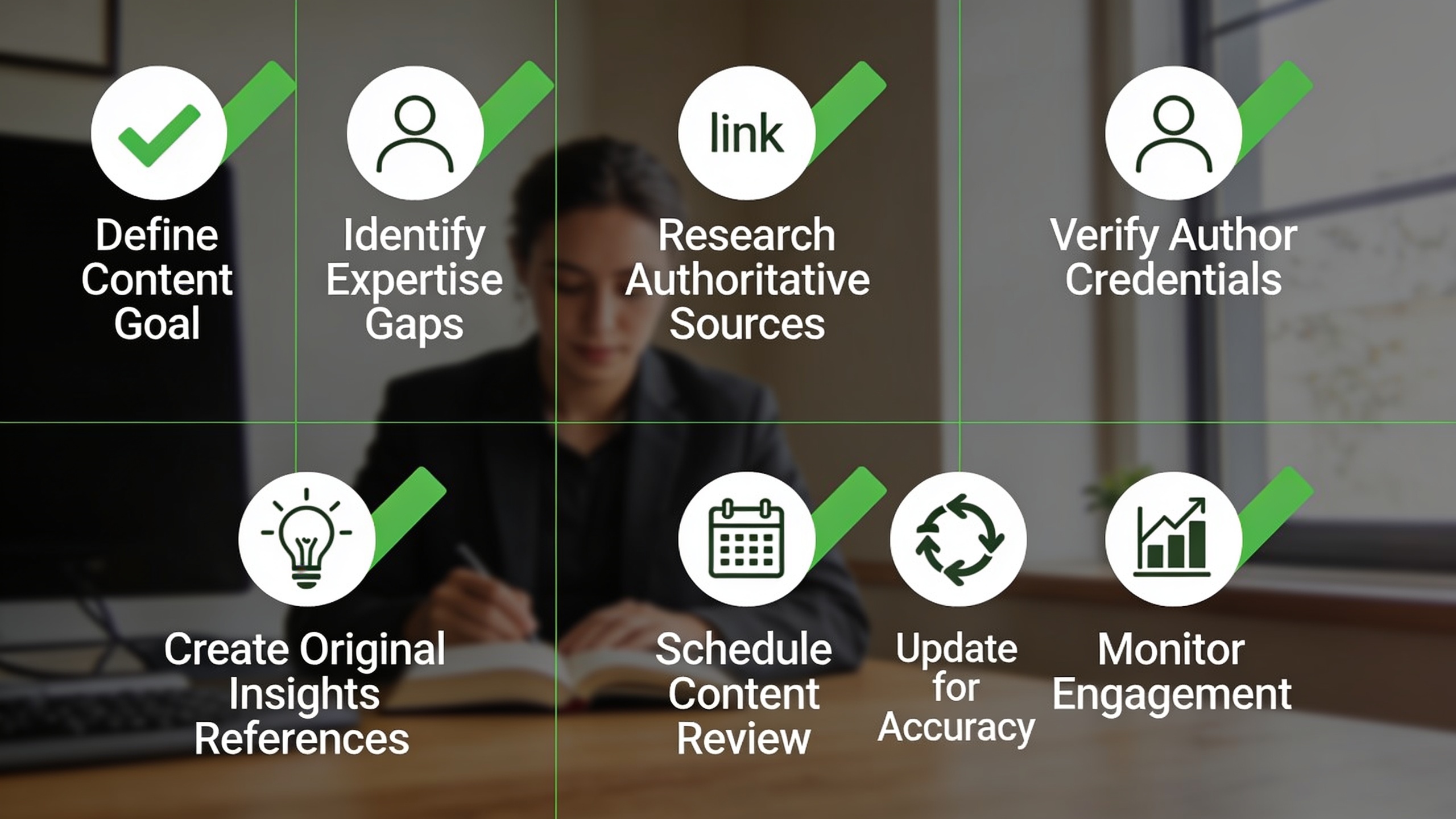
The most reliable way to keep cranking out solid E-E-A-T content is to run every article through a fixed checklist before it publishes, instead of leaning on one editor's memory or gut feel. Here's a sequence that holds up whether the first draft came from a person, an AI tool, or some Frankenstein mix of the two.
- Verify every factual claim. Cross-check stats, dates, names, and figures against a primary source. Cut or soften anything you can't confirm.
- Attribute a real author. Real byline, short bio that establishes some relevant credibility. Even a couple sentences beats nothing.
- Insert at least one first-hand detail. A tested outcome, a number from your own data, a real scenario you actually lived through.
- Link to credible external sources. Cite the original study or documentation, not some secondhand summary of it.
- Cross-link to related internal content. Connecting to other relevant articles on your own site, the whole topic-clustering thing from evergreen strategy, signals depth and consistency across your domain.
- Set a review date. Schedule a factual re-check, especially for anything with pricing, stats, or software features that drift over time.
- Check for overstated claims. Make sure nothing promises more than the product, service, or data can actually back up.
- Confirm the site-wide trust signals. About page, contact info, clear ownership. All visible, all current.
- Chase earned, verified links over bulk purchased ones. A handful of manually-reviewed live placements beats a mountain of unverified junk.
Treating this as a repeatable checklist, not a one-time audit you do when you remember, is the whole difference between publishers who occasionally get an AI article to rank and the ones who quietly build a durable base of trustworthy AI content across hundreds of pages.
Frequently Asked Questions
So does Google actually penalize AI content or not?
Not for being AI. Google's public policy is that it doesn't penalize content just because AI helped make it. What it penalizes, AI or human, is content built mainly to game rankings or content that can't show helpfulness, originality, and E-E-A-T. How it got made isn't the deciding factor. Whether the result is good and trustworthy is.
What's the actual difference between Experience and Expertise?
Experience is first-hand, lived involvement. You've actually used the product, visited the place, gone through the process. Expertise is accurate, in-depth knowledge of the subject, whether that came from doing it yourself or from serious study. Google split Experience out as its own fourth pillar back in December 2022 precisely because expertise alone didn't capture whether someone had really done the thing they were writing about.
Can a fully automated tool produce trustworthy AI generated articles?
It can, as long as the workflow includes fact-checking against real sources, a named author or editorial identity, and some way to keep the content accurate as time passes. Automation that just speeds up drafting with zero verification or accountability? That's exactly the thin, unverified content Google's guidelines flag as low quality.
Do backlinks still matter for E-E-A-T, or is that just a general rankings thing?
They feed the Authoritativeness pillar directly, because they're external proof that other sites think your content is worth referencing. The distinction Google draws, again, is between links earned because your content is genuinely useful versus links bought purely to manipulate rankings. First one supports E-E-A-T. Second one breaks Google's spam policies.
How often should I update AI articles to keep the trust signals fresh?
There's no magic number. But anything with pricing, stats, software features, or regulatory info should get reviewed whenever those underlying facts have probably shifted, and at bare minimum on some recurring schedule rather than never. Content built for long-term ranking value, the evergreen kind, usually wants lighter, more frequent touch-ups instead of one giant rewrite every few years.
Bringing It Together
E-E-A-T was never built to lock AI out of content. It was built to filter out content that lacks real experience, verified expertise, credible authority, and basic honesty, no matter who or what typed the first draft. For teams using AI to scale up, the work that genuinely protects your rankings happens around the model's output. Fact-checking. Real bylines. First-hand detail. Honest sourcing. A link profile built on actual relationships instead of shortcuts. Get those layers right and AI stops being a liability and becomes a production accelerator sitting inside a trustworthy editorial process. Which, funnily enough, is exactly the standard Google's quality systems were built to reward.
Ready to stop writing content by hand? Start your free RobinRank trial and get a full month of SEO-optimized articles published on autopilot.