Evergreen Content Strategy: How to Create Articles That Rank for Years
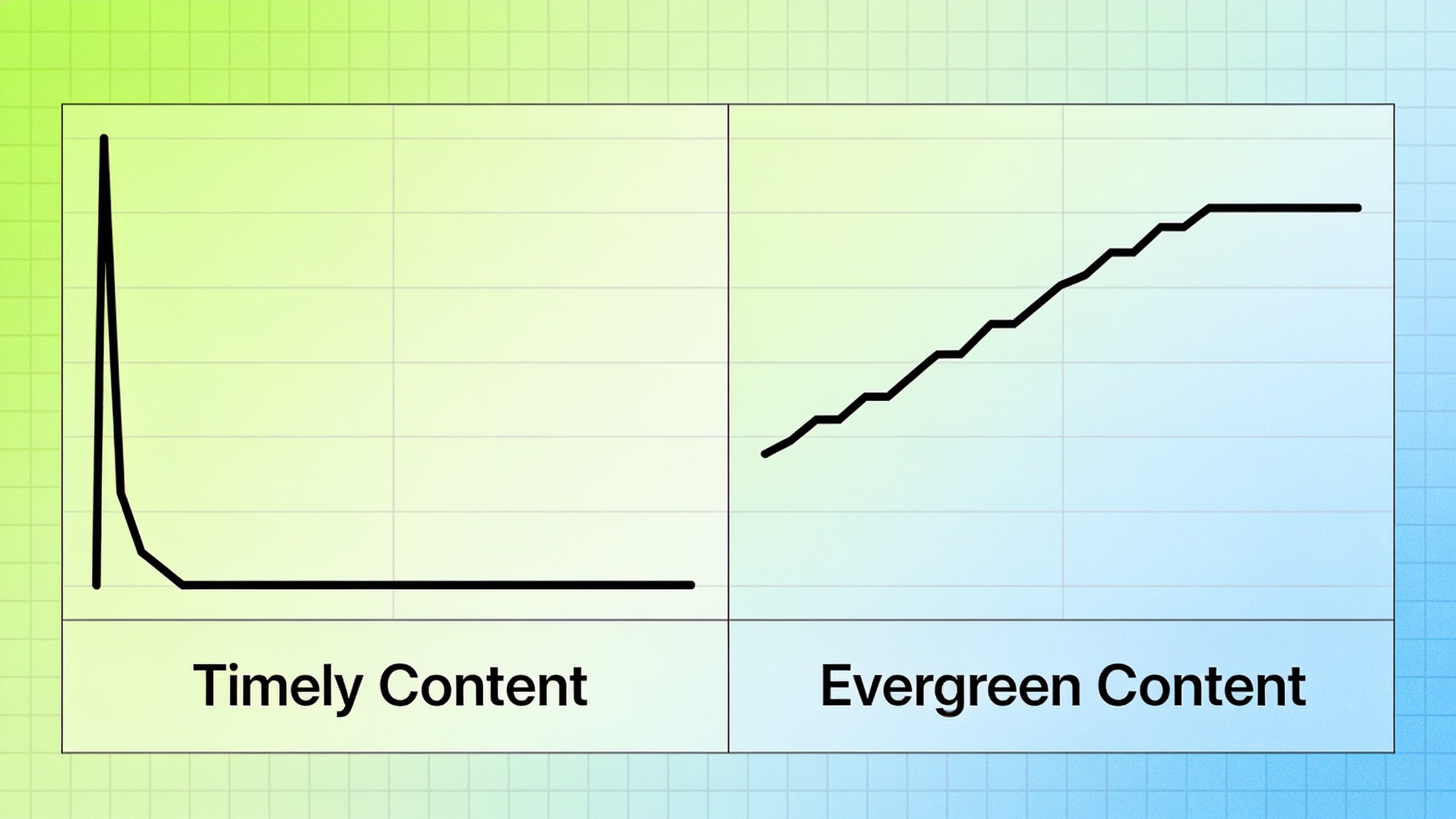
Evergreen content is the stuff that stays useful no matter when someone stumbles onto it. "How to write a resume" is evergreen. "Resume trends for this year's holiday hiring rush" is not. The first one can rank for years with barely any upkeep. The second has a shelf life you could measure with an egg timer.
If you're doing SEO, running content marketing, or you're a founder trying to grow organic traffic without an actual editorial team behind you, evergreen content is about the highest-leverage thing you can build. So let's get into what actually makes content evergreen, how to plan and structure it, how to keep it ranking, and where automation tools are worth using.
Table of Contents
- What Is Evergreen Content?
- Why an Evergreen Content Strategy Matters for Organic Growth
- How Do You Create Evergreen Articles That Actually Rank?
- The Anatomy of a High-Performing Evergreen Article
- Evergreen vs. Timely Content: When to Use Each
- How Often Should You Update Evergreen Content?
- Common Mistakes That Kill Evergreen Potential
- Frequently Asked Questions
What Is Evergreen Content?
Evergreen content is any published piece, an article, guide, or page, whose core information stays accurate and useful well past its publish date without needing constant rewrites. The name comes from the tree, obviously. It stays green in every season instead of going brown the way news articles and seasonal promos do.
A few types of topics tend to lend themselves to this. Foundational how-tos, like "how to write a business plan" or "how to set up email automation." Explainers that define something, the "what is technical SEO" type of piece. Comparison guides where you're helping someone choose between two options. And process frameworks, step-by-step methods that don't hinge on a specific tool version or calendar year.
But honestly, the topic matters less than how you write about it. A piece on "SEO best practices" can be evergreen if it sticks to durable principles. Or it can rot within months if you cram it full of algorithm-specific trivia that's stale by summer. That's the part people miss. An evergreen content strategy is at least as much about editorial discipline as it is about picking the right subject.
Why an Evergreen Content Strategy Matters for Organic Growth
An evergreen content strategy matters because it compounds. Every article you publish keeps earning search visibility, backlinks, and conversions long after the launch push, instead of needing you to constantly prop it up. That compounding is basically the whole difference between a blog that plateaus and one that keeps climbing.
Most content calendars lean hard on timely stuff. Reactions to industry news, "trends for this year" roundups, product announcements. All fine, they have a place. But they're rented traffic. Great for a short window, then gone. Evergreen articles are more like something you own. A well-optimized evergreen page you publish today could still be pulling search traffic two or three years from now, assuming you don't neglect it.
And this gets more interesting once you think about what happens after the traffic shows up. Ranking is only half the job. Turning a steady stream of visitors into actual leads takes its own system, which is something I'd point you to Turning Blog Traffic Into Leads: A Content Lead Generation Playbook for. Evergreen content is the fuel. Conversion architecture is the engine.
There's a defensive angle too. Rankings for any single article erode over time on their own, competitors publish fresher, meatier pages, and search engines reward recency. This slow bleed, where a page that used to crush it quietly loses traffic, gets picked apart in Content Decay: Why Your Best Articles Stop Ranking. Building genuinely evergreen content from day one, and then actually maintaining it, is the most reliable way to slow that bleed down.
How Do You Create Evergreen Articles That Actually Rank?
To create evergreen articles that rank for years, you need four things working together: topics built for longevity, on-page coverage that's genuinely thorough, a structure both readers and search engines can parse, and a maintenance habit that keeps everything accurate. Skip any one of these and you've just shortened the article's lifespan.
Step 1: Pick Topics That Can Actually Survive
Before you write a word, ask whether the topic can even survive the passage of time. Will the core answer still be true in three years? Is it driven by a fundamental, persistent need, how something works, how to fix a recurring problem, rather than some passing event? And does search intent for the keyword stay steady, or does it spike around specific dates?
Topics tied to a particular year, a software version, or a news cycle are just harder to keep evergreen. That doesn't mean you avoid them. Timely content still captures demand in the moment. It just means they need a totally different maintenance rhythm than the durable stuff.
Step 2: Cover the Topic Completely, Not Just to Hit a Word Count
The articles that stay evergreen tend to be the ones that answer the question so completely the reader doesn't need to open five other tabs. So cover the main question, sure, but also the follow-up questions they'll have right after. Definitions, comparisons, examples, the weird edge cases. All in one place.
This is also, increasingly, where AI answer engines like ChatGPT, Gemini, and Perplexity pull from. Pages that answer a question clearly and completely, with the definition stated up top instead of buried under three paragraphs of throat-clearing, get cited and paraphrased way more often. Worth keeping in mind.
Step 3: Structure It for Humans AND Machines
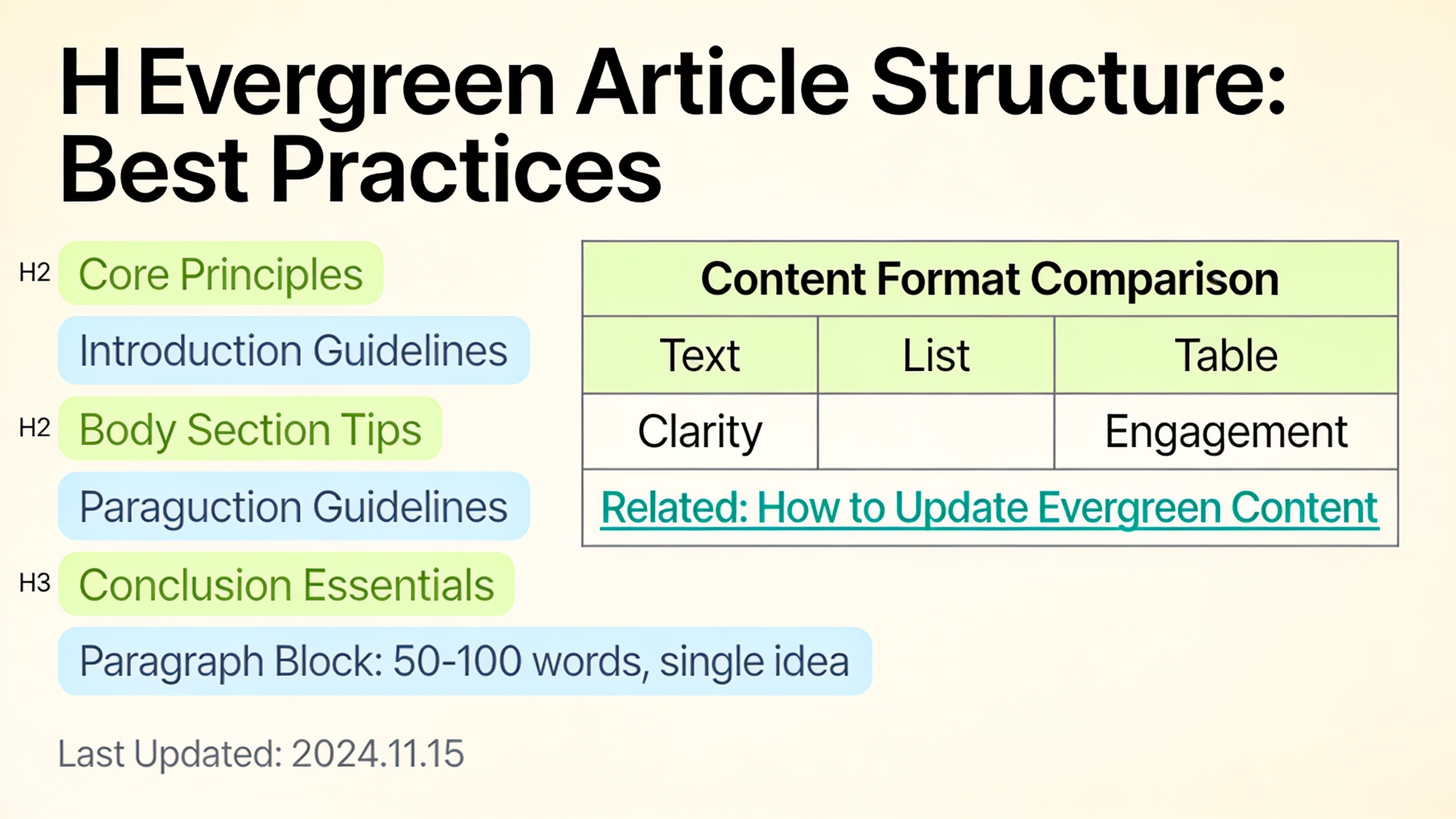
Clean heading hierarchy, short paragraphs, a logical flow from broad to specific. This stuff makes an article easy to scan for a human skimming it, and easy for a search engine to figure out what each section is about. Structure isn't decoration. It's how both machines and impatient people extract meaning from a page.
Step 4: Build a Maintenance Rhythm
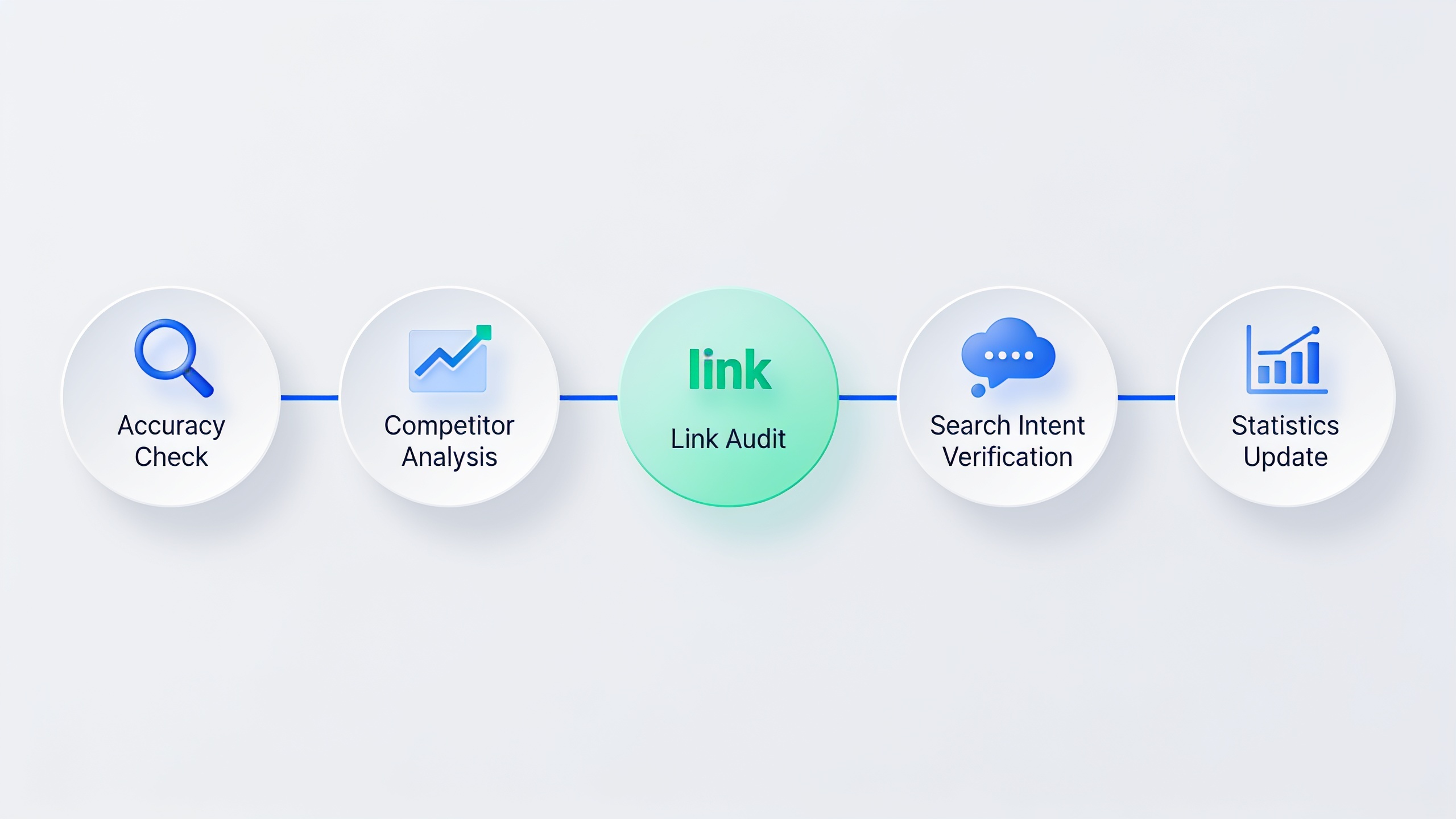
Evergreen does not mean "write once, forget forever." Even the sturdiest articles benefit from a periodic look, checking for stale statistics, dead links, or some competitor who has since out-covered you. Baking this review into your editorial calendar is honestly what makes an article evergreen across its whole life, not just on launch day.
The Anatomy of a High-Performing Evergreen Article
A high-performing evergreen article shares a pretty recognizable set of traits: a clear answer near the top, logical subheadings, internal links to related stuff, and periodic freshness updates. Miss any of these and you'll usually see faster decay.
Here's how the pieces tend to break down:
| Component | Purpose | Common Mistake |
|---|---|---|
| Direct answer in the intro | Satisfies search intent immediately and helps AI answer engines quote the page | Burying the answer under a long, generic introduction |
| Descriptive H2/H3 headings | Breaks content into scannable, logically ordered sections | Vague headings like "More Info" that give no context |
| Defined terminology | Makes each section understandable even out of context | Assuming readers already know jargon |
| Internal links to related content | Keeps readers on-site and distributes topical authority | Linking to unrelated pages just to hit a link quota |
| Visual structure (tables, lists) | Improves scannability and helps with featured snippets | Overusing bullet points where prose would explain better |
| Update log or "last updated" date | Signals freshness to both readers and search engines | Never revisiting the article after publish |
| FAQ section | Captures long-tail questions and voice/AI search queries | Repeating the main body content instead of adding new value |
Want content like this running on autopilot for your own site? Try RobinRank free — AI-written, SEO-optimized articles generated and published automatically, no credit card required.
Each of these does its own job. But together they make a page that's durable on purpose rather than by dumb luck.
Evergreen vs. Timely Content: When to Use Each
Evergreen and timely content aren't rivals. They're two halves of a balanced calendar, and most good blogs run both at once. Evergreen builds the long-term traffic base. Timely captures short spikes and keeps your brand in the current conversation.
| Factor | Evergreen Content | Timely Content |
|---|---|---|
| Typical lifespan | Years, with periodic refreshes | Days to a few months |
| Traffic pattern | Slow build, long tail | Fast spike, sharp drop-off |
| Example topics | "How to build a content calendar" | "SEO changes announced this quarter" |
| Maintenance need | Periodic accuracy checks | Often archived or retired after relevance passes |
| SEO role | Compounding organic traffic base | Capturing trend-driven search demand |
| Best for | Cornerstone/pillar pages, glossary terms, how-to guides | News reactions, product launches, event coverage |
Here's a rule of thumb I keep coming back to. If you could strip the publish date off an article and it'd be just as useful, that's a strong evergreen candidate. If the date is essential context, treat it as timely and plan to retire or heavily rewrite it down the line.
How Often Should You Update Evergreen Content?
There's no universal schedule, but a solid baseline is reviewing your highest-traffic evergreen articles once or twice a year, and checking any page that shows a noticeable traffic dip sooner than that. The right cadence really depends on how fast your industry moves. A piece on "how compound interest works" needs way less attention than "best marketing automation tools," where the landscape shifts every few months.
When you do go back in, look at a few specific things. Is everything still accurate, the facts, the stats, the examples? Has a competitor published something more comprehensive that's now beating you? Do your internal links still point to pages that exist and matter? And has search intent drifted, are people now searching this in a more comparison-heavy or more question-based way than they used to?
Skipping this review is exactly how strong articles quietly slide down the rankings. That whole pattern gets covered in depth in Content Decay: Why Your Best Articles Stop Ranking, which walks through the signals that tell you whether a piece needs a light refresh or a full teardown.
Common Mistakes That Kill Evergreen Potential
The most common way people kill evergreen potential is writing about a durable topic but stuffing it with time-sensitive references, specific years, current pricing, "recently released" phrasing, that quietly expire the whole thing. A genuinely evergreen topic can absolutely get sabotaged by careless writing.
A few others show up constantly. Shallow coverage is a big one, writing just enough to hit a word count instead of actually answering the follow-up questions a reader will have. So is having no internal linking strategy at all, publishing evergreen pieces in isolation instead of connecting them to related content and conversion paths, which kneecaps both the SEO value and the business impact.
Then there's ignoring the reader's next step. Articles that inform but never nudge anyone toward doing something leave a lot on the table, which is exactly why pairing content with a lead-gen framework like the one in Turning Blog Traffic Into Leads: A Content Lead Generation Playbook matters as much as the writing does. And of course, treating "publish" as the finish line, assuming a page will just rank forever with zero monitoring. It won't.
Oh, and one more: chasing trends inside evergreen pages. Dropping trendy references into a foundational guide dates it prematurely. Cover the trends in separate, clearly timely posts and leave your cornerstone stuff alone.
Where Automation Fits Into an Evergreen Content Strategy
Cranking out a steady library of well-structured, thorough evergreen articles by hand is a genuine time sink, which is a big part of why AI-assisted content platforms have crept into so many SEO workflows. RobinRank, for instance, runs on a three-step loop. It analyzes a business's niche, competitors, and Domain Rating to find content topics and backlink opportunities, then it writes and publishes SEO-optimized articles in a natural tone straight to a connected CMS like WordPress, and it helps sites earn verified backlinks through a community-based exchange network where DR-weighted credits fund inbound links. For a team trying to build an evergreen library without hiring a full in-house editorial crew, that kind of automated planning-writing-publishing loop can keep the publishing cadence consistent. And consistency, as I keep hammering, is one of the core requirements for evergreen content to actually pay off over years instead of months.
Frequently Asked Questions
So what's the actual difference between evergreen and cornerstone content?
Cornerstone content is a site's most important, most comprehensive pages, the ones meant to represent your core topical authority. Evergreen content is any article whose relevance doesn't expire quickly. In practice they overlap a lot. Most cornerstone pages are written to be evergreen, but not every evergreen article needs to be a flagship cornerstone piece.
Can I use statistics in evergreen content without it going stale?
Yes, you just have to frame them carefully. Instead of writing "as of this year, X percent of marketers do Y," attribute the stat to its source and year outright, like "according to [Source], [Year]." That way the claim stays accurate and traceable even after time passes, rather than pretending it's current info.
How long before evergreen content actually starts ranking?
It varies a lot, based on domain authority, competition, and content quality, and there's no fixed timeline anyone can honestly give you. New sites chasing competitive keywords take longer than established sites going after less contested terms. Don't expect quick wins. Treat evergreen content as a medium- to long-term investment and track progress through Search Console over several months.
Should I bump the publish date every time I refresh a piece?
A lot of sites update a visible "last updated" date when they make a real refresh, since it signals freshness to readers and can be a mild positive signal for search engines. But it should reflect a genuine update, factual corrections, new sections, refreshed examples, not just a cosmetic date change with no actual improvement behind it. Readers can smell that.
How many evergreen articles does a small business need before it sees real growth?
There's no magic number, since it hinges so much on how competitive your niche is and how good the content is. A common approach is to build a foundational library covering the core questions your audience searches for, then branch into supporting subtopics over time. Honestly, consistency in publishing and maintenance tends to matter more than hitting some specific article count.
---
Evergreen content isn't a thing you write once and forget. It's a commitment to answering durable questions thoroughly, structuring them for both people and search engines, and revisiting them before they quietly decay. Get those fundamentals right and a single well-built article can keep earning organic traffic, backlinks, and leads for years after the day you hit publish. Which, when you think about it, is a pretty good deal.
Ready to stop writing content by hand? Start your free RobinRank trial and get a full month of SEO-optimized articles published on autopilot.