How Agencies Can Add a Content Marketing Service Offering

Here's what most agencies miss: if you already sell SEO, PPC, or web design, your clients are basically begging for this. They always need more content. And almost none of them have the internal bandwidth to make it happen consistently. So the question was never really whether to offer content marketing. It's how to do it without torching your margins or your delivery timelines.
Table of Contents
- What Is a Content Marketing Service Offering?
- Why Agencies Are Adding Content Services Now
- How Much Does It Cost to Launch a Content Marketing Service Offering?
- How to Package Agency Content Services Without a Full Writing Team
- Building the Workflow: Roles, Tools, and Quality Control
- Pricing Models Compared: Retainer vs. Project vs. Performance-Based
- How Do Agencies Scale a Content Marketing Service Offering Profitably?
- Common Mistakes to Avoid
- FAQ
What Is a Content Marketing Service Offering?
A content marketing service offering is a packaged set of deliverables (strategy, writing, optimization, distribution) that an agency sells as an ongoing or project-based service, either on its own or bundled with SEO, social, or paid media. In plain terms, that usually means blog articles, landing page copy, email newsletters, gated stuff like ebooks, and sometimes video scripts or repurposed social posts.
The whole thing lives or dies on one word: consistency. Most in-house marketing teams know they should be publishing regularly. They've got the strategy deck to prove it. What they don't have is the time, the writers, or an editorial process that survives contact with a busy quarter. That's the gap you're filling. You own the pipeline end to end: topic research, drafting, SEO optimization, internal linking, publishing straight to their CMS.
And this is genuinely different from a one-off project, like writing five landing pages for a product launch. A content service has a heartbeat to it. Weekly, biweekly, monthly, whatever cadence you agree on. It's usually tied to something measurable too, like organic traffic, keyword rankings, or leads. That recurring, results-linked structure is exactly what makes it worth building.
What's Actually in the Box
Most agency content offerings include some mix of these:
- Content strategy plus topic and keyword planning
- SEO-optimized long-form articles (usually 1,000 to 2,500 words)
- On-page optimization: titles, meta descriptions, headings, internal links, schema
- Editorial calendar management
- Publishing and CMS integration
- Performance reporting on traffic, rankings, and engagement
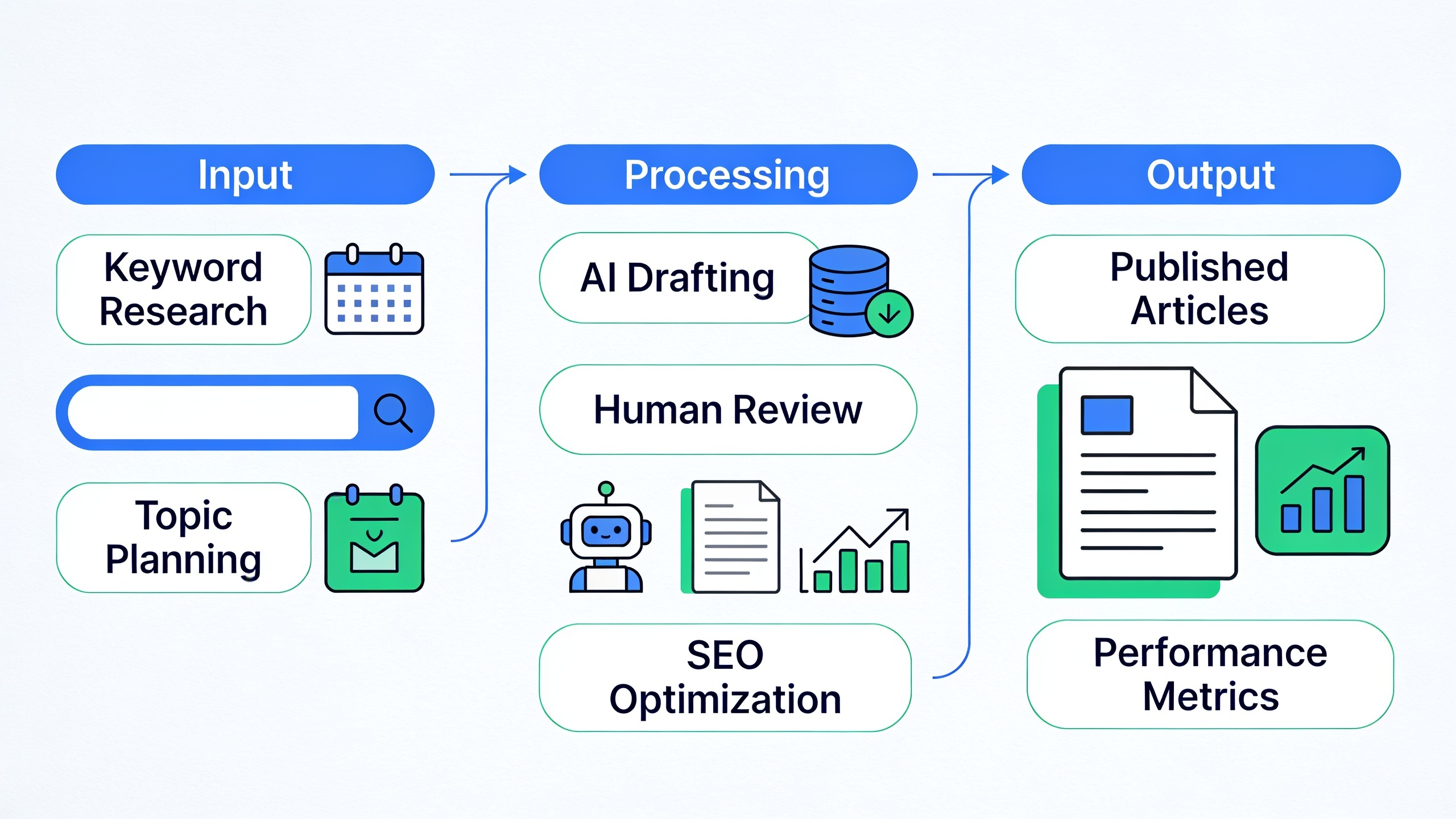
But you don't need all of this in-house on day one. Not even close. Plenty of agencies stitch together AI writing tools, a freelance editor, and their existing SEO people into one workflow that looks polished from the client's side and is refreshingly lean on the back end.
Why Agencies Are Adding Content Services Now
Agencies are adding content marketing because clients now treat it as a baseline requirement for organic growth, not a nice-to-have. Search engines and AI answer engines like ChatGPT, Gemini, and Perplexity keep rewarding sites that publish useful, well-structured content on a regular schedule. If all you offer is technical SEO and link building, you're basically handing that content revenue to someone else.
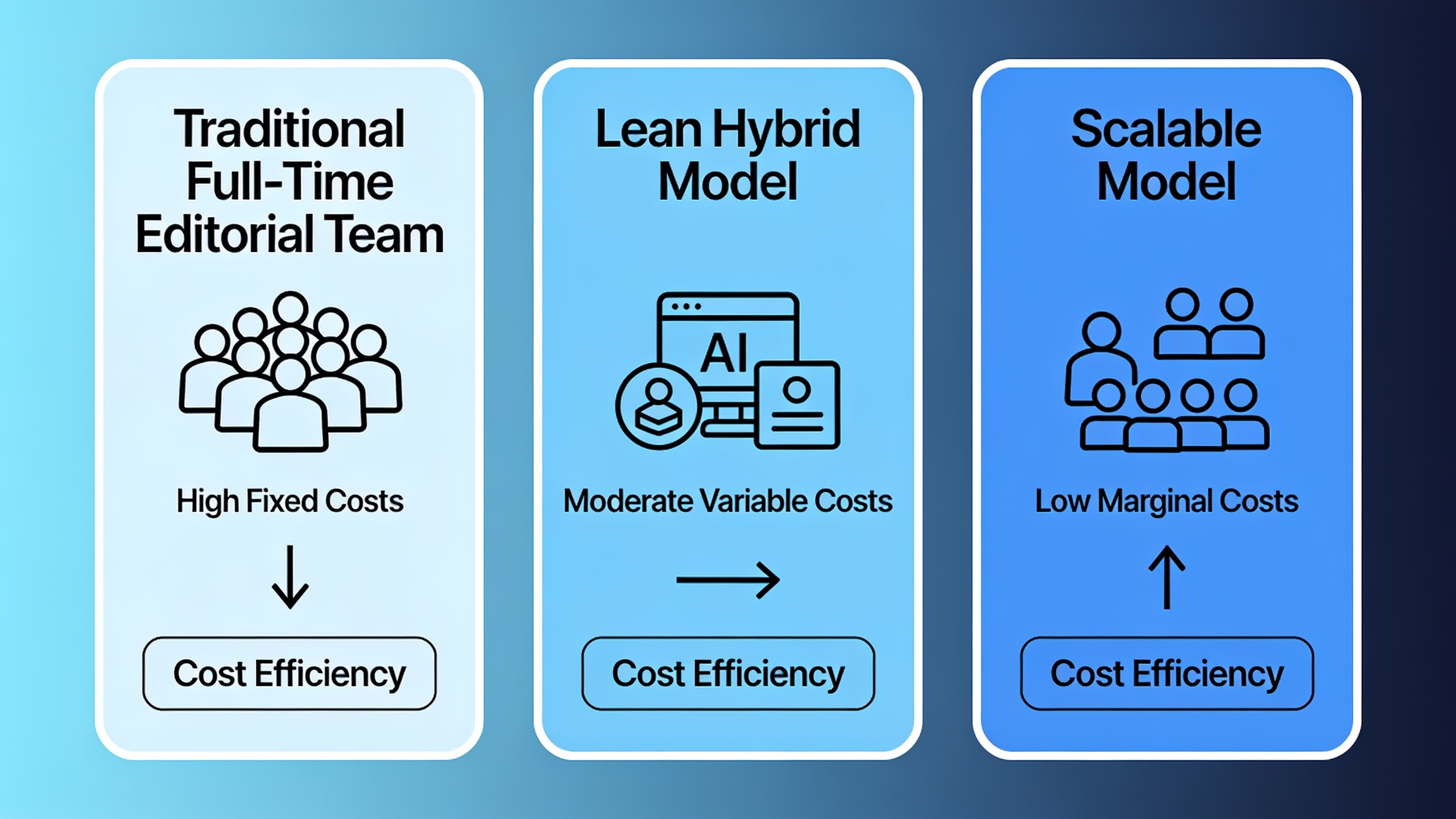
There's a bigger shift going on underneath all this, though, and it's worth understanding. Ten years ago, scaling content meant hiring more writers and editors. Full stop. Which meant your margins were capped, because labor costs climbed in a straight line with output. More articles, more people, less profit per piece. AI-assisted writing tools broke that math. They handle a lot of the first-draft research and structuring, so the economics of offering content at scale look completely different now. The bottleneck used to be "how many writers can we afford to hire." Now it's "how well can we run a hybrid human-AI editorial process." That's a much better problem to have.
This is exactly the shift documented in how a broke SaaS startup built a content engine that actually worked, where a team with basically no budget had to crack the same problem agencies face: producing consistent, ranking-worthy content without a traditional editorial headcount. Different context, same playbook.
How Much Does It Cost to Launch a Content Marketing Service Offering?
Launching a content service is cheap compared to your other service lines, because you can start with software subscriptions and freelancers instead of full-time salaries. Most agencies can pilot the whole thing with a single client for well under a few thousand dollars a month in tooling and contractor costs, then scale spend up as retainers roll in.
The costs really come down to three buckets. First, tooling: an AI content or SEO platform, a project management tool, maybe a dedicated keyword research tool. This varies a ton depending on the platform and how many articles you're pushing out each month. Second, human oversight. Even with AI doing the drafting, somebody, an editor or strategist or account manager, has to review drafts, keep brand voice consistent, and manage the relationship. Part-time is fine to start.
And third, the least glamorous one: client acquisition and packaging. All the time you'll spend building proposal templates, pricing tiers, and (eventually) case studies before you've got any track record to point to. It's a sunk cost. It's also unavoidable, so budget the hours honestly.
The nice part? Because the marginal cost of producing one more article is so much lower with an AI-assisted workflow than a fully manual one, you can price your first retainer conservatively, prove results, then raise your rates once you've got data backing you up.
How to Package Agency Content Services Without a Full Writing Team
You can package a content service without a full writing team by combining an AI content platform for first drafts, a lightweight editorial review, and a client-facing reporting layer. Basically, you act as the strategist and quality control, not the sole content producer. This is how a team of one or two people can deliver output that used to require three or four full-time writers.
Step 1: Nail Down the Deliverable Menu
Decide exactly what's included before you sell anything. Vagueness here will haunt you. A solid starter menu looks something like:
- 4 SEO-optimized blog articles per month
- Monthly keyword and topic research
- An on-page SEO checklist applied to every article
- Publishing straight to the client's CMS
- A monthly performance summary (traffic, impressions, rankings)
Keep it simple for your first few clients. A tight menu is way easier to price accurately, and it saves you from the slow bleed of scope creep.
Step 2: Pick Your Production Model
There are three broad ways agencies produce content, and honestly, most people end up blending them:
- Fully manual. Freelance writers research and draft, an internal editor reviews.
- AI-assisted. An AI platform generates the first draft, structure, and metadata; a human reviews and approves before anything publishes.
- Fully automated with spot-checks. Content generates and publishes on a schedule, with periodic audits instead of reviewing every single piece.
Most agencies starting out go with the AI-assisted model, and for good reason. It's the sweet spot between speed, quality, and cost. RobinRank, for example, is built around this exact workflow. It analyzes a client's niche and competitors, writes SEO-optimized articles with real structure (titles, meta descriptions, internal and external links, plus auto-generated schema markup), and publishes directly to WordPress, Ghost, or through a webhook and API. And every draft stays fully editable before it goes live. That editable-before-publish bit is the whole game, actually. It's what lets you slot in your own review layer without rebuilding the entire pipeline from scratch.
Step 3: Build a Review and Approval Flow
Even a great AI draft needs a human pass. For brand voice, for factual accuracy on client-specific claims, for internal linking. A simple two-step review does the job for most agencies: an editor checks the draft against a brand voice checklist, then the account manager (or the client, if they want approval rights) signs off. Done.
Step 4: Decide What to White-Label
You'll need to figure out how much of your tooling to show clients. Some agencies present the whole thing as "our proprietary content team" and use AI purely as internal plumbing. Others lean into transparency, framing AI-assisted production as a value-add: faster turnaround, lower cost than a traditional agency. Both work. It genuinely comes down to your positioning and what your clients expect. I don't think there's a universally right answer here, and anyone who tells you there is probably wants you to buy something.
Building the Workflow: Roles, Tools, and Quality Control
A functional content workflow needs four things no matter how big your team is: a strategist to plan topics, a production system (human or AI) to draft, an editor to enforce quality and voice, and a reporting process to prove ROI. Skip any one of these and I promise you that's where the whole offering starts to fall apart.
Want content like this running on autopilot for your own site? Try RobinRank free — AI-written, SEO-optimized articles generated and published automatically, no credit card required.
Minimum Viable Team Structure
| Role | Responsibility | Can Be Part-Time? | Can Be Outsourced? |
|---|---|---|---|
| Content strategist | Topic research, keyword mapping, calendar | Yes | Yes (freelance) |
| Editor / QA lead | Brand voice, fact-checking, final approval | Yes | Yes (freelance) |
| Account manager | Client communication, reporting | Often already exists at agency | Rarely |
| Production system | Drafting, SEO structure, metadata | N/A (software) | N/A (software) |
Notice that only the production step is fully automatable. The strategist, editor, and account manager all still need human judgment. But none of them need to be full-time hires when you're running one or two clients.
Choosing the Right Tools
When you're sizing up an AI content platform for the production layer, a few things are non-negotiable. You want SEO-structured output (proper heading hierarchy, meta titles and descriptions), the ability to publish directly to common CMS platforms, and editable drafts rather than some locked black-box output you can't touch. Automatic schema markup generation is a real time-saver too, because manually coding JSON-LD for every article is tedious and, let's be honest, the first thing everyone skips when a deadline's breathing down their neck.
Once your workflow's humming, you've got to prove it works. Both to keep clients renewing and to justify raising prices down the road. That's where measuring ROI on AI content marketing tools becomes required reading for your account managers, the folks who have to turn "we published eight articles" into numbers a client actually cares about, like organic traffic growth, ranking movement, and cost per published piece.
Pricing Models Compared: Retainer vs. Project vs. Performance-Based
Agencies price content services one of three ways: monthly retainers, per-project fees, or performance-based deals tied to traffic or leads. Retainers are the most common, and that makes sense given how recurring content production is, but each model has tradeoffs worth understanding before you commit to a pricing page.
| Pricing Model | Best For | Pros | Cons |
|---|---|---|---|
| Monthly retainer | Ongoing blog/SEO content programs | Predictable revenue, easier to forecast staffing | Requires consistent delivery even in slow months |
| Per-project | One-off content pieces, launches, campaigns | Simple to quote, no long-term commitment needed | Revenue is lumpy, harder to plan capacity |
| Performance-based | Clients wanting to tie cost to results | Aligns incentives, easier to sell to skeptical clients | Hard to isolate content's exact contribution to results; riskier for the agency's cash flow |
My advice? Start with a simple monthly retainer covering a fixed number of articles, then bolt on performance-based upsells (bonus payments tied to ranking milestones, say) once you've got a track record with that client. Pure performance-based pricing is brutal early on, because content results, the traffic and the rankings, usually take a few months to show up. And an agency with zero case studies is going to have a really hard time convincing a client to wait that long before they pay you. Don't set yourself up for that fight.
How Do Agencies Scale a Content Marketing Service Offering Profitably?
You scale a content service profitably by standardizing your production so that adding a new client doesn't mean adding a proportional chunk of new labor. The whole goal is to decouple headcount from client count. The same small editorial team should handle five clients about as smoothly as it handles two, assuming your tooling and process are solid underneath.
Standardize Before You Scale
Before you take on client number five or six, write down your process. The brief template, the SEO checklist, the review workflow, the reporting template. All of it. Without that documentation, every new engagement reinvents the wheel, and your margins quietly erode as account managers burn hours on process instead of strategy. Boring? Yes. Skippable? No.
Batch Similar Work
If you're serving a few clients in the same industry (say, a handful of SaaS companies, or several local service businesses), batch your keyword research and topic ideation across those accounts. Treating every client as a totally separate research project when half of them share the same competitive landscape is just wasted effort.
Automate Publishing, Not Just Writing
Here's a scaling lever almost nobody talks about: publishing automation. Manually copy-pasting finished articles into a client's WordPress dashboard, adding images, scheduling everything, it's mind-numbing, and it eats your account managers alive. Tools that connect straight to a CMS and publish on a set schedule kill this bottleneck entirely. RobinRank, for instance, supports scheduled auto-publishing to WordPress and other platforms, so approved content just goes live without anyone uploading anything by hand. That's staff time freed up for strategy and client conversations instead of data entry.
Track Unit Economics Per Article
Know your cost per published article. Tooling plus editor time plus strategist time, divided by articles delivered. Then compare it against what you're charging per article in each retainer. If the numbers don't work at five clients, they sure as hell won't work at fifteen. So run this math before you go chasing aggressive growth, not after you're already underwater.
Common Mistakes to Avoid
The single most common mistake is overpromising on volume or turnaround before your workflow is actually proven. That leads to rushed drafts, and rushed drafts lead to churn. But there are a few other traps worth flagging.
Skipping the strategy layer is a big one. Publishing articles with no keyword or topic plan behind them rarely moves organic traffic, no matter how beautifully written each piece is. Good writing on the wrong topics is just expensive noise.
Then there's treating every client's brand voice the same. AI-assisted drafts need a human editorial pass calibrated to that specific client's tone, audience, and industry lingo. "Make it sound professional" is not a brand voice guideline, it's a placeholder for one.
Underpricing your first few clients is another classic. So many agencies price their pilot clients dirt cheap to "prove the model," then can't figure out how to raise rates later. Anchor a client to a discount and they'll fight you on every increase. Better to price close to your target rate from the start and over-deliver instead.
Ignoring performance reporting will quietly kill retainers too. Clients renew when they can see traffic and rankings moving. If you don't build a simple, recurring reporting habit into the workflow, you'll struggle to justify the spend even when your content is genuinely working. Which is maddening, but that's how it goes.
And finally, no internal linking or schema strategy. These technical bits are easy to drop under deadline pressure, but they meaningfully affect how content performs in search and how easily it gets picked up by AI answer engines, which lean hard on indexed pages and structured data. Don't skip them just because they're invisible to the client.
FAQ
Do you actually need to hire writers to offer content marketing services?
Nope. Plenty of agencies run a hybrid model instead: an AI content platform handles the research-backed drafting and SEO structuring, while a smaller in-house or freelance editorial team handles review, brand voice, and strategy. Keeps your headcount low while still shipping client-ready work.
How many articles should go in a starter retainer?
There's no magic number, but a lot of agencies start with a modest, clearly defined volume, often around four articles a month, so both sides can judge quality and results before scaling up. The right number really depends on the client's industry, how competitive their space is, and their budget.
How long until a content service shows results?
Organic content usually takes several months to produce measurable traffic or ranking gains, because search engines need time to crawl, index, and weigh your new pages against the competition. Set this expectation loudly during onboarding, or you'll be dealing with a frustrated client in the first 60 to 90 days wondering where their traffic went.
Can a small agency actually compete with the big content shops?
Yes, and efficient production workflows are the reason why. A small agency with a well-documented process and the right tooling can often match a bigger competitor on quality and turnaround while running leaner overhead and staying way more flexible on price. Small can be an advantage here, not a handicap.
Should you white-label AI tools or just tell clients you use them?
Depends on your positioning. Some agencies present their content service as a proprietary process without listing every tool under the hood. Others are upfront that AI-assisted production means faster turnaround and lower cost. Both are totally common. The real thing that matters is setting accurate expectations about quality, review, and turnaround, no matter which route you pick.
---
Look, adding a content marketing service doesn't mean turning your agency into a publishing house overnight. Put together a clear deliverable menu, a lean-but-defined workflow, and tooling that does the heavy lifting on research and drafting, and you can launch a profitable content line inside a single quarter. And then scale it without scaling your headcount at the same rate. That last part is the whole point.
Ready to stop writing content by hand? Start your free RobinRank trial and get a full month of SEO-optimized articles published on autopilot.