How Often Should You Publish Content for SEO Growth?

Table of Contents
- Why Content Publishing Frequency Matters for SEO
- What Does the Data Say About Ideal Publishing Frequency?
- How Do You Determine the Right SEO Content Cadence for Your Site?
- Quality vs. Quantity: Where's the Real Tradeoff?
- How Automation Tools Help Maintain Consistency
- Building a Sustainable Publishing Calendar
- Common Mistakes That Undermine Publishing Consistency
- Frequently Asked Questions
Why Content Publishing Frequency Matters for SEO
Publishing frequency matters because it shapes how often search engines crawl your site, how fast you build topical authority, and how much room you give yourself to catch long-tail keywords. Google isn't sitting there thinking "wow, these people post a lot, let's rank them higher." It doesn't work like that. But publishing consistently gives you more shots on goal, more internal linking paths, and a clear signal that your site is alive and being cared for.
There's this concept called crawl budget, which is basically Google's word for how many pages its bots will bother crawling on your site in a given window. Sites that ship fresh content on a predictable schedule tend to get crawled more often, and that's straight out of Google's own docs on managing crawl budget. Now, does daily publishing guarantee faster indexing? No. But I've seen plenty of stagnant sites with month-long gaps between updates, and they almost always get crawled slower, with new pages sitting in limbo longer than they should.
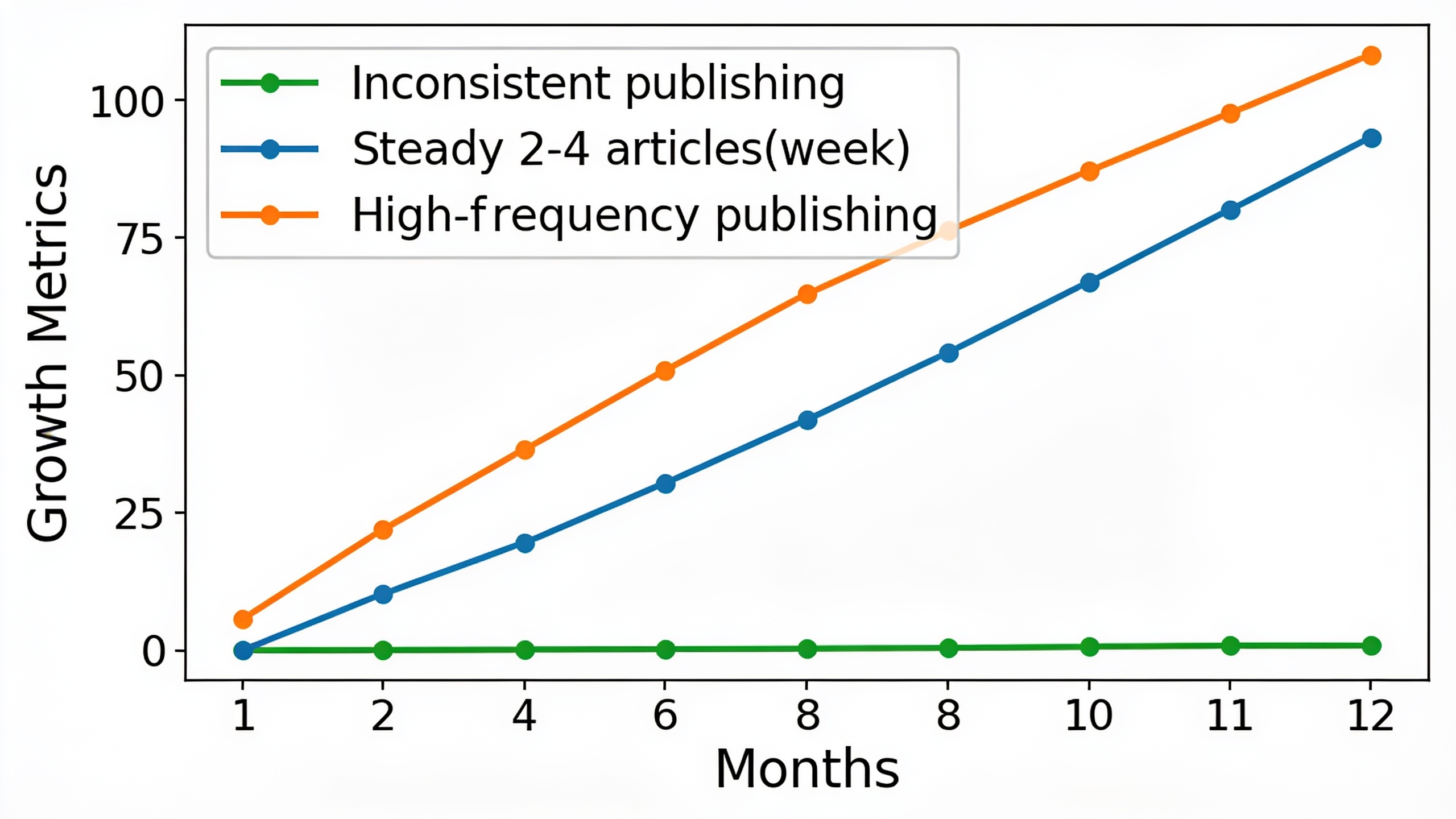
And then there's the compounding thing, which is honestly the whole game. Every article is a new front door for organic traffic, a new keyword cluster to target, a new asset you can link internally. Do the math: a site cranking out four articles a month builds up 48 potential ranking assets in a year. A site doing sixteen a month? Nearly 200. Even if only 20-30% of those actually perform, the absolute number of winners is way higher when you keep the cadence up. That's not magic. That's just volume working in your favor.
What Does the Data Say About Ideal Publishing Frequency?
There's no single "ideal" number that works for every site, but the research is pretty consistent: businesses that publish more frequently and more consistently tend to see faster and bigger organic gains, especially in the first year of a content program. HubSpot has run this research on blogging frequency more than once, and they keep finding that companies publishing 16 or more posts a month pull in significantly more traffic than the ones doing four or fewer. The relationship isn't perfectly linear though, and it leans hard on content quality and existing site authority.
Semrush's 2023 State of Content Marketing report found that teams publishing more often reported higher satisfaction with their SEO results. But (and this is the part people skip over) the same report pointed out that quality signals like depth, originality, and matching search intent correlated more strongly with actual traffic growth than raw volume did. That nuance is everything. Frequency without quality plateaus fast. Quality without frequency just caps how many keywords you'll ever reach. You need both.
Backlinko's ranking-factor analysis has landed in a similar place over the years: freshness and update frequency tend to help rankings for time-sensitive or competitive queries, especially in fast-moving fields like tech, finance, and health. For evergreen stuff, though, it's less about pure output and more about coverage. Can you cover a subject thoroughly across a bunch of interlinked articles, rather than dumping everything into one giant post? That's usually the better play.
Publishing Frequency by Business Stage
Where you are in your journey changes the answer completely. A brand-new site clawing for its first indexed pages needs a totally different approach than an established domain just defending what it already ranks for.
| Business Stage | Recommended Cadence | Primary Goal |
|---|---|---|
| New site (0-6 months, low domain authority) | 3-5 articles/week | Rapid indexing, topical footprint, keyword coverage |
| Growth stage (6-18 months, building authority) | 2-4 articles/week | Sustained traffic growth, internal linking depth |
| Established site (18+ months, strong authority) | 1-3 articles/week | Maintaining freshness, targeting new SERP opportunities |
| Niche/B2B site with narrow keyword set | 1-2 articles/week | Depth over volume, thought leadership |
| E-commerce/high-competition vertical | 4-6 articles/week | Outpacing competitor content velocity |
Don't treat these as commandments. They're patterns pulled from content marketing case studies and platform data, including the trajectory documented in AI Content Case Study: How a SaaS Startup Tripled Organic Traffic in 6 Months, where a steady multi-article-per-week cadence was one of the big drivers behind the traffic jump, right alongside topical clustering and internal linking.
How Do You Determine the Right SEO Content Cadence for Your Site?
Your right cadence is the most frequently you can publish content that hits your quality bar, without torching your team or your budget. That's it. Figuring out that number really comes down to three things: your current domain authority, how big your addressable keyword universe actually is, and how much you can realistically produce.
Step 1: Audit Your Keyword Opportunity
First, map out how many real keyword clusters actually exist in your niche. Ahrefs or Semrush will get you a decent estimate of total addressable search volume and keyword difficulty. This matters more than people think. If you've only got 30-40 viable clusters, trying to publish 20 articles a month will burn through your opportunity space in a hurry and shove you into thin, pointless content nobody wants. But if you've got hundreds of long-tail variations sitting there? Then a higher cadence isn't just justified, it's sustainable.
Step 2: Assess Your Domain Authority and Crawl History
Newer or lower-authority sites usually benefit from going harder early on, because Google needs to see a bunch of signals before it trusts you as an authority on anything. So you're building breadth fast. Once your domain has some authority behind it, generally after 6-12 months of steady output, you can shift gears from breadth to depth. That means updating and expanding what you already have instead of only bolting on new pages.
Step 3: Calculate Realistic Production Capacity
This is where most content plans quietly fall apart. One skilled writer, working full-time on content, can usually manage 2-4 well-researched articles of 1,500+ words a week once you factor in research, drafting, editing, and formatting. That's it. Agencies and in-house teams juggling ten other things constantly overestimate what they can do, and then the schedule goes sideways, which kills the exact momentum they were chasing. It's one of the sneakiest traps out there, and it shows up in 5 Content Marketing Mistakes That Are Quietly Wrecking Your SEO, where inconsistent output gets flagged as a silent traffic killer. Silent because it doesn't cause a dramatic crash. It just... plateaus. And you don't notice until you're wondering why the graph went flat.
Quality vs. Quantity: Where's the Real Tradeoff?
The real tradeoff isn't quality OR quantity, it's finding the highest frequency where your quality doesn't start slipping. Pump out lazy content every single day and you can actually hurt yourself, diluting your topical authority and stacking up thin pages against your strong ones. But publish one gloriously researched masterpiece a month and you're leaving a mountain of keyword opportunity on the floor. Neither extreme wins.
Google's Helpful Content system, which showed up in 2022 and later got folded into the core algorithm, is specifically hunting for content that looks like it was made to rank rather than to actually help a human being. So a rushed cadence that cuts corners on research, accuracy, or usefulness can backfire hard. The system looks at whether your content shows first-hand expertise, whether it genuinely answers the question someone typed in, and whether it'd still be worth reading if search engines didn't exist at all. That last one is a good gut check, honestly.
Want content like this running on autopilot for your own site? Try RobinRank free — AI-written, SEO-optimized articles generated and published automatically, no credit card required.
Signs Your Cadence Has Outpaced Your Quality
Here's when you know you've pushed too hard. Your articles keep coming in under 800 words on topics that clearly deserve more. Your editorial review has shriveled down to 15-20 minutes per piece (or less). You've got multiple articles chasing basically the same keyword with nothing to distinguish them. Bounce rates and time-on-page are drifting the wrong direction on your new stuff. And your writers are covering topics they don't really know, without enough time to research their way into competence.
If two or more of those ring true, the fix usually isn't publishing less. It's fixing your production process so more output doesn't mean cutting corners. Which, conveniently, is exactly the gap AI-assisted workflows are built to close.
How Automation Tools Help Maintain Consistency
Automation tools keep you consistent by knocking out the bottlenecks that usually wreck your schedule: research time, first drafts, on-page optimization, manual publishing. The whole promise of AI content automation isn't "fire your editors." It's shrinking the distance between "we should write about this" and "this is live and optimized."
Platforms like RobinRank are built to attack this exact problem, the consistency problem that derails most content programs before they ever compound. Instead of a calendar that lives or dies on whether your writer had a good week, an AI-powered system can research a topic, draft a structured article that actually matches search intent, apply on-page SEO, and push it straight to your CMS on a fixed schedule. It doesn't replace your strategy or your oversight. But it does mean a small business can hold a 3-4 article per week cadence without staffing up a full content team.
What Automation Should and Shouldn't Do
Automation shines on the repeatable, structural grunt work: synthesizing keyword research, generating outlines, banging out first drafts, optimizing meta tags, scheduling the publish. Where it gets dicey, and I'd genuinely be careful here, is treating it as a fully hands-off replacement for real expertise on technical, legal, medical, or financial topics where a wrong answer has actual consequences. In SEO circles that stuff gets called YMYL content, short for "Your Money or Your Life," and it's not the place to go fully autopilot.
What most SEO folks actually settle on is a hybrid. Use automation to hit a steady cadence, say three articles a week, but keep a lightweight human review step for accuracy, brand voice, and just making sure the facts are, you know, facts. That combo tends to beat both a fully manual team (great content, terrible consistency) and fully unsupervised AI (great consistency, content that slowly drifts toward generic mush).
Comparing Manual vs. Automated Publishing Workflows
| Factor | Fully Manual Team | AI-Assisted Automation | Fully Unsupervised AI |
|---|---|---|---|
| Typical weekly output | 1-3 articles | 3-7 articles | 10+ articles |
| Consistency risk | High (dependent on staff availability) | Low | Low |
| Cost per article | Highest (salary/agency fees) | Moderate | Lowest |
| Quality control | High, but slow | Balanced with review step | Variable, higher risk |
| SEO optimization consistency | Depends on writer training | Built-in, systematic | Built-in but unchecked |
| Best suited for | Highly technical or YMYL niches | Most SEO-driven content marketing | Not generally recommended |
Building a Sustainable Publishing Calendar
A sustainable calendar is one that matches your realistic output to your keyword opportunity, and that you can actually keep up for at least 6-12 months without a gap, because SEO gains compound and every gap slows that compounding down. And here's the thing I wish more people internalized: the biggest predictor of long-term content success isn't the cadence you pick on day one. It's whether you can keep it going.
So set a baseline you're confident you'll hit even during your busiest, most chaotic weeks. Something like two articles a week, not some aggressive target you'll ditch by month two. Consistency tells search engines your site is alive and tended, and it protects that compounding effect where your older articles keep pulling traffic while the new ones climb.
Here's a framework a lot of marketing teams use, and it works because it's forgiving:
- Core cadence: Your fixed, non-negotiable floor (say, 2 articles/week) that ships no matter what else is on fire.
- Opportunistic cadence: Extra content when the moment's right. Product launches, trending topics, a keyword gap you just spotted.
- Maintenance cadence: A recurring monthly or quarterly slot for refreshing old articles, because content decay is real. Older pieces slowly bleed rankings if you never touch them again.
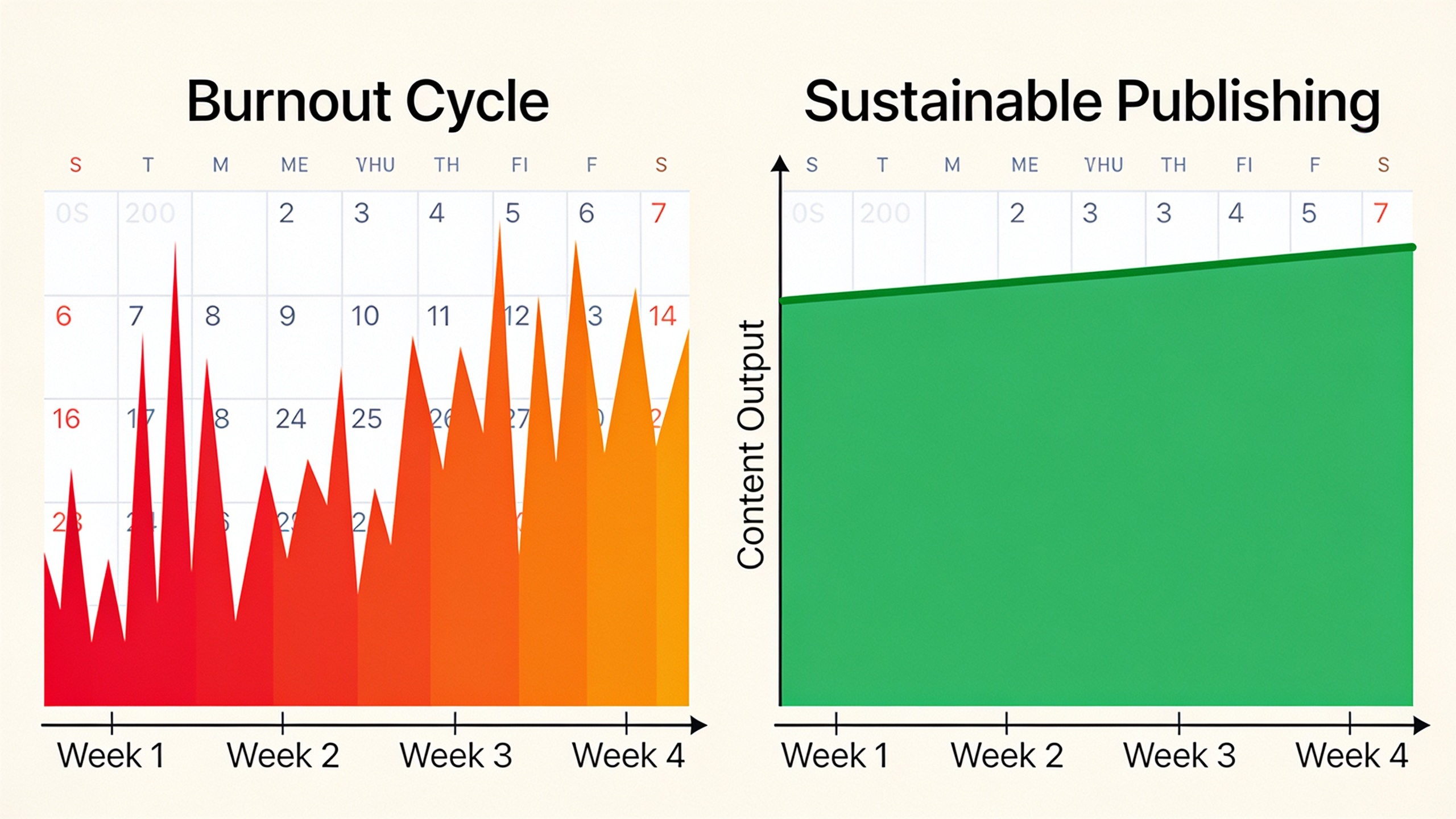
This three-tier thing exists mostly to prevent the classic disaster: teams sprint for three months, burn themselves to a crisp, then go dead silent for another three. That pattern erases most of the momentum you built during the sprint. It's the content marketing equivalent of a crash diet.
Common Mistakes That Undermine Publishing Consistency
The single most common mistake is setting your cadence based on ambition instead of actual capacity, which pretty much always ends in the burnout-and-abandon cycle within a few months. Right up there with it: treating publishing frequency as a vanity metric that's disconnected from your keyword strategy, and forgetting to build in a content refresh process alongside all your new stuff.
Another one that bites teams hard is letting quality control slip as they scale. When you jump from one article a week to five without touching your editorial process, quality slides so gradually that nobody clocks it until traffic starts sagging months later. Build a standardized editorial checklist first (search intent, internal linking, readability, factual accuracy) before you crank up the volume. Boring advice, but it saves you.
And finally, so many teams sleep on internal linking. Every new article should link to and from relevant existing content, reinforcing your topical clusters and helping Google actually understand how your site fits together. Publishing more without a deliberate linking strategy is like building rooms with no doors between them. Isolated articles almost never perform as well as ones woven into a well-connected network. It's low effort, high payoff, and people just skip it.
Frequently Asked Questions
Is there a magic number of articles per week that guarantees SEO growth?
Nope. Google has never confirmed any specific frequency that guarantees ranking improvements, and anyone who tells you otherwise is guessing. What the data does show is a correlation between sustained, consistent publishing (usually 2-4 quality articles a week for growing businesses) and faster organic traffic growth. But the real engine underneath that is topical coverage and content quality, not the raw number.
Can publishing too often actually hurt my SEO?
Yeah, it can, if that extra frequency costs you quality, originality, or accuracy. Google's Helpful Content system exists specifically to sniff out and suppress content that looks mass-produced for rankings rather than made for actual humans. High-frequency publishing only helps when every single article still clears a reasonable quality and usefulness bar.
How long until I see results after ramping up publishing?
Most SEO folks start seeing traffic move within 3-6 months of a consistent increase, with the bigger compounding growth usually showing up after 6-12 months. It varies a lot depending on your domain authority, how competitive your space is, and how good your content is. And it assumes you actually maintain the new cadence rather than doing it in short, doomed bursts.
Should I stop publishing new content to fix up my old articles instead?
Generally, no. Run both at once. Content decay chips away at your older articles no matter how much new stuff you're publishing, so a dedicated maintenance slot (even just one or two updates a month) running alongside new content tends to beat hitting pause on everything to play catch-up.
How do AI content tools change the ideal frequency?
AI automation generally lets you sustain a higher frequency than manual production could, since it compresses research and drafting time significantly. But the quality-control step is still non-negotiable. The most effective setup pairs automated generation with a human review layer to check accuracy and brand alignment before anything goes live.
At the end of it all, finding your right frequency comes down to matching ambition with what you can actually sustain. The businesses winning long-term at SEO aren't necessarily the ones publishing the most. They're the ones who picked a realistic cadence, protected their quality at that cadence, and just... stuck with it long enough for the compounding to kick in. Whether that's two carefully researched articles a week or a higher-volume approach propped up by automation, the principle doesn't budge: consistency beats intensity, every single time.
Ready to stop writing content by hand? Start your free RobinRank trial and get a full month of SEO-optimized articles published on autopilot.