How Often Should You Publish? Finding Your Content Velocity

So let's clear something up. Content velocity is just the pace at which your site publishes or updates content over time, and it's probably one of the most misunderstood things in SEO. More posts does not automatically equal more traffic. What actually matters is whether your pace lines up with your resources, what your audience needs, and whether you can keep the quality bar high month after month. This piece walks through what content velocity really is, why the "post daily or die" thing is nonsense, and how to set a pace you can hold for years instead of weeks.
Table of Contents
- What Is Content Velocity?
- How Often Should You Publish Blog Posts? Debunking the Daily-Posting Myth
- Does Content Velocity Actually Affect Organic Growth?
- What Factors Determine Your Ideal Content Velocity?
- A Framework for Setting a Sustainable Content Velocity
- Content Velocity by Business Stage
- Common Content Velocity Mistakes to Avoid
- FAQ
What Is Content Velocity?
Content velocity is the rate at which a website publishes, updates, or refreshes content over time, usually measured in posts per week or per month. I like it better than just "publishing frequency" because it counts the whole picture: the brand-new stuff and the ongoing maintenance of what you've already got.
Think about two sites. One publishes four new articles a month and refreshes two old ones. The other publishes eight new pieces and never looks back. Both "published eight things," technically. But they're not doing the same thing at all. Search engines and readers respond to the total signal of freshness, depth, and relevance. Not the raw count of shiny new URLs.
And here's a thing people miss: your content velocity isn't some fixed number you set once and keep forever. It shifts over the life of a site. Early on, when your domain has basically nothing indexed, you go aggressive on coverage. Later, once you've built some real topical authority, you ease off and pour more energy into depth, internal linking, and fighting content decay. Getting that distinction is the first step to answering the question everybody actually came here for: how often should you publish to grow traffic without running your team into the ground?
How Often Should You Publish Blog Posts? Debunking the Daily-Posting Myth
There's no magic number of posts per week or month that guarantees you rank. The right frequency comes down to your team's ability to keep quality high, how brutal your competition is, and how much genuinely unique value each article brings. The whole "you must publish daily" idea sticks around mostly because it's easy advice to hand out, not because it reflects how search engines actually judge content.
Google's own Search Central guidance is pretty blunt about this: make content to help people, not to hit some arbitrary posting cadence. Their helpful content guidance keeps hammering the same point, that depth, originality, and demonstrated expertise beat volume every time. One thorough, well-researched 2,000-word article that fully nails a searcher's question and gets updated now and then will usually crush seven thin 400-word posts you shoved out in the same week. Especially in competitive niches, where flimsy content doesn't even get a seat at the table.
That said, don't write off frequency entirely. It matters, just indirectly, in a few ways worth knowing:
- Crawl frequency and discovery. Sites that publish and update more regularly tend to get crawled more often, which can shrink the gap between hitting publish and actually getting indexed.
- Topical coverage speed. Trying to own a new topic cluster? Publishing a bunch of related, high-quality pieces close together helps you plant your flag before a competitor does.
- Compounding traffic. More useful pages means more doors into your site over time, assuming each one is actually helpful and properly optimized.
Notice none of those need daily posting. What they need is consistency, a steady pace your team can actually keep, married to quality high enough that each piece has a real shot at ranking and staying there.
Does Content Velocity Actually Affect Organic Growth?
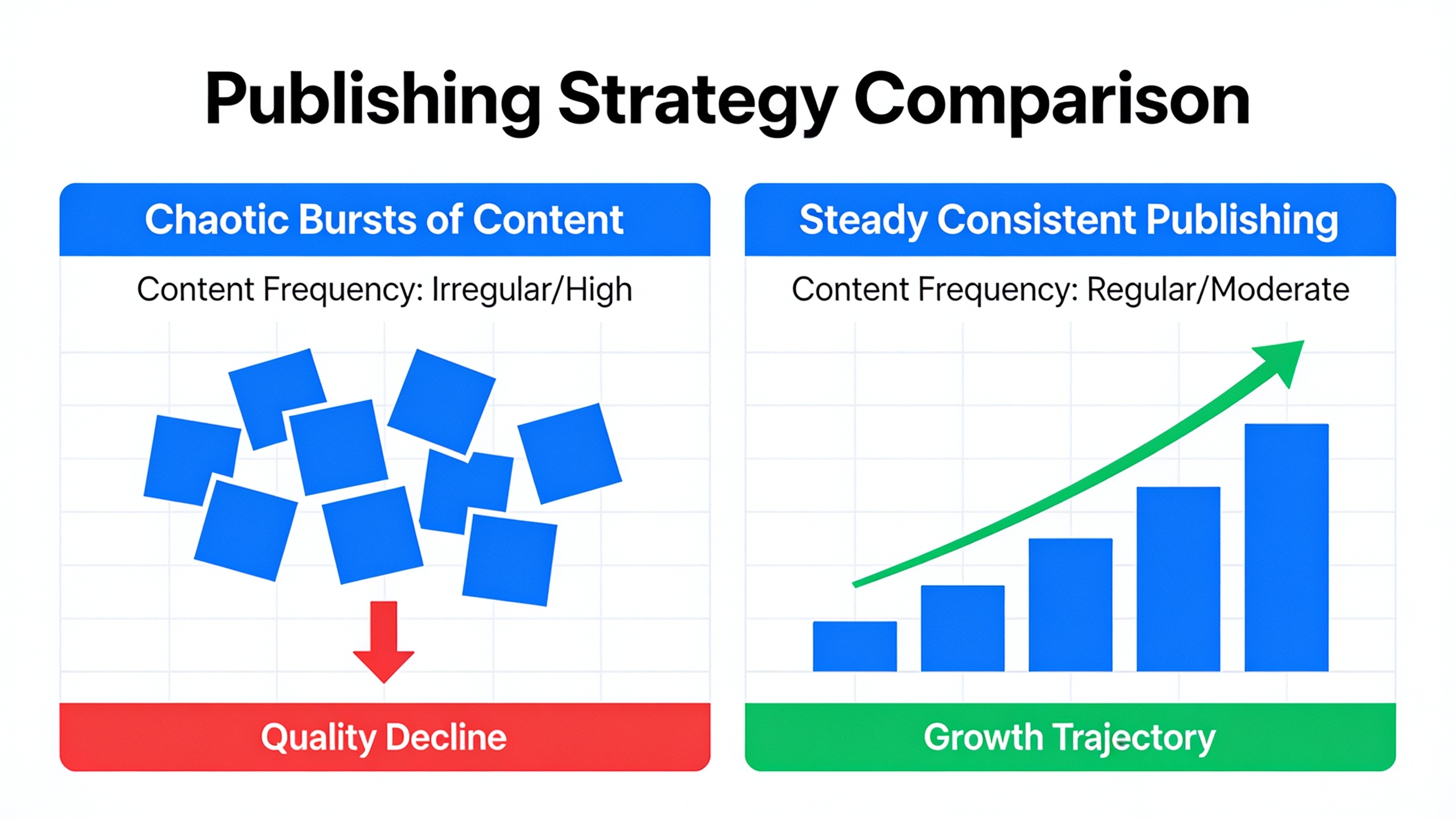
Content velocity drives organic growth mostly through compounding: every well-optimized, genuinely useful article becomes a permanent asset that can pull in search traffic indefinitely. So a steady pace tends to stack up more cumulative traffic than sporadic bursts, but only if quality holds as volume climbs. It's not linear. It's definitely not "more posts, more traffic, the end."
I see two failure patterns constantly.
The first is velocity with no quality control. A team jumps from two posts a month to twelve, hits a wall on research and editing time, and quality quietly slides. The newer, thinner articles stall out, and sometimes that average quality drop drags the whole site's perception down with it, because Google's helpful content systems look at your site as a whole, not just page by page.
The second is the opposite. Quality with no velocity. A team publishes gorgeous, deeply researched stuff, but only twice a quarter. Each piece might rank fine on its own. But the site never builds enough breadth to compete for all the related queries surrounding that topic, and growth just... plateaus. Way below where it could be.
The sweet spot sits in between: a pace where every published piece clears a consistent quality bar, and the cadence is realistic enough that you don't abandon it three months in. This is exactly the kind of consistency problem automation is good at. A platform like RobinRank, which is built to automatically write, optimize, and publish articles, exists for precisely this reason, helping teams hold a steady velocity without the burnout that comes from hand-researching, writing, and formatting every single post.
And honestly, publishing is only half the job. What happens after someone lands on your article matters just as much for the long game. If your velocity is pulling in traffic but not building an audience you actually own, take a look at how to turn blog readers into email subscribers with tactical placement. Turning organic visitors into subscribers compounds the value of every article you put out, no matter how often you post.
What Factors Determine Your Ideal Content Velocity?
Your ideal velocity sits at the intersection of four things: your team's production capacity, how deep and frequent your competitors go, your site's current authority, and how fast information in your niche changes. There's no single correct number. The right pace is just the fastest one you can sustain without letting quality slip.
Team capacity and available resources
If you've got one part-time writer, eight posts a week is not happening. Doesn't matter how badly you want it. Real capacity planning has to account for research, writing, editing, on-page SEO, internal linking, and publishing, not just the drafting. Most teams badly underestimate the invisible work too. Updating old posts, checking for keyword cannibalization, building internal links, all the unglamorous stuff that keeps a content velocity healthy in the first place.
Competitive content depth
If ranking page one for your keywords currently takes 3,000-word guides packed with original research, publishing 800-word posts twice as often won't get you there. Audit what's actually ranking before you set a pace. Sometimes the honest answer is "publish less, but go way deeper."
Domain authority and site age
Newer or lower-authority sites usually benefit from a higher initial velocity, just to build coverage and give search engines more to chew on. But once you've established authority in a niche, each additional new article matters a little less compared to updating and expanding the top performers you already have.
Want content like this running on autopilot for your own site? Try RobinRank free — AI-written, SEO-optimized articles generated and published automatically, no credit card required.
Topic volatility
Some industries move fast enough that content needs constant refreshing just to stay accurate. AI tools, financial regulations, algorithm updates, that kind of thing. That effectively bumps up your required velocity even after you've covered all the new topics. Other stuff (evergreen how-tos, historical explainers) can sit untouched for a year and still be perfectly relevant.
A Framework for Setting a Sustainable Content Velocity
A sustainable velocity is one you can keep up for at least 12 months without quality dropping, deadlines slipping, or your team melting down. The simplest way to find that number is to work backward from capacity, not forward from ambition. Here's the four-step version I actually use.
Step 1: Calculate your true capacity. Add up the total hours per week your team (or your budget) has for content, research and writing and editing and optimization all included. Then divide by how long it realistically takes to produce one article at your quality standard. Be honest here. Most teams inflate this number and then wonder why they're always behind.
Step 2: Set a quality floor, not a quantity ceiling. Nail down the non-negotiables every article has to hit. Originality, depth, accurate sourcing, internal links, solid on-page SEO. Then figure out how many articles clear that bar in a month. If a target velocity would force you below the floor, drop the velocity. Never the standard.
Step 3: Pick a cadence you'd commit to out loud. Twice a week, once a week, twice a month, whatever. Consistency itself is a signal, to your audience and to the crawlers that hit your site on a schedule. One article a week sustained for a year (that's roughly 52 articles) will beat a chaotic burst of 100 in two months followed by six months of dead silence. Every time.
Step 4: Review and adjust quarterly. Track which velocity level lines up with your traffic, ranking, and conversion goals, and revisit it every quarter instead of locking it in forever. As your authority grows, you'll probably want to shift some effort away from pure volume and toward updating and expanding your existing winners.

This is also the point where questions about ownership and authorship tend to pop up, especially for teams mixing human writers with AI tools to hit their targets. Before you scale up with automation, it's worth getting clear on who actually owns the AI content you publish, because copyright and usage rights can shift depending on which tools and workflows you're using.
Content Velocity by Business Stage
Different stages of growth call for different velocities, mostly because your goal keeps shifting, from building initial coverage to defending and expanding what you've already got. The table below is a set of starting points, not commandments.
| Business Stage | Typical Goal | Suggested Velocity | Primary Focus |
|---|---|---|---|
| New site / pre-launch | Build initial topical footprint | 3–5 articles/week | Broad keyword coverage, foundational pages |
| Early growth (0–12 months of content) | Establish authority in core topics | 2–4 articles/week | Topic clusters, internal linking, pillar pages |
| Established site (1–3 years) | Defend rankings, fill content gaps | 1–2 articles/week | Content gap analysis, competitive keywords |
| Mature site (3+ years) | Maintain and refresh | 1–2 articles/week + regular updates | Refreshing decaying content, expanding depth |
| Resource-constrained team (any stage) | Consistency over volume | 1 article/week (or biweekly) | Quality floor, sustainability |
Again, these are directional. Planning numbers, not benchmarks pulled from some study. The right pace for your site still hangs on the capacity, competition, and volatility stuff we covered above.
Common Content Velocity Mistakes to Avoid
The single most common mistake? Picking a pace because some competitor or influencer said it worked for them, instead of figuring out what your own team and topic actually need. And there's a cluster of related screwups I see over and over, on teams of every size.
Starting too fast, then flaming out. Fifteen articles in month one, then two months of silence. That sends a wobbly signal to readers and crawlers alike, and it wrecks any chance of building the habitual repeat visits that make a blog worth anything.
Treating every post as equally valuable. Not all of your velocity should go toward brand-new articles. A real chunk of your effort belongs on updating and expanding posts that are already ranking but starting to slip, which people call content decay. Refreshing a page that already has some authority is often faster and more effective than building from zero.
Ignoring distribution and conversion. A high velocity that never gets promoted, internally linked, or tied to an email capture plan leaves a mountain of value on the floor. Cranking out volume with no plan to turn traffic into subscribers or leads is the number one reason I hear "we publish a ton but growth is flat."
Confusing velocity with a pile of low-effort junk. Programmatically spinning up hundreds of near-duplicate pages to hit a number is exactly the pattern Google's helpful content systems are built to sniff out and bury. Velocity is a sustained rhythm of genuinely useful content. It's not a workaround for quality.
And the quiet one: never revisiting the number. A pace that made sense for a fresh site with zero indexed pages usually stops making sense once that same site has 200 articles and a backlog of outdated ones. Locking in a cadence forever, no quarterly reassessment, is one of the sneakier ways teams burn resources without noticing.
FAQ
Is there an ideal number of blog posts per week for SEO?
Nope, not one that works for every site. The right frequency depends on your team's ability to hold quality, how competitive your keywords are, and where your site's authority stands right now. A realistic, consistent pace, even one article a week held over a year, generally beats an unsustainable daily sprint that fizzles out.
Does posting every day actually help rankings?
Daily posting isn't required to rank well, and Google's own guidance is clear that content should be made for people, not for a posting schedule. It can help in narrow cases, like news sites where freshness itself is the ranking signal. But for most blogs and business sites, depth and usefulness matter way more than raw frequency.
How do I know if my content velocity is too slow?
Watch for big, obvious gaps in topical coverage next to your competitors, a shrinking slice of search visibility for your core topics, and an editorial calendar full of long unplanned silences. If competitors keep covering related subtopics you haven't touched, that's your cue to pick up the pace, though not necessarily to publish more just for the sake of it.
Should I prioritize new articles or updating old ones?
Both matter, but mature sites should generally tilt more toward updating as their library grows. A page that already has some ranking history and a few backlinks can often be improved faster than a brand-new article can be built from scratch, which makes updates one of the smartest uses of a limited velocity.
Can AI tools help maintain a consistent content velocity without sacrificing quality?
They can, yeah. AI-assisted writing and publishing tools cut down the manual time you'd otherwise sink into drafting, optimizing, and formatting each article, which is one of the core things platforms like RobinRank are built around. That said, quality control, fact-checking, and clear editorial standards still have to live in your workflow, no matter how the content gets made.
Content velocity was never about winning a publishing race. It's about finding a pace you can hold steady long enough for compounding organic growth to actually show up. Set it based on your real capacity and a firm quality floor, watch how it performs, and stay willing to adjust as your site grows up. The teams that grow steadily aren't the ones publishing the most. They're the ones publishing consistently enough, and well enough, to keep building on everything they've already put out there.
Ready to stop writing content by hand? Start your free RobinRank trial and get a full month of SEO-optimized articles published on autopilot.