How to Actually Edit AI-Written Content (Without Publishing Garbage)

The fix isn't complicated in theory. You treat the AI draft as a first pass, never a finished product, and you run it through human checkpoints for accuracy, voice, and compliance before a single reader sees it. That's the whole idea behind a solid AI content editing workflow. This piece is me walking you through how to build one that lets you move fast without publishing something that torches your credibility, your rankings, or your brand.
Doesn't matter if you're a solo founder trying to scale content, an in-house marketer wrangling a blog calendar, or an agency cranking out client work by the dozen. The principle holds either way: AI writes, humans decide.
Table of Contents
- What Is a Human-in-the-Loop AI Content Editing Workflow?
- Why Human Review of AI Content Still Matters
- The Step-by-Step AI Content Editing Workflow
- How Long Should Editing Take? Balancing Speed and Quality
- Editing Tiers: Matching Review Depth to Content Risk
- Common Mistakes When Editing AI-Written Content
- Tools, Checklists, and Team Roles
- Frequently Asked Questions
What Is a Human-in-the-Loop AI Content Editing Workflow?
A human-in-the-loop AI content editing workflow is a publishing process where every AI-generated draft runs through defined human checkpoints (fact-checking, voice alignment, SEO structuring, compliance review) before it goes live. The phrase "human-in-the-loop" actually comes from machine learning, where it describes keeping a real person in the decision-making loop instead of letting the model run wild on its own.
Apply that to content marketing and it just means the AI, whether that's ChatGPT, Claude, Gemini, or an integrated platform like RobinRank, does the grunt work of research synthesis, drafting, and formatting. Then a human editor verifies the claims, fixes the tone, checks the sourcing, and makes the actual call on whether the thing is ready to ship. And to be clear, this isn't about not trusting AI. It's about matching your review effort to the real-world risk of getting something wrong in front of an audience or a search engine.
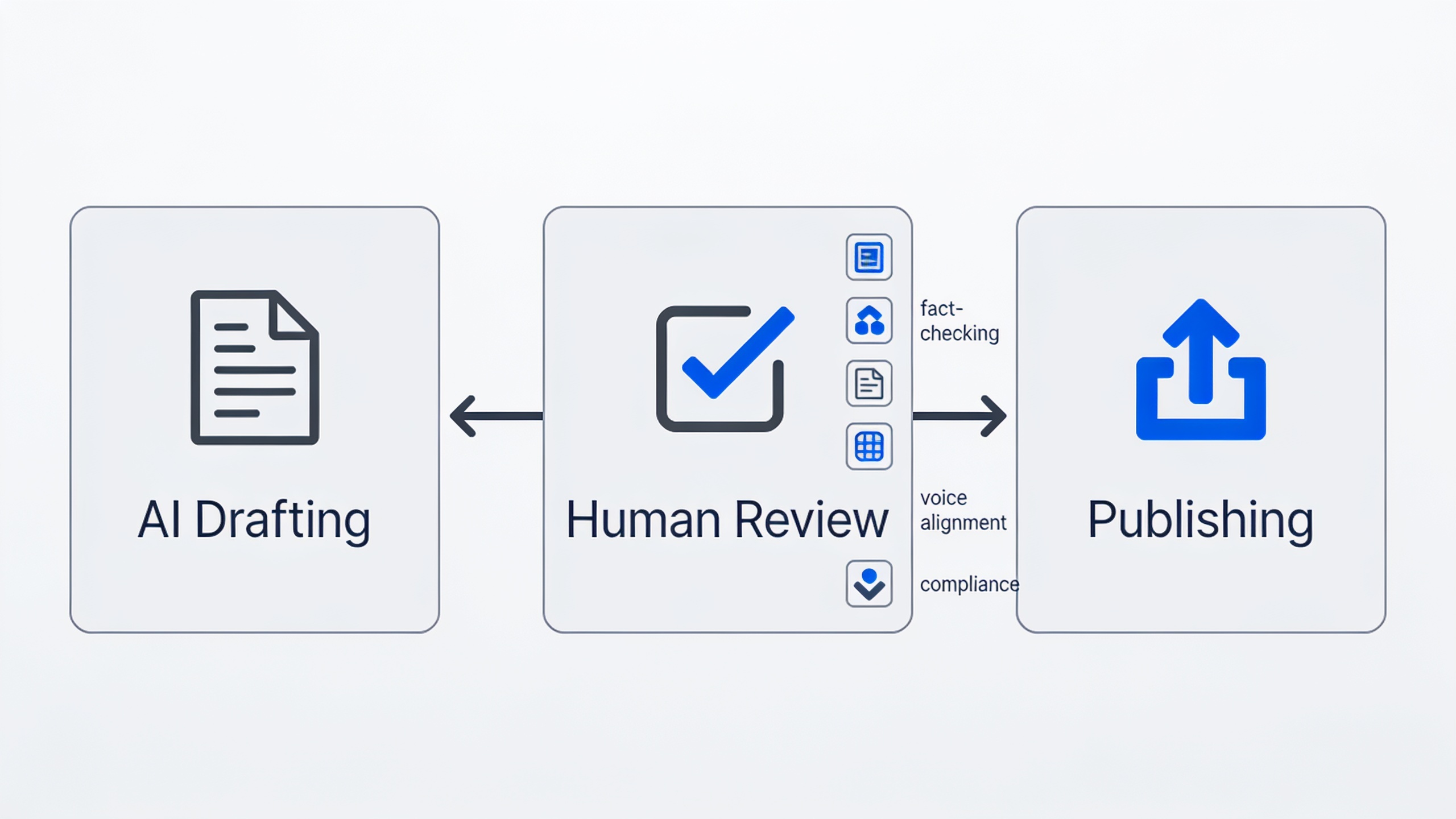
A mature workflow has three parts, really. Drafting (AI-generated or AI-assisted), review (human-led, checklist-driven), and publishing (final formatting, internal links, metadata). Skip that middle stage and I promise you, that's where 90% of AI content disasters are born.
Why Human Review of AI Content Still Matters
Human review matters because large language models are terrifyingly good at producing fluent, confident text that happens to be flat wrong, out of date, or quietly disconnected from what your brand actually knows. People call this "hallucination," and here's the uncomfortable part: no amount of clever prompting fully kills it. That's exactly why editorial oversight isn't optional before you publish.
There are three reasons this stays true even as the models get scary good.
First, accuracy and liability. AI generates text from patterns in its training data, not from verified real-time facts. It'll cite a statistic that sounds completely plausible but doesn't exist. It'll misattribute a quote. It'll describe a product feature that got deprecated six months ago with total confidence. And when that goes live under your business's name? You're on the hook. Not the AI. You.
Second, the trust signals search engines care about. Google's Search Quality Rater Guidelines lay out E-E-A-T (Experience, Expertise, Authoritativeness, and Trustworthiness) as the framework raters use to judge content quality, especially for anything touching someone's health, money, or safety. Content that comes off as generic, unverified, or clearly written by someone who's never done the thing tends to tank on these fronts. If you want the deeper version of how this plays out with AI writing specifically, E-E-A-T AI Content: How to Pass Google's Trust Test walks through exactly how editors can bake real expertise back into a draft.
Third, brand voice. Left to its own devices, AI defaults to this neutral, faintly corporate register that could belong to literally anyone. Readers respond to specific, distinctive language, and so do the AI answer engines now summarizing your content for other people. Human review is where that personality gets put back in.
None of this makes AI drafting useless as a starting point. It just means the draft is exactly that. A starting point. It needs a second set of eyes before it goes out there representing you.
The Step-by-Step AI Content Editing Workflow
A practical AI content editing workflow runs through five checkpoints in order: fact-check, structural edit, voice edit, SEO polish, and compliance sign-off. Treat them as separate passes instead of one big read-through and you'll actually go faster while catching more, because each pass only has one job to do.
Step 1: Fact-Check Every Verifiable Claim
Before you touch a single sentence for style, go hunting. Isolate every factual claim in the draft (stats, dates, product features, named studies, pricing, legal statements) and check each one against a primary source. If the AI drops a statistic, you either confirm it against the original and add the citation, or you delete it. My personal rule, and one I've seen work well for teams: if you can't find the source in under two minutes, cut the claim. Don't publish it on faith.
This is also where you catch stale info. Models trained up to a cutoff date will happily describe pricing, features, and regulations that changed ages ago. Anything time-sensitive (software pricing, tax rules, algorithm details) gets checked against a live source. Not the model's memory. The live source.
Step 2: Edit for Structure and Logical Flow
AI drafts love to produce technically correct paragraphs that don't build toward anything. They'll make the same point three times in slightly different words, or bury the one useful thing under paragraphs of generic throat-clearing. So read the draft for structure alone this time. Does each section earn its spot? Does the piece answer the reader's actual question early instead of making them scroll? Does the argument go somewhere? Cut the redundant stuff, reorder so the good bits come first.
Step 3: Rewrite for Voice, Specificity, and Experience
This is the step where a draft stops smelling like "AI content" and starts sounding like you. Take the vague statements ("many businesses find success with...") and replace them with specific ones. Real examples. First-hand detail. Actual numbers. If your team has data, case studies, or client outcomes sitting around, now's when you fold them in, and honestly this is one of the most direct ways to strengthen that experience signal the quality raters keep looking for.
Step 4: SEO and Formatting Polish
Make sure your target keyword shows up naturally in the title, the intro, and a sensible number of subheadings, without jamming it in awkwardly. Check the heading hierarchy (your H2s and H3s), scan for missing or duplicate meta elements, and confirm your internal links actually point somewhere relevant instead of being dropped in mechanically. If the article touches backlink strategy or off-page SEO at all, this is the natural moment to reference related resources. A piece about how AI content earns authority, for instance, might send readers to Niche Edits SEO Explained: Pros, Cons, and Hidden Risks so they understand where link placements fit into the bigger picture once content is live.
Step 5: Compliance and Final Sign-Off
Your last checkpoint is a named human. Not "the team." One accountable person. For regulated stuff (finance, health, legal), that means a subject-matter reviewer, not just an editor with good instincts. For everyone else, you still want a single owner who signs off before publish, so accountability doesn't just evaporate across five contributors who all assumed someone else had it handled.
How Long Should Editing Take? Balancing Speed and Quality
Want content like this running on autopilot for your own site? Try RobinRank free — AI-written, SEO-optimized articles generated and published automatically, no credit card required.
Editing time should scale with content risk, not with some fixed company policy. A low-stakes blog roundup might need 15-20 minutes of human review. A YMYL (Your Money or Your Life) topic like financial or health advice deserves a much longer, multi-reviewer grind. There's no magic number that fits everything, and teams that force one end up either over-editing harmless posts or under-reviewing the risky ones. Both are bad.
The rule of thumb I keep coming back to is sizing your review effort by two questions. How wrong could this be? And how far would it travel if it were wrong? A product comparison that fumbles a competitor's pricing is embarrassing and fixable. A piece giving bad tax or medical advice can genuinely hurt someone and is a nightmare to walk back once it's indexed and shared everywhere. The first one justifies a quick pass. The second should never skip full fact-checking and expert review, deadline be damned.
And look, speed and quality aren't actually enemies here. They only fight when your review process is a mess. A checklist-driven flow (fact-check, structure, voice, SEO, sign-off) is usually faster overall than the vague "I'll read it a few times" approach, because it stops you from re-reading the same paragraph over and over hunting for different problems each time.
Editing Tiers: Matching Review Depth to Content Risk
Not every piece needs the same scrutiny, and pretending otherwise just wastes your best people's time. Sort content into tiers by risk and purpose, and you can spend editorial energy where it actually counts instead of spreading it evenly over everything on the calendar.
| Editing Tier | Typical Content Type | Review Focus | Who Should Review | Relative Time Investment |
|---|---|---|---|---|
| Quick Pass | Internal notes, low-traffic blog updates, social captions | Grammar, tone, obvious errors | One editor | Low |
| Standard Edit | Most blog posts, product pages, how-to guides | Fact-check, structure, voice, basic SEO | One editor, spot-checked by a second | Moderate |
| Deep Edit | YMYL topics, comparison/review content, anything citing statistics or studies | Full fact-check, sourcing, compliance, subject-matter accuracy | Editor + subject-matter expert + final sign-off owner | High |
| Regulated Review | Financial, medical, legal, or safety-related content | Everything in Deep Edit plus formal compliance or legal review | Editor + expert + compliance/legal reviewer | Highest |
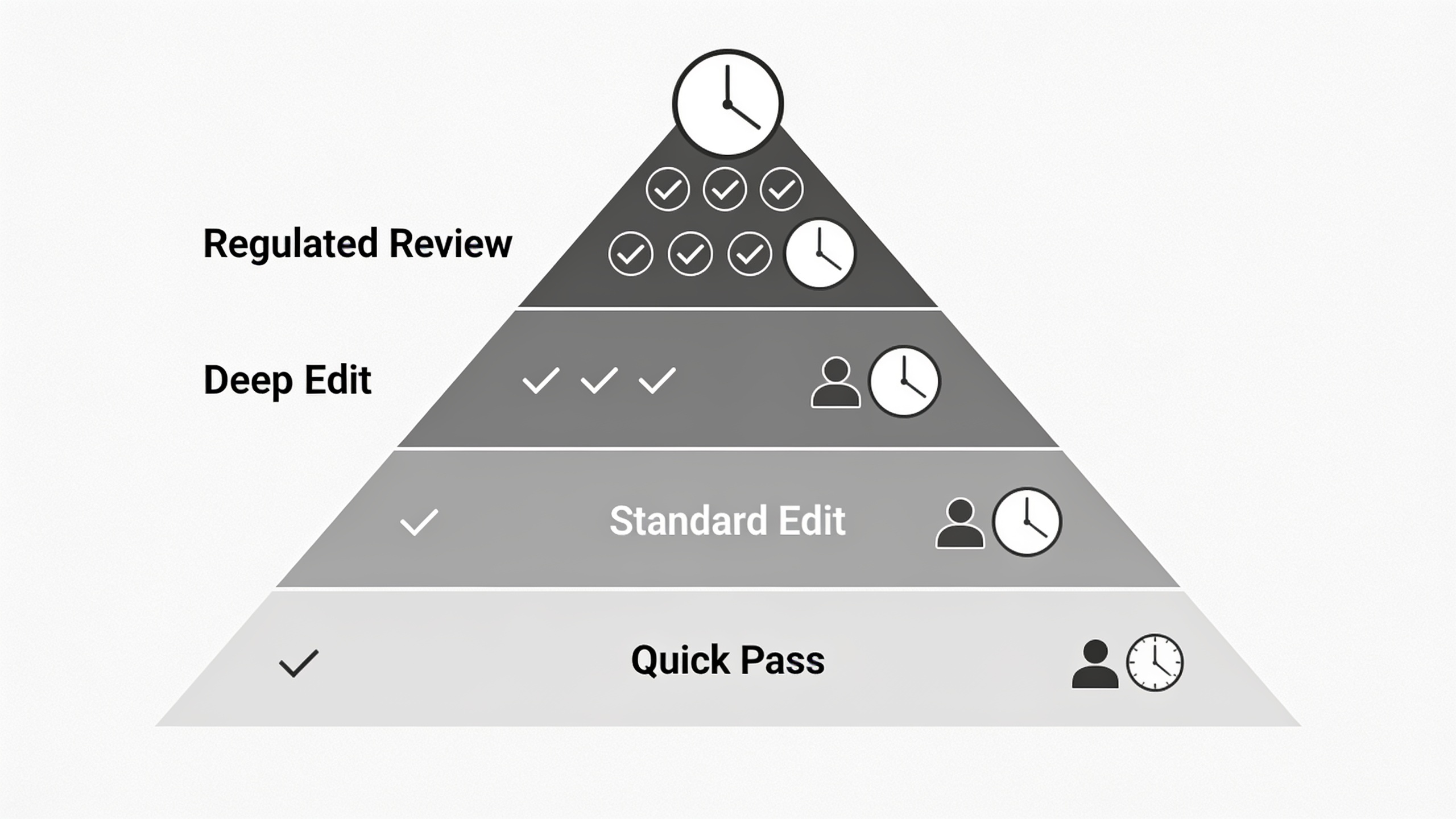
Treat this as a starting structure, not gospel. Adjust the tiers for your own industry and risk tolerance. The labels themselves don't matter much. What matters is the discipline of deciding, before drafting even begins, how much human review a given piece is going to need.
Common Mistakes When Editing AI-Written Content
The single most common mistake is treating AI editing like a light proofread instead of a real review. People skim for typos while unverified claims, generic phrasing, and structural problems sail right through to publish. There are a few other patterns that show up again and again once teams start leaning on AI drafting.
The big one is trusting confident-sounding text. AI writes with total authority whether the underlying claim is true or complete nonsense, and editors who aren't specifically watching for it mistake that fluency for correctness. The fix is boring and procedural: treat every number, name, date, and study reference as unverified until you've checked it, no matter how beautifully the sentence reads.
Then there's skipping the "why should I believe this" test. Content that's competent but generic (the kind that could've been written about any brand in any industry) underperforms with both readers and the trust signals Google evaluates. My gut check: if you could publish the piece on a competitor's site by swapping the brand name and nothing else, you haven't edited it enough for voice and experience. Not even close.
Publishing without an accountable reviewer is another killer. When responsibility gets diffuse ("the team looked at it"), stuff slips through because everyone quietly assumes someone else caught it. Naming one final reviewer per piece, even in a two-person shop, closes that gap fast.
Over-relying on a single editing pass hurts too. Trying to catch factual errors, structural issues, tone problems, and SEO gaps all in one read is both slower and worse than splitting them into separate passes. And finally, ignoring internal linking. AI drafts have no clue what else lives on your site, so they either skip internal links entirely or suggest weird unrelated ones. That's on you to fix. Connect new content to the relevant existing pages, both for your readers and for the topical authority a well-linked site earns.
Tools, Checklists, and Team Roles
Effective editing workflows for AI content usually split the work across three roles: a drafter (human or AI-assisted), an editor who runs the checklist review, and a final approver who signs off before publish. Smaller teams smoosh these into one or two people, and that's fine. Just don't skip the functions themselves even when you're consolidating who does them.
A simple, repeatable checklist should cover the basics:
- Every statistic and named claim traced back to a live, verifiable source
- Product and feature descriptions checked against current info, not training-data-era info
- At least one section rewritten with specific, brand-grounded detail instead of filler
- Heading structure reviewed for logical flow and keyword placement
- Internal links checked for relevance, not just existence
- One named person confirming final sign-off
Platforms built specifically for AI content production, including RobinRank's own take on automated writing and optimization, are increasingly designing these review checkpoints straight into the publishing pipeline instead of leaving fact-checking as a manual afterthought bolted on at the very end. But whatever your tool stack looks like, the underlying discipline never changes. Define the checkpoints, assign the roles, and don't let a deadline crush the whole thing back down into one rushed read-through.
Frequently Asked Questions
Does AI-written content actually hurt my rankings if it's disclosed or obviously AI-generated?
Google's public guidance is about content quality and helpfulness, not how the content got made. But unedited AI drafts routinely fall short on the accuracy, depth, and originality that quality-focused ranking systems reward. A properly edited AI-assisted draft that survives human fact-checking and voice review is a completely different animal than raw, untouched output.
How many people need to review a single AI-generated piece?
Depends on the risk tier. Low-stakes stuff can move through one editor and be done. Higher-stakes content (financial guidance, health info, competitive comparisons making specific claims about other companies) should get at least one subject-matter reviewer on top of the editor, plus a named final approver.
Can't AI tools just fact-check their own output?
Not reliably, no. A model generating a claim and a model asked to verify that same claim are drawing on the same training data and the same pattern-matching, so asking an AI to "check itself" isn't a real substitute for tracing a claim back to an independent, verifiable source. Your workflow should always include manual source verification for the specific claims.
What's the fastest way to build an editing workflow from scratch?
Start with the five steps up top (fact-check, structure, voice, SEO, sign-off) and assign one person per checkpoint, even if that person is you doing all five in a row. Formalizing the sequence, even in the simplest possible way, prevents the most common failure mode: the unstructured single read-through that misses whole categories of problems.
Should every draft get the same level of editing?
Nope. Matching review depth to risk, like the tiers above, beats applying the same scrutiny to everything. A quick internal update just doesn't need the same treatment as a published comparison article making specific factual claims about real products.
Building a reliable AI content editing workflow was never about slowing your publishing down. It's about making sure the speed AI hands you doesn't quietly cost you your accuracy, your reader's trust, or your brand's credibility. The teams that separate drafting from review, size their editing effort to the actual risk, and put clear accountability on every checkpoint? They end up shipping faster and cleaning up fewer messes than the ones treating editing as an afterthought. Every time.
Ready to stop writing content by hand? Start your free RobinRank trial and get a full month of SEO-optimized articles published on autopilot.