How to Build a Topic Cluster Strategy That Boosts Rankings
I've watched sites do this well and I've watched sites do it badly, so this is my attempt to lay out how it actually works, step by step, with examples you can steal.
The core idea is simple. Instead of pumping out isolated blog posts that end up fighting each other for the same keywords (yes, that happens, more on it later), you build a connected system. Crawlers move through it more efficiently. Readers navigate it more naturally. And your site slowly becomes the obvious answer for an entire subject area instead of just one lonely query.
Table of Contents
- What Is a Topic Cluster Strategy?
- Why Topic Clusters Improve Topical Authority and Rankings
- How Do You Choose a Pillar Topic?
- Building the Cluster: Structure and Internal Linking
- How Long Does It Take to See Results From a Topic Cluster Strategy?
- Tools and Workflows for Managing Clusters at Scale
- Common Mistakes That Undermine a Topic Cluster Strategy
- Maintaining and Expanding Clusters Over Time
- Frequently Asked Questions
What Is a Topic Cluster Strategy?
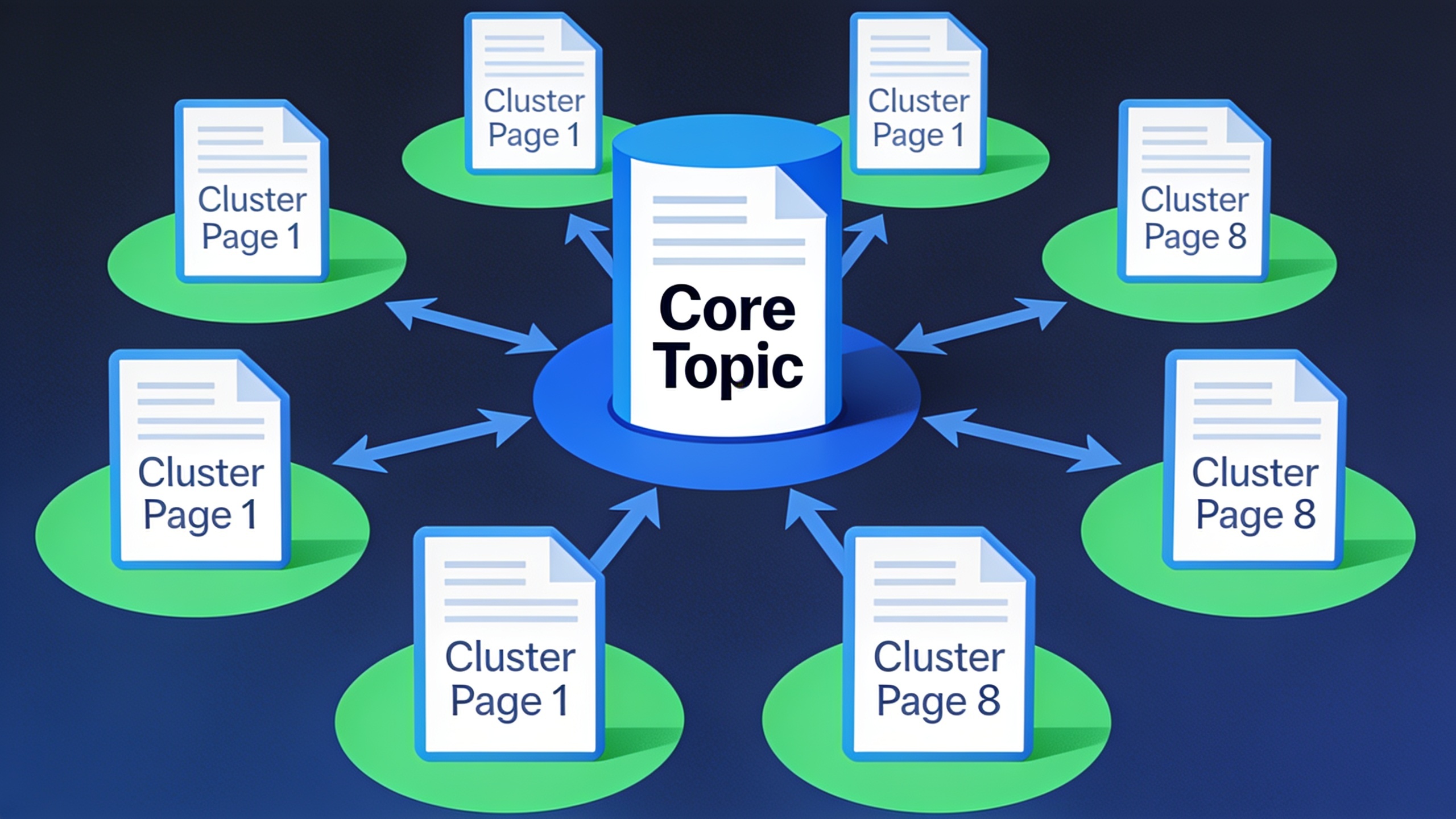
A topic cluster strategy organizes your content into a hub-and-spoke model: one broad pillar page covers a topic at a high level, and multiple narrower cluster pages each tackle a specific subtopic, all linking back to the pillar and to each other. HubSpot popularized this back in the mid-2010s as a reaction against the old, kind of dumb habit of building a separate page for every single keyword.
The pillar page is your anchor. It goes after a broad, high-volume term. Something like "email marketing," or in our case, "topic cluster strategy." It gives the big-picture overview without getting lost in the weeds of any one subtopic. Then the cluster pages take each of those subtopics (how to pick email software, how to write subject lines that don't get ignored, how to segment your list) and go deep, always pointing back up to the pillar and nodding to their sibling pages when it makes sense.
This is a completely different mindset from your typical content calendar, where articles get planned one at a time based on whatever keyword looked juicy that week. A cluster treats your keyword list as a map of one connected topic, not a grab-bag of unrelated ideas. And the practical payoff is real: fewer pages elbowing each other for the same search intent, plus a much cleaner signal to Google about what your site is actually about.
Why Topic Clusters Improve Topical Authority and Rankings
Topic clusters improve rankings mostly because they kill keyword cannibalization and build a dense web of internal links that helps search engines crawl, understand, and rank a whole subject area instead of a scattering of unrelated pages. Topical authority is really just Google's confidence that you've shown deep, consistent expertise on something, and that confidence gets built page by page, link by link. There's no shortcut.
Search has moved on from the old keyword-matching days. It's now much more about reading the intent and context around a topic as a whole. Google's own documentation on how Search works talks about judging relevance based on a page's overall context and how it relates to other content, not just whether the exact phrase shows up. A well-built cluster hands Google a pile of those contextual signals. Related terms, internal links, consistent entities all reinforcing the same theme.
There are three things actually doing the work here.
First, reduced cannibalization. When several of your pages loosely target the same keyword, Google gets confused about which one to rank. Rankings start bouncing around, or worse, settle on your weaker page. A cluster gives each page its own distinct, non-overlapping job, so they prop up the pillar instead of undercutting it.
Second, concentrated internal link equity. Every cluster page that links to the pillar passes it relevance and authority. Do this across a dozen pages and the pillar ends up with more internal links than any single article could ever earn on its own, and that tends to correlate with better rankings for the head term.
Third, deeper semantic coverage. Because each cluster page hits a different facet of the topic, the site collectively covers way more related terms, questions, and entities than one article ever could. That breadth is a big part of how both search engines and AI tools judge whether you actually know the subject.
And that last point is getting more important by the month. AI assistants like ChatGPT, Perplexity, and Gemini lean on well-indexed pages and recognizable, independently-cited sources when they build answers. A site that's built a genuine cluster, not one article but a dozen interlinked ones on the same subject, simply gives those systems more surface area to find and quote. More entry points. More reasons to trust you.
How Do You Choose a Pillar Topic?
The right pillar topic is broad enough to pull meaningful search volume but narrow enough that you can realistically cover it with 8 to 15 supporting articles without running out of stuff worth saying. And it has to be something your business can actually claim expertise in, not just something that happens to rank well.
Business relevance comes first. The pillar should map to a product, a service, or a real problem your audience has. A marketing agency writing about "content marketing" as a pillar? Makes total sense. A plumbing company writing about it because the search volume looked nice? No. Doesn't matter how many people search it.
Then there's search demand at the head term. Do the keyword research and confirm the pillar term itself actually gets meaningful monthly volume. You want something a broad audience searches, not some niche long-tail phrase. (Those belong in the clusters, not the pillar.)
Subtopic depth is the one people skip. Before you commit, brainstorm or research at least 10 to 20 related questions, comparisons, and how-tos. If you can only come up with three or four subtopics, honestly, your pillar is too narrow and should probably become a cluster page under a bigger pillar instead.
And finally, competitive reality. Go look at who's actually ranking for the pillar term right now. If the top results are all giant, decades-old publishers, you've got two options: narrow the pillar (say, "topic cluster strategy for SaaS companies" instead of "content strategy"), or make peace with a longer timeline. Both are fine. Pretending you'll outrank Wikipedia in three months is not.
A trick I use for surfacing subtopics: mine the "People also ask" boxes, the autocomplete suggestions, and the forum threads on Reddit and Quora around your candidate term. Then group all those questions into four to six thematic buckets. Each bucket usually becomes one or two cluster articles. Easy.
Building the Cluster: Structure and Internal Linking
Once you've locked in the pillar and its subtopics, you build the cluster by writing the pillar page first (or updating an existing one), then producing individual cluster articles that each go after one subtopic and link both ways with the pillar. That linking pattern is the whole thing. It's what actually turns a pile of related articles into a "cluster" in any technical sense. Skip it and all you've got is a category of vaguely related blog posts. Which is not the same thing at all.
The Core Linking Rules
Keep the pattern consistent across every page:
- Every cluster page links up to the pillar, ideally in the first few hundred words, using descriptive anchor text (not "click here," not a naked URL, please).
- The pillar links down to every cluster page, either in a structured section or naturally in the body where that subtopic comes up.
- Cluster pages link sideways to two or three sibling pages where the content genuinely overlaps. This reinforces the semantic relationships Google uses to gauge depth.
- Let your URL structure reflect the hierarchy where you can. Nest the cluster pages under a shared subfolder, or tag them consistently.
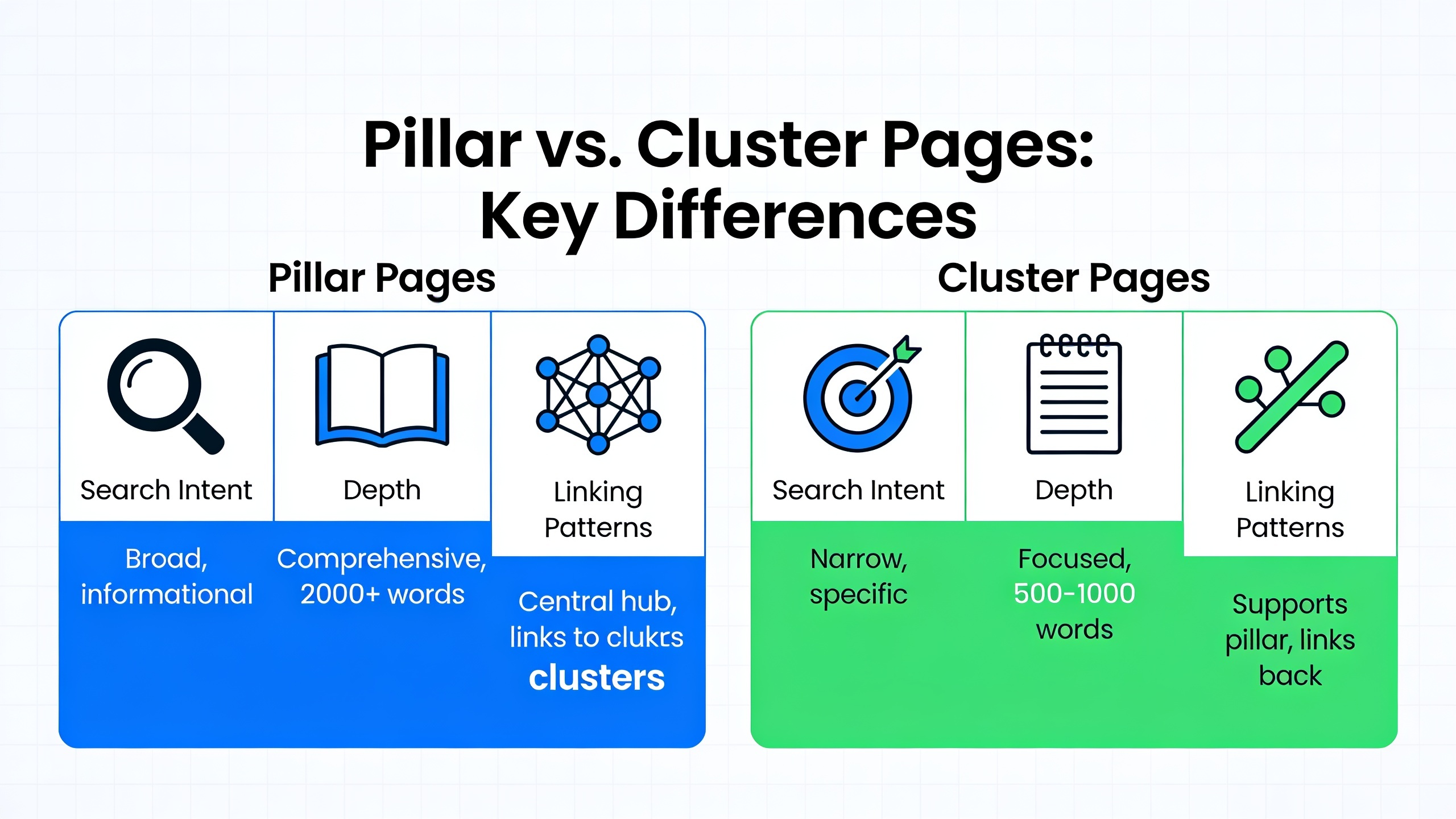
Pillar vs. Cluster Page: Key Differences
| Attribute | Pillar Page | Cluster Page |
|---|---|---|
| Search intent | Broad, informational overview | Specific, narrow question or task |
| Target keyword volume | High volume, competitive | Lower volume, long-tail |
| Content depth | Comprehensive summary, links out for detail | Deep dive on one subtopic |
| Typical length | Long-form (1,500-3,000+ words) | Focused (800-2,000 words) |
| Update frequency | Frequent, since it's the main ranking asset | Periodic, as facts or trends shift |
| Internal links | Links down to all cluster pages | Links up to pillar, sideways to siblings |
| Primary goal | Rank for the head term, aggregate authority | Capture long-tail traffic, feed authority upward |
Content Format Considerations
Think of the pillar page as a navigable overview. Almost like a table of contents with actual substance, giving readers and crawlers the full picture before sending them deeper into specific cluster pages. Don't copy an entire cluster article into the pillar, though. Summarize the key point, then link out for the depth. This keeps your pillar's word count sane while still being comprehensive in scope.
Cluster pages are the opposite. You have to assume someone lands on one straight from a search result, having never seen the pillar. So each one needs to stand completely on its own: a clear intro, a direct answer to the exact question in the title, and enough context that it doesn't read like an orphaned fragment. This is also where you fold in your comparisons, examples, and any product or service mentions that actually fit the subtopic.
So if your cluster ever touches on how AI-generated content stacks up against competing tools, it's worth linking out to something like this breakdown of Koala.sh vs RobinRank and which AI writer actually moves rankings, because people building a content strategy usually need to evaluate the tools that'll produce it too.
Want content like this running on autopilot for your own site? Try RobinRank free — AI-written, SEO-optimized articles generated and published automatically, no credit card required.
How Long Does It Take to See Results From a Topic Cluster Strategy?
Most sites start seeing measurable ranking movement within 3 to 6 months of publishing a complete cluster, though the exact timeline swings a lot based on domain authority, competition, and how fast you actually finish building the thing. And this is important: a single pillar page with no supporting cluster pages behaves like any other standalone article. It won't show the compounding effect that gives clusters their whole reason for existing.
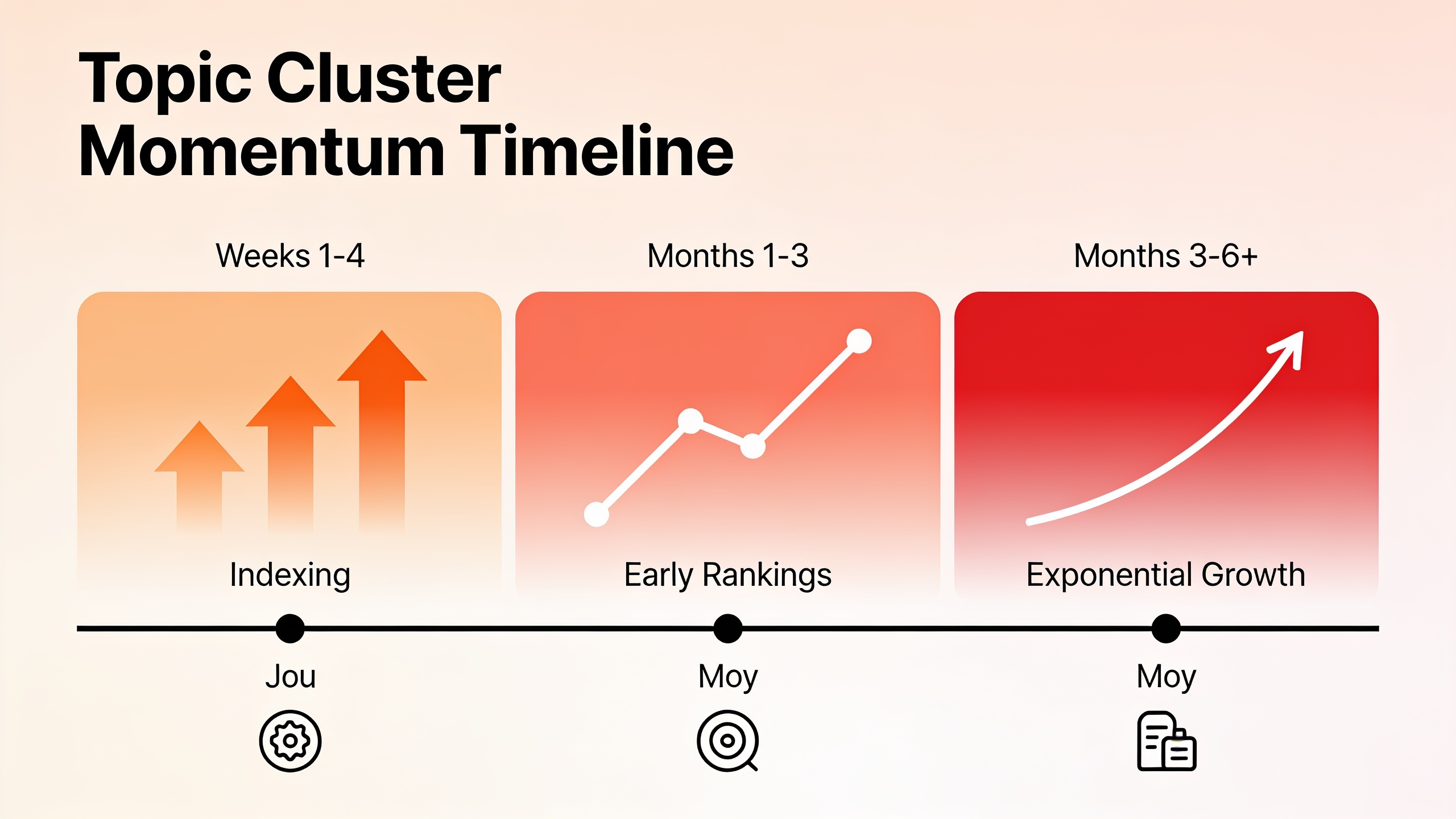
Roughly, it plays out in three phases.
Weeks one through four are indexing and initial crawl. New pages have to get discovered and indexed before they can rank at all. Submitting them through Google Search Console and making sure they're linked from something already indexed (like your pillar) speeds this up.
Months one through three bring early ranking signals. Your cluster pages going after the less competitive long-tail terms usually rank first, sometimes on page one for very specific queries, while the pillar climbs more slowly for the big competitive head term. This is normal. Don't panic that the pillar's still on page four.
Then months three through six and beyond is where authority compounds. As more cluster pages go live and pick up their own backlinks and engagement, the internal links pointing at the pillar keep strengthening its relevance signals, and the pillar's rankings for the broad term start to climb. This is also when topical authority really shows up. Your site starts ranking for variations and related queries you never even targeted. That's the fun part.
Because all of this depends on volume and consistency, sites that publish a full cluster of 10-plus interlinked articles within a few months tend to hit the authority effect faster than sites trickling out one post every few weeks. Which is exactly why cadence matters as much as quality. A cluster strategy rewards completeness. Half a cluster is basically no cluster.
Tools and Workflows for Managing Clusters at Scale
Managing a topic cluster at scale needs three things running together: a research process to map subtopics and keywords, a production workflow to write and structure everything consistently, and a publishing system that keeps your internal links and schema markup accurate across the whole cluster. Trying to do all this by hand across dozens of articles is exactly where most in-house teams run out of hours in the day.
A workable flow usually looks like this:
- Analyze the niche and competitors. Before you write a word, map what's already ranking for your pillar and cluster keywords, and spot the gaps competitors left open.
- Draft with SEO structure built in. Optimized titles, meta descriptions, heading hierarchy, internal links, all planned from the start instead of bolted on after.
- Publish consistently, ideally on a schedule, so the cluster hits critical mass instead of dying after article three.
- Track and adjust based on which cluster pages are gaining traction and which pillar sections need beefing up.
This is more or less the workflow RobinRank is built around. The platform analyzes a site's niche, competitors, and Domain Rating to surface content topics and backlink opportunities, then writes SEO-structured articles (optimized titles, meta descriptions, internal and external links, auto-generated JSON-LD schema) and can publish them on a schedule straight to a connected CMS like WordPress. For teams building out a full cluster without a dedicated content department, having the planning, drafting, and scheduled publishing in one place strips out a ton of the manual coordination that usually causes clusters to stall halfway through.
One more thing, because it matters. Authority signals don't stop at internal linking. External validation, meaning other independent sites linking to your pillar and cluster pages, is still one of the clearest signals search engines and AI systems use to decide whether you're trustworthy. If you're working the link-earning side alongside the content, this guide on how to build backlinks without buying links in 2025 covers approaches that pair naturally with a cluster's internal linking.
Common Mistakes That Undermine a Topic Cluster Strategy
The single most common mistake is treating the pillar and cluster pages as separate little projects instead of one connected system. You publish them without deliberate, two-way internal links, and that linking is the one element that actually creates the "cluster" effect in the first place. Without it, you don't have a cluster. You have a blog. There are a few other patterns that reliably tank results, too.
Keyword overlap between cluster pages is a classic. If two of your articles both loosely target "how to write a blog post" and "blog post writing tips," congratulations, they're now cannibalizing each other instead of feeding the pillar. Every cluster page needs a genuinely distinct angle or question. If you can't tell two of them apart, Google can't either.
Then there's the thin-page trap. Some people publish short, low-value pages purely to have more links pointing at the pillar. This backfires. If a cluster page doesn't independently satisfy search intent, it won't rank on its own and it won't pass any meaningful authority upward. It's just dead weight.
Abandoning the cluster after the pillar is maybe the saddest one. A team publishes this ambitious, gorgeous pillar page, knocks out one or two cluster articles, gets bored, and jumps to a new topic. The cluster never reaches critical mass, so the compounding effect never kicks in. All that work for nothing.
And two more, quickly. Ignoring existing content during planning is a waste. Most sites already have relevant articles scattered across the blog, and auditing them to retrofit them into the cluster structure (instead of only planning new stuff) often speeds up results and avoids duplicate content. Finally, static pillar pages. If you treat the pillar as "finished" instead of a living document that gets updated as you add cluster pages and as best practices shift, it slowly drifts out of sync with the cluster it's supposed to be leading.
Maintaining and Expanding Clusters Over Time
A topic cluster is not a one-and-done project. It needs periodic audits to add new subtopics, refresh outdated info, and expand into adjacent clusters as the pillar topic matures. Search behavior shifts, competitors publish new stuff, and a cluster you never touch gradually loses whatever freshness edge it once had.
The maintenance work isn't glamorous, but it's what keeps things compounding:
- Review search performance quarterly to find cluster pages that are underperforming and need either an update or a stronger internal link from the pillar.
- Add new cluster pages as fresh subtopics, tools, or questions pop up. A cluster should keep growing, not sit frozen after launch.
- Update the pillar's outline whenever a significant new cluster page goes live, so the two stay in sync.
- Consolidate or redirect cluster pages that never gained any traction and are just eating crawl budget or muddying your internal links.
- Keep an eye out for cannibalization as you grow, because more pages means more chances for accidental keyword overlap.
Over time, a mature pillar often spawns a whole second-tier cluster of its own. A pillar on "content marketing," for instance, might eventually support a dedicated sub-cluster on "AI content marketing," complete with its own supporting articles, once there's enough distinct search demand to justify it. Knowing when a cluster has outgrown its original scope, and splitting it thoughtfully instead of cramming everything under one overstuffed pillar, is honestly what separates a strategy that keeps compounding from one that quietly plateaus.
Frequently Asked Questions
How many cluster pages do I actually need for this to work?
There's no magic number, but most effective clusters have at least 6 to 10 supporting pages around a single pillar before the authority-compounding effect really becomes noticeable. Smaller or super-niche topics might need fewer. Broad, competitive ones often want 15 or more to cover the ground properly.
Should I write the pillar first or the cluster pages first?
Most people draft the pillar's outline first so the subtopics are mapped out clearly, but it's totally common to publish two or three cluster pages before the pillar goes live. Those long-tail pages can start ranking and gathering data while you're still polishing the pillar.
Can this work for a brand-new site with zero authority?
Yep, though it takes longer for the pillar to rank for the competitive head terms. New sites usually see their long-tail, lower-competition cluster pages rank first, and those then feed authority signals up to the pillar as the cluster fills out. Patience required.
What's the actual difference between a topic cluster and a content silo?
A content silo is a similar idea but focused mainly on categorizing pages by URL structure and navigation, while a topic cluster is all about the internal linking relationships between a pillar and its supporting pages, regardless of folder structure. In practice most sites just do both. Organize URLs by silo, then link the content in a cluster pattern.
Do topic clusters help with AI search visibility, or just regular Google rankings?
Both, in theory. A well-built cluster gives assistants like ChatGPT, Gemini, and Perplexity more indexed, interlinked pages on a subject to pull from, and independently-referenced content tends to get favored when these systems build answers. That said, no platform guarantees a citation, and visibility still comes down to relevance, indexing, and each assistant's own sourcing quirks.
Building a topic cluster strategy is less about writing more content and more about writing the right content in the right relationship to everything else on your site. Start with one pillar you can genuinely speak to. Map its real subtopics instead of guessing. Link everything deliberately in both directions. And treat the whole thing as a living structure, not a box to check. Do that consistently and the compounding effect on topical authority, plus the rankings that follow, mostly takes care of itself.
Ready to stop writing content by hand? Start your free RobinRank trial and get a full month of SEO-optimized articles published on autopilot.