How to Catch AI Content Hallucinations Before They Wreck Your SEO

So let's talk about what these hallucinations actually look like in the wild, why they're a genuine SEO problem and not just an embarrassing one, and how to build a review process that catches them every single time. I'll give you a checklist you can hand to anyone on your team, too.
Table of Contents
- What Are AI Content Hallucinations?
- Why This Actually Hurts Your SEO
- The Five Kinds You'll Run Into Most
- How to Spot Them During Editing
- Building a Checklist That Actually Works
- Tools and Workflows That Catch This Stuff
- What to Do When One Slips Through
- Frequently Asked Questions
What Are AI Content Hallucinations?
An AI content hallucination is any statement a language model generates that sounds fluent and authoritative but is factually wrong, fabricated, or backed by absolutely nothing. The term comes out of machine learning research, where it describes a model producing output that isn't grounded in its training data or in retrieved facts, but says it with the exact same confidence as a verified claim. That confidence is the whole problem, really.
Here's why this bites content marketers specifically. Generative AI tools don't "know" facts the way a human researcher does. A model like GPT-4, Claude, or Gemini is basically predicting the next most statistically likely word based on patterns it picked up during training. Most of the time that gets you accurate, genuinely useful writing. But when the model hits a topic where it doesn't have solid information (a niche statistic, a recent product update, some specific study), it'll often just... make something plausible up rather than admit it doesn't know. OpenAI even says so in its own documentation: ChatGPT can produce answers that look correct but contain factual inaccuracies. Which is exactly why a human editor still matters, even with the fancy models.
In an actual marketing article, a hallucination might show up as a stat pinned to "a 2023 Nielsen study" that never existed. Or a quote put in the mouth of a real executive who never said it. Sometimes it's a wrong claim about a competitor's pricing, a citation URL that 404s (or was never real), or a confidently botched definition of something technical, like a model cheerfully explaining how canonical tags work while getting it backwards.
Why This Actually Hurts Your SEO
AI content hallucinations hurt your SEO because search engines and AI answer engines increasingly judge content on trustworthiness, and factual errors, especially the ones that get caught by readers, competitors, or fact-checking tools, eat away at exactly that. This isn't some theoretical worry I'm inventing to scare you. It's baked right into how modern search quality gets evaluated.
Google's Search Quality Rater Guidelines (which the company publishes, so you can go read them) lean hard on E-E-A-T: Experience, Expertise, Authoritativeness, and Trustworthiness. That's especially true for anything touching health, money, or safety. A page full of factual errors, even little ones, screams low trustworthiness. And Google has said over and over that low-quality, inaccurate, unhelpful content is precisely what its ranking systems are hunting for, most notably through the Helpful Content system, which got folded into the core algorithm in 2024.
Then there's the newer, scarier one. Generative answer engines like ChatGPT, Perplexity, and Google's AI Overviews now summarize and cite web content directly. So if your article carries a hallucinated stat or a fake source, and one of these systems grabs it and repeats it, congratulations, you're now the original source of misinformation, and it traces straight back to your domain. Honestly, that's worse than just not ranking. On the flip side, content that's accurate, well-sourced, and internally consistent is exactly what these systems like to surface and cite, because AI assistants tend to lean on indexed pages, recognized entities, and sources they can independently verify.
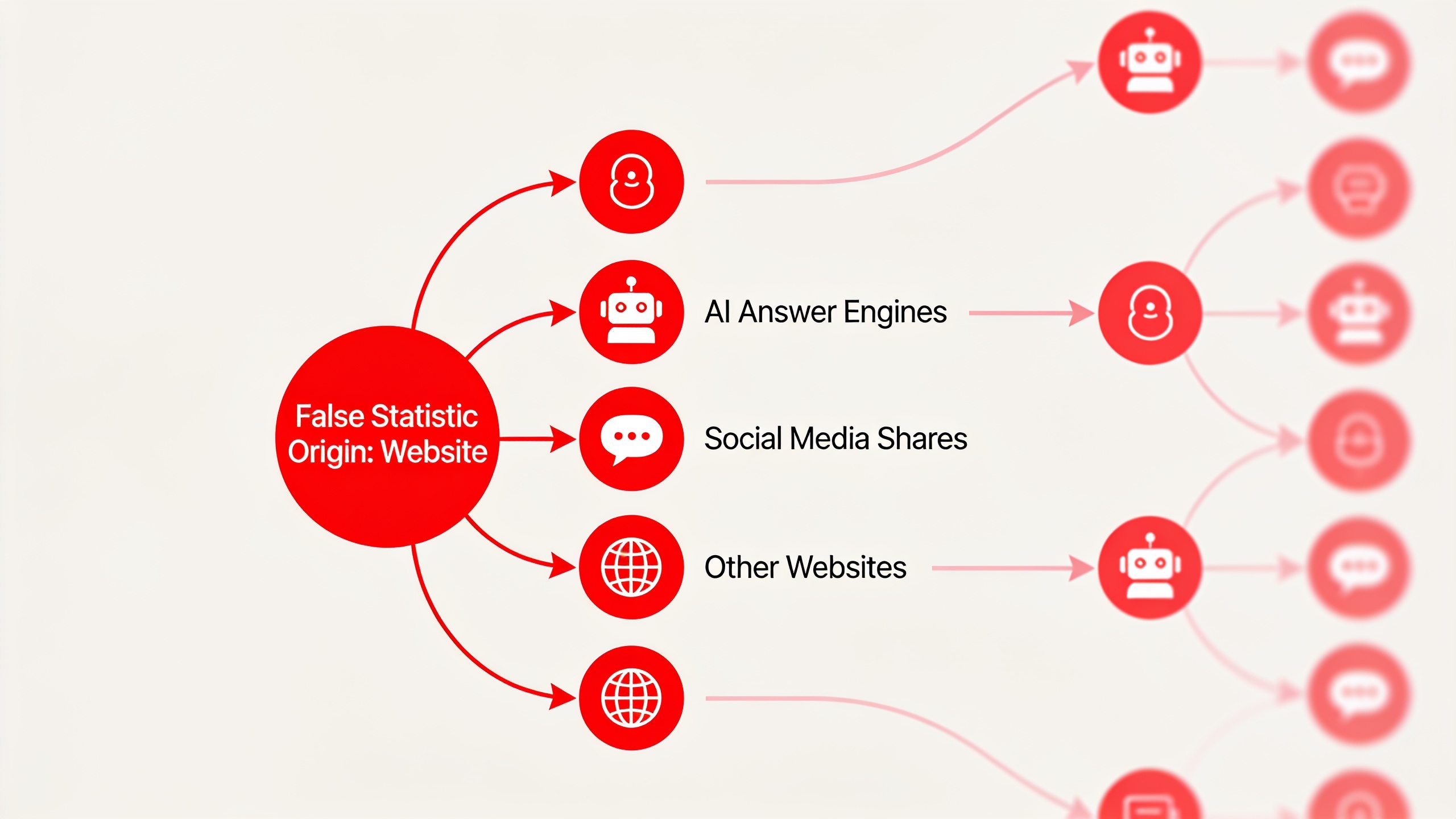
And it compounds. If a competitor or a journalist or some sharp-eyed reader publicly catches you with a wrong statistic or a fake citation, it doesn't just discredit that one line. It makes people question everything else you've published, including the stuff that was totally fine. Trust is expensive to rebuild once it cracks. Search engines have no real way to tell "reliable brand that made one mistake" apart from "unreliable brand," except through the pattern your content shows over time. That's a rough deal.
The Five Kinds You'll Run Into Most
AI hallucinations in marketing content tend to fall into five recognizable buckets, each with its own risk level and its own way of getting caught. Knowing which one you're staring at tells you where to spend your review time.
| Hallucination Type | What It Looks Like | SEO/Reputation Risk | How to Catch It |
|---|---|---|---|
| Fabricated statistics | A precise-sounding number ("73% of marketers...") with no real source | High — often gets cited or shared, spreading the error | Search for the exact stat + source name; if you can't find the original study, cut it |
| Fake or broken citations | A link, study name, or report that doesn't exist or 404s | High — damages trust instantly if a reader clicks through | Click every citation link before publishing; verify the source actually says what's claimed |
| Misattributed quotes | A quote assigned to a real person who never said it | High — legal and reputational exposure | Reverse-search the exact quote; confirm via the person's own site or verified social account |
| Outdated or superseded facts | Correct information that is no longer current (old pricing, deprecated tools, expired laws) | Medium — erodes trust more slowly but still hurts credibility | Check publish/update dates on any source; verify against the current version of the product or policy |
| Logical inconsistencies | Two contradictory claims in the same article, or a conclusion that doesn't follow the evidence given | Medium — subtle, but flagged by careful readers and AI detection tools | Read the full draft in one sitting and outline the argument structure before publishing |
Fabricated stats and fake citations are usually the worst offenders, and it's for an annoying reason: they're the most quotable. Which means they're the exact bits most likely to get screenshotted, cited, and shared, carrying your error way past your own site before you even notice.
How to Spot Them During Editing
You catch AI content hallucinations by treating every AI draft the way a good editor treats a freelancer's first submission: assume nothing is true until you've checked it yourself. That means baking specific verification habits into your process instead of skimming for tone and calling it a day.
Every number, statistic, study reference, or "according to X" needs a live source check. Full stop. If there's a link, open it. If there's no link, copy the exact stat, wrap it in quotation marks, and search for it to see if a real source pops up. If you've searched around for a reasonable while and still can't find the original, the safe move is to cut the claim or rewrite it in qualitative terms. Better to say "roughly a third" than to invent a number.
Watch out for suspiciously precise language, too. Hallucinated stats often sound more specific than a real source would be. Real research gets reported with round numbers or ranges plenty of the time, but a model inventing a figure will sometimes overcorrect into false precision to sound legit, like "68.4% of small businesses" instead of "roughly two-thirds." Treat oddly exact numbers as a flag for extra checking, not as proof they're solid.
Names and titles need independent confirmation. If a draft attributes a statement to some executive or researcher, go verify that person's title, their company, and the quote itself through a source that isn't the AI, their bio page, a press release, a verified social profile. Models are weirdly good at generating plausible-but-wrong attributions, especially for people who aren't household names.
Same deal with competitor claims. If your draft describes a rival's pricing or features, check it against that company's actual current website before publishing. Models love to blend outdated training data with a confident guess, and you end up with a description that was true two years ago, or never true at all.
And read for internal consistency, not just individual facts. A hallucination doesn't always announce itself as one wrong line. Sometimes it's a contradiction between two parts of the same piece: a stat in the intro that doesn't match a claim buried in the body. The only reliable way I've found to catch this is reading the whole draft in one sitting, start to finish, instead of hopping around section by section.
Want content like this running on autopilot for your own site? Try RobinRank free — AI-written, SEO-optimized articles generated and published automatically, no credit card required.
This kind of review honestly works best when it starts before anyone writes a word. A clear brief that spells out the topic, the target claims, and the approved sources up front makes it way easier to notice when a draft has wandered off into invented territory. That's one big reason a strong brief matters so much; there's a solid template over at 15 SEO Content Briefs Every Writer Needs Before Hitting Publish that you can adapt for AI-assisted work specifically.
Building a Checklist That Actually Works
An AI content accuracy checklist gives your team a repeatable, non-negotiable set of checks to run on every single draft before it goes live, instead of hoping each editor happens to remember what to look for. Here's a practical version you can steal and tweak.
Before anyone drafts, lock down the specifics. Define the claims, statistics, and sources the article is actually allowed to reference (this belongs in the brief, not left up to the AI's imagination), and flag which competitor or product claims, if any, will need independent verification.
During review, do the grunt work:
- Click every external link and confirm it lands on a real, relevant, currently-live page
- Search any statistic in quotation marks to confirm it traces to a real, findable source
- Verify every named person, title, and quote against an independent source
- Confirm dates, prices, and product details reflect the world as it is today, not as it was in the training data
- Read the whole thing start to finish for contradictions, then flag anything you can't verify and either cut it or soften it to a qualitative statement

And right before publishing, one last sweep. Confirm every citation link is live and not a 404 or some leftover placeholder. Make sure your schema markup and metadata actually match the content. And for anything financial, medical, legal, or safety-related, get a second person to read it, because that's where a mistake does the most damage.
Treating this checklist as mandatory rather than optional is basically the whole difference between teams that scale AI content safely and teams that end up issuing an awkward correction three months in. It's also worth folding this into how you think about discoverability generally. Content built to directly and accurately answer the questions real people ask tends to do better in regular search and in voice and conversational search, which I get into more over in Voice Search Optimization: Writing Content People Can Actually Ask For.
Tools and Workflows That Catch This Stuff
The single best way to catch hallucinations before publish is pairing human review with a workflow that makes drafts easy to check and edit, rather than one that fires content straight from "generate" to "live." Those fully automated, generate-and-auto-publish pipelines with no review step? That's where hallucinations quietly slip through and stay there.
A few things worth building into your stack. First, editable drafts instead of black-box publishing. Any AI tool you use should let you review and edit before anything goes live, not force a direct push. RobinRank, for instance, spits out a full draft with an SEO score, suggested citations, internal and external links, and schema markup, all of it still fully editable before it hits your CMS, so an editor can actually verify claims and swap out weak sources before the public sees it.
Second, look for source-aware generation. Tools that surface real, checkable citations and links as part of the draft beat tools that just generate unsupported claims into the void. You still have to click and verify those citations (always), but a draft that includes source suggestions is a whole lot easier to fact-check than one that hands you nothing.
Version history and rollback matter more than people expect. If something does get published and needs fixing, a CMS that tracks versions makes it fast to see what changed and when. Beyond that, don't sleep on the low-tech stuff: reverse image and quote searches, plagiarism and AI-detection tools, and plain old searching a claim in quotes are still some of the most reliable ways to catch a fabrication, and they cost nothing but your editor's time.
Oh, and one more. Schedule human spot-checks on stuff you've already published. Even with a great review process, going back through older, stats-heavy posts every so often catches facts that were accurate at publish time but have quietly gone stale since.
What to Do When One Slips Through
If you find a factual error, fake citation, or hallucinated stat in something you've already published, correct it immediately, transparently, and permanently. Don't quietly nuke the whole post and pretend it never existed, and definitely don't just cross your fingers. Speed and honesty limit both the SEO hit and the reputational one.
Start by fixing the specific error. Replace the fabricated statistic, the broken citation, or the misattributed quote with real information, or pull the claim entirely if no reliable source backs it up. Then check whether it spread. Search the exact phrase or stat to see if it got picked up elsewhere, by other sites, on social, in some AI summary. If it has spread, you probably can't fully reel it back in, but you can at least fix the source, which is you.
For minor stuff, a silent fix is fine, nobody needs a changelog for a corrected typo. But if the error was substantive, a wrong statistic the whole argument leaned on, a defamatory misattribution, a false claim about a real company or person, add a visible correction note with the date. That's just standard practice at any decent publication, and it reads as honest rather than sketchy.
Then audit similar content. If a hallucination got through once, go check other articles from the same workflow, prompt, or time period, because whatever caused it (a weak brief, a skipped review step, over-trusting the output) almost certainly hit more than one piece. And finally, tighten the process itself. Update the checklist, the brief template, or the review assignment so this exact kind of error has a harder time recurring.
Frequently Asked Questions
So what actually causes these hallucinations in the first place?
AI content hallucinations happen because language models generate text by predicting statistically likely word sequences from their training data, not by pulling verified facts out of a database. When a model doesn't have reliable info on a specific detail (a niche stat, a recent event, an obscure name) it can still produce a fluent, confident answer that just happens to be made up. Fluency and factual accuracy are two separate skills in these systems, and that gap is the whole issue.
Can't AI detection tools just catch hallucinations automatically?
Not really, no. AI detection tools are built to flag whether text was likely written by AI, not whether the facts inside it are true, so they're no substitute for actual fact-checking. Catching hallucinations still means verifying individual claims (statistics, quotes, citations, product details) against real, independent sources, ideally as a defined step in your editorial checklist.
Do these things actually hurt my Google rankings, or is that overblown?
There's no evidence Google directly penalizes a single factual error, but accuracy feeds into the broader trustworthiness signals that shape how a page and a whole site get evaluated over time, part of Google's publicly documented E-E-A-T framework and its Helpful Content system. A one-off typo-level slip isn't going to sink you. Repeated or high-visibility inaccuracies are a different story, and those genuinely damage site trust.
Realistically, how much review does AI content need?
At a bare minimum, every AI draft should have every external link clicked, every statistic source-checked, every named person and quote independently verified, and a full read-through for consistency before it publishes, no matter how polished the writing sounds. And anything touching health, finance, legal matters, or safety earns an extra review pass, because the cost of a mistake there is a lot higher.
Is it ever safe to publish AI content with zero human review?
Honestly, no, that carries real risk. Even well-built AI writing tools can produce fluent statements that are flat-out wrong, and there's no automated system that guarantees 100% accuracy. Workflows that keep drafts fully editable before publishing, so a human can verify claims, sources, and citations first, dramatically cut the odds of a hallucination reaching a live page.
Look, catching AI content hallucinations isn't about deciding AI writing tools are the enemy. It's about applying the same editorial discipline any serious publication would apply no matter who or what wrote the first draft. A clear brief before you write, a specific checklist while you review, and a fast, transparent fix when something slips through. Those three habits are what let marketing teams use AI to scale their content without quietly scaling their error rate right alongside it.
Ready to stop writing content by hand? Start your free RobinRank trial and get a full month of SEO-optimized articles published on autopilot.