How to Choose the Right AI SEO Tool for Your Business
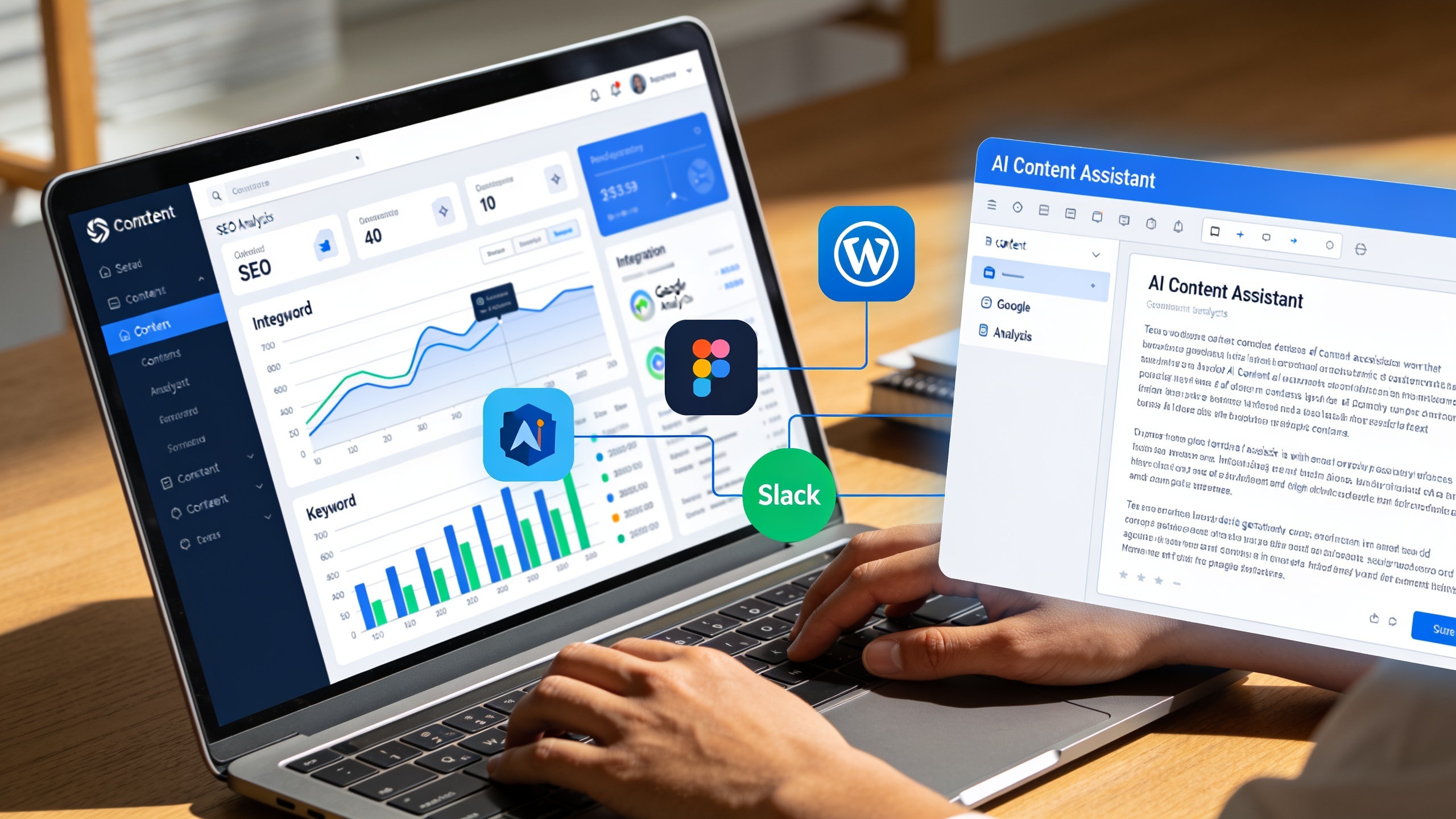
And there are a lot of these tools now. The market's absolutely flooded. Every other landing page promises to "10x your content output" or get you to page one "automatically." Some of that is genuinely true. A good chunk of it is just marketing doing marketing things. So this is my attempt to walk you through what actually matters before you hand over a credit card, what to grill the vendor about, and the dumb mistakes people make when they pick a tool with zero framework to guide them.
Table of Contents
- Why Choosing the Right AI SEO Tool Matters
- What Level of Automation Do You Actually Need?
- How Do You Judge AI Content Quality Before You Buy?
- Integrations: Making Sure the Tool Fits Your Stack
- How Much Does an AI SEO Tool Cost?
- Comparing the Best SEO Software for Business Needs
- Red Flags to Watch For When You Choose AI SEO Tool Vendors
- A Practical Framework to Choose AI SEO Tool Options
- FAQ
Why Choosing the Right AI SEO Tool Matters
The right AI SEO tool moves the needle on three things that actually matter: your organic traffic, what your content team costs you, and how fast you can scale up publishing without the quality falling off a cliff. The wrong one burns your budget and can genuinely tank your rankings with thin, recycled junk. Semrush's 2024 State of Content Marketing report found that companies publishing consistently (weekly or more) see meaningfully higher organic traffic growth than the ones posting whenever they get around to it, and these days AI tools are the main way most companies hit that kind of cadence.
But "AI SEO tool" is such a vague label. It could mean a bunch of totally different things: a keyword research assistant that just suggests topics, an AI writer that bangs out blog drafts from a prompt, a full platform that researches and writes and optimizes and publishes on its own, a technical crawler that flags issues with AI recommendations, or an outreach tool that personalizes your link-building emails.
These solve completely different problems. A founder trying to build a content engine from literally nothing needs something wildly different from an agency juggling 40 client sites. That's the whole reason I keep coming back to those four criteria (automation, quality, integrations, price) instead of pointing you at some "best tool of 2025" listicle. Those rankings are mostly useless for your specific situation.
What Level of Automation Do You Actually Need?
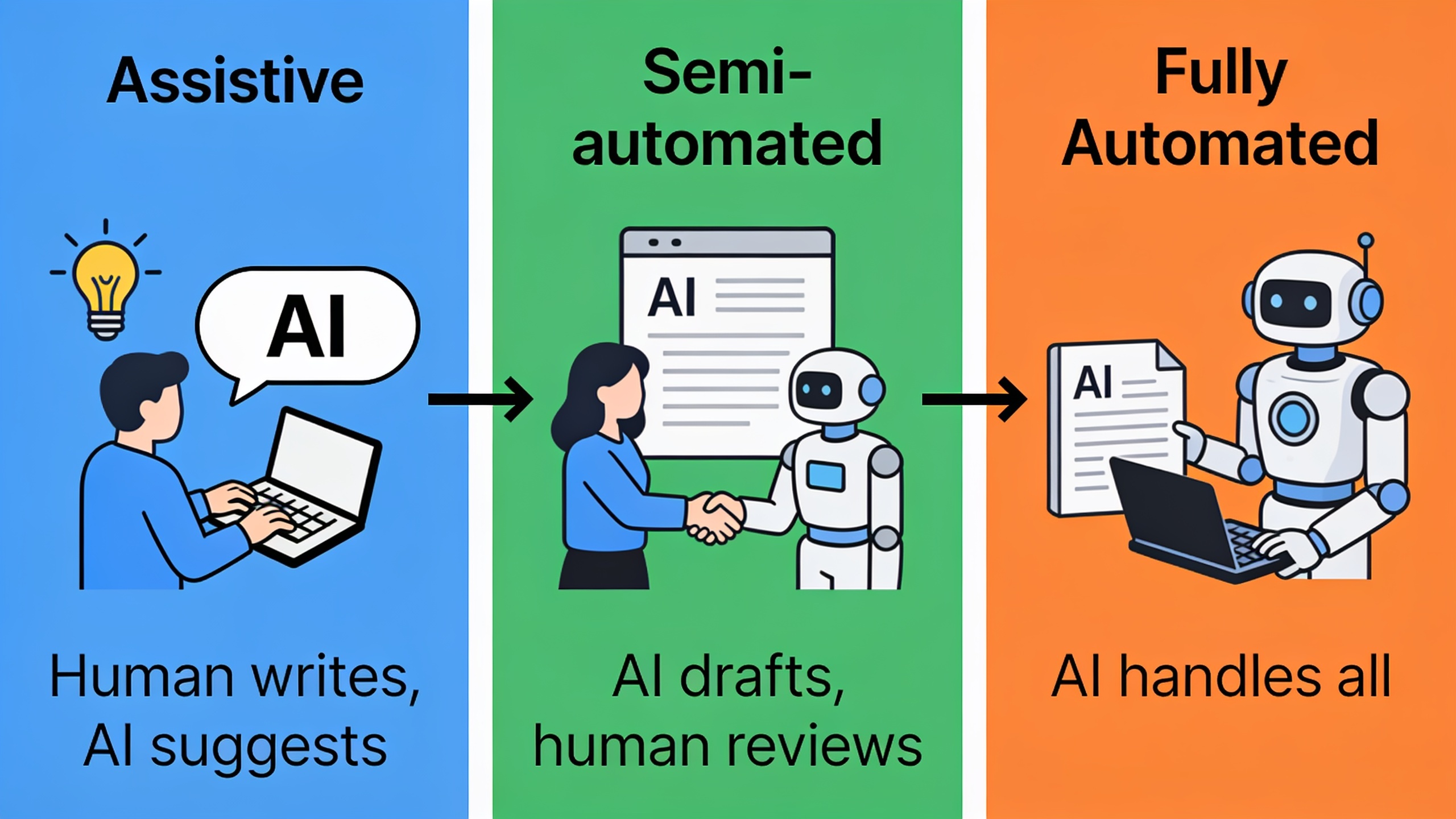
The honest answer here depends on one question: do you want AI to help your existing team, or replace the manual grind entirely? Automation basically comes in three flavors. There's assistive (AI helps you write faster), semi-automated (AI drafts and optimizes, a human checks it before it goes live), and fully automated (AI does the research, writing, optimization, and publishing while you mostly stay out of the way).
Assistive Tools
These are your AI writing assistants baked into a doc editor. You're still doing the keyword research yourself, outlining the piece yourself, and wrestling with the CMS yourself. Works fine if you've already got a content team and you just want them cranking out drafts faster. The catch? Somebody still has to sink real hours every week into strategy, editing, and publishing. The AI just makes the typing part quicker.
Semi-Automated Platforms
Semi-automated platforms take on the keyword clustering, the brief creation, the first draft, then hand it back to a human for sign-off before anything publishes. This is the sweet spot for a lot of mid-sized marketing teams. You get most of the speed but you keep your hand on the editorial wheel.
Fully Automated Platforms
Fully automated platforms, like RobinRank, do the whole thing. They research topics, write the SEO-optimized article, handle the on-page stuff (titles, headers, internal links, meta descriptions), and publish straight to your CMS on a schedule, with barely any hands-on work from you. This tier is a lifesaver for small business owners and founders who don't have a content team, and for agencies that need to pump out way more without hiring three more writers. There's an agency case study worth reading on exactly this, how one agency scaled content output by 5x with AI, and the difference is honestly kind of eye-opening.
Here's the gut-check question before you pick your automation level: do you actually have someone on staff who can spend 5-10 hours a week reviewing and publishing content? If the answer is no, a fully automated platform isn't some fancy upgrade. It's the only realistic way you'll ever publish consistently.
How Do You Judge AI Content Quality Before You Buy?
You judge AI content quality by pressure-testing three things during a free trial: is it actually accurate and deep, does it read like a human or like a robot, and is it structured in a way that works for both readers and crawlers? And whatever you do, don't trust a vendor's "human-quality content" claim on its own. Test it. On a real topic from your niche, not their cherry-picked demo.
A few things I'd actually run through during any trial:
First, depth and specificity. Bad AI just restates the obvious over and over without a single example, number, or named thing. Good tools give you actual data points, mention real competitors or products, cover the subtopics properly. Not just the same keyword rearranged twelve ways.
Then there's the structural SEO side. Does it give you proper H2/H3 hierarchy, meta titles and descriptions, internal linking suggestions, schema readiness? Google's own helpful content documentation is pretty clear that content should be built for people first, with search visibility being the byproduct of being genuinely useful. Tools that just chase keyword density and skip the structure tend to fade over time.
Originality is the one people skip, and they shouldn't. Take a sample and run it through a plagiarism checker. Loads of cheaper AI tools recycle the same template phrasing across thousands of customers, which means your "unique" article might be near-identical to a hundred others. That's a real problem, especially since Google's March 2024 core update went after "scaled content abuse" specifically.
Last thing: tone control. Can you actually set a brand voice, a reading level, a point of view? If a tool writes for a law firm and a skincare brand in the exact same voice, it wasn't built with real editorial flexibility in mind. It was built to churn.
| Content Quality Signal | What to Test | Red Flag |
|---|---|---|
| Depth | Ask for an article on a topic you know well | Generic, surface-level statements |
| Structure | Check H2/H3 use, meta tags, internal links | Wall of unformatted text |
| Originality | Run output through a plagiarism checker | Repeated phrasing across samples |
| Tone control | Request two different brand voices | Identical tone regardless of input |
| Fact accuracy | Verify any stats or claims cited | Invented statistics or sources |
Integrations: Making Sure the Tool Fits Your Stack
An AI SEO tool is only worth anything if it connects to the systems you already run. Your CMS, your analytics, your existing SEO stack. What I mean by integration here is direct, no-code connections (think a WordPress plugin or an API) that move content from the tool onto your live site without you copy-pasting like it's 2011.
CMS and Publishing Integrations
Look for native hooks into WordPress, Webflow, Shopify, or a headless CMS via API. Because if you're manually exporting each article and pasting it into your CMS, you've already thrown away most of the time savings that made automation appealing in the first place. The good platforms let you schedule publishing, auto-set categories and tags, even generate featured images for you.
Analytics and Search Console Integrations
A tool wired into Google Search Console or GA4 can use your real numbers (impressions, click-through rate, ranking position) to decide what to write next. That's the difference between a content engine that learns from itself and one that's just firing articles into the void hoping something lands.
Link Building and Outreach Integrations
Backlinks are still one of the top three ranking factors according to pretty much every industry survey out there, including Ahrefs' correlation studies on ranking factors. So if your AI SEO tool doesn't touch link building at all, you're only solving half the puzzle. This is where a platform that pairs content automation with a backlink exchange network (RobinRank does this) has a real structural edge. Your published pieces can slot into a natural link exchange with other relevant sites, so you build authority without grinding through manual outreach campaigns.
Team and Workflow Tools
Want content like this running on autopilot for your own site? Try RobinRank free — AI-written, SEO-optimized articles generated and published automatically, no credit card required.
If you're an agency or a bigger team, check for Slack integration, project tools like Asana or Trello, and multi-client dashboards. When you're running SEO for a dozen clients, being able to jump between accounts and spin up white-label reports matters just as much as the writing quality. Maybe more, honestly.
How Much Does an AI SEO Tool Cost?
AI SEO tools run anywhere from about $29 a month for a basic writing assistant up to $500+ a month for a full-stack platform doing research, writing, optimization, and publishing at scale, with agency and enterprise tiers climbing higher depending on how many sites or articles you're pushing. What's "right" depends on your volume and whether you're buying a tool or basically buying a replacement for an entire content operation.
Most pricing shakes out into one of these:
- Per-word or per-credit: you pay for what you generate. Fine for occasional use, brutal at scale.
- Per-article: a flat fee per published piece, which makes budgeting nice and predictable if you've got a set cadence.
- Per-site or per-seat subscription: the usual agency model for managing multiple client sites, normally with monthly article caps.
- Flat monthly platform fee: unlimited (or high-cap) usage, often bundled with extras like backlink exchanges or analytics.
Here's where people mess up the math though. Don't just stare at the sticker price. Add up what your current process actually costs you. A freelance writer runs $150-$300 per article. A mid-level SEO content strategist is $60,000+ a year in salary before you count benefits. Against that, an AI SEO platform at a few hundred bucks a month pumping out dozens of optimized articles is dramatically cheaper per piece, even after you factor in editing time. If you want the full breakdown across tool types and business sizes, this piece on how much AI content marketing costs in 2025 goes through the real tiers and the sneaky hidden costs.
Comparing the Best SEO Software for Business Needs
There's no single winner here, and anyone who tells you otherwise is selling something. The best SEO software for your business depends entirely on whether you need research, writing, technical auditing, or a full content operation. Here's a rough framework across the categories most businesses end up weighing.
| Tool Category | Best For | Automation Level | Typical Monthly Cost |
|---|---|---|---|
| Keyword research tools | Teams that write content manually | Low | $99–$250 |
| AI writing assistants | Writers wanting faster first drafts | Assistive | $29–$99 |
| Technical SEO crawlers | Larger sites with complex architecture | Low–Medium | $100–$500 |
| Semi-automated content platforms | Teams wanting drafts with human review | Medium | $150–$400 |
| Full-stack AI SEO platforms (e.g., RobinRank) | Businesses wanting end-to-end automation, publishing, and link building | High | $200–$600+ |
| Backlink/outreach platforms | Businesses focused solely on link building | Low–Medium | $100–$400 |
If you're a small business owner or founder with no dedicated content team, full-stack platforms usually give you the most bang, since you're not stitching together three separate tools for research, writing, and publishing. Agencies tend to need a combo: a full-stack platform for producing client content plus a technical crawler for the audits. And SEO pros who already know their stuff technically but need to scale volume? They mostly do best with semi-automated or full-stack writing platforms that slot into the workflow they've already built.
Red Flags to Watch For When You Choose AI SEO Tool Vendors
The biggest red flags are vague quality claims with no sample content, zero data on how the content actually performs, and pricing that hides its usage caps until after you've signed up. Basically, if a vendor won't show you real output on a topic from your own industry, be suspicious. Very suspicious.
A few specifics I'd watch for. If there's no trial and no sample content, that's usually because the output can't survive a close look. If they're throwing around "ranking guarantees," run. No legitimate tool can promise rankings. Google weighs hundreds of factors and anybody swearing they'll get you page one is just lying to close the deal.
Then there's the E-E-A-T thing, which sounds like jargon but matters. Google's Search Quality Rater Guidelines lean hard on Experience, Expertise, Authoritativeness, and Trustworthiness. If a tool's writing is generic and unattributed with no way to inject real expertise or your actual brand perspective, that's not just an annoyance. It's a genuine long-term ranking risk.
Watch for hidden limits too. "Unlimited" plans have a funny habit of quietly capping word counts, image generation, or connected sites right after you've locked into an annual contract. And finally, if a tool doesn't support internal linking or site structure at all, that tells you it was built for raw volume, not SEO strategy. Content that never links to the rest of your site is leaving a big on-page opportunity on the table.
A Practical Framework to Choose AI SEO Tool Options
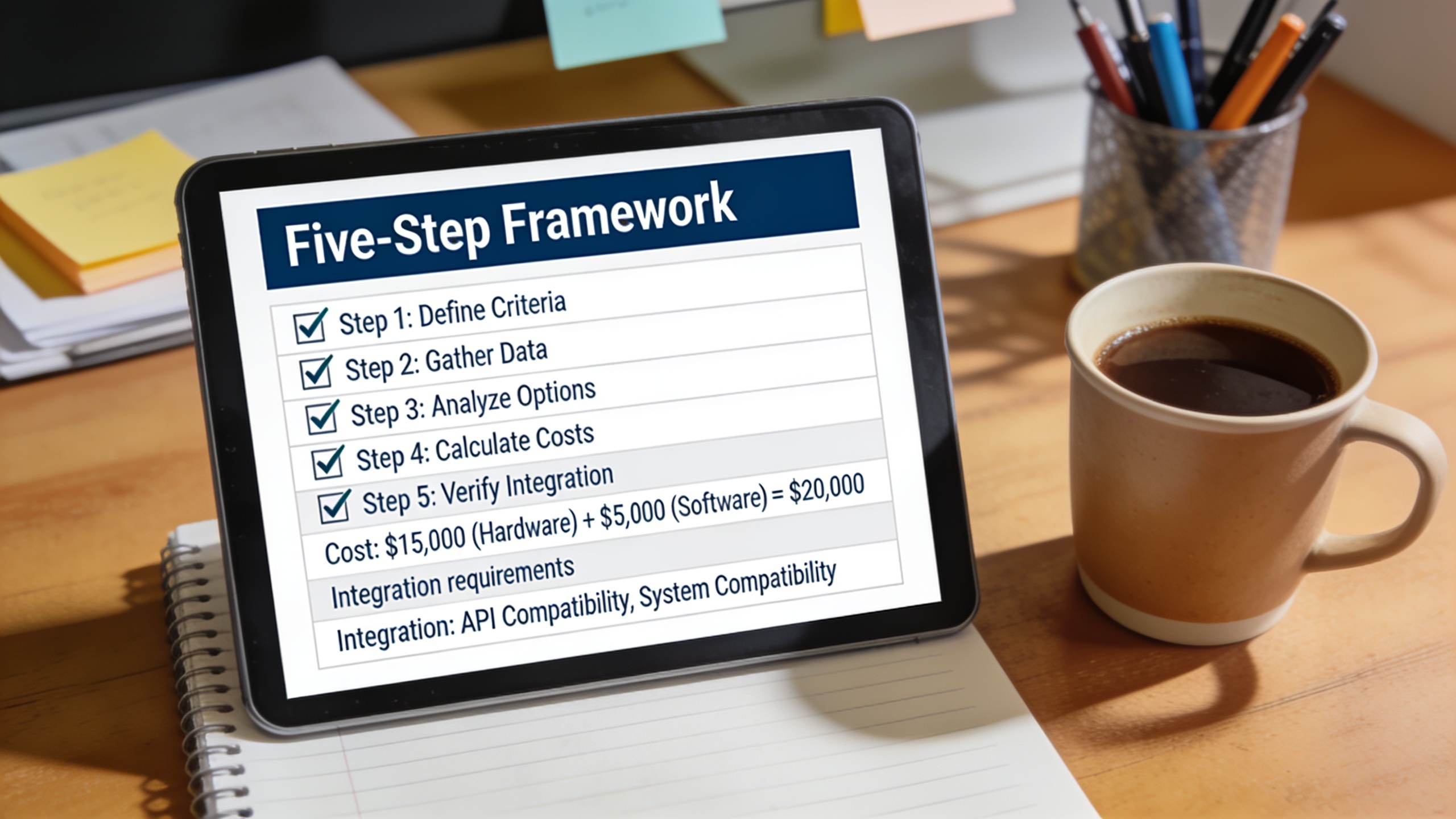
Picking the right one is really a five-step thing: figure out your content goals, map out the integrations you need, test the quality with your own topics, compare pricing against your real volume, and run a 30-day trial before you commit to anything annual. Skip any of these and you're the most likely candidate to be switching tools again within six months. I've seen it happen plenty.
Step 1: Define your content goals. Are you publishing 4 articles a month or 40? Thought leadership? Product-led SEO pages? Local landing pages? Your volume and content type will knock out half the market immediately, which is a good thing.
Step 2: Map your integrations. Write down your CMS, your analytics, any SEO software you already use. Then check that against each vendor's integration list before you even glance at the pricing.
Step 3: Test quality with your own topics. Never, ever judge a tool on the demo topic the vendor picked. Ask for a sample on something specific to your industry and hold it up against your best existing content. If it can't compete, move on.
Step 4: Compare pricing against real volume. Work out the cost per article at your expected volume, not the advertised starting price. A $99/month plan capped at 4 articles is actually more expensive per piece than a $299/month plan that includes 20. Do the math.
Step 5: Run a real trial first. A 30-day trial should be plenty to publish 2-4 actual articles and watch the early signals: indexing speed, initial impressions in Search Console, and how much editing time your team says it saved.
Once you've gone through this, the answer usually just... shows up. And here's the thing most people don't expect: the deciding factor is almost never which tool has the shiniest AI model. It's which one fits your actual workflow and produces stuff you'd happily publish without a heavy rewrite.
FAQ
How do I choose an AI SEO tool if I have zero SEO experience?
Go with a full-stack platform that bundles keyword research, writing, and on-page optimization together, rather than trying to duct-tape separate research and writing tools yourself. The ones built for founders and small business owners with no SEO background usually walk you through topic selection and publishing cadence, so you don't have to go learn SEO fundamentals before you can post anything.
Can AI SEO tools actually improve my Google rankings?
Yeah, when the content is genuinely helpful, well-structured, and published consistently. But rankings come from the quality and relevance of the content and links, not from the fact that an AI touched it. Google has said publicly it doesn't penalize AI-generated content just for being AI-generated. It penalizes low-quality, unhelpful content no matter who or what made it.
What's the difference between an AI writing tool and a full AI SEO platform?
A writing tool spits out draft text from a prompt. A full AI SEO platform runs the whole pipeline: topic research, keyword targeting, writing, on-page optimization, and publishing straight to your CMS. With a writing tool, you're still on the hook for strategy and publishing yourself. Full platforms are built to take most of that manual work off your plate.
Is it worth paying more for a full-stack platform over a cheaper writing tool?
Usually, if you're trying to replace a content team's workflow instead of just speeding up drafting for a team you already have. A cheap writing tool might be $30-$50 a month, but if you still have to hire someone for research, optimization, and publishing, your total content operation ends up costing more than a full-stack platform at a few hundred a month. Cheaper up front isn't cheaper overall.
How long before I see results after switching?
Most businesses see initial indexing and impressions in Search Console within 2-4 weeks of publishing consistently, but real traffic growth usually takes 3-6 months. That's just normal SEO timing, whether the content is AI-assisted or written by hand. And honestly, publishing consistently matters way more than how fast any single article ranks.
---
At the end of the day (yeah, I know, but it fits here) choosing the right AI SEO tool isn't about the most features or the lowest price. It's about matching automation, quality, integrations, and cost to how your business actually runs. Run a real trial. Test with your own topics. Do the true cost-per-article math before you sign anything. The businesses that squeeze the most out of AI SEO software are the ones that treat the whole evaluation like they're hiring someone new, because in a lot of ways, a full-stack platform is exactly what's stepping into that role.
Ready to stop writing content by hand? Start your free RobinRank trial and get a full month of SEO-optimized articles published on autopilot.