How to Win Featured Snippets and Own Position Zero
Table of Contents
- What Are Featured Snippets, and Why Do They Matter?
- How Do Featured Snippets Actually Work?
- What Content Patterns Increase Your Odds of Ranking in Featured Snippets?
- How to Structure a Page for Position Zero Optimization
- Formatting Techniques Google Prefers for Snippets
- Common Mistakes That Keep You Out of Position Zero
- How to Track and Measure Featured Snippet Performance
- Frequently Asked Questions
What Are Featured Snippets, and Why Do They Matter?
A featured snippet is a short chunk of your content (a paragraph, a list, or a table) that Google lifts from a ranking page and sticks in a highlighted box above the first normal search result. People call this "position zero" because it sits above the traditional #1 spot, even though your page is still technically ranking somewhere in the top 10 underneath it all.
And they're not some rare unicorn. An Ahrefs study of roughly 2 million keywords, published back in 2019, found that featured snippets showed up for about 12% of the queries they looked at. Doesn't sound huge until you realize that's one in eight searches where the top spot on the page is up for grabs before you even get to the normal rankings. For the juicy stuff (the "what is" queries, the "how to" queries, the "best" queries) the odds climb even higher.
Here's why I care about this so much, and why you should too if you're running something small. A snippet lets a page ranking #3, #5, even #8 basically cut the line and jump over everybody visually. If you're a startup that can't out-muscle the big players on backlinks and domain authority, this is one of the few corners of SEO where being smart about formatting genuinely beats throwing money at links. At least for that one query. That's rare in this business.
How Do Featured Snippets Actually Work?
Google builds snippets algorithmically. It grabs a passage from a page it already trusts for a given search, then formats that passage so it answers the question head-on. You can't buy one, you can't submit one, you can't email anyone at Google and ask nicely. The machine picks the source on its own based on relevance, clarity, and how the content is laid out.
There are four common snippet formats, and each one rewards a different kind of structure:
| Snippet Type | Best For | Ideal Content Format | Typical Trigger Queries |
|---|---|---|---|
| Paragraph | Definitions, explanations | One concise 40–60 word answer directly under a question-style header | "What is," "why does," "who invented" |
| Numbered list | Sequential processes | Ordered steps with a header stating the process name | "How to," "steps to," "ways to" |
| Bulleted list | Non-sequential collections | Grouped items with short labels | "Best," "types of," "examples of" |
| Table | Comparisons, data | Markdown or HTML table with clear column headers | "Vs," "pricing," "comparison," "differences between" |
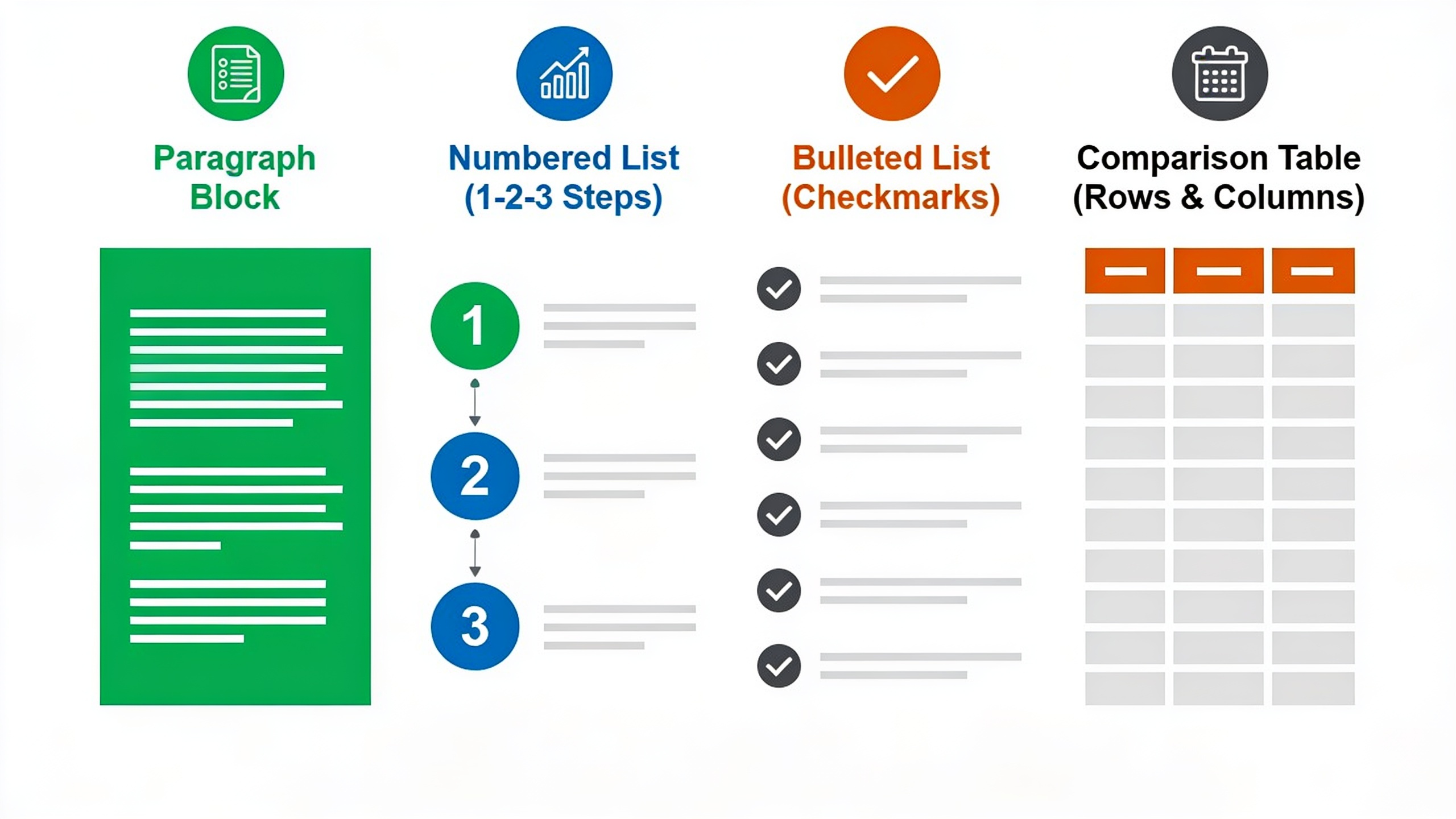
Figuring out which format a query wants is honestly step one of the whole thing. If you write a nice flowing paragraph in answer to a "how to" query that's clearly begging for a numbered list, you're fighting Google's decision about what works best for that intent. And you will lose that fight. Give it what it already wants.
What Content Patterns Increase Your Odds of Ranking in Featured Snippets?
The content that wins snippets over and over tends to do three things: it uses a question phrased almost exactly the way people type it, it drops the direct answer right after that question, and it uses formatting (list, table, short paragraph) that matches what the query is really asking for. Google likes passages that can stand completely on their own without needing the rest of the page to make sense.
Use Question-Based Headers That Mirror Real Search Queries
Headers written as actual questions ("What is a featured snippet?" or "How much does SEO software cost?") hand Google a clean, self-contained unit to grab. That's because the snippet system is basically matching what someone typed to a nearby heading, then pulling whatever comes right after it. So if your H2 reads almost word-for-word like what somebody searched, you've done Google's job for it.
A habit I'd steal: before you write a section, go peek at the "People also ask" box and the autocomplete suggestions for your keyword. Then phrase at least one of your headers using that exact question language. This is also why long articles with a proper table of contents (like this one, actually) tend to do well. Every H2 becomes its own little answer opportunity instead of one giant wall of text nobody can extract anything clean from.
Write a Concise, Standalone Definition Immediately After the Header
The sentence right under a question header should fully answer that question in one or two sentences, ideally somewhere in the 40 to 60 word range, before you go adding nuance and caveats and examples. Google's paragraph snippets are short by design. So if your real answer is buried three paragraphs deep, you've handed the algorithm nothing clean to work with.
Quick gut check: if someone read only the first sentence after your header, would they get the answer with zero other context? If yes, congrats, you wrote something that can actually stand alone as a snippet.
Format Lists So Each Item Is a Complete Thought
For "how to" and "steps to" queries, use an ordered list where each item is a short, self-contained instruction. Not a fragment that only makes sense if you read the one before it. Google usually only shows the first six to eight items of a longer list in the box, so put your clearest, most important steps up front. Don't save your best explanation for step nine where nobody's ever going to see it.
Build Tables for Comparison and Data-Heavy Queries
When the query smells like a comparison ("X vs Y," "pricing tiers," "features compared"), a real Markdown or HTML table gives Google structured data it can grab in one clean lift. Vague prose like "Option A is generally cheaper but Option B has more features" almost never gets pulled, because there's no tidy row-and-column structure to work with. The machine wants a grid. Give it a grid.
How to Structure a Page for Position Zero Optimization
Position zero optimization is basically designing your whole page (headers, where you put the answer, formatting, schema) around the specific snippet format Google's likely to show for your target query. And the key thing people miss is that it starts before you write a single word, back at the outline stage. Not after the draft's already done and you're trying to retrofit it.
Start With Query Research, Not Keyword Volume
Before you touch any formatting, actually search your target query and see if a snippet box even shows up. Simple as that. If Google's currently pulling a paragraph snippet from some competitor, mirror the paragraph format. If it's showing a table, don't hand it a bulleted list and pray Google switches things up for you, because it won't. A lot of rank trackers flag which keywords currently show a featured snippet, and you can use that to build a hit list of "snippet-owned" keywords where the competitor looks vulnerable. Usually vulnerable because their answer is buried, vague, or badly formatted despite ranking fine.
Put the Table of Contents and Answer Structure Near the Top
A visible table of contents, like the one up top here, tells both readers and search engines that the page is organized around distinct, answerable questions. It also helps you land those "jump link" snippets, where Google links straight to a specific section of a long page instead of dumping people at the top.
Add Schema Markup Where It's Genuinely Applicable
FAQ schema, HowTo schema, table markup. These give Google explicit machine-readable clues about which bits are questions, which are steps, and which are structured data. Schema won't guarantee you a snippet, I want to be honest about that. But it kills the ambiguity about how a section's supposed to be read, which supports the exact same clarity goals as good headers do.
Want content like this running on autopilot for your own site? Try RobinRank free — AI-written, SEO-optimized articles generated and published automatically, no credit card required.
Keep Publishing Consistently So Google Has Fresh Signals to Re-Evaluate
Snippets aren't set in stone. Google re-checks and swaps out the source page all the time, especially on competitive or trending stuff. Businesses that publish in random bursts tend to bleed snippets they used to own, simply because a competitor refreshed their content more recently. If staying consistent is your actual bottleneck (and for most founders it is), the content calendar built for founders with zero spare time lays out a lightweight system for planning and shipping on a schedule without hiring a whole editorial team.
Formatting Techniques Google Prefers for Snippets
Google's snippet system pretty consistently rewards short, well-labeled, visually structured content over dense paragraphs, no matter how authoritative the source page is. That last part trips people up. This is a formatting problem as much as a quality problem. Two pages with equally accurate info can get wildly different snippet outcomes based purely on how they're structured.
Word Count and Sentence Length
Paragraph snippets run short, usually 40 to 60 words based on a bunch of analyses, including the one Backlinko published. So answer the core question in one or two sentences, then elaborate. Don't do the thing where you slowly build up to the answer like you're writing a mystery novel. Give it away immediately.
Use Descriptive Subheadings, Not Clever Ones
A subheading like "The Cost Question" is way less likely to trigger a snippet than "How Much Does SEO Software Cost?" because it doesn't match how anyone actually searches. Clarity and literal phrasing beat cleverness for snippet purposes, every time. Save the witty headers for stuff where you're chasing engagement, not extraction.
Structure Numbered Steps as Standalone Actions
Every numbered step should kick off with an action verb and get the whole instruction across in one sentence, the same way you'd explain it out loud to someone who can't see the rest of the page. This principle shows up everywhere, honestly. Take video, for instance. Clean, timestamped steps in a description can help a video surface for how-to searches. The approach in how to optimize YouTube videos so they show up in search runs on the exact same logic: clear, literal, query-matching structure beats vague or overly creative framing whenever an algorithm's trying to match your content to a specific intent.
Keep Tables Clean and Genuinely Comparative
A table that gets pulled into a snippet needs short, clear column headers and consistent row data. Don't cram unrelated stuff into one cell, don't switch units halfway down the column. If you're comparing pricing or features or timelines, make sure every row is answering the same type of question so Google can grab the whole thing cleanly instead of some confusing fragment of it.
Common Mistakes That Keep You Out of Position Zero
Most pages that whiff on featured snippets aren't short on authority or backlinks. They're short on the specific formatting alignment Google needs to extract a clean answer. Here are the patterns I see block strong content over and over.
- Burying the answer. Three paragraphs of throat-clearing before you actually answer the question in your header means Google's got nothing clean near the top of the section to grab.
- Answering a different question than the header asks. Your H2 says "What is a featured snippet?" but the paragraph underneath launches into why snippets matter. You just snapped the question-to-answer link Google was looking for.
- Mismatching format and intent. Writing a narrative paragraph for a clearly list-based or comparison query (or the reverse) fights the format Google already picked for that intent.
- Overly long list items. A numbered list where every step is a whole multi-sentence paragraph is way harder to extract than the same list written in tight, single-sentence steps.
- No visible structure at all. No headers, no subheadings, no table of contents means fewer discrete units to pull from. Everything just blends into one endless block.
- Ignoring existing snippet formats. Trying to win with a bulleted list when Google's currently showing a table for that query ignores the single clearest signal you have about what it wants.
How to Track and Measure Featured Snippet Performance
Tracking snippet performance means watching which of your target keywords currently show a snippet, whether you own it, and how that ownership shifts over time. Not just staring at your overall organic ranking. And this is where a lot of people get fooled, because plain rank trackers that only report numeric position (1, 2, 3...) often completely miss that you're actually sitting in position zero, since some tools count snippet ownership separately from the ranking underneath it.
A tracking routine that works: keep a running list of your snippet-targeted keywords, check monthly whether a snippet still exists for each query and who's got it, and jot down any format changes Google makes (say, switching from a paragraph to a list). If a competitor snatches a snippet you used to hold, put their new content structure side by side with yours. Nine times out of ten the shift traces back to a formatting or freshness change, not some sudden authority gap that appeared overnight.
One more thing worth doing: track snippet volatility specifically for your industry's most valuable queries, because the competitive commercial ones tend to swap hands way more often than niche informational stuff. Bake this kind of query-level tracking into a regular publishing rhythm (reviewing and refreshing your snippet pages on a set schedule, not just when traffic tanks) and you'll get more durable position zero results than any one-off optimization sprint ever gives you.
Frequently Asked Questions
Do I have to rank #1 to get a featured snippet?
Nope. The snippet gets pulled from a page Google already trusts enough to rank somewhere in the top results, but that source is very often sitting at #2 through #8, not #1. That's honestly the whole appeal of position zero optimization even for pages that aren't top dog. A well-formatted answer from a #5 page can visually leapfrog the #1 result by grabbing the box.
Can I just pay Google to feature my page?
No. Snippets are generated by the algorithm based on relevance and formatting. There's no submission form, no ad product, no payment that buys you one. The only lever you've got is optimizing the content and structure of a page that already ranks well enough to be eligible.
How long does it take to win a snippet after I optimize a page?
There's no set timeline, sorry. It hinges on how fast Google recrawls and re-evaluates your page against the current snippet source, plus how competitive the query is. The volatile high-volume queries swap ownership constantly, while niche long-tail ones can stay locked up for ages once a page earns the spot.
If I lose a snippet, does that mean my ranking dropped?
Not necessarily. A page can lose the snippet to a competitor while holding the exact same organic position underneath, because Google judges snippet eligibility somewhat separately from raw ranking order. Losses usually trace back to a competitor's formatting refresh or a change in how Google displays that snippet type, rather than you dropping in the rankings.
Is it even worth optimizing for snippets if I already rank #1?
Yeah, usually. Owning both the #1 organic spot and the snippet for the same query gives you two placements on the page instead of one. And if you don't format your #1 content in a snippet-friendly way, a page ranking below you with cleaner formatting can absolutely walk off with the box.
Snippets reward clarity and structure more than raw authority, which is exactly why position zero is one of the more winnable fights out there for businesses without a giant backlink budget. Getting there and staying there comes down to a few things: match your headers to real search questions, answer those questions directly and briefly, format your lists and tables the way Google already shows them for that query, and keep your content fresh enough that Google's got a reason to keep quoting you instead of the competitor down the page.
Ready to stop writing content by hand? Start your free RobinRank trial and get a full month of SEO-optimized articles published on autopilot.