Internal Linking Strategy: The SEO Lever Almost Nobody Bothers to Pull

So what actually is it? An internal linking strategy is the deliberate practice of connecting the pages on your own site with hyperlinks, so that authority, relevance, and crawl priority flow toward the pages you most want to rank. Do it well and you can lift rankings for target pages in a matter of weeks. Do it badly (or, more likely, not at all) and you quietly cap how much of your content ever gets discovered, indexed, or ranked in the first place.
This is the part that always bugged me: people will spend three months chasing links from other websites while completely ignoring the ones they could add themselves in an afternoon. Anyway. Below I'll walk through why internal linking matters, how search engines actually treat it, and a framework you can use to audit and improve your own structure. Works whether you've got a scrappy five-page startup site or a 500-post content monster.
Table of Contents
- What Is an Internal Linking Strategy?
- Why Internal Linking Strategy Matters for SEO
- How Internal Links Distribute Authority
- Common Internal Linking Mistakes That Hurt Rankings
- How Do You Audit Your Internal Link Structure?
- A Framework for Building an Internal Linking Strategy
- Internal Link Building vs. External Link Building
- Tools and Tactics to Scale Internal Link Building
- FAQ: Internal Linking Strategy
What Is an Internal Linking Strategy?
An internal linking strategy is a documented, repeatable approach to how the pages on your site link to each other, set up to steer both readers and search engine crawlers toward your most important content. Unlike backlinks, which come from other people's domains, internal links stay entirely inside your own site. A blog post pointing to a service page. A category page pointing to a product. Your homepage pointing to that cornerstone guide you spent two weeks writing.
The "strategy" part is what actually matters, because almost every site already has internal links. They just happen by accident. Navigation menus, footers, or whatever the writer happened to feel like linking to that particular Tuesday. A real strategy swaps that randomness out for intent. You decide which pages deserve the most internal "votes," then you build a linking pattern that reinforces how your topics relate to each other. This ties directly into building topical authority, because a strong internal link structure is usually what turns a random pile of related articles into something search engines (and humans) recognize as an actual topic cluster.
Why Internal Linking Strategy Matters for SEO
Internal linking matters because it directly influences three things search engines care about: crawlability, link equity distribution, and contextual relevance. Nail those three and your target pages tend to rank faster and hold their spots more reliably.
Let me take them one at a time, because they're not interchangeable.
Crawlability is just how easily search bots can find and reach the pages on your site. Google's own Search Central docs have said for years that Googlebot discovers new URLs mostly by following links, internal ones included. A page with nothing pointing to it (an "orphan page," as it's charmingly called) is genuinely hard for Googlebot to find at all, unless you've fed it straight into a sitemap.
Link equity is the value, or authority, passed from one page to another through a hyperlink. When a strong page (your homepage, say, or some blog post that's collected a pile of backlinks) links to a newer or weaker page, some of that authority signal flows down the link. Internal linking is how you consciously send that authority to pages that need the boost. A new service page. A guide you just shipped. Whatever's punching below its weight.
And then there's contextual relevance, which comes from the anchor text and the words around the link. When Google keeps seeing internal links with consistent, descriptive anchor text all pointing at the same page, it reinforces what that page is actually about. That's what props up topical relevance across a cluster of related content.
How Internal Links Distribute Authority
Internal links distribute authority by passing along a portion of a page's accumulated ranking signals to whatever it links out to. But not evenly, and not without limits. A page with ten outbound internal links splits its passed authority differently than one with two. And pages sitting closer to the homepage (fewer clicks away) tend to hoard more of that passed authority over time.
PageRank, but in the Real World
The whole idea traces back to Google's original PageRank algorithm, which basically modeled the web as a giant network where every link counts as a vote. Google has moved way, way past that original formula by now, but the core mechanic (links passing value between pages) still runs under the hood of how internal linking works. That's why SEO folks still talk about a page's "link equity" even though Google stopped publishing public PageRank scores ages ago.
Click Depth and Where Authority Goes
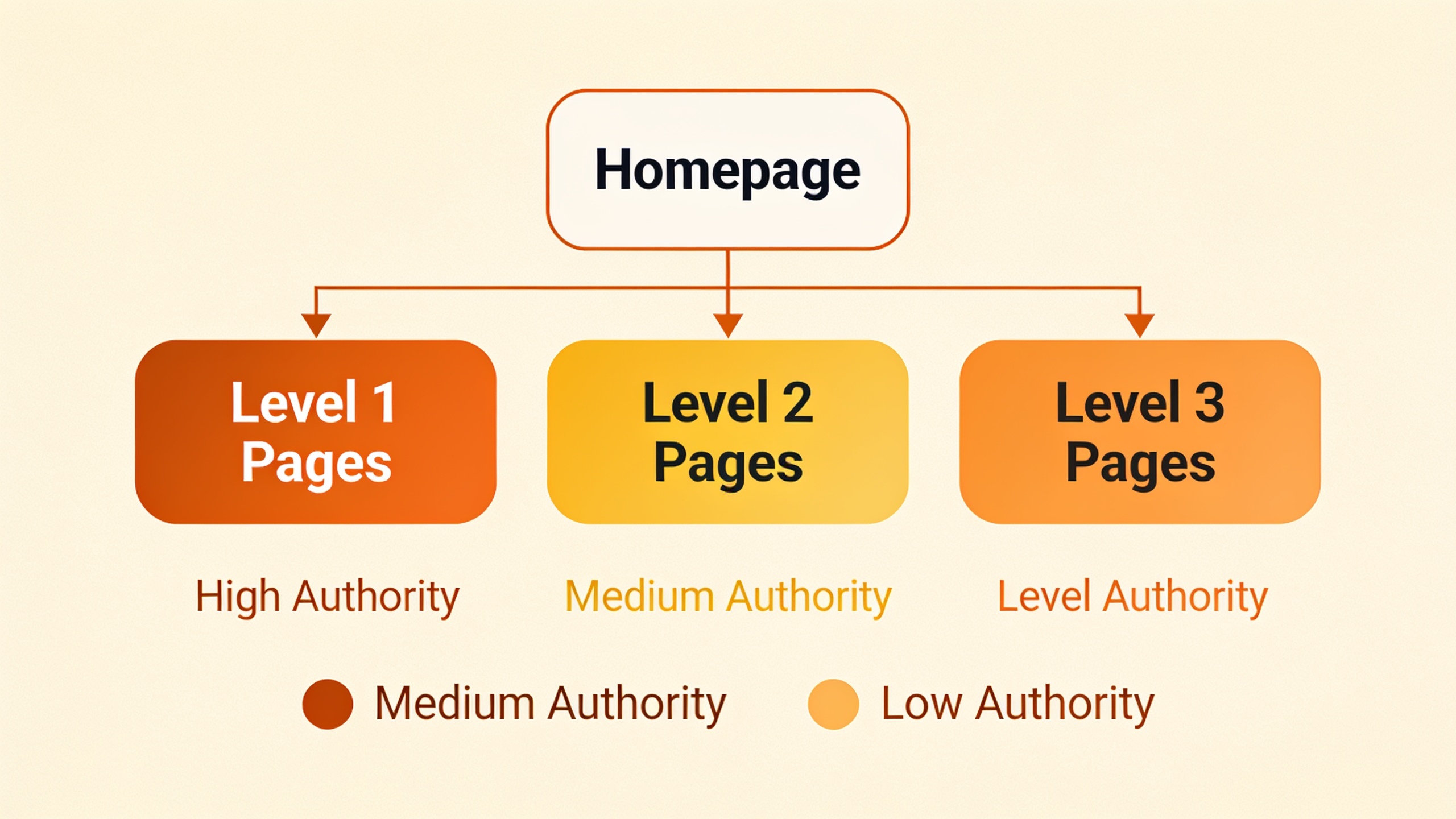
Click depth is just the number of clicks it takes to reach a page starting from your homepage. Pages buried five or six clicks deep (super common on big e-commerce sites and sprawling blogs) get less crawl attention and less passed authority than pages one or two clicks away. The rule of thumb most SEOs live by: important pages should be reachable within three clicks of the homepage. If a page you actually want to rank is sitting deeper than that, you've got a structural problem, and honestly, that's worth fixing before you touch anything else.
The Hub-and-Spoke Thing
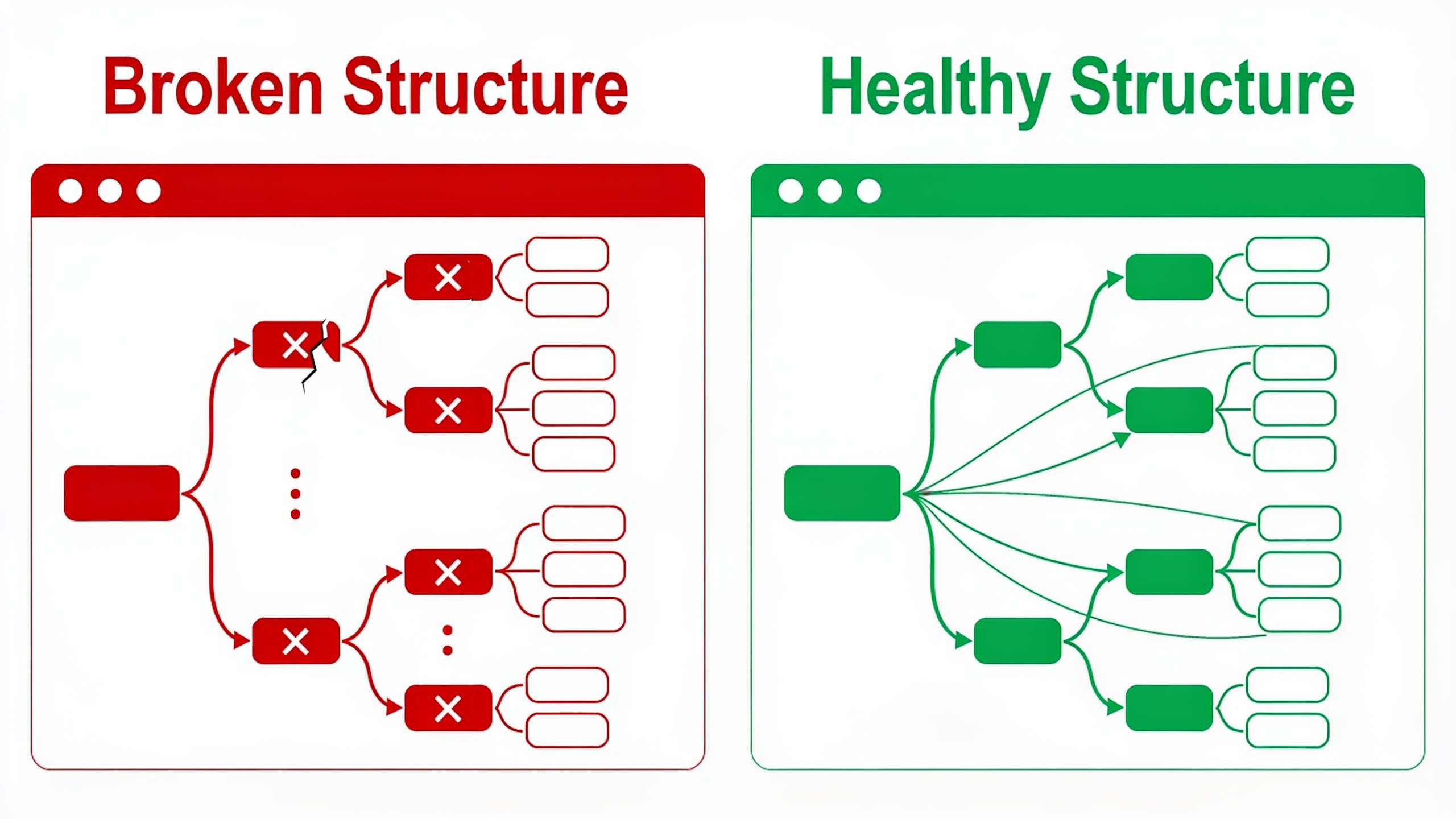
A lot of the internal linking setups that actually work use a hub-and-spoke model. You've got a central "hub" page (usually a big comprehensive guide or a category page) that links out to a bunch of related "spoke" pages, and each spoke links back to the hub. This concentrates authority on the hub while still spreading some of it across the supporting content. Which, conveniently, is exactly the kind of structure that builds topical authority for a whole subject area instead of just one lonely page.
Common Internal Linking Mistakes That Hurt Rankings
The most common mistakes? Orphan pages, leaning too hard on navigation-only links, sloppy inconsistent anchor text, and linking your shiny new content to old content without ever linking back the other way. Each of these quietly chokes off how much authority and crawl priority your best pages actually get.
| Mistake | What It Looks Like | Why It Hurts SEO |
|---|---|---|
| Orphan pages | A page exists but no other page links to it | Crawlers struggle to find and re-crawl it; it may fall out of the index over time |
| Navigation-only linking | Pages only get links from the main menu or footer | Passes minimal contextual relevance; anchor text is often generic ("Blog," "Services") |
| Inconsistent anchor text | Ten different phrasings link to the same page | Dilutes the topical signal instead of reinforcing it |
| One-directional clusters | New posts link to old cornerstone content, but the cornerstone never links back or gets updated | Newer supporting pages get less authority passed back to them |
| Over-linking | Dozens of internal links crammed into one page | Diminishes the value passed through each individual link and confuses priority |
| Broken internal links | Links pointing to deleted or moved pages (404s) | Wastes crawl budget and breaks the authority pathway entirely |
The good news is that fixing this stuff is rarely about bolting on hundreds of new links. It's mostly about taking the links you already have and pointing them more intentionally.
How Do You Audit Your Internal Link Structure?
You audit your internal link structure by crawling your own site the way a search engine would, then mapping how authority and crawl paths currently flow versus how you want them to flow. This is the diagnostic bit, and it needs to happen before any big internal link building push. Don't skip it. Adding links blind is how you end up making things worse.
Step 1: Crawl your site. Grab a crawling tool (Screaming Frog, Ahrefs' Site Audit, Semrush's Site Audit, take your pick) and generate a full list of your URLs, their internal inlink counts, and click depth from the homepage. Now you've got a factual baseline instead of a hunch.
Step 2: Find the orphans and the under-linked pages. Cross-reference your crawl data against your XML sitemap or your CMS page list. Any URL that shows up in the sitemap but has zero or barely-any internal inlinks in the crawl needs attention right away. Those are the pages search engines are probably under-crawling or missing entirely.
Step 3: Map where the authority is piling up. Figure out which pages currently pull the most internal links (your accidental "hub" pages), then compare that list to the pages you actually want ranking for competitive keywords. And here's where it gets interesting: if your most-linked pages and your priority pages don't overlap, that mismatch is usually the single biggest fixable problem in the whole audit. I see it constantly.
Want content like this running on autopilot for your own site? Try RobinRank free — AI-written, SEO-optimized articles generated and published automatically, no credit card required.
Step 4: Look at your anchor text. Pull a report of the anchor text used across internal links pointing to your top 10-20 priority pages. Hunt down the lazy generic anchors ("click here," "read more") and swap them for descriptive, keyword-relevant phrasing. Just don't make it repetitive or spammy while you're at it.
Step 5: Kill the broken and redirected links. Broken internal links (404s) and pointless redirect chains both waste crawl budget and cut off the flow of link equity. Clean these up before you spend any time adding new links, otherwise you're pouring water into a bucket with holes in it.
A Framework for Building an Internal Linking Strategy
A practical framework really only needs four repeatable stages: prioritize, connect, reinforce, monitor. That's it. This is what turns internal linking from a one-time spring-cleaning project into an actual ongoing part of how you run your content.
1. Prioritize your money pages
Start by listing the pages that matter most to your business. Product pages, service pages, cornerstone guides, the stuff that drives conversions or targets your juiciest keywords. Those become your priorities, the pages that should be soaking up the most inbound internal links from everywhere else on the site.
2. Connect related content on purpose
Every single time you publish something new, ask two questions. Which existing pages should link to this new page? And which existing pages should this new page link out to? Baking that habit into your editorial workflow (instead of treating linking as an afterthought you'll "get to later") is what separates a real strategy from occasional, accidental linking. This is also where topic clusters earn their keep. Content built around a clearly defined subject naturally throws off way more relevant linking opportunities than some scattershot content calendar ever will.
3. Reinforce with consistent, descriptive anchor text
Use anchor text that actually describes the page it's pointing to, and vary the phrasing naturally instead of copy-pasting the exact same match every time. Cramming identical, over-optimized anchor text across dozens of links looks manipulative to Google. Descriptive-but-varied anchors read naturally to both people and search engines, and nobody gets flagged.
4. Go back and re-link your old stuff
Internal linking is not a set-it-and-forget-it thing. Every quarter, take your newest cornerstone content and dig back through your archive to add links from older, topically relevant posts that were published before this new page even existed. This "historical optimization" pass is honestly one of the highest-ROI, lowest-effort tactics there is, because it needs zero new content. You're just updating pages you already have.
Internal Link Building vs. External Link Building
Internal and external link building both build authority, but they work through completely different mechanisms, take different amounts of effort, and carry very different risk. The big one: internal links are 100% within your control. External links depend on talking some other website owner into linking to you.
| Factor | Internal Link Building | External Link Building |
|---|---|---|
| Who controls it | You, entirely | Another website owner |
| Cost to execute | Low — mostly editorial time | Higher — outreach, content, negotiation, or paid tools |
| Speed of implementation | Immediate (edit a page and publish) | Slower, dependent on third-party response |
| Risk of penalty | Very low if done naturally | Higher if links are manipulative, purchased, or from spammy domains |
| Primary SEO benefit | Crawlability, authority distribution, topical relevance | New authority entering your site from outside |
| Scalability | High — limited mainly by your own content volume | Limited by relationships, budget, and willing partners |
These two aren't rivals, though. They work together. External links bring fresh authority into your site from the outside world, and internal linking decides how efficiently that authority actually spreads once it lands. A site with killer backlinks but garbage internal linking? You'll watch that external authority pool up around the homepage and a handful of pages while the deeper content that needs it most just... sits there, thirsty.
If your team's building external authority through structured partnerships instead of grinding out cold outreach, it's worth reading this case study on how an agency tripled client backlinks using an exchange network. It pairs nicely with internal linking work, since the two feed each other. New backlinks start flowing in, and if your internal structure is already sorted, it's ready to distribute all that incoming authority instead of hoarding it.
Tools and Tactics to Scale Internal Link Building
Scaling internal link building means shifting from manual, page-by-page decisions to systematic processes that catch linking opportunities across your whole site as your content stack grows. This becomes basically mandatory once a site crosses roughly 50-100 published pages, because at that point remembering every past article you've written by hand is a lost cause.
For the auditing side, tools like Screaming Frog, Ahrefs Site Audit, and Semrush Site Audit will spit out inlink counts, orphan page reports, and click-depth data automatically. That's the raw dataset you need for the audit framework I laid out above.
On the content management front, I'm a big believer in keeping an internal content index. Nothing fancy, just a spreadsheet or database listing every published page, its target keyword, and its topic cluster. It makes finding relevant linking opportunities so much faster than manually digging through your archive every time you write something.
Then there's the workflow side. Build the linking checks straight into your publishing checklist. Something like: "add at least 2-3 contextual internal links before hitting publish, and update 1-2 older relevant pages to link back." Once that's a standing habit rather than a periodic cleanup, the whole thing pretty much runs itself.
Oh, and one more thing worth flagging. Platforms built for AI content marketing are increasingly baking internal linking suggestions right into the drafting and publishing flow. Large language models can scan your existing content and surface topically relevant pages to link to as you're writing new articles, which cuts out a huge chunk of the manual research that traditionally made consistent internal linking such a pain to keep up at scale. Is it perfect? No. But it removes the "I forgot that old post existed" problem, which is most of the battle.
FAQ: Internal Linking Strategy
How many internal links should a page have?
There's no magic universal number, but a common practical guideline is 2-5 contextual internal links in the body of a typical blog post or article, on top of whatever navigation or footer links you've got. The right count depends on how long the page is and how many genuinely relevant related pages actually exist. Relevance beats hitting some arbitrary target every time.
Does internal linking actually improve rankings?
It improves crawlability and helps spread authority and topical relevance signals across your site, and both of those support rankings, though indirectly rather than as one single magic ranking factor. Pages that used to be hard to find or barely linked often get indexed faster and become more visible once they start pulling in more contextual internal links from relevant, authoritative pages on the same site. So: not a silver bullet, but a real lever.
What's the difference between internal linking and site navigation?
Site navigation (menus, footers, breadcrumbs) gives you structural links that show up on every page, while "internal linking strategy" usually means the contextual links dropped inside the body content, connecting related articles, guides, and product or service pages. Both help crawlability, but contextual body links generally carry more topical relevance signal thanks to the anchor text and the words surrounding them.
Should I use exact-match anchor text for internal links?
Using exact-match anchor text now and then is totally fine. Repeating the identical phrase across dozens of links all pointing at the same page is where you get into trouble. It looks manipulative to search engines and, frankly, reads awkwardly to actual humans. Varying your anchor text naturally, while keeping it descriptive of where the link goes, is the safer and more sustainable play.
How often should I audit my internal link structure?
Quarterly is a sensible cadence for most growing content sites, since you're constantly publishing new pages and your older cornerstone content keeps needing fresh links pointed at it. Larger sites cranking out content weekly or more might want a lighter monthly check focused specifically on orphan pages and anything newly published.
Here's what I keep coming back to: internal linking doesn't need a redesign, a new content budget, or months of outreach. It needs a clear map of what you already own and a deliberate plan for connecting it. Start with an audit. Fix the orphan pages and broken links first. Then build the habit of linking new content to old and old content back to new. It's one of the very few SEO levers that's entirely in your hands, and it compounds a little more every single time you publish.
Ready to stop writing content by hand? Start your free RobinRank trial and get a full month of SEO-optimized articles published on autopilot.