Topical Authority: The SEO Strategy Beating Keyword Lists

The mental shift is simple but huge. You stop asking "what single keyword can I rank for today?" and start asking "what does my site need to cover so it's the obvious answer to every question in this space?" That one change ripples through everything: how you plan content, how you link pages together, how often you publish, even how you think about backlinks. So let's get into what topical authority actually is, why Google's systems keep rewarding it, and how you can map out content clusters to build it faster than the competitors still picking off keywords one at a time.
Table of Contents
- What Is Topical Authority in SEO?
- Why Search Engines Reward Topical Authority Over Keyword Lists
- How SEO Topic Clusters Build Topical Authority Faster
- How Do You Map Content Clusters for Your Niche?
- Topical Authority vs. Traditional Keyword-First SEO
- How Long Does It Take to Build Topical Authority?
- Common Mistakes That Undermine Topical Authority
- How RobinRank Helps Founders Build Topical Authority Without a Content Team
- Frequently Asked Questions
What Is Topical Authority in SEO?
Topical authority is how thoroughly and credibly a site covers one subject area, as far as search engines can tell from your content depth, your internal linking, and outside validation. A site with real topical authority doesn't just rank for a keyword or two. It ranks for dozens, sometimes hundreds, of related queries because Google treats the whole domain (or a clearly defined chunk of it) as a trusted reference on that subject.
And this is not the same thing as domain-wide authority, which people usually estimate with backlink-based metrics. It's a related idea, sure, and it's worth getting clear on what domain authority really means for your SEO before you assume a shiny score automatically means topical strength. It doesn't. A site can have a perfectly respectable backlink profile and still be a nobody in a given niche if its content is spread thin across a hundred unrelated subjects. And flip that around: a newer site with barely any backlinks can sometimes out-rank an older, more "authoritative" domain on niche-specific queries, purely because it went deeper and connected its coverage better.
Here's the frustrating part, though. Topical authority isn't a number you can pull up in a dashboard like Domain Rating or search volume. It's more of an emergent thing, something search engines infer from patterns. How many angles of a subject have you actually covered? Do you answer the follow-up questions a reader would naturally have next? Do your pages reference and reinforce each other, or just sit there in isolation?
Why Search Engines Reward Topical Authority Over Keyword Lists
Search engines reward topical authority because it lines up with the kind of comprehensive, trustworthy content that satisfies a searcher's whole information need, not just the exact words they typed. Google's own Search Quality Rater Guidelines lean hard on Experience, Expertise, Authoritativeness, and Trustworthiness (E-E-A-T) as the signals human raters use to judge quality, and depth of coverage is about the clearest proxy for expertise you can show at scale.
You can trace this back to how much better semantic search has gotten. Since Hummingbird in 2013 and then BERT in 2019, Google's systems got a lot smarter about understanding what people actually mean and how concepts relate, instead of just matching exact-match strings. So a lonely page optimized around one narrow phrase, with no broader context around it, gives those systems almost nothing to work with. But a cluster of interlinked pages that answers the beginner question, the intermediate question, the "X vs. Y" comparison, and the weird edge case? That's a mountain of evidence that you genuinely know this stuff.
There's also a very human reason it works. People don't ask one question and walk away. Someone digging into "email marketing automation" is going to want to know about deliverability, segmentation, pricing tiers, integrations, all of it. If your site already has answers to those adjacent questions, that visitor sticks around, clicks deeper, and hands search engines exactly the engagement patterns that reinforce your standing for the whole subject, not just the query they came in on.
And then there's Google's Helpful Content System, which started rolling out in 2022. It was built specifically to demote stuff that was clearly written to rank rather than to help a real person, and to reward sites showing first-hand expertise and depth. Comprehensive coverage is basically the structural answer to that. It's a lot harder to fake real depth across fifty interconnected pages than it is to cram keywords into one.
How SEO Topic Clusters Build Topical Authority Faster
SEO topic clusters are groups of related pieces built around a central "pillar" page and tied together with deliberate internal links, and together they prove you've covered a subject properly. Building in clusters instead of firing off isolated articles is the fastest realistic route to topical authority, mostly because it front-loads the exact structural signals search engines are hunting for.
The Pillar-and-Cluster Model
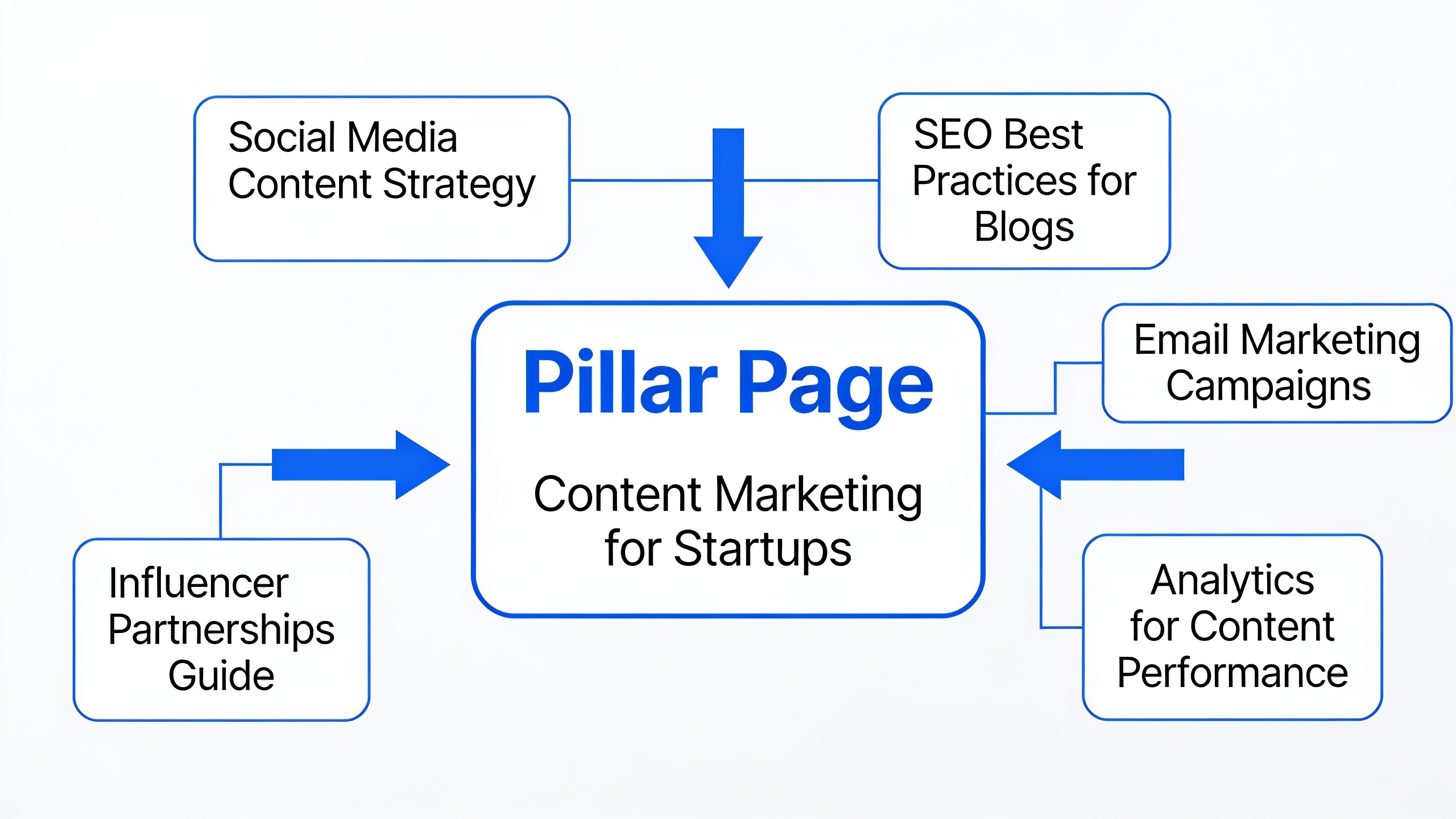
HubSpot's marketing team basically popularized the pillar-and-cluster model back in the mid-2010s, right as search behavior was drifting from short exact-match queries toward longer, conversational ones. The setup is straightforward. One broad "pillar" page covers a subject at a high level (say, "Content Marketing for Startups"), and a bunch of narrower "cluster" pages each go deep on one subtopic ("How to Write a Content Brief," "Content Marketing Budget for Early-Stage Startups," "Content Marketing vs. Paid Ads: Which to Prioritize First"). Every cluster page links back up to the pillar. The pillar links back down to every cluster page.
That does two useful things at the same time. Readers get a clear path to go deeper on whatever they actually need, and search engines get an unmistakable map of which pages belong together under one umbrella. Instead of forty scattered pages elbowing each other with no hierarchy, you've got one coherent subject network.
Internal Linking as the Connective Tissue
Internal links are what turn a pile of related articles into an actual topic cluster. Skip the deliberate linking and even your best articles just read as one-off efforts rather than a real body of work. So each cluster article should link to the pillar and to at least two or three sibling articles in the same cluster, and please use descriptive anchor text that says what the linked page is about. Not "click here." Not "read more." Those tell Google nothing.
That same logic reaches past your own site, too. Just like internal links tell search engines which pages are family, external validation (other relevant sites linking to your cluster) tells them the wider web also treats you as credible on this subject. This is exactly where link building crosses paths with topical authority, and it's worth rethinking whether guest posting is still a worthwhile strategy in 2025 as one way to earn that reinforcement, especially when the placement is topically relevant and not just some random link on an unrelated blog.
How Do You Map Content Clusters for Your Niche?
Mapping content clusters means figuring out your core subjects, breaking each one into the specific questions and subtopics your audience actually searches for, and organizing them into a pillar-and-cluster structure before you write a single word. Honestly, this planning step is the thing that separates founders who build topical authority in a few months from the ones who publish for years and still never become the go-to name in their space.
Step 1: Define Core Topics vs. Subtopics
Start by listing the three to five core topics that describe what your business really helps people with. Not what you sell, but the problem space you live in. A project management software company's core topics might be "team collaboration," "task prioritization," and "remote work productivity," rather than "our software's features." Each core topic becomes a pillar. Every keyword, question, or pain point that fits under it becomes a candidate cluster article.
Step 2: Keyword-to-Cluster Mapping
Once your core topics are set, take that keyword research you already have (yeah, the same list you used to churn out one-off articles) and sort each keyword under the pillar it belongs to instead of treating it as some standalone target. A keyword list gets way more useful the second you organize it this way, because the gaps jump right out at you. If your "remote work productivity" pillar has keywords for beginners and advanced users but nothing about common objections or comparisons? That's your next article. Not whatever keyword happens to have the biggest search volume this week.
Want content like this running on autopilot for your own site? Try RobinRank free — AI-written, SEO-optimized articles generated and published automatically, no credit card required.
Step 3: Content Gap Analysis
Now go dig through your own site and your competitors' sites for the subtopics they've covered under each pillar. If three competitors all have detailed articles on something you haven't touched, that gap is actively working against you, no matter how tiny that subtopic's keyword volume is. And yeah, sometimes comprehensive coverage means writing articles that'll never pull huge traffic on their own. That's fine. Their real job is to complete the cluster and prop up the pillar, not to be a traffic hero.
Topical Authority vs. Traditional Keyword-First SEO
The real differences between a topical authority approach and a keyword-first one show up in planning, in output, and in what happens over the long haul. The table below lays the two side by side across the stuff that actually matters when you're deciding where to spend your content budget.
| Dimension | Keyword-First SEO | Topical Authority Approach |
|---|---|---|
| Planning unit | Individual keyword | Subject cluster with a pillar page |
| Content relationship | Pages often stand alone | Pages deliberately interlinked |
| Success metric | Individual page ranking | Ranking breadth across a subject |
| Vulnerability to algorithm updates | Higher — isolated pages can be devalued individually | Lower — a cluster provides redundancy and depth signals |
| Time to first result | Can rank quickly for low-competition terms | Slower initial results, compounding over the full cluster |
| Long-term traffic pattern | Traffic tied to individual page performance | Traffic distributed and reinforced across many related pages |
| Content decisions | Driven mainly by search volume | Driven by subject completeness and reader questions |
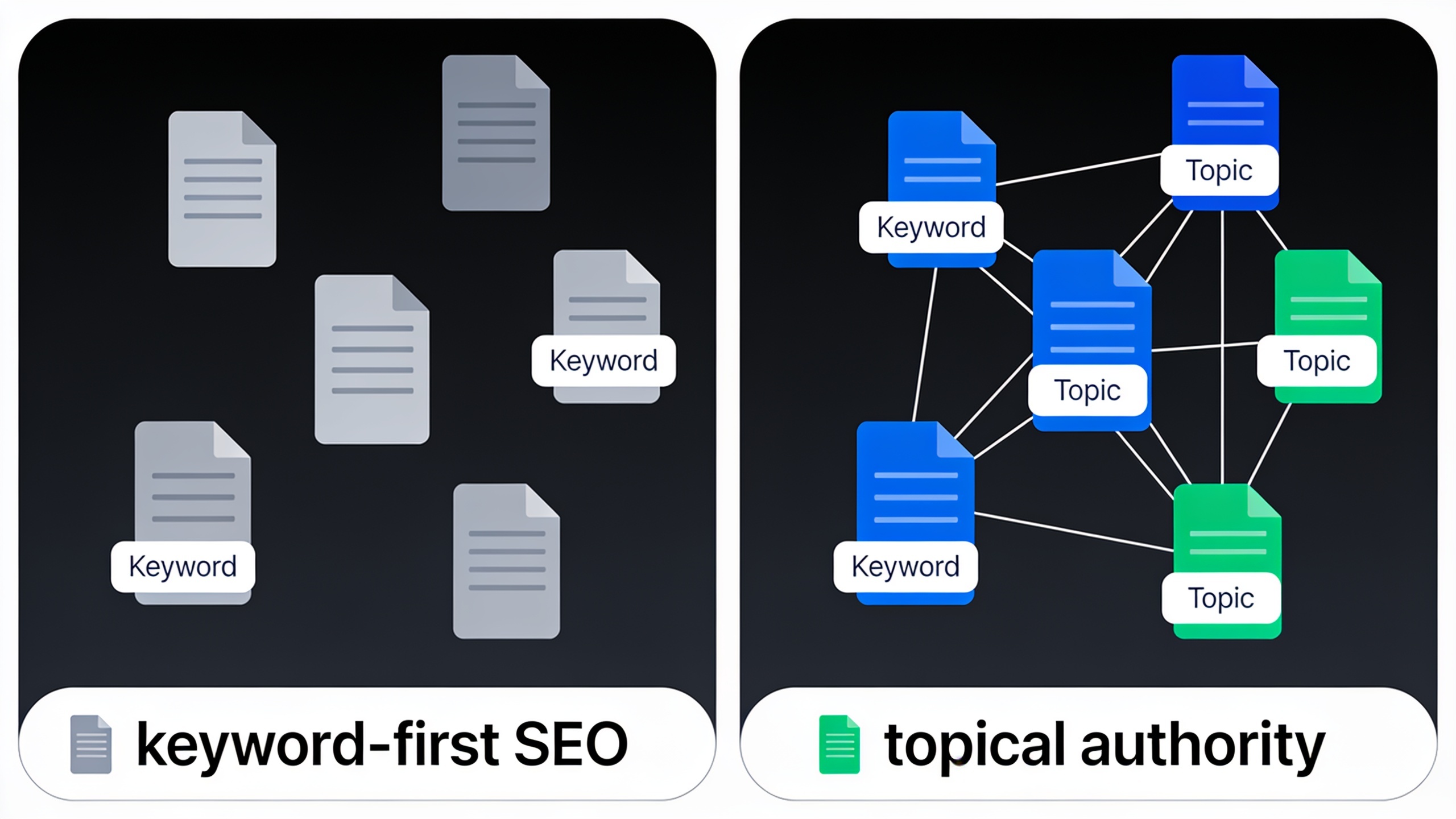
Neither one is flat-out wrong, by the way, and most sites end up using a bit of both. Some straight keyword targeting still makes total sense for high-intent commercial terms. But as your main strategy, topical authority tends to hold up better because it's not riding on any single page's luck. If Google tweaks how it judges one article, a well-built cluster still has dozens of supporting pages holding the subject up.
How Long Does It Take to Build Topical Authority?
Topical authority usually builds up gradually over several months of consistent, interconnected publishing, not after a quick handful of articles, because search engines need to see a pattern of comprehensive coverage before they'll trust you as a subject source. There's no official timeline Google hands out for this, and results swing a lot depending on how competitive your niche is, how much authority your site already has, and whether you actually keep publishing.
What's more predictable than the timeline is the sequence. Your early cluster articles, the ones aimed at less competitive, more specific questions, tend to catch on first. The pillar page and the bigger head-term rankings usually strengthen later, once you've got enough cluster pages feeding it through internal links and sheer depth. Founders who publish in fits and starts (a few articles, then a long silence) tend to see the whole thing stall out, because search engines are basically re-asking "is this still an active, comprehensive source?" every time crawl activity picks back up.
Which is exactly why consistency matters as much as any single article being great. A cluster of twelve solid, regularly updated articles published over a focused stretch will generally build authority faster than those same twelve articles dribbled out over two years with big gaps of nothing.
Common Mistakes That Undermine Topical Authority
The biggest mistake that wrecks topical authority is treating cluster content like a checklist to knock out rather than a living structure to maintain. That's what leads to thin coverage, orphaned pages, and stale info that quietly eats away at the very trust signals the cluster was supposed to create.
A few patterns show up again and again. The most obvious one is publishing cluster articles and then never linking them together, which strips out the entire structural benefit even if the writing itself is fantastic. Then there's chasing high-volume keywords that have nothing to do with your cluster, just because the traffic number looks juicy. That dilutes the focus your topical authority depends on. Letting your pillar pages go stale is another slow killer. A pillar written two years ago that hasn't been updated with new cluster links, current stats, or changed best practices reads as declining relevance, not ongoing expertise.
And two more worth calling out. Duplicating subtopics across articles, where two pieces basically answer the same question, means they compete with each other for the same query instead of expanding your coverage (people sometimes call this keyword cannibalization). Finally, ignoring external validation completely. Internal structure on its own rarely builds authority as fast as internal structure plus relevant links and mentions from other credible sites in your space.
Dodging all of this really comes down to treating the cluster as one evolving asset. Audit it now and then, update the pillar as you add cluster content, and resist the urge to publish some unrelated topic just because a keyword tool waved a shiny opportunity in your face.
How RobinRank Helps Founders Build Topical Authority Without a Content Team
RobinRank is an AI-powered SEO platform built to help founders and marketers publish consistently and earn the external validation topical authority relies on, all without hiring a full in-house content team. On the publishing side, RobinRank's AI writes, optimizes, and publishes articles, which is exactly the steady output cluster-building demands and exactly the thing solo founders and tiny teams struggle to keep up on their own.
On the link-building side, RobinRank runs a manually reviewed backlink exchange network where site owners request placements from each other directly, offer reciprocal links back, and get the live placement verified, instead of grinding through cold outreach or dealing with link brokers. Every site in the network gets reviewed by hand before it lands in the Discover section, and RobinRank throws out adult spam, PBNs, and throwaway domains, filtering by real metrics like Domain Rating from Ahrefs rather than borrowed parent-platform scores. Because placements get found and negotiated between actual site owners rather than bought off a marketplace, the exchange leans toward the relevant, niche-specific links that reinforce a topic cluster, not the generic unrelated ones that add basically zero topical signal.
The platform's free for seven days after your submitted site gets approved, no credit card needed, then it's $19 per month with the option to cancel whenever. For founders trying to build topical authority on a tight budget, that combo (consistent AI-assisted publishing plus a vetted, reciprocal link exchange) covers both halves of the equation at once: comprehensive internal content and credible external validation.
Frequently Asked Questions
Is topical authority actually a confirmed Google ranking factor?
Google hasn't published topical authority as a named, standalone ranking factor the way it has for something like page speed. But the ideas behind it (expertise, authoritativeness, comprehensive subject coverage) are spelled out explicitly in Google's Search Quality Rater Guidelines as part of E-E-A-T, and systems like the Helpful Content System are built to reward genuinely thorough, expert content over thin, keyword-targeted pages.
How many articles do I actually need to build topical authority in a niche?
There's no magic number, since it depends on how broad your subject is and how crowded the niche already is. The better question is whether your cluster covers the full range of questions a genuinely knowledgeable person in that field would expect answered, from beginner concepts to comparisons to common objections to practical how-tos, rather than chasing some arbitrary article count.
Can a small site with low domain authority still pull this off?
Yes, in principle, because topical authority is about subject-level depth and internal structure, not just site-wide backlink volume. A smaller, newer site that covers a narrow subject comprehensively can sometimes out-rank a bigger, more generally authoritative site on niche-specific queries, though it'll still benefit from earning some relevant external links over time.
Do I have to abandon keyword research entirely to focus on topical authority?
Nope. Keyword research is still useful, its role just changes. Instead of spitting out a flat list of standalone targets, it becomes the raw material you sort into pillar-and-cluster structures, helping you spot which subtopics inside a cluster are missing rather than dictating a bunch of disconnected articles.
What's the difference between a topic cluster and just having a ton of content on a subject?
Deliberate internal linking and structural hierarchy, mostly. A big pile of content on a subject that isn't interlinked or organized around a clear pillar still reads to search engines as scattered pages rather than a coherent, navigable authority. Volume alone just isn't the same thing as a real SEO topic cluster.
Building topical authority isn't a one-and-done project you finish and forget. It's an ongoing editorial habit: map your subjects before you write, link your content on purpose, and earn relevant external validation as the cluster grows. Founders who work this way tend to compound their organic visibility over time. The ones still chasing individual keywords one article at a time? They keep starting from scratch with every new list.
Ready to stop writing content by hand? Start your free RobinRank trial and get a full month of SEO-optimized articles published on autopilot.