Is Your AI Content Actually Original, or Just Quietly Getting Buried?

Short version. Google doesn't penalize content just because a machine wrote it. What it does do is bury content that's thin, repetitive, or basically a reworded copy of what's already ranking. And AI drafts fall into that hole way more often than most people writing them realize.
So let's talk about how search engines actually judge originality, what you should be checking before you hit publish, and the editorial habits that keep automated content unique, indexable, and actually ranking instead of collecting dust on page seven.
Table of Contents
- What AI Content Originality Really Means for SEO
- Does Google Actually Penalize AI Content?
- How Search Engines Sniff Out Duplicate Content
- Running a Duplicate Content Check on Your AI Drafts
- How to Make AI Content More Original Before You Publish
- The Mistakes That Get You in Trouble
- Building a Workflow That Keeps Content Original at Scale
- FAQ
What AI Content Originality Really Means for SEO
AI content originality is basically whether your AI-generated text says something genuinely its own, in its own wording and structure, or whether it just mirrors pages that already exist and other outputs from the same model. It matters because search engines reward pages that add something distinct to a topic and mostly ignore, dedupe, or suppress the ones that don't.
Language models are trained on enormous piles of text scraped from the public web. When they write, they're predicting the most statistically likely next word based on patterns they've already seen. That's not plagiarism in the classic sense. The model isn't copy-pasting anything. But it absolutely can spit out phrasing, structure, even example sentences that look an awful lot like the source material, especially on well-trodden topics like "how to write a resume" or "best CRM software for small business." There are only so many ways the internet has already covered those, and the model has read all of them.
For anyone doing SEO or content marketing, originality isn't just some ethical box to tick. It's a ranking mechanism. Google's systems are built to reward pages that show real expertise or a fresh angle, and to filter out the ones that just reshuffle whatever's already on page one. So if ten AI articles targeting the same keyword all come out structurally identical (because everyone used roughly the same prompt), none of them stand out enough to win. They just cancel each other out.
Does Google Actually Penalize AI Content?
No. There's no blanket penalty for content just because AI produced it. Google said so directly in its Search Central guidance back in February 2023: "appropriate use of AI or automation is not against our guidelines." Their ranking systems care about quality and usefulness, not which tool you used to write the thing.
But. And this is a real but. Google is equally explicit that using automation "with the primary purpose of manipulating ranking in search results" breaks its spam policies. So in practice, AI content doesn't get penalized for existing. It gets penalized (or just fails to rank, which amounts to the same thing) for the exact reasons any bad content underperforms. Thin coverage. No original insight. Keyword stuffing. Or being basically the same as a hundred other pages already indexed.
I think this distinction is the whole ballgame, honestly, because it reframes where the actual risk is. The danger was never "Google detected AI and slapped me." The danger is "Google detected low value and shoved me down the results," and unedited AI drafts are statistically way more likely to land in that pile. Google's Helpful Content System, which started rolling out in August 2022 and has since been folded into the broader core ranking systems, was built specifically to reduce visibility for content that seems made to rank rather than to actually help someone. Which, let's be honest, describes a ton of mass-produced AI content.
The Real Risk Is Duplication, Not "AI Detection"
Search engines aren't running your content through some AI detector to decide whether to rank it. They're checking whether your content is duplicative, thin, or unhelpful compared to what's already out there. Google's own duplicate content documentation is pretty clear that having duplicate content on a site "isn't grounds for action" by itself, unless it looks like you're trying to game rankings or trick users. But duplicate or near-duplicate pages still get consolidated, with usually just one version shown in search. So the others don't get penalized, exactly. They just get no traffic. Which, again, same outcome.
How Search Engines Sniff Out Duplicate Content
Search engines catch duplicate content mostly through content fingerprinting and similarity clustering. They compare chunks of text across billions of indexed pages, spot the near-identical passages, and then pick one canonical version to actually show. A duplicate content check, in this world, is just any process (automated or by hand) that confirms your content isn't overlapping heavily with stuff that's already published.
There are three flavors of this that search engines watch for, and they're not equally common.
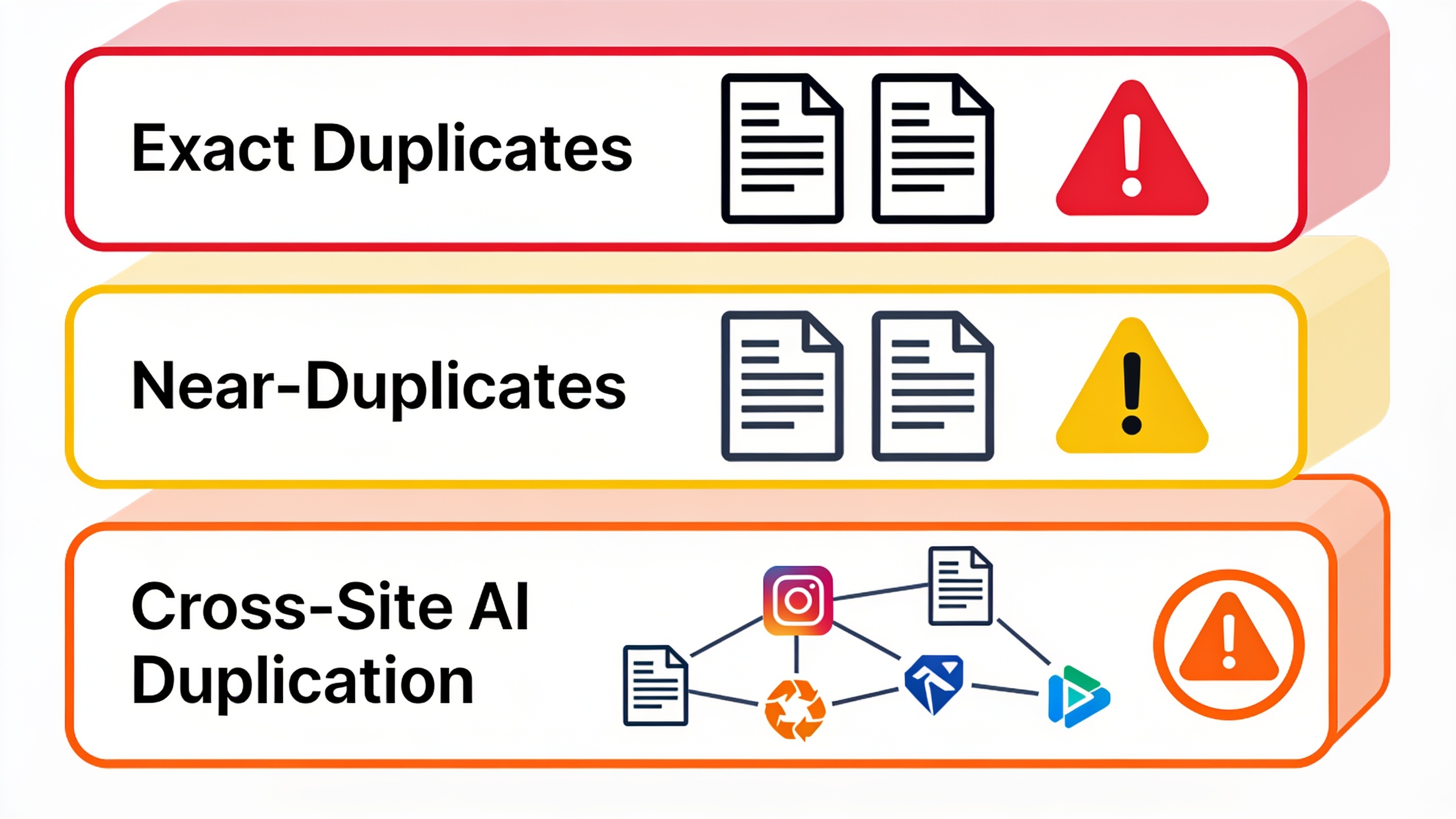
Exact duplicates are the obvious ones, where the same text shows up word-for-word on multiple URLs. Usually this comes from syndication, scraping, or dumb technical stuff like URL parameters spawning multiple versions of one page. These almost always get sorted out with canonical tags, not penalties.
Near-duplicates are trickier and way more common with AI. This is when content gets reworded but follows the exact same structure, argument order, and set of examples as some existing page that's already ranking. This is the failure mode for AI content, because models tend to converge on the same outline when you give them similar prompts about the same topic. Different words, identical skeleton.
And then there's cross-site AI duplication, which is the newer, sneakier one. A bunch of different businesses use similar prompts or the same underlying model to write about the same topic, and you end up with articles that are technically unique strings of text but conceptually interchangeable. Swap the logos and you couldn't tell them apart. Search engine quality systems are getting better at spotting this low-differentiation stuff, even when a word-for-word duplicate check would technically pass with flying colors.
Running a Duplicate Content Check on Your AI Drafts
A proper duplicate content check on an AI draft means comparing it against both the live web and your own site's existing content before you publish, using some mix of plagiarism-style scanners, AI-output detectors, and just... looking at the search results yourself. No single tool catches everything, so anybody who's been doing this a while combines at least two.
Here's a breakdown of the main types of checks, what each one's actually good at, and where they fall apart.
| Check Type | What It Detects | Best Used For | Limitations |
|---|---|---|---|
| Web-based plagiarism scanners | Verbatim or near-verbatim text matches against indexed web pages | Catching exact copy-paste duplication or scraped content | Doesn't reliably catch reworded near-duplicates or structural similarity |
| AI-output detectors | Statistical patterns associated with machine-generated text | Flagging drafts that may need heavier human editing before publishing | Detection accuracy varies and is not considered fully reliable industry-wide; should not be the sole decision-maker |
| Manual SERP comparison | Whether your draft's structure, examples, and angle differ from the current top-ranking pages | Confirming genuine differentiation on competitive topics | Time-consuming; requires human judgment, not automatable at scale |
| Internal duplicate content check | Whether your own site already has a page covering the same query or angle | Preventing keyword cannibalization across your own content library | Only checks your own site, not the broader web |
| Search Console duplicate/canonical reports | Which of your own URLs Google considers duplicates and which version it indexes | Diagnosing why a published page isn't appearing in search results | Reactive — tells you after indexing, not before publishing |
For most teams the practical version of this is pretty simple. Run a plagiarism scan to rule out exact matches. Do a quick read against the top three ranking pages for your keyword to make sure your angle is actually different. And check your own site so you're not quietly cannibalizing an article you published six months ago and forgot about.
Cadence matters here too, more than people admit. If you're publishing faster than your team can genuinely differentiate each piece, the originality checks are the first thing to get skipped when a deadline looms. That's exactly why it's worth thinking through how often should you publish? finding your content velocity before you spin up a big AI content operation. Speed and quality fight each other, and speed usually wins if you don't plan for it.
Want content like this running on autopilot for your own site? Try RobinRank free — AI-written, SEO-optimized articles generated and published automatically, no credit card required.
How to Make AI Content More Original Before You Publish
The single most reliable way to make AI content original is to feed the model something distinct at the input stage: proprietary data, a specific expert opinion, real examples, a narrower angle. Generic prompts produce generic, convergent garbage. Originality is decided by what you put in, not by paraphrasing your way out of trouble afterward.
Give the Model Something It Can't Get Anywhere Else
If you prompt an AI tool with nothing but "email marketing tips," it's going to pull from the same tired patterns every other AI article on that keyword pulls from. Give it something real instead. Your own customer data. A contrarian take your team actually holds. A case study from a real client. Numbers from your own product usage. That's raw material that doesn't exist anywhere else on the web, and it's the actual source of originality. Not clever synonyms.
Edit the Structure, Not Just the Sentences
Near-duplicate content is almost never a wording problem. It's structural. If your draft marches through the exact same section order as the top three articles (definition, benefits, how-to steps, tools, conclusion), then just reordering or merging some sections can change how differentiated the whole thing feels before you've rewritten a single sentence. This is the step everybody skips, and it's the one that matters most.
Say Something
Search engine quality systems, and increasingly the AI answer engines like ChatGPT, Gemini, and Perplexity that summarize and cite sources, tend to favor content that actually takes a position instead of neutrally restating the consensus. A paragraph that says "here's what we've seen work with clients" or "here's where we think the common advice is wrong" is fundamentally harder to duplicate than one that just recites the textbook. Opinions are inherently original. Nobody else has yours.
Check Your Facts Before Publishing, Not After
AI models will happily generate plausible-sounding but flat-out wrong statistics, outdated pricing, and studies that don't exist attributed to people who never said them. This goes beyond originality. Publishing fabricated stats under your brand's name is a straight-up liability, not just an SEO problem. Every number, every study, every named source in an AI draft needs to be checked against the original before it goes live. No exceptions.
Refresh, Don't Just Republish
Originality checks shouldn't end at the publish button. A piece that was totally unique when it launched can go stale as new competing pages pile up on the same topic. That's why ongoing review matters, and it's something I dig into more in content freshness: when and how to refresh old blog posts. Circling back to your older AI-assisted articles to add fresh data, swap in newer examples, or tighten the angle keeps them differentiated as the field around them keeps moving.
The Mistakes That Get You in Trouble
Most duplicate content messes with AI material come from a small handful of repeatable mistakes, not one catastrophic blunder. And catching these early is a whole lot easier than trying to resurrect a suppressed page later.
The biggest one is reusing the same prompt across everything. If your team or your tool runs the same templated prompt ("Write a comprehensive article about X covering benefits, how-to, and FAQ") for every single piece, the outputs start looking like siblings. Same tone, same structure, even the same example choices. Now you've got near-duplication across your own site, not just against competitors. You did it to yourself.
Then there's publishing without a human actually reading it. Skipping the read-through to hit a quota is, hands down, the single biggest driver of both accuracy errors and originality problems, because no automated check can tell you whether an angle is genuinely different. Only a person can.
Keyword cannibalization is another one. When two or more of your own pages target the same search intent, you confuse Google about which one to rank, and often neither performs well even if both are individually solid. You're competing against yourself.
Syndication is a quiet killer too. If your content gets pushed out to partner sites, aggregators, or your own regional domains without proper canonical tags, search engines may treat the copies as duplicates and rank a version you never intended.
And finally, leaning too hard on AI detection scores as your quality gate. Some teams reject any draft that scores as "likely AI-written" without ever checking whether the thing is accurate, useful, or original. That's mistaking the proxy for the goal. You end up burning editorial time while genuinely low-value (but conveniently "human-sounding") content sails right through.
Building a Workflow That Keeps Content Original at Scale
The best way to keep AI content original at scale is to bake originality into your publishing workflow as a checkpoint, not treat it as some audit you run in a panic after something breaks. That means deciding, upfront, what a piece needs before it's allowed anywhere near the publish button.
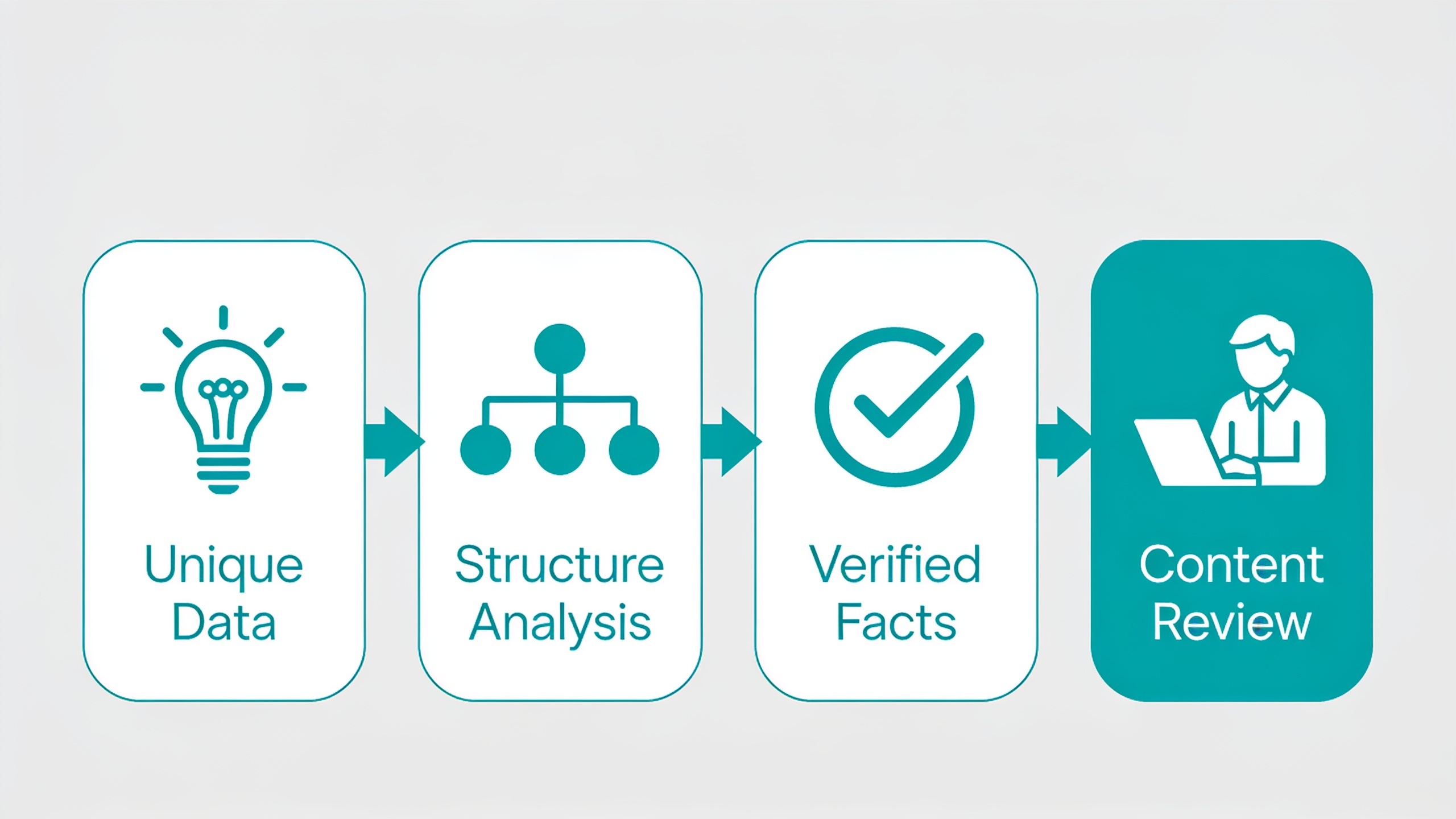
A workable checklist for most teams looks something like this: a unique data point, example, or opinion you won't find in the top-ranking competing pages; a structure that isn't just a mirror of whoever's leading the SERP; verified facts and properly sourced stats; and one final human read-through with a single question in mind. Would a reader learn something here they couldn't get from the first three Google results for this query? If the answer's no, it goes back for another pass. Doesn't matter how polished the prose reads. Polished and pointless is still pointless.
This is also exactly where cadence and quality start pulling against each other, and where a lot of teams get burned. Push for more volume without adjusting your review process, and originality and accuracy problems creep in slowly, so slowly you don't notice until traffic dips. Which is why I'd argue volume decisions and quality-control steps have to be planned in the same conversation, not treated as two separate problems for two separate people.
FAQ
Does using AI to write content automatically create a duplicate content penalty?
No. Google has said appropriate use of AI or automation isn't against its guidelines, and there's no penalty tied to the mere fact that content was AI-generated. The risk shows up when AI content is structurally similar to existing pages or thin on unique value, which is a quality and duplication issue, not some special "AI penalty."
What's the difference between an AI detector and a duplicate content check?
An AI detector guesses at the statistical likelihood that text was machine-generated, based on patterns in word choice and sentence structure. A duplicate content check compares your text against other published material, either the live web or your own site, to see whether it overlaps heavily with something that already exists. They answer totally different questions. One's about how the text was made, the other's about whether the text is actually unique.
Can two AI articles on the same topic count as duplicate content even if the wording is different?
Yep. Search engine quality systems can treat them as low-value near-duplicates even with zero word-for-word matching, if they follow the same structure, hit the same points in the same order, and bring no distinct angle or data. Search engines increasingly weigh conceptual similarity, not just exact text matches.
How often should I re-check published AI content for originality?
There's no magic universal schedule. But it's worth revisiting a piece whenever new competing articles start outranking it, or on a regular review cycle as part of a broader content freshness routine, since the bar for "original enough" keeps rising as more content gets published on any given topic.
Is a low AI-detection score enough to prove my content is safe from duplicate penalties?
No. Detection scores measure how machine-like the writing sounds, not whether the content is duplicative or good. A piece can score as "human-written" and still be a near-duplicate of something that already exists, or score as "likely AI" while carrying genuinely unique data and insight. Treat detection scores as one weak signal among several, not a pass/fail gate.
---
At the end of it, AI content originality isn't about outsmarting a detector. It's about making sure every page you publish actually earns its spot by giving readers something they can't already find on page one of Google. Bake duplicate content checks, structural review, and fact verification into your workflow, and you're protecting both your search visibility and your brand's credibility, which only matters more as AI-assisted publishing stops being the exception and becomes the default.
Ready to stop writing content by hand? Start your free RobinRank trial and get a full month of SEO-optimized articles published on autopilot.